
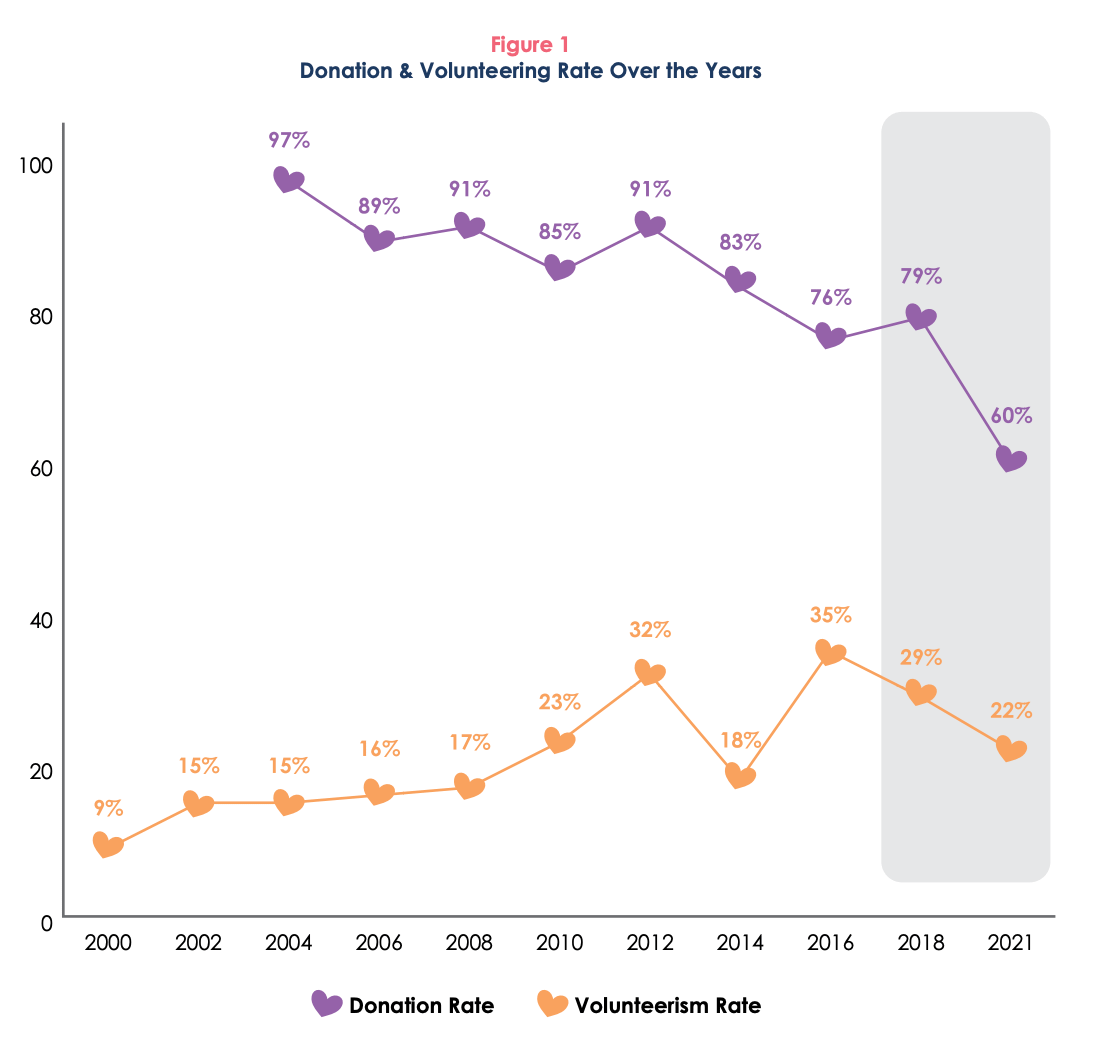
The latest National Giving Study (“NGS”, previously the Individual Giving Survey or Study) by the National Volunteer and Philanthropy Centre (NVPC) opens with a reassuring claim that generosity in Singapore is widespread. Perhaps so, if you accept NVPC’s premise that about 68 per cent of people in Singapore engaged in some form of “giving” in the past year. But the same report also finds that only 21 per cent of people in Singapore volunteered (a 10-year low), and 45 per cent donated (lowest since data were first tracked in 2004).
On the face of NVPC’s historical data, the volunteerism and donation figures are weak by recent standards. Donation rates are clearly on a long-run downward trend. Volunteerism is more volatile, but the latest figure remains strikingly low. In this vein, the 2025 NGS is both reporting lower volunteerism and donation rates and reframing what counts as “giving.” In principle, the reframing is defensible. Yet the public report does not provide enough methodological detail or data transparency to adequately support the reframing.
In 2025, just over one in five people in Singapore volunteered (the 21 per cent figure is a 10-year low). Fewer than half donated money or items in kind (the 45 per cent figure is the lowest since donation data were first tracked in 2004). These figures come from NVPC’s 2025 NGS, which has tracked giving patterns as well as giving facilitators and barriers in the country since 2000, every two to three years.
However, the observations that Singapore’s volunteerism and donation rates are on a downward trend are not immediately clear in the 59-page report. Before these rates are presented on page 17, NVPC first claims that “generosity is widespread.” This claim rests on a broader definition of giving: 68 per cent of survey respondents “engaged in acts of giving” in 2025, which – in addition to volunteering or donating to causes (captured by the aforementioned figures) – includes “everyday acts of mutual aid” or “spontaneous helping” beyond one’s personal networks (e.g., from the report: lifting a stroller, picking up litter, caring for community cats).
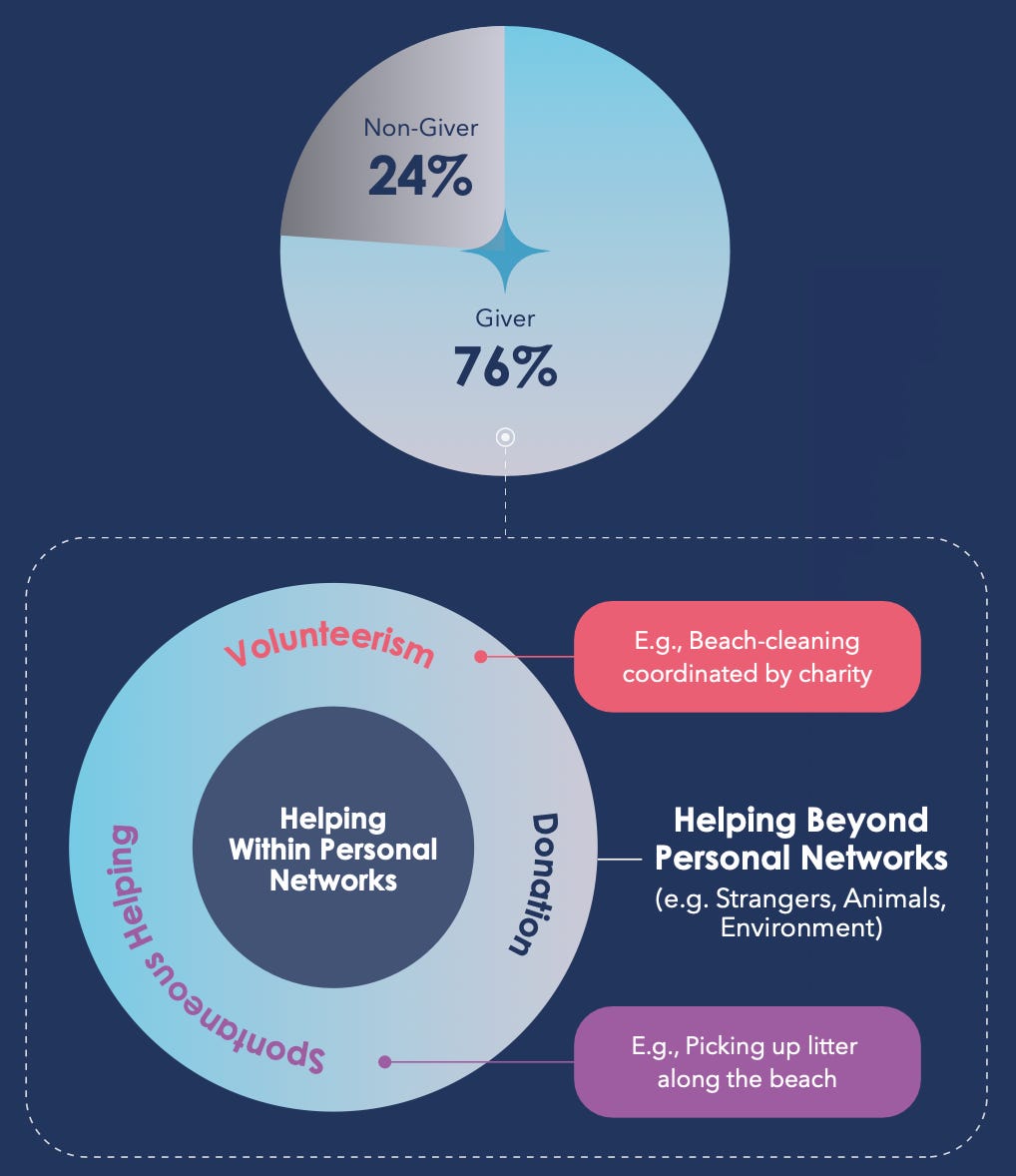
My recurring critique of the 2025 NGS is the imprecise presentation and explanation of important statistics. For instance, 68 per cent of people in Singapore reportedly engaged in those acts of mutual aid or spontaneous helping in 2025. “About three in four people living in Singapore have engaged in acts of giving at some point” (emphases mine), and it is this 76 per cent figure NVPC presented in two pie charts, such as the one above, which came without corresponding titles or descriptions. This interpretation is supported by reporting in “The Straits Times,” which states that 68 per cent did such acts in 2025, while 76 per cent recalled doing so at some point in their lives.
It matters that, on the headline indicators, structured volunteerism and donation appear weaker than in recent waves. Consider two sets of figures.
First, as aforementioned, donation rates have been on a long-run downward trend. Volunteerism is more volatile, but the latest figure is weak by recent historical standards. NVPC’s own 2021 report presented the following chart illustrating these patterns. In 2023, the country’s volunteerism and donation rates were 30 and 62 per cent respectively. Such data can motivate important questions:
Volunteerism-wise, why has it declined since 2016? What explains the ceiling of one-third of Singaporeans who volunteer at least once throughout any given year?
Donation-wise, how have rates fallen so steadily from the 90s and high-80s? Somewhat counterintuitively, shouldn’t the Internet and smartphones have increased the ease of digital giving?
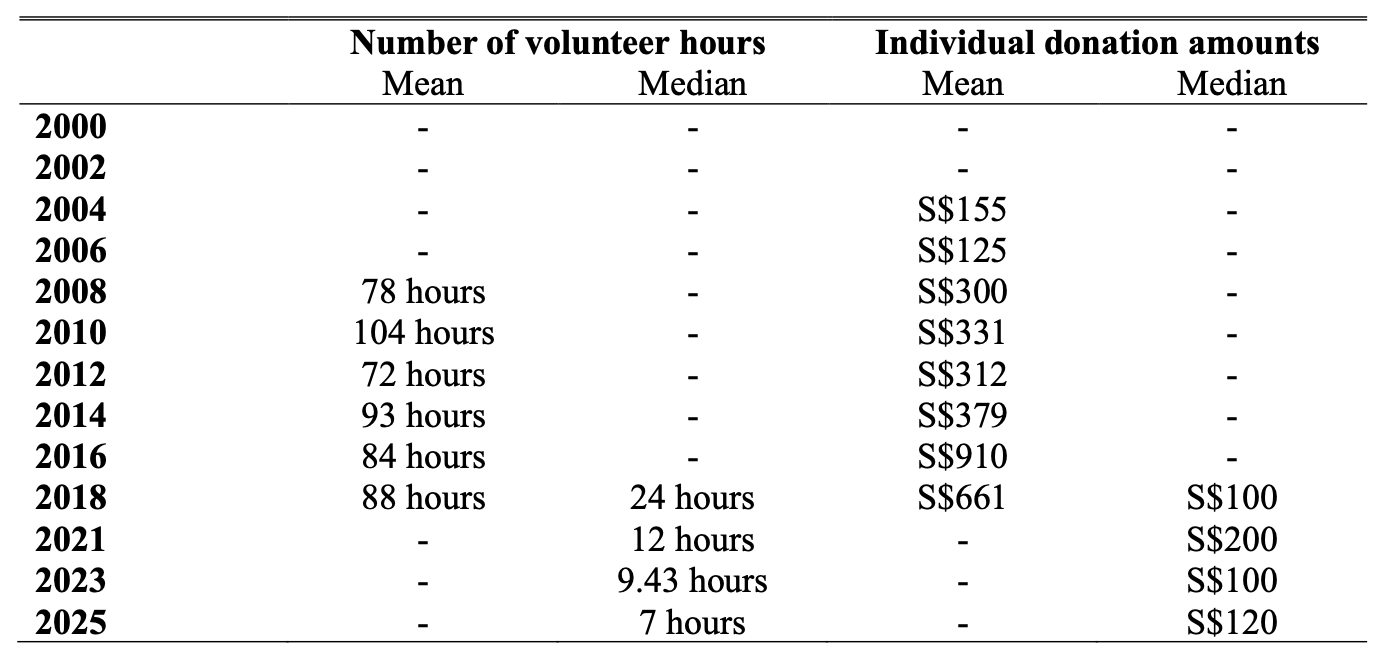
Second, in addition to volunteerism and donation rates, the reports have also historically reported the number of volunteer hours and individual donation amounts. I created the following table to synthesise the data publicly provided by NVPC. Overall, the median volunteer hours has decreased from 24 hours in 2018 to seven in 2025, whereas the individual donation medians have ranged consistently from S$100 to S$200.
However, consistent with my critique about the imprecise presentation and explanation of important statistics: (a) earlier reports often used averages (or means), while later reports shifted to medians (medians are better, because they are not skewed by heavy volunteers and large donors, yet reporting both means and medians is the best; moreover, when both mean and median are available, such as in 2018, the gap is large, suggesting a highly skewed distribution); (b) the individual donation amounts are not always consistent, depending on whether all donors are included, or if the report only counts those who gave to organisations or through formal means.
What also warrants further scrutiny is the methodological approach alongside the level of detail provided of the 2025 NGS. NVPC will likely argue that my fixation on structured volunteerism and donation, thus far, is misguided and overlooks how Singaporeans may “give” generally and informally. In this year’s report (emphases mine):
“Participation in structured forms of giving therefore provides only one part of a larger story. While just over one in five had volunteered in the past year, and nearly half made monetary or in-kind donations, more telling is the pattern within Singapore itself – that much of Singapore’s generosity may flow through informal, relational channels rather than organised structures.”
An NVPC representative added in “The Straits Times”: “If you were to look at it from a layman’s perspective, you may think it’s a drop (in volunteering hours), but in fact, it’s actually a different expression in giving.”
Herein lies my first methodological critique. Focusing on “giving” so generally – including both formal and informal forms – buries the lede about falling formal volunteerism and donation, and the 2025 NGS does not demonstrate much analytical value in comparing “givers” and “non-givers.” In other words, “giving” is such a broad construct that it appears to possess minimal explanatory power.
Of the three substantive chapters, the broadly defined “giving” construct only appears meaningfully in the first. In the second chapter, when describing Singapore’s “participation landscape,” it is formal volunteerism and donation – not the informal acts or behaviours – that remain the units of analysis. We read about, among others, volunteerism and donation rates by age and gender, patterns of volunteerism and donation over a one-year period, as well as how Singaporeans volunteered (e.g., in-person or online, location, proximity) and donated (e.g., money or in-kind, intensity). Relatedly, the formal outcomes are not “giver status” or “forms of giving,” but volunteerism and donation status, patterns, and intensity.
The third chapter details findings with practical implications for understanding what may motivate or deter Singaporeans from societal participation. Here, again, participation largely excludes those widely touted “everyday acts of mutual aid” and “spontaneous helping” in the beginning of the report to focus exclusively on formal volunteerism and donation. More precisely, the 2025 NGS establishes that current volunteers and donors are very useful benchmarks and reference groups.
My second methodological critique is that NVPC has consistently considered informal forms of giving in addition to volunteerism and donation but chose to centre it far more prominently this year. In 2018, it measured “micro-giving,” or “voluntary, spontaneous and everyday acts of giving” (e.g., giving way to others, giving up one’s seat on public transportation, returning one’s tray after a meal). Additionally, “micro-giving” was also treated as an analytic variable vis-à-vis other giving behaviours. In 2021, in addition to “micro acts of giving,” NVPC documented informal individual and community-led giving initiatives, especially in the context of the COVID-19 pandemic. And in 2023, “micro-volunteering” and “micro-donations,” and civic participation were included in the report as “alternative ways of giving.”
I understand the importance of informal giving, particularly as a precursor to formal volunteerism and donation. Having multiple forms of entry – through smaller acts of giving – may make it more likely for Singaporeans to volunteer and donate. Moreover, formal giving can be wrapped up with inequality, wherein socio-economically disadvantaged groups are less likely, on average, to have the time and bandwidth to volunteer and donate.
Still, and this leads to my third methodological critique, if NVPC wishes to broaden the Singaporean conceptualisation and understanding of “giving,” its ambition in the 2025 NGS is not matched, in the public report, by methodological disclosure and data detail. Or rather, it has not provided enough information and wants readers to accept that “the 2025 numbers cannot be compared with those in previous years as researchers used different methods,” even though the report has not made a convincing case.
The request is not unreasonable, and it is not resolved by NVPC saying that their Knowledge & Insights team can be reached for more information. Consider, for example, the International Labour Organisation’s 2011 manual, which the 2025 NGS itself references and cites. The manual published the actual question wording, prompts about unpaid work, the number of hours, and whether the activity was done through an organisation.
The move from a definition-led approach to a criteria-led one is a significant one. As such, NVPC should provide more information, including examples from the survey or even key questionnaire excerpts. Notably, alongside definitions of volunteerism and donation, past versions of the NGS provided important survey questions in their entirety. As recently as 2023, volunteerism was defined as such:
“Volunteering is defined as an activity one does out of one’s own free will, without expecting financial payment, to help others outside of one’s household, family, relative or friends. Volunteering excludes compulsory community work such as [VIA], [CIP] in schools and [CWO], unless compulsory volunteer hours were exceeded. ‘Formal volunteering’ refers to volunteering with registered organisations, whereas ‘informal volunteering’ refers to helping others directly, without going through any registered organisations.”
Based on such a definition, in previous NGS waves, respondents would first indicate whether they have done so, before subsequent questions about frequency and the like. In 2025, such a definition-led approach was replaced by a criteria-led one:
“Rather than presenting respondents with a definition to interpret and apply to their own behaviours, the redesigned questionnaire follows an activity-focused sequence. Respondents are first prompted to recall whether they engaged in any acts of helping others or contributing to society – without labels or definitions being introduced at this stage. For each reported activity, structured follow-up questions capture what was done, who was helped, and the conditions surrounding participation. Activities are subsequently classified as volunteering, donation, or other forms of helping during analysis, based on pre-specified operational criteria – shifting the cognitive burden of classification from the respondent to the research instrument.”
NVPC’s justification to change its approach makes sense on the surface. Notwithstanding my two preceding critiques that the “giving” construct has minimal analytical value and that both formal volunteerism and donation seem to be comparatively more useful, the three-page technical notes section at the end of the 2025 report leaves multiple methodological questions unanswered:
Data collection: How were respondents prompted to recall acts of helping or contribution? What were the main and structured follow-up questions? What were the examples of the reported activities?
Data analysis: As part of the “pre-specified operational criteria,” the researchers considered activities (a) beyond one’s personal network; (b) that were voluntary and free from compulsion; and (c) substantively uncompensated. Who did the classification, and – if multiple researchers were involved – how were differences resolved? Was inter-rater reliability captured to assess how consistently researchers distinguished between formal and informal giving and whether an activity constituted volunteerism?
Constructs and measures: Given the move from a definition-led approach to a criteria-led one, did NVPC consider including both the old and new measures in the same wave, so as to test if the different approaches resulted in different giving or volunteerism rates being derived? Does NVPC have a bridge estimate showing what the 2025 volunteerism and donation rates would have been under the previous definition-led approach?
To NVPC’s credit, the 2025 NGS included a larger sample (3,699 respondents) and reported regression and sequence analyses. My underlying concern is that the public report is not sufficiently auditable.
My final methodological critique is also a practical suggestion for NVPC to publish more data. Specifically, the 2025 NGS looks aesthetically great, yet the amount of data and information is comparatively scant.
The suggestion to go back to basics can sound trite, yet NVPC’s past reports – even with similar critiques – produced useful insights. Since its inaugural benchmarking survey in 2000, NVPC has collected important demographic data: race/ethnicity, age group, marital status, monthly household income, housing type, employment status, occupation, education level. Volunteerism and donation rates may vary by socio-economic status, and organisations offering volunteer opportunities could better tailor how they recruit and engage potential volunteers.
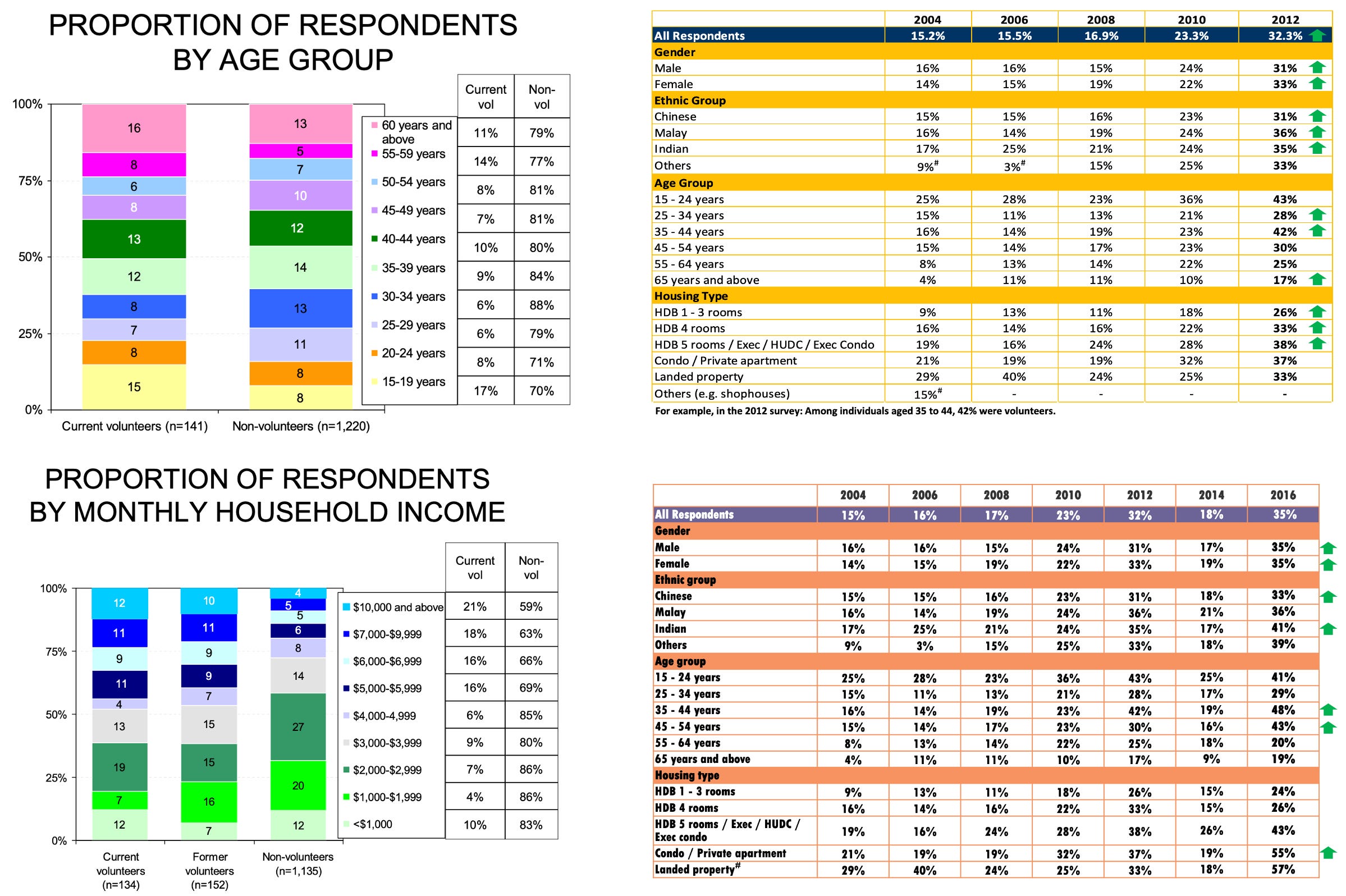
Against this context, I preferred how NVPC previously presented its NGS findings. Refer above to the collation of screenshots from past NGS reports. The two diagrams on the left are from the 2000 report, presenting that year’s volunteerism rate by age group and monthly household income. The two diagrams on the right are from 2012 and 2016 respectively. They show the overall volunteerism rate in the first row of the table, before presenting the breakdowns across gender, race/ethnicity, age group, and housing type. Additionally, year-on-year statistically significant comparisons are represented by the arrows.
My perspectives are inevitably coloured by my work as a social service researcher. This first means that I’m always in favour of more data and more methodological information. Furthermore, the NGS’s volunteer and donation time-series data – that is, a sequence of data collected about the Singapore population over a period of time – can inform knowledge generation.
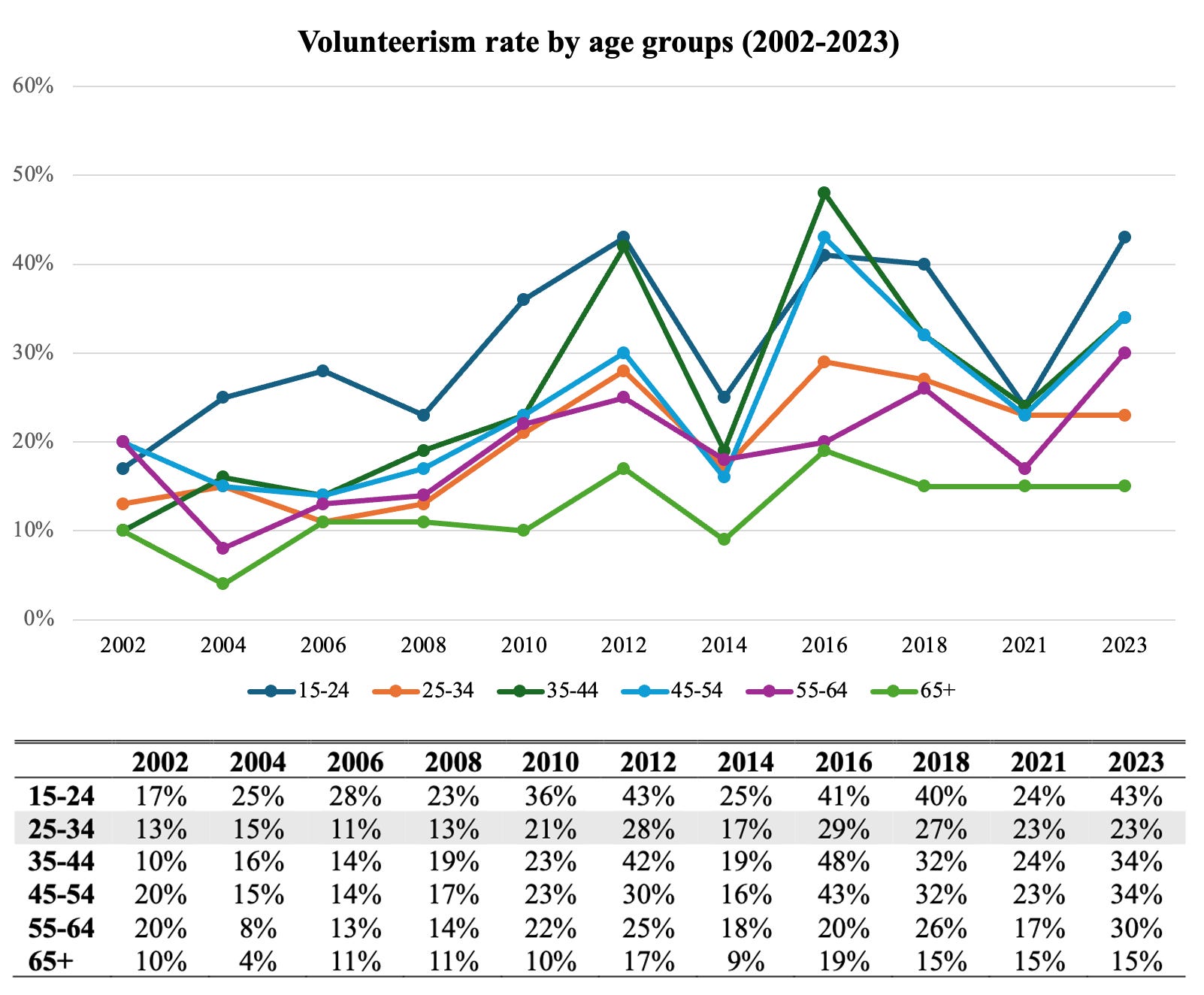
For example, I’ve been interested in youth volunteerism for the past decade. Think school-based frameworks such as the Community Involvement Programme and Values in Action, service-learning in the community, and overseas voluntourism. Most recently, I’ve studied and published about the “bathtub volunteerism” phenomenon, wherein young Singaporeans disengage from volunteerism to prioritise their careers and families, only to volunteer again after their mid-40s.
And that journal article referenced NGS data. Specifically, below, I show a chart and table comparing volunteerism rates across six age groups. Across the years, Singaporeans aged 25-34 are among the least likely to volunteer, especially compared with youth and those in mid-life. In 2023, only 23 per cent of them did so, which is below the national average of 30 per cent, and only ahead of those aged 65 and above.
In other words, share more data! To produce a report that is equal parts aesthetically pleasing, accessible to the public, and comprehensive enough for research analysis may be too much to ask of a single publication. If so, given the NGS’s importance and usefulness, perhaps a supplementary publication with all the data, methodological, and statistical trappings is needed. As it stands, the technical notes in the 2025 report are unfortunately inadequate.
The point is not that NVPC should ignore informal giving, or that only structured volunteerism and donation matter. Everyday acts of “giving” and care do matter, and they may be the foundation from which more sustained civic participation grows. But if NVPC and the 2025 NGS ask readers to accept a broader story of “giving” at the same time that headline volunteerism and donation rates appear weak, then the public report must do more: show the questionnaire, explain the coding process, publish bridge estimates, and provide fuller sub-group tables. Otherwise, the language of “giving” risks doing more rhetorical than analytical work, especially when readers do not have sufficient data to test the narrative for themselves.
No posts
Comments
Nothing yet. Say the first thing.
Sign in to join the conversation.