

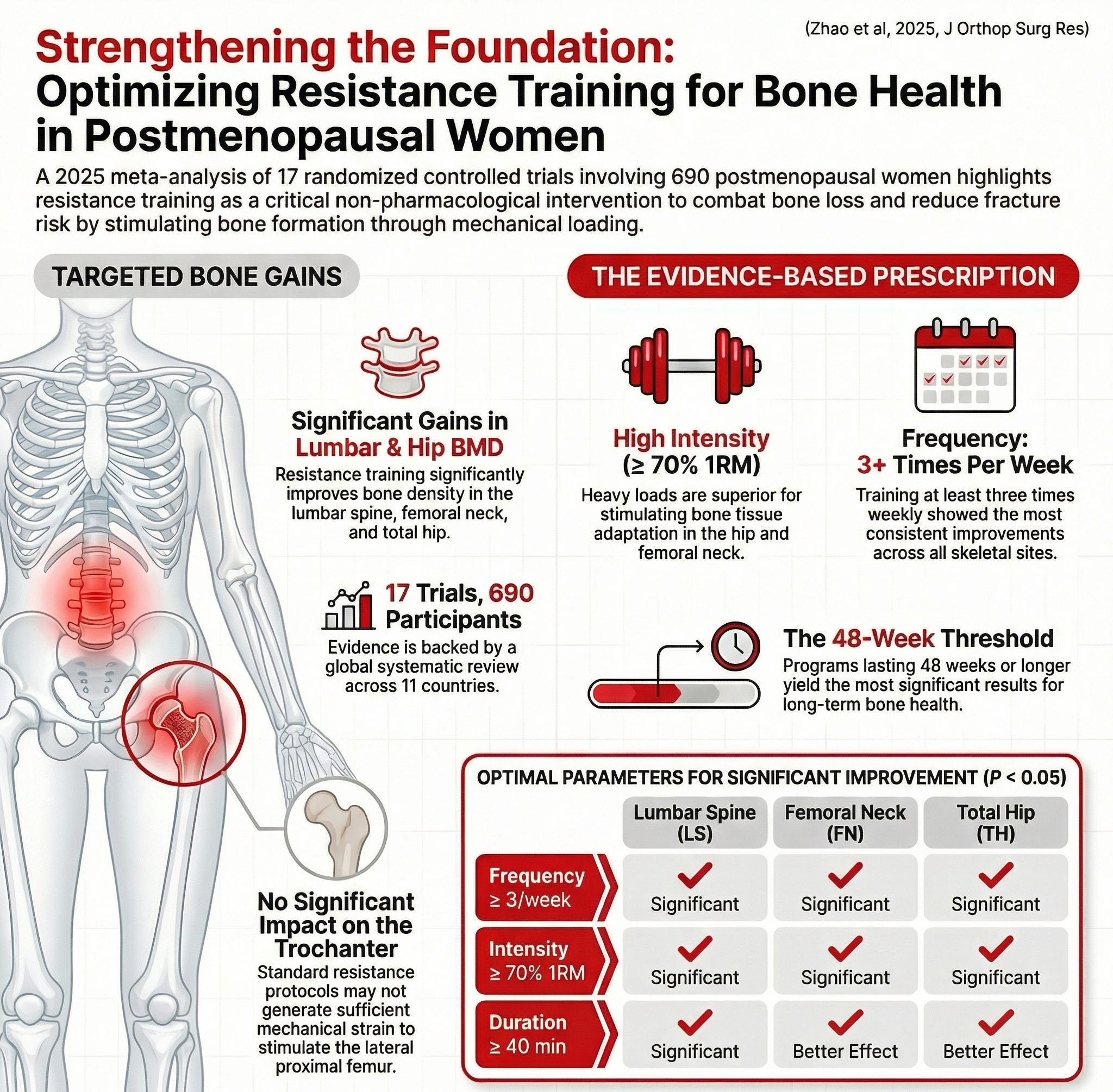
Estrogen deficiency following menopause severely disrupts bone metabolic homeostasis. The shift toward “high-turnover bone metabolism,” where bone resorption outpaces formation, leads to a decline in Bone Mineral Density (BMD) and deterioration of bone microstructure, dramatically increasing the risk of osteoporotic fractures.
Currently, pharmacological therapies such as bisphosphonates are widely used; however, clinical barriers include concerns over side effects like osteonecrosis of the jaw and atypical femoral fractures, as well as poor long-term compliance.
Against this background, Resistance Training (RT) as a non-pharmacological therapy occupies a critical position as a strategic intervention to actively promote bone formation.
RT activates bone formation signals through mechanical loading on osteocytes. Specifically, increased expression of Wnt1 drives the Wnt/β-catenin signaling pathway, inducing bone formation factors such as Runx2, Osterix, and Cyclin D1 to promote osteoblast differentiation. Simultaneously, it efficiently suppresses bone resorption by inhibiting the expression of Sclerostin, a Wnt signaling antagonist. Furthermore, the release of IGF-1 associated with muscle contraction increases muscle mass via the PI3K-Akt-mTORC1 pathway, creating a synergistic effect that further enhances physical loading on the bone.
Presented below is a specific clinical protocol based on the latest meta-analysis data.
Integrating the meta-analysis results from Zhao et al. (2025), RT brings significant improvements to key sites in postmenopausal women, though responsiveness varies by location.
Lumbar Spine (LS):
SMD = 0.88, [0.21, 1.56], P = 0.01
Strongly Recommended: High improvement effect observed, though heterogeneity warrants caution.
Femoral Neck (FN):
SMD = 0.89, [0.40, 1.39], P = 0.0004
Strongly Recommended: Shows extremely high statistical significance.
Total Hip (TH):
SMD = 0.30, [0.10, 0.50], P = 0.003
Recommended: Consistent and significant improvement observed.
Greater Trochanter (Troch):
SMD = 0.23, [-0.01, 0.47], P = 0.06
Effect Uncertain: Has not reached statistical significance at this time.
The lack of significant improvement in the greater trochanter may be attributed to a mismatch between bone mechanical properties and loading vectors. To stimulate bone formation around the trochanter, sufficient mechanical strain must be generated against the lateral proximal femur. However, many conventional RT exercises focus on vertical loading, which may provide insufficient stimulus to this area. Clinically, the introduction of multi-directional exercises, including lateral loading such as side lunges, should be considered.
Four primary prescription parameters defining the “threshold” for improving BMD are identified below:
Training Intensity:
High Intensity (HI) of 70% 1RM or higher
In this context, HI is defined as 70% 1RM or higher, determined to be the essential threshold for maintaining proximal femur BMD. Note that previous research (Wang et al., 2023 [50]) defines HI as 80% 1RM or higher; be aware that this 10% difference in definition may influence clinical judgment. Since low loads do not reach the stress threshold required to stimulate bone formation, a load setting of 70% or higher is recommended for reliable results.
Frequency: 3 or more times per week
A frequency of 3 or more times per week showed superiority in systemic BMD improvement compared to 2 or fewer times per week. Specifically for the LS, FN, and Troch, intervention three times a week directly links to statistically significant improvement (P < 0.05).
Intervention Cycle: Long-term continuation of 48 weeks or more
The bone remodeling cycle requires 3–4 months, and 7–9 months are needed for new bone mass to stabilize (establishment of mineralization). Therefore, 48 weeks or more is the “gold standard” to ensure the fixation of BMD around the hip joint. However, significant improvements are seen in the LS and FN even with interventions under 48 weeks, making short-term success a useful tool for maintaining patient motivation.
Session Duration: Ensuring 40 minutes or more per session
For BMD improvement in the LS, a session duration of 40 minutes or more yields statistically significant effects. This is an essential condition for accumulating sufficient “stimulus volume” in the bone tissue.
Comments
Nothing yet. Say the first thing.
Sign in to join the conversation.