
In the strategic diagnosis and treatment of chronic primary pain (CPP), evaluating the bidirectional interaction between the stress response system and the pain processing system is a top clinical priority. CPP is not merely a sensory abnormality;
it is closely linked to dysfunction in two fundamental physiological stress regulation systems: the autonomic nervous system (ANS) and the hypothalamic-pituitary-adrenal (HPA) axis.
In healthy individuals, acute stress triggers “stress-induced analgesia” through the activation of endogenous opioids and descending inhibitory systems. In patients with CPP, however, this homeostatic mechanism is disrupted.
Instead of stress-induced “pain suppression,” CPP patients tend to exhibit “hyperalgesia,” where sensitivity is actually heightened.
The “desensitization” or “dysregulation” shown by these regulatory systems is the root cause of “resistance” to conventional pharmacotherapy and physical therapy. In a state where systemic resilience is lost, even micro-stressors can easily lead to the amplification of pain.
Therefore, peripheral interventions alone are insufficient. Clinicians must utilize physiological indicators as strategic data to visualize “systemic vulnerability” and optimize treatment protocols.
Utilizing cardiovascular reactivity as an objective measure of pain management is the first step toward precision medicine that does not rely solely on subjective reports. Specifically, the dynamics of heart rate, blood pressure, and heart rate variability reflect the success or failure of the patient’s endogenous pain inhibitory capacity.
Mean Arterial Pressure (MAP) and Baroreflex:
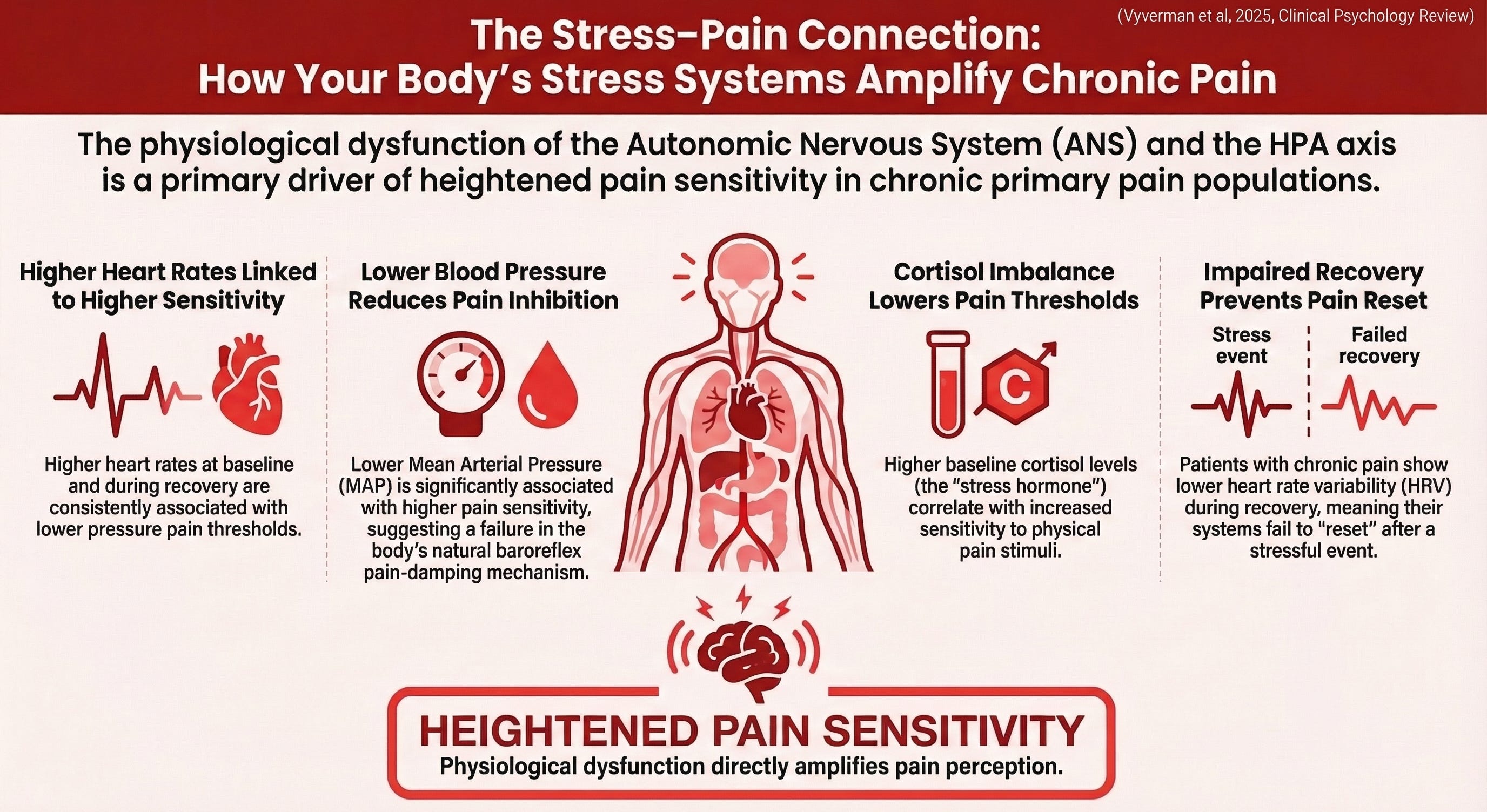
Meta-analysis results show that a decrease in MAP significantly correlates with a decrease in electrical pain threshold (EPTh) and electrical pain tolerance (EPTo). This suggests a failure of adaptive homeostasis (BP-related hypoalgesia) via the baroreflex.
A low MAP is not just a number; it is a signal that the “brake” of central pain inhibition is not functioning.
Heart Rate (HR) and Pain Sensitivity:
Elevated HR across all phases—resting, under stress, and during recovery—predicts a decrease in pressure pain threshold (PPTh). Particularly in patients with widespread pain, the correlation between elevated HR and decreased PPTh is prominent, indicating that sympathetic hyperarousal directly drives pain hypersensitivity.
Heart Rate Variability (HRV) and Recovery:
A decrease in high-frequency heart rate variability (HF-HRV) during the recovery phase after stress correlates with low cold pain tolerance (CPTo). This signifies a failure of parasympathetic reactivation—namely, a lack of self-regulatory capacity following a painful stimulus.
Low MAP
Lower EPTh / EPTo
Failure of adaptive homeostasis (dysfunction of endogenous inhibitory system)
High HR
Lower PPTh
Sympathetic dominance and hypersensitivity of the pain system
Low HF-HRV (Recovery)
Lower CPTo
Failure of parasympathetic reactivation (lack of self-regulatory capacity)
Clinical Caution: Much of this evidence is classified as “very low to low” under GRADE assessment. Clinicians should prioritize fluctuations from the patient’s personal baseline rather than fixating on standardized norms.
The regulatory capacity of the endocrine system, particularly the HPA axis, is a long-term biomarker that influences the persistence and intensity fluctuations of pain. Meta-analysis results confirm a negative correlation: higher baseline cortisol concentrations (single measurements from morning to early afternoon) are associated with lower pressure pain thresholds (PPTh).
This suggests that chronic overactivity of the HPA axis or weakened feedback inhibition increases the vulnerability of the pain system.
As a critical strategic note, it must be recognized that the correlation between cortisol and pain thresholds loses significance when analyzed separately for subgroups of widespread pain (e.g., fibromyalgia) versus localized pain.
Therefore, cortisol levels should not be treated as a uniform indicator; they require interpretation based on the extent of the patient’s pain and their individual profile.
Interventions based on physiological feedback are not mere relaxation; they are strategic approaches to rebuilding a patient’s “systemic resilience.”
Phase 1: Stabilization of Baseline
If abnormalities in MAP and HR are confirmed, introduce slow breathing techniques or biofeedback aimed at strengthening the baroreflex. This is an essential step to physically reboot the descending pain inhibitory system.
Phase 2: Strengthening Reactivity and Resilience
Dynamically adjust intervention intensity based on HRV and cortisol evaluation.
Strategic Directive: If HF-HRV during recovery is significantly low, or if baseline cortisol shows abnormal values, high-intensity exercise or physical loading carries a high risk of inducing a pain flare. In such cases, choose to “postpone high-load interventions” and prioritize low-load central approaches, such as mindfulness.
This integrated strategy shifts the goal of treatment from “reducing pain intensity” to “normalizing the stress response system.” Once the system regains normal resilience, pain will stabilize as a secondary effect. This perspective has the power to fundamentally transform the quality of decision-making for patients with refractory CPP.
Prioritize Cardiovascular Indicators:
Low MAP (especially in relation to EPTh/EPTo) and elevated HR are the most accessible indicators of a failing endogenous pain inhibitory system.
Contextual Interpretation of HPA Axis Evaluation:
Cortisol levels are useful, but as the correlation fluctuates depending on the extent of pain (localized vs. widespread), careful interpretation considering subgroup characteristics is vital.
Need for Standardization and Consideration of Evidence Quality:
Given current evidence levels (GRADE: Low), continuous intra-individual monitoring using standardized methods (e.g., 5–10 minute resting measurements) should be conducted in clinical settings.
Neglecting these physiological insights and performing interventions based solely on subjective pain reports poses a significant clinical risk, leading to inadequate outcomes. An integrated approach centered on systemic resilience is what promises a new breakthrough in chronic pain treatment.
Comments
Nothing yet. Say the first thing.
Sign in to join the conversation.