
The success or failure of exercise prescription in clinical settings depends on whether it can elicit the appropriate “adaptation” in target muscles.
In the world of sports physical therapy, there has been a deeply rooted custom of using Surface Electromyography (EMG) amplitude as an “indicator of muscle activity” and judging the superiority of an exercise based on the height of that signal.
However,
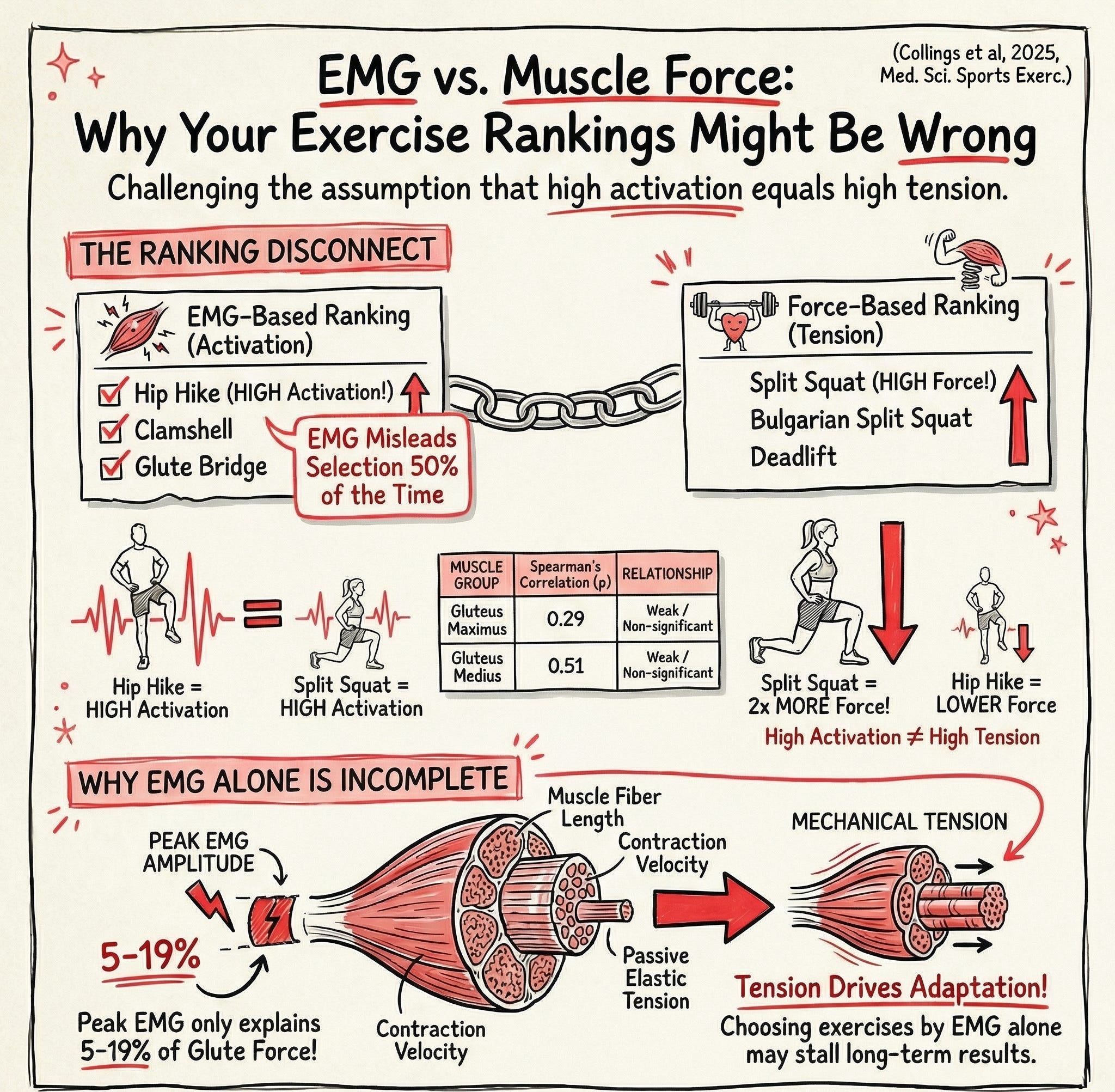
the latest neuromusculoskeletal modeling (Collings et al. 2025) sounds an alarm against this approach based solely on “activation.”
The primary factor driving desirable physical adaptations, such as muscle hypertrophy and strength improvement, is the “Mechanical Tension” experienced by muscle fibers—in other words, the “Muscle Force” itself.
Mechanosensing structures within muscle fibers, such as titin, do not sense neurological on/off states (activation); they sense the magnitude of physical tension to generate protein synthesis signals.
Relying on EMG as the sole indicator carries serious clinical risks.
Overestimating exercises that have high muscle activity but low tension, while dismissing exercises that generate extremely high tension (muscle force) despite modest activity as “insufficient,” can only be described as an “evidence-based malpractice” that results in lost opportunities for adaptation.
In this article, we dismantle the divergence between EMG and muscle force from a biomechanical perspective and present new clinical criteria for optimizing true mechanical loading.
Surface EMG is an excellent tool for capturing motor unit recruitment and firing frequency, but the idea that it directly reflects “muscle force” is a clinical misunderstanding.
There is a non-negligible non-linearity between EMG and muscle force in dynamic exercise.
The reasons why Muscle Force is not proportional to EMG amplitude are summarized in the following biomechanical principles:
Muscle length (Force-length relationship):
The overlapping of actin and myosin within the sarcomere defines the force (active tension) that the muscle fiber length can exert.
Contraction velocity (Force-velocity relationship):
As shortening velocity increases, cross-bridge formation decreases and muscle force drops; however, high muscle force is generated under lengthening (eccentric) contractions.
Passive force contribution:
When a muscle is placed in a long (stretched) position, elastic elements generate powerful tension independently of neural drive (EMG).
According to the study by Collings et al., the proportion of the variation in peak muscle force that can be explained by peak EMG amplitude alone (coefficient of determination R^2) is shockingly low.
Gluteus Maximus (GMax): R^2 = 0.05 (EMG explains only 5% of force variation)
Gluteus Medius (GMed): R^2 = 0.19 (Similarly, only 19%)
This data means that
in the GMax, 95% of the muscle force components are determined by factors other than EMG (muscle length, velocity, and passive tension).
Simply selecting exercises at the top of an EMG ranking provides no guarantee that sufficient mechanical load is being applied to the target gluteal muscles.
Considering the impact that exercise selection has on program effectiveness, it is essential to understand the discrepancy between “overestimation” and “underestimation” by EMG.
Below is a summary of the ranking reversal phenomenon based on the modeling data from Collings (2025).
EMG Ranking and Estimated Muscle Force Ranking Discrepancy (12RM/BW Comparison)
Split Squat (12RM) Underestimated
Gluteus Maximus
EMG Rank: #8
Muscle Force Rank: #1
Loading at a long fiber length due to deep hip flexion. Passive tension from titin, etc., generates high muscle force.
Hip Hike (12RM) Overestimated
Gluteus Maximus
EMG Rank: #2
Muscle Force Rank: #11
High neural drive due to quasi-isometric contraction.
Absolute force production is limited as muscle length change is small.
Single-leg RDL (12RM) Underestimated
Gluteus Medius
EMG Rank: #8
Muscle Force Rank: #2
Under dynamic control of hip rotation/abduction, muscle fibers exert high mechanical tension while being stretched.
Side-lying leg raise (12RM) Overestimated
Gluteus Medius
EMG Rank: #1
Muscle Force Rank: #12
EMG amplitude is maximized by the external load, but absolute muscle force generated is low due to short-position contraction of a single joint.
Analysis: Why is “Muscle Force” high even if “Activity” is low?
Dynamic exercises such as the Split Squat or Single-leg RDL involve deep hip flexion.
In this position, the fiber length of the gluteus maximus is maximized, and passive elastic energy derived from titin and fascia is added to the optimal overlap of actin and myosin.
As a result, even if the neurological switch (EMG) is moderate, the physical stress (muscle force) that the muscle actually receives far exceeds that of exercises with a strong “feeling of it working,” such as the bodyweight Hip Hike.
Clinicians must move away from dependence on a patient’s subjective “feeling of activation” or “EMG Top 10 lists” in papers.
A strategic framework for maximizing mechanical loading is presented below:
Non-negotiable Load of 12RM:
Exercises using only bodyweight (BW) are often insufficient in absolute force production, even if EMG amplitude appears relatively high. If the goal is muscle hypertrophy or strength increase, introduce a 12RM (a load that reaches the limit at 12 repetitions) external load to physically secure mechanical tension.
Prioritize Dynamic Loading in a Long Muscle Length:
Prioritize dynamic exercises where target muscles exert force while being stretched, such as the Split Squat or Single-leg RDL, over isolation exercises or “activation” drills in a short position. These maximize protein synthesis signals via mechanosensing.
Principle of Intra-individual Comparison:
When using EMG in a clinical setting, avoid comparisons between different exercises (e.g., side plank vs. squat). Limit comparisons to “variations of the same exercise (e.g., presence/absence of load, difference in foot width)” with the same sensor placement.
Believe in “Force” Over “Feeling”:
A “burn” (feeling of burning) can be an indicator of metabolic stress or neural activity, but it does not necessarily correlate with high mechanical tension. Clinicians should biomechanically infer the “force” the muscle is generating from the relationship between anatomical muscle length and the load vector.
Distinguish the limits of EMG:
EMG amplitude is merely an indicator of “neurological effort.” In the gluteus maximus, judging the superiority of muscle force by EMG alone is synonymous with ignoring 95% of the determining factors.
Mechanical tension is the key to adaptation:
The biggest driver governing muscle hypertrophy and strength improvement is “mechanical tension.” Long-position exercises with heavy weights (12RM) accompanied by moderate activity result in higher long-term outcomes than low-load exercises with high activity.
Integrate a biomechanical modeling perspective:
Clinicians should not be misled by superficial data and should have a perspective of “moving anatomy” that evaluates exercise by integrating the contributions of muscle length, contraction velocity, and passive tension.
Ultimately, to maximize patient functional recovery, the best evidence-based advice is to graduate early from “easy-to-feel” exercises like the Side-lying Leg Raise and transition the program to dynamic exercises such as the Split Squat and Single-leg RDL, which can provide high mechanical tension.
Comments
Nothing yet. Say the first thing.
Sign in to join the conversation.