
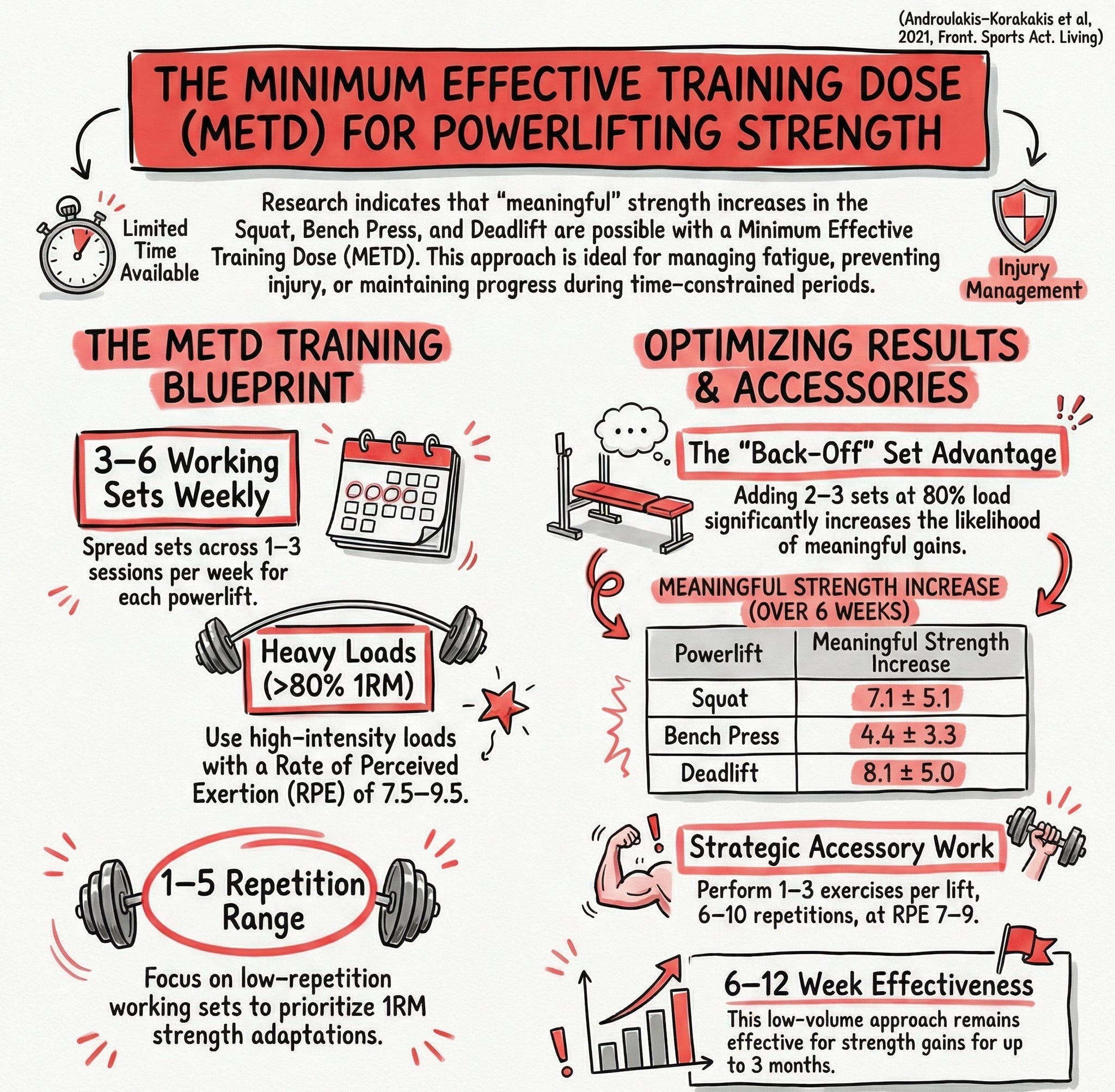
The Minimum Effective Training Dose (METD) in powerlifting is defined as the “minimum amount of training necessary to elicit a statistically significant and meaningful improvement in 1RM (one-repetition maximum) strength.”
In traditional high-performance training, the dogma that “volume is the primary driver of adaptation” has been dominant, but the METD strategy advocates for a departure from this “volume dependency.”
The strategic value of this article lies in shifting limited adaptive energy away from “morphological hypertrophy (Hypertrophic adaptation)” and toward the optimization of “neuromuscular efficiency.”
This is not mere labor-saving.
It is a “precise strategic intervention” that eliminates unnecessary fatigue and concentrates physical and mental resources on improving competition-specific output.
The adoption of this approach functions as a “precision-strike capability in fatigue management” to avoid burnout syndrome due to excessive loading and to physically extend the competitive lifespan of elite athletes.
Below, based on scientific evidence, a specific framework is presented to guarantee the maximum improvement in strength with the minimum investment.
The improvement of 1RM strength is situated at the intersection of intensive adaptation to lifted weight and technical proficiency.
In the METD protocol, the following variables are manipulated to elicit maximum neurological output with the minimum number of sets.
Weekly number of sets: 3 to 6 sets per powerlift movement
Rep range: 1 to 5 reps
Intensity: 80% 1RM or higher, or RPE 7.5 to 9.5
Duration of implementation: 6 to 12 weeks
The core of this strategy lies in “Practicing the Test” through heavy singles (lifting a high weight for a single repetition).
What is noteworthy is that,
the method of simply repeating single sets (MAX) alone carries risks in terms of the probability of success.
Research data (Study 3 & 4) show that by adding 2 to 3 back-off sets (multiple reps at a load of approximately 80% of the top set) to a heavy single, the probability of strength improvement reaching a “meaningful level” increases to 98%.
This “MAX+boff” approach increases volume by approximately 600% compared to MAX alone, but compared to traditional training (1,000% to 1,800% increase), it is still an extremely minimalist design.
The Failure of AMRAP: The Fallacy of Volume
An important fact that coaches should recognize is the result of the AMRAP (As Many Reps As Possible) group in Study 4.
The AMRAP group was inferior in the degree of 1RM improvement despite exceeding the MAX+boff group in total volume.
This confirms the essence of METD: “Volume where intensity has been sacrificed is worthless in improving 1RM strength.”
Composition Criteria for Accessory Movements
Accessory movements are introduced to complement the METD of the primary movements and to reinforce structural weaknesses at a minimum cost.
Composition: 1 to 3 movements per exercise, 6 to 10 reps, RPE 7 to 9
Converting the subjective sense of progress into objective indicators is essential for fulfilling accountability to athletes and organizational decision-makers.
Based on Study 2, the criteria for “meaningful” weight increases expected in 6 weeks of training are shown below.
Squat (SQ)
7.1 ± 5.1 kg
Bench Press (BP)
4.4 ± 3.3 kg
Deadlift (DL)
8.1 ± 5.0 kg
Total
These figures are general expectations, but the interpretation differs in the elite tier.
While survey respondents consider a “Total increase of 17.5 kg” to be significant, for an elite athlete facing a plateau, an improvement of even just 2.5 kg is evaluated as a strategic victory that has broken the stagnation.
At the elite level, reliably accumulating this “slight progress” with minimal fatigue in itself builds a competitive advantage.
Individualization of frequency according to movement characteristics is the key to refining movement as a skill while suppressing fatigue accumulation.
The standard model shown in Study 5 is the “2-3-1 (SQ-BP-DL)” frequency strategy.
Justification for High Frequency of Bench Press (BP)
The logical rationale for setting the bench press to 3 times a week lies in its technical precision and the characteristics of the muscle groups mobilized.
Because the BP uses relatively small muscle groups compared to SQ or DL, it is less likely to cause systemic neurological fatigue (Systemic Fatigue).
For this reason,
recovery is possible even when higher frequency and volume are imposed, and high frequency contributes to the maintenance of technical accuracy.
The “So What?” of Frequency Setting
By adopting this frequency model (SQ 2 times, DL 1 time), each session is always implemented with high freshness (recovery state).
This functions as a mechanism to eliminate form breakdown due to fatigue and to always etch “lifting movements with near 100% accuracy” into the nervous system.
The proposal to “reduce the amount” in many cases causes psychological barriers (fear of strength decline) for volume-dependent athletes and coaches.
To break through this, it is necessary to logically present the scientific justification of METD.
Resource Limitation Period:
Periods when training time is limited due to external factors such as work, academics, or family.
Competition Peaking:
Periods immediately before a match to dramatically eliminate fatigue and manifest (Realization) latent strength.
Injury Management:
Periods to ensure long-term athlete longevity by maintaining competition-specific intensity while suppressing systemic load.
Toward “anxiety due to insufficient volume,” present the following three points:
Optimization of Neurological Output:
By focusing on “the output efficiency of the brain and nerves” rather than muscle mass, 1RM improves even with low volume.
Maximization of Output by Fatigue Elimination:
Ensures 100% performance on the day of the test by eliminating accumulated fatigue.
98% Success Probability:
Through multiple experiments (Multi-experiment paper), it has been demonstrated that the probability of the MAX+boff setting bringing “meaningful improvement” is extremely high.
Comments
Nothing yet. Say the first thing.
Sign in to join the conversation.