

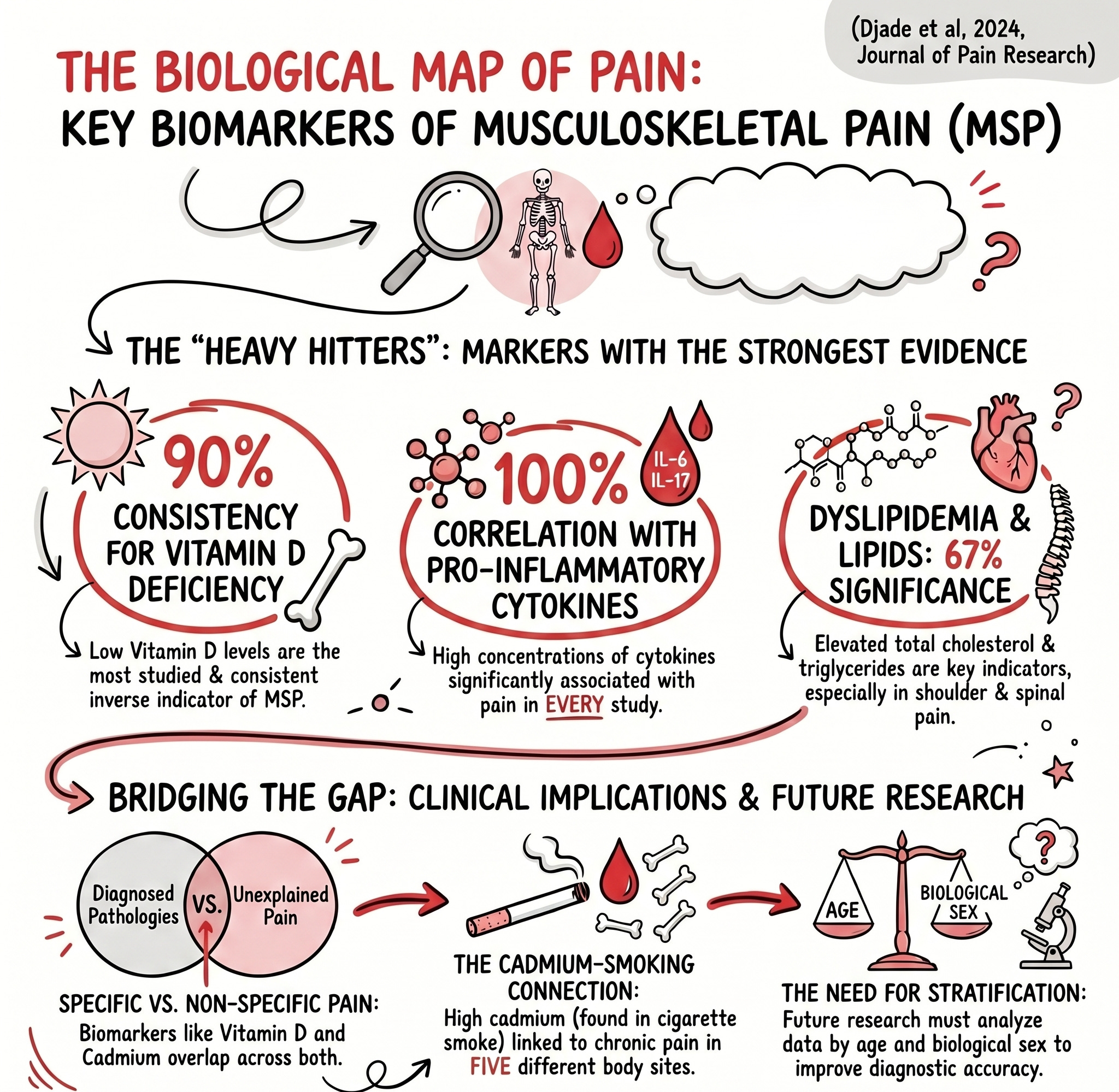
Musculoskeletal pain (MSP) remains the largest contributor to the global burden of disability-adjusted life years (DALYs) that limits mobility and dexterity. Over the past three decades, our understanding has evolved from a purely biological viewpoint to a biopsychosocial approach encompassing psychosocial factors. However, even with this paradigm shift, MSP management stagnates, and evaluating pathogenesis in clinical settings has reached its limits. The strategic importance of biomarkers as objective indicators in clinical management lies in redefining processes that traditionally rely on subjective assessments, thereby dramatically reducing diagnostic uncertainty.
We as clinicians must move beyond the simple biopsychosocial model toward a biomarker-augmented model based on objective data. This will improve the accuracy of prognostic modeling and optimize the timing of therapeutic interventions. Beginning with the definition of biomarkers, this article presents a specific classification that can be deployed immediately in clinical settings, alongside its clinical utility.
Biomarkers are defined by Puntmann et al. as “a characteristic that is objectively measured and evaluated as an indicator of normal biological processes, pathogenic processes, or pharmacologic responses to a therapeutic intervention.” To refine the clinical management of MSP, it is necessary to clearly distinguish between “specific pain,” which is based on known pathology, and “non-specific pain,” and to understand the role of biomarkers in each. The introduction of biomarkers serves as the key to uncovering the biological substrate behind cases that have historically been dismissed as non-specific or psychogenic.
Target Conditions and Symptoms:
Osteoarthritis (OA), Rheumatoid Arthritis (RA), Fibromyalgia, Rotator cuff tears, Adhesive capsulitis (Frozen shoulder).
Current Diagnostic Status and Biomarker Contributions:
In addition to diagnostic imaging, disease-specific antibodies and cytokines support diagnosis and reflect pathological activity.
Target Conditions and Symptoms:
Non-specific low back pain, Neck pain, Unexplained joint pain, Extremity pain, Tibial bone pain.
Current Diagnostic Status and Biomarker Contributions:
Identifying etiology is difficult with traditional examinations. Metabolic indicators such as vitamin D deficiency and dyslipidemia objectify latent pathological states.
Using these classifications as a foundation, we proceed to the clinical interpretation of the three primary domains supported by the strongest evidence to date.
Vitamin D is the highest priority indicator in MSP management. In 90% of analyzed data, a significant negative correlation has been observed between vitamin D deficiency and MSP. Notably, clear dose-response patterns corresponding to the degree of deficiency have been confirmed in tibial bone pain and leg pain. Vitamin D functions beyond its role as a bone component, serving as an objective risk marker for chronic and widespread pain. From the perspective of Evidence-Based Medicine (EBM), screening patients presenting with widespread pain is indispensable as a standard protocol.
Elevated levels of total cholesterol, LDL, and triglycerides (TG), along with low levels of HDL (dyslipidemia), are not merely vascular risks but are directly linked to the degeneration of musculoskeletal tissues. These show strong associations particularly with rotator cuff tears, primary frozen shoulder, adhesive capsulitis, and degenerative disc disease. By reframing dyslipidemia as a biomarker of tissue degeneration, it is possible to transition from traditional symptomatic treatment using anti-inflammatory analgesics to a personalized therapeutic strategy incorporating dietary and metabolic improvements.
Studies on cytokines (IL-6, IL-17, TNF-α, COMP) demonstrate a significant association in 100% of cases, serving as powerful objective indicators of systemic inflammation. Specifically, data show that elevated high-sensitivity CRP (hs-CRP) is specifically associated with acute sciatic pain. These markers reflect precursors of irreversible tissue destruction in real time. Clinicians must not rely solely on subjective pain complaints but should strategically determine the timing to initiate stepped care based on these values.
Some indicators are currently at a stage of insufficient evidence accumulation, yet they possess added value by reflecting specific environmental exposures or tissue metabolism.
Cadmium:
A key factor mediating the link between smoking and MSP. Cadmium exposure is involved in the development of osteomalacia and osteoporosis and is associated with non-specific pain in the arms, feet, and neck.
Collagen Markers:
PIIANP and CTX-II are expected to show medium-term utility as indicators of cartilage turnover in osteoarthritis.
Omega-3 Fatty Acids:
Low levels have been reported in patients with rotator cuff tears, but the strength of evidence, including the mechanism of inverse correlation, is currently rated as weak.
Clinicians are recommended to select biomarkers according to the following structured checklist based on the patient’s chief complaint.
Comments
Nothing yet. Say the first thing.
Sign in to join the conversation.