

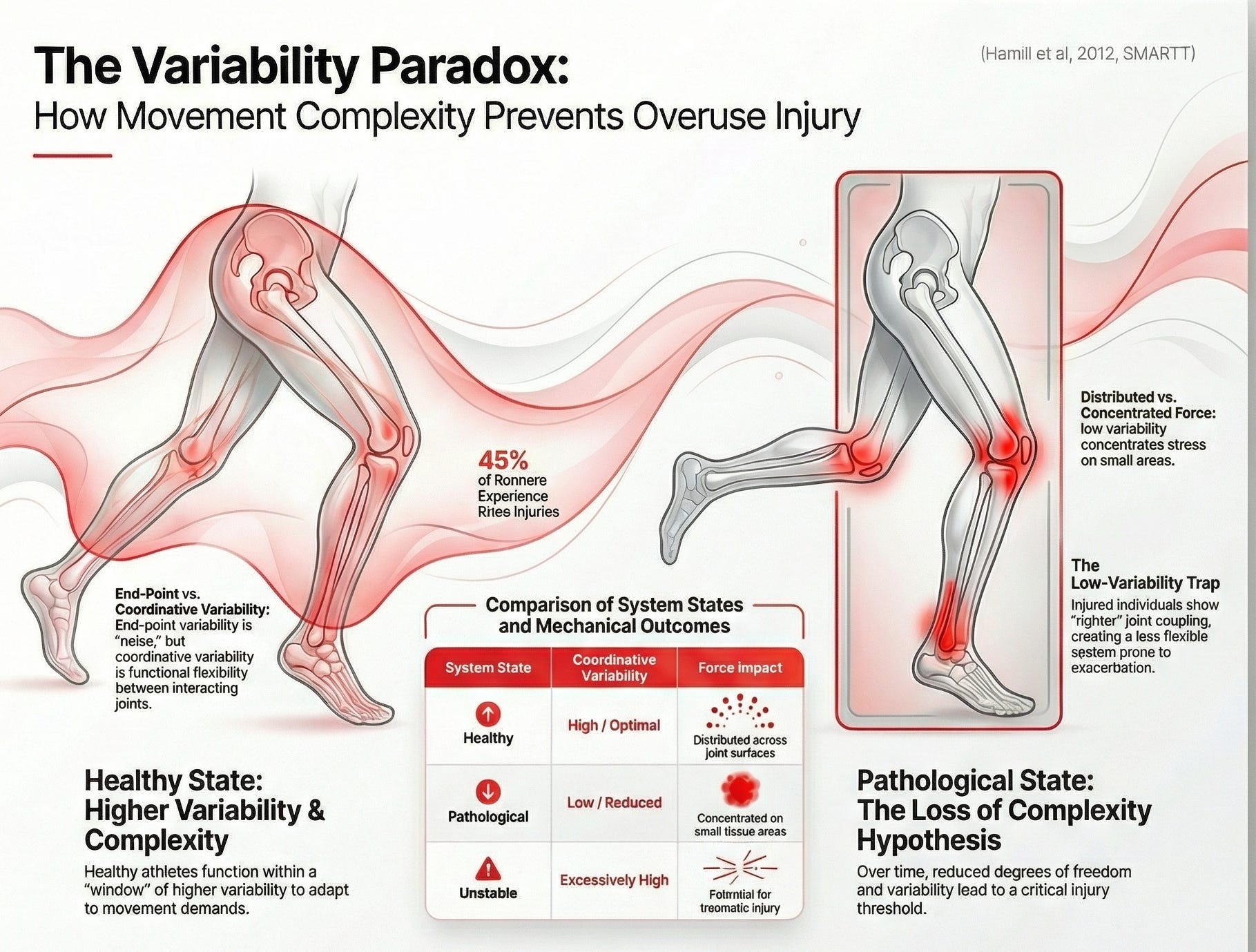
Over the past 30 years, the incidence of running injuries has shown no signs of improvement. Traditional biomechanical analysis has remained fixated on identifying kinematic and kinetic parameters at specific “points,” such as peak rearfoot angle or peak ground reaction force. However, it must be stated that analyzing the angles of a single joint is insufficient for elucidating the etiology of injuries in a complex biological system. What we as clinicians face is not an abnormality in a single variable, but a dysfunction of “coordinative structures” where multiple degrees of freedom (DoF) are mutually adjusted.
For a long time, movement variability was dismissed as “noise” indicating measurement error or lack of skill. However, based on Dynamical Systems Theory, this variability is redefined as a “functional signal” for the system to adapt to environmental changes and dynamically distribute loads across tissues. Variability is a direct indicator of the system’s flexibility and adaptive capacity; it is not a mere error but the very essence of biological resilience.
In clinical practice, an approach that attributes the cause of Patellofemoral Pain (PFP) solely to the rearfoot pronation angle is no longer strategic. What is critical is how the foot, lower leg, and thigh interact (coupling) and utilize dynamic redundancy. This macro-perspective is the key to avoiding repetitive micro-trauma to specific tissues. To understand complex biological systems, a transition from traditional descriptive anatomical models to a “dynamic systems approach” that captures the dynamics of the entire movement pattern is essential.
The human body is a redundant system with vast degrees of freedom (DoF), achieving stable movement by integrating and coordinating these into functional units. In understanding this process, the concepts proposed by Bernstein are extremely important.
Movement variability must be evaluated across the following two hierarchies:
Endpoint Variability (Outcome Variance):
Variability in the final result of the movement (e.g., stride length, aiming accuracy).
Coordinative Variability (Process/Inter-joint Variance):
Variability in the process where joints collaborate to achieve a goal.
As shown by the example of skilled pistol shooters (Arutyunyan et al.), experts intentionally increase the “coordinative variability” of the shoulder, elbow, and wrist to stabilize the barrel (endpoint). In other words, internal joints compensate for each other’s movements to create stability in the final output.
Absolute Coordination is characterized by low variability, which means force is constantly concentrated on a specific, narrow surface area, directly inducing tissue trauma (overuse). In contrast, Relative Coordination accompanied by high variability functions as a buffer, dispersing loads across the entire biological tissue and minimizing overload to specific parts.
Healthy biological systems maintain high variability, but this complexity decreases with aging or injury. When degrees of freedom are reduced and movement patterns become uniform (fixed), variability decreases, and the system becomes vulnerable to perturbations. Overuse injuries manifest when this “loss of complexity” exceeds the Injury Threshold.
Comments
Nothing yet. Say the first thing.
Sign in to join the conversation.