
In the South Australia series we’ve watched the daily rhythm of a high-solar grid:
Midday: solar floods the system → prices crash (often below zero).
Early evening: solar vanishes on schedule → prices spike.
A natural question follows, and one of our commentators asked it:
Why don’t thermal generators just turn off at 8am when solar takes over, then turn back on at 4pm when the shoulder ramp starts?
If you’ve never been inside a power plant (or a power-plant P&L), it sounds reasonable.
It usually isn’t.
Take a representative coal unit: not ancient, not brand new — something like a few-hundred-MW subcritical or early supercritical unit.
The key constraint isn’t ideology. It’s thermal mass.
A coal unit is a big boiler, big steam lines, big turbine casings — thick metal that expands and contracts. Heat it up fast and cool it down fast and it fatigues. Do it daily and you don’t just pay in fuel. You pay in maintenance, forced outages, and shortened life.
So coal plants have three awkward characteristics:
They have a minimum stable operating level (often around 25–40% of nameplate for “average” coal units).
They often have long minimum up/down times (order tens of hours, in generic “average plant” summaries).
Warm starts take hours, not minutes.
A useful set of indicative start timings comes from the Parsons Brinckerhoff assessment (prepared for UK DECC). For a coal unit, they break start-up into (i) “notice to synchronise” and (ii) “synchronisation to full load.” In their table, a warm start for coal is roughly 300 minutes notice-to-synch plus 85+ minutes synch-to-full-load — i.e. ~6+ hours to full load.
That creates the core problem with the “8am–4pm switch-off” plan:
If you want coal back for the shoulder, you often have to start the restart around mid-morning — which means you never really switched off.
So coal plants tend to idle low, export if they can, or accept negative prices if they must.
A simple cash intuition (very approximate):
Consider a 500 MW coal unit forced to sit at ~35% minimum load for 8 hours (175 MW). That’s 1,400 MWh generated. If the price is –$20/MWh, it pays $28k to stay online. Add fuel burn, and the “midday pain” can be on the order of tens of thousands of dollars for that one unit.
Could it be cheaper to shut down and restart? Sometimes on paper, yes — but the long start time and minimum downtime often make the “intra-day off” option non-existent, even before you count the reliability risk and wear.
Now take a typical gas plant of that era. The important distinction is:
CCGT (combined-cycle): efficient, but slower and more constrained.
OCGT (open-cycle “peaker”): fast and flexible, but expensive to run.
For a representative existing CCGT, Parsons Brinckerhoff reports indicative hot start timing around 15 minutes notice-to-synch plus 40–80 minutes synch-to-full-load (so roughly ~1 hour to full load). Warm and cold starts take longer, but still generally in the “hours, not half-days” range.
So gas can actually take the lunch break.
Economically, gas has the opposite problem from coal:
Gas fuel is expensive compared with coal.
Idling a CCGT at minimum load is very costly fuel-wise.
Starting costs exist (maintenance, stress, lifecycle), but they’re usually far smaller than running through long negative-price periods.
This is why batteries show up as the perfect bridge: they don’t replace gas, they buy time — covering the first part of the evening shoulder while the gas fleet ramps and synchronises.
Most readers will stop here, but for those more interested..
The range of “what’s possible” is much wider than many people assume, because flexibility is partly design and partly retrofits/control strategy.
IRENA’s flexibility summary gives a simple “average plant vs post-flexibilisation” comparison:
Coal minimum load can be reduced (e.g., 25–40% → 10–20% in some post-flex cases).
Coal start-up time can shorten (e.g., 2–10 h → 80 min–6 h), and minimum down/up times can shrink in some configurations.
CCGT can also be improved (minimum load lower, ramps faster, start time shorter).
OCGT is inherently fast (minutes to full load), which is why it exists.
Assumptions (for intuition only):
Midday “glut” period = 8 hours (08:00–16:00)
Midday price = –$20/MWh
Coal fuel = $2–$3/GJ, gas = $10/GJ (you can swap in your own)
Plants forced to operate at minimum load (i.e., they can’t simply opt out)
Startup costs are based on NREL’s synthesis of cycling/start costs (Intertek APTECH / NREL) and include startup fuel + representative cycling O&M/capital components.
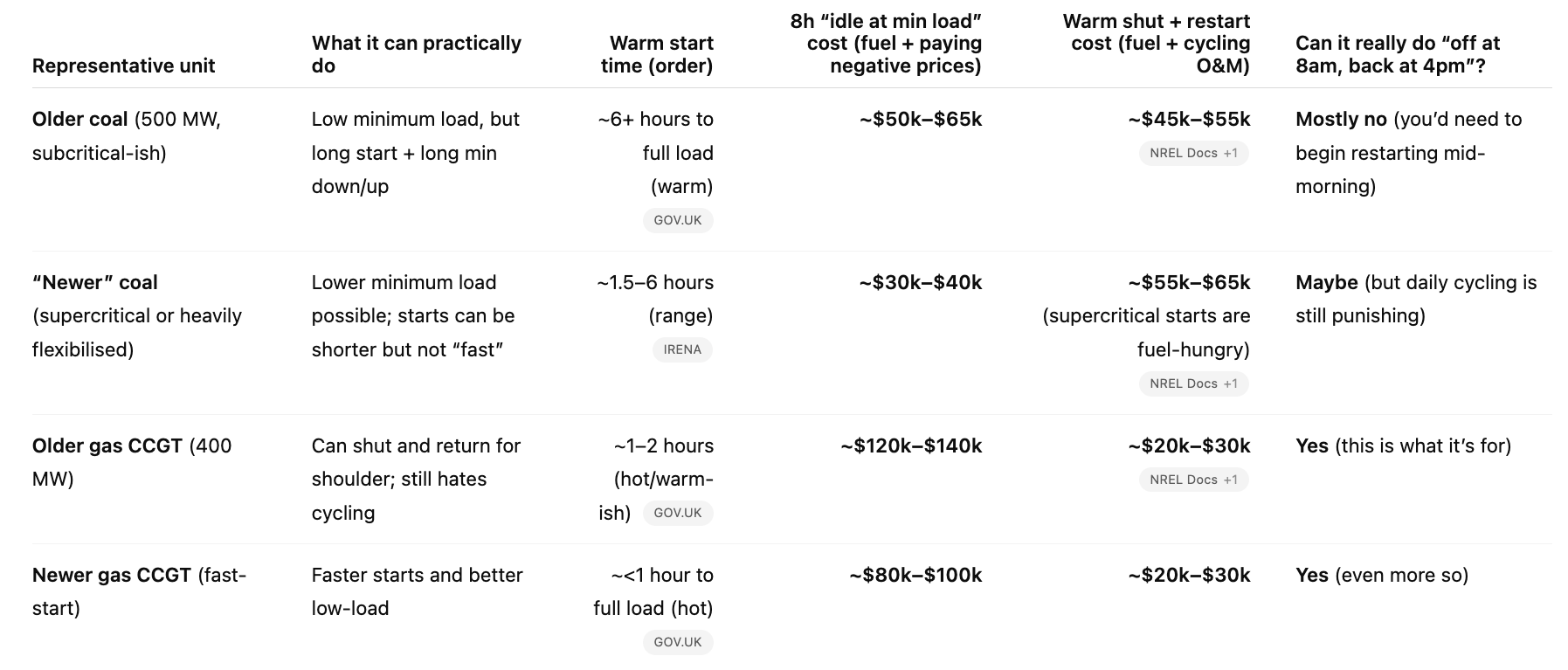
A few points on the the table:
The “idle cost” depends massively on the actual price, contract position, and whether the unit is genuinely forced to run. The point is the scale and the incentives.
For coal, feasibility is dominated by start time and minimum down/up constraints, not by whether the spreadsheet says restart might be cheaper.
“Newer coal” is largely academic in Australia (because they aren’t building it), but the flexibility ranges matter for international readers and for retrofits.
A common definition is:
Hot start: down for < ~8 hours
Warm start: 8–48 hours
Cold start: >48 hours
IRENA uses this style of definition and notes explicitly that cold starts take longer than hot starts.
Parsons Brinckerhoff’s table makes the same point in a way traders care about: start-up consists of (i) preparation to synchronise and (ii) ramp from synchronisation to full load — and both get worse the colder the plant is.
From IRENA’s summary table:
Hard coal (average): min load 25–40%, ramp 1.5–4%/min
CCGT (average): min load 40–50%, ramp 2–4%/min
OCGT (average): ramp 8–12%/min, start minutes, but lower efficiency at part-load
The important nuance: ramp rates only matter after you’re synchronised. Coal’s killer is time-to-synchronise.
Part-load operation isn’t just annoying — it burns more fuel per MWh.
IRENA’s table gives representative efficiencies:
Hard coal: ~43% at full load vs 40% at 50% load
CCGT: ~52–57% at full load vs 47–51% at 50% load
OCGT: ~35–39% at full load vs 27–32% at 50% load
So “keeping the unit warm at minimum load” comes with a very real fuel penalty.
NREL’s cycling cost synthesis is useful because it turns “wear and tear” into ballpark numbers.
Two relevant tables:
Startup fuel inputs (MMBtu per MW of capacity): supercritical coal has much higher startup fuel requirements than other types; gas combined cycle startup fuel is small in comparison.
Maintenance & capital start costs (per MW of capacity, by hot/warm/cold starts): even the median “lower bound” costs imply tens of thousands of dollars per start for large units — and there’s a wide range between plants.
NREL also notes that long-term heat-rate degradation attributable to cycling is plausibly ~1–5%, and that a ~1% heat-rate increase over 4–5 years is “not uncommon.”
So the intuition is:
Cycling doesn’t just change today’s operating cost.
It changes the plant’s future cost and reliability profile.
Which is why market participants price flexibility — and why “just ramp harder / shut down more” isn’t free.
The shoulder problem isn’t “we need 24 hours of batteries.”
It’s “we need fast power for the first hour or two while slower assets wake up.”
Coal usually can’t take an 8-hour lunch break and still be ready for the shoulder.
Gas often can — but it’s expensive to idle, and it still dislikes being treated like a yo-yo.
Batteries thrive precisely in that gap.
That’s the practical reason the evening price spike exists — and why the spike has been a profitable invitation for batteries.
NREL (2012) Power Plant Cycling Costs (startup fuel inputs, startup costs, cycling impacts):
https://docs.nrel.gov/docs/fy12osti/55433.pdf
IRENA (2019) Flexibility in Conventional Power Plants (min load, ramp rates, start times, efficiencies):
https://www.irena.org/-/media/Files/IRENA/Agency/Publication/2019/Sep/IRENA_Flexibility_in_CPPs_2019.pdf
Parsons Brinckerhoff for UK DECC (2014) Technical Assessment of the Operation of Coal & Gas Fired Plants (start timings):
https://assets.publishing.service.gov.uk/media/5a7dfc11ed915d74e33ef4be/Technical_Assessment_of_the_Operation_of_Coal_and_Gas_Plant_PB_Power_FIN....pdf
Comments
Nothing yet. Say the first thing.
Sign in to join the conversation.