
In our previous articles looking at South Australia’s grid, we’ve explored the market machinery.
We saw that the price crashes below zero in the middle of the day - because of solar. And that the price soars high in the early evening - because of solar.
But behind that volatile, five-minute auction there has always been a second market running in parallel. One that helped build the renewable fleet in the first place.
That market is the market for Large-scale Generation Certificates (LGCs).
If the spot market is the fast-paced auction for energy, LGCs were the slow-burning policy engine that got the renewables sector off the ground.
To understand what’s happening now — and why new schemes like CIS and REGO exist — we need to understand that invisible layer.
A wind farm in South Australia does not receive just one payment per megawatt-hour (MWh) generated.
It receives two:
The wholesale electricity price - that’s the price we’ve been analysing — sometimes $150/MWh, sometimes $15,000/MWh, sometimes negative.
An LGC.
For every MWh of eligible renewable electricity generated, the project receives one certificate.
Think of an LGC as a green receipt. It contains no energy. It is simply proof that one MWh of renewable electricity was generated.
But that proof has value because electricity retailers are legally required to surrender a certain number of these certificates each year.
That obligation creates demand. Demand creates a price.
So the total revenue of a wind farm historically looked like:
Total revenue ≈ Spot price + LGC price
And for many years, that second term was enormous.
The Renewable Energy Target was designed as a scarcity engine:
Set a fixed annual renewable target.
Force retailers to buy certificates.
Let scarcity drive price.
Let price drive investment.
In the mid-2010s, that worked exactly as intended. LGC prices rose toward $80–$90.
At those levels, certificate revenue could rival electricity revenue. Wind farms were financed on the back of that policy-created scarcity.
And then something interesting happened - the capacity got built.
By 2021, the 33,000 GWh annual large-scale target had been met.
The machine had done its job, but the machine didn’t switch off. It kept issuing certificates — only now they weren’t scarce.
Once supply exceeds a fixed target, certificates stop being rare. Over 2024–2025, LGC prices slid hard.
From the $40s, to the $20s. And by early 2026, they were trading around $4–$6.
And that tells you something important:
The policy worked.
The investment signal did its job.
But once the target was met and capacity abundant, the extra revenue stream largely evaporated.
Which leads to the an obvious question - why new federal government schemes (CIS & REGO)? But first, who pays for the current system..
The government doesn’t pay for LGCs. Grid operators don’t pay for LGCs. Consumers and businesses pay.
The money flow:
The Government sets a Renewable Power Percentage (RPP)—the fraction of total energy a retailer must “cover” with certificates (currently ~19%).
The Retailer (AGL, Origin, etc.) must buy these LGCs on the open market.
The Consumer: The retailer adds a “Green Charge” to the bill to recover this cost.
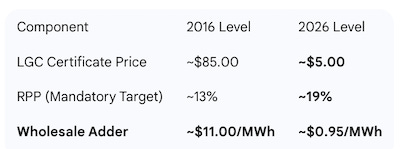
In 2016, this “Green Tax” was a significant 15% of the SA wholesale electricity cost. Today, at less than $1 per MWh, it is a rounding error.
A lot of commentary talks as if “wind and solar are cheap now” means “problem solved.”
But that’s mixing up two different things:
Cheap energy, sometimes (midday solar / windy hours)
versus cheap electricity, always (the thing households and factories actually require)
Solar is cheap when it shows up — and then it disappears right on schedule. Wind is cheap when it’s windy — and then it may not be. The grid doesn’t care about annual averages; it cares about the tight hours, especially the shoulder period we’ve been looking at in South Australia.
That’s the punchline from the earlier articles:
Midday prices go negative because solar overwhelms demand.
Evening prices spike because solar vanishes and wind often can’t fully cover the gap.
The scarcity signal has pulled in batteries — not to “run the state overnight,” but to act as a fast bridge while slower plant and imports ramp.
So the real shift isn’t “renewables are cheap.” The real shift is:
We built a lot of cheap intermittent energy, and now the expensive part is making the system work when that energy isn’t there.
LGCs were designed for the first phase: get renewable energy built. They created a second revenue stream that made projects bankable, and—by their own success—they eventually destroyed their own scarcity value.
Once LGC prices collapsed, the question stopped being “how do we incentivise wind and solar?” and became more like:
How do we incentivise the missing half of the system — the stuff that makes renewables usable at the hours that matter?
That’s where CIS seems to fit.
Not as “incentivising a new renewable technology that doesn’t exist,” but as a way to underwrite investment in the system-level complements we now need: dispatchable storage, firming, transmission-linked renewables in the right places, and capacity that can be relied upon through the shoulder.
Whether CIS is the best way to do that (or whether the market would have solved it anyway, given enough time and pain) is a bigger question.
For this article, the point is narrower:
LGCs helped build the renewable fleet.
The fleet changed the shape of prices (cheap/negative at noon, expensive at sunset).
And the next wave of policy is mostly about integration and reliability, not “inventing renewables again.”
I’ll leave CIS and REGO as open questions — because the goal of this article is to explain the LGC mechanism — but now we can at least see why governments feel pressure to add new tools even after “renewables went mainstream.”
The Capacity Investment Scheme (CIS) isn’t a certificate like LGCs, and it isn’t a simple “$X per MWh” subsidy.
It’s revenue underwriting, awarded through competitive tenders. Projects bid in, and winners sign a long-term contract with a revenue collar:
Below a floor: government tops up most of the revenue shortfall.
Above a ceiling: the project shares part of the upside back.
So: a seatbelt on the downside, and profit-sharing on the upside. It stabilises financing without turning projects into guaranteed-return utilities.
It’s also highly competitive (not central planning):
CIS Tender 1 — NEM generation (target 6 GW): 119 registrations → 84 bids → 19 winners, 6.4 GW awarded.
CIS Tender 3 — NEM dispatchable (target 16 GWh / 4 GW 4-hour equivalent): 166 registrations → 124 bids → 16 winners, 4.13 GW / 15.37 GWh awarded.
Example: the Goulburn River Standalone BESS (Lightsource bp) — 450 MW / 1,370 MWh — was one of the successful Tender 3 projects.
Comments
Nothing yet. Say the first thing.
Sign in to join the conversation.