
On August 20, 1866, delegates representing labor organizations across the United States gathered in Baltimore and formed the National Labor Union — the first attempt in American history to create a national federation of workers across industries. The NLU’s founding document included a demand that would define the American labor movement for the next 70 years: a federal mandate for an 8-hour workday. In 1866, the standard American workday was 10 to 12 hours, six days a week, in conditions that ranged from grueling to fatal, with no meaningful legal protection for workers who objected. The NLU’s founders were not radical in their politics — many were Civil War veterans who believed the republican principles they had fought for should extend to the workshop as well as the polling place.
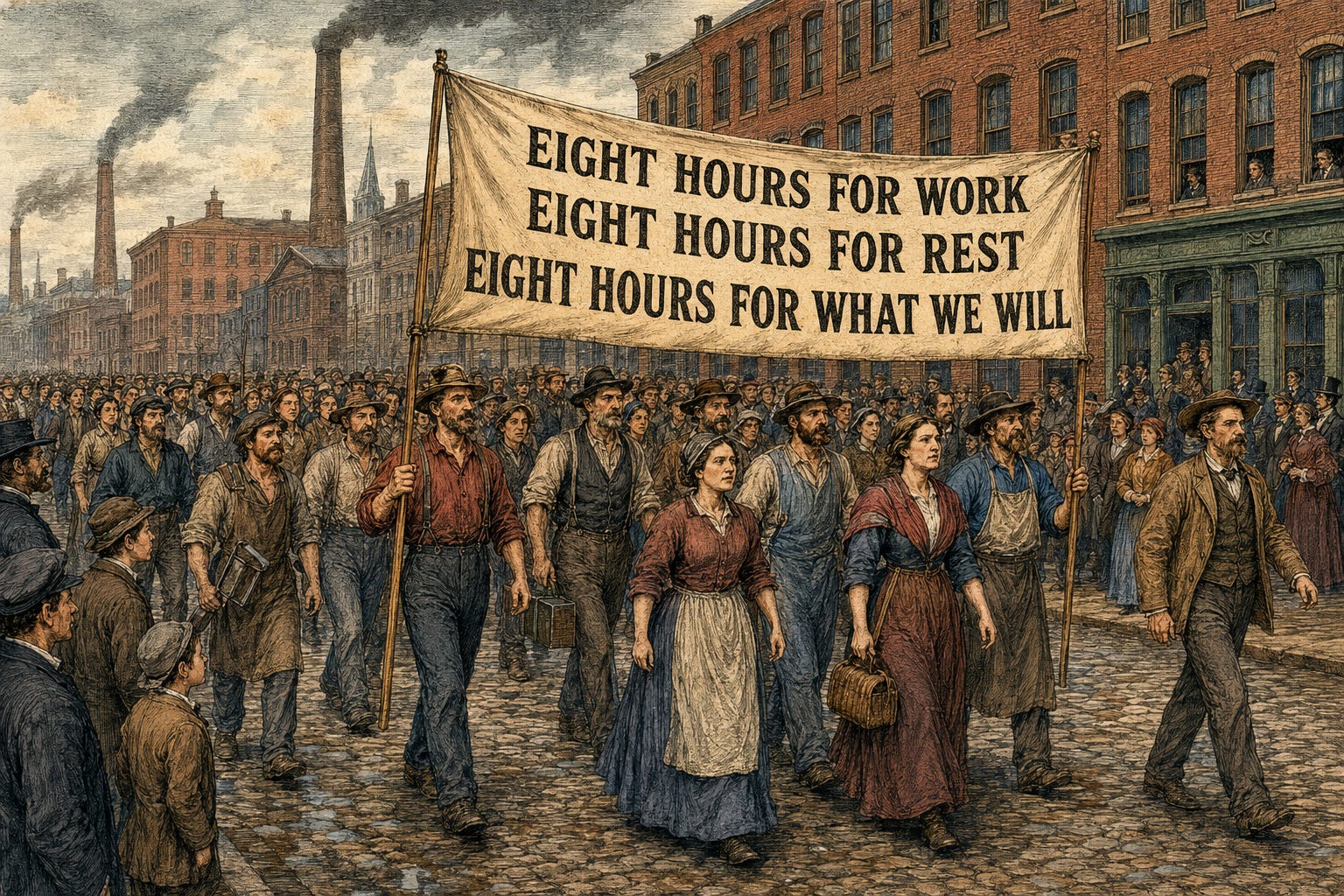
What They Were Fighting Against. In the decade following the Civil War, American industrial production exploded — and so did the conditions under which it was produced. Factory workers, mine workers, and railroad workers operated in environments with no safety standards, no limits on hours, no protections against arbitrary dismissal, and no recourse if injured. Child labor was widespread and legal. The 1866 economy was producing extraordinary wealth and distributing it with extraordinary inequality. The NLU’s founders argued that the same democratic principles that had abolished chattel slavery should prohibit what they called “wage slavery” — work under conditions that left workers no freedom, no time, and no power to negotiate.
The Eight-Hour Idea. The NLU’s central demand — the 8-hour workday — was more radical than it sounds today. An 8-hour day implied that workers had a right to time: time for rest, time for family, time for civic participation. The economist Ira Steward, one of the movement’s leading theorists, argued that shorter hours would increase consumption — workers with free time would develop wants and purchase goods, expanding the economy. This was a proto-Keynesian argument in 1866: that labor protections and consumer demand were connected, and that limiting one limited the other. The 8-hour day became law — unevenly, incompletely — through the Fair Labor Standards Act of 1938.
Where It Stands Now. The NLU itself lasted only six years before dissolving in 1872. But it established the template for the American Federation of Labor (1886) and the Congress of Industrial Organizations (1935), which eventually merged into the AFL-CIO (1955). The 8-hour workday and 40-hour work week the NLU first demanded are now legal standards, if not universal practice. The percentage of American workers represented by unions has declined substantially since its postwar peak — from roughly 35% in the 1950s to approximately 10% today — and the debate about the proper relationship between labor and capital remains as live as it was in Baltimore in August 1866.
Did You Know? The NLU was notably progressive for its era on the question of race: its 1869 congress formally endorsed the inclusion of Black workers in the labor movement and called for equal pay regardless of race. This was not universal sentiment among member unions, many of which explicitly excluded Black workers. But the NLU’s formal position was ahead of its time — and ahead of the AFL that replaced it, which tolerated racially exclusionary union practices for decades. The history of the American labor movement and the history of American racial equality have been entangled from the start.
No posts
Comments
Nothing yet. Say the first thing.
Sign in to join the conversation.