
On August 19, 1848, the New York Herald — then the most widely circulated newspaper in the United States — published the first major East Coast report on the gold discovery at Sutter’s Mill in California. The discovery itself had happened on January 24, 1848, when James Marshall found gold flakes in the tailrace of a sawmill on the American River. It had been reported in San Francisco in March. But California was far away, and the reports seemed implausible. It was the Herald’s report, combined with a confirmation from President Polk in his December message to Congress, that triggered what became the largest voluntary mass migration in American history. By 1852, California’s non-native population had grown from 14,000 to more than 250,000.
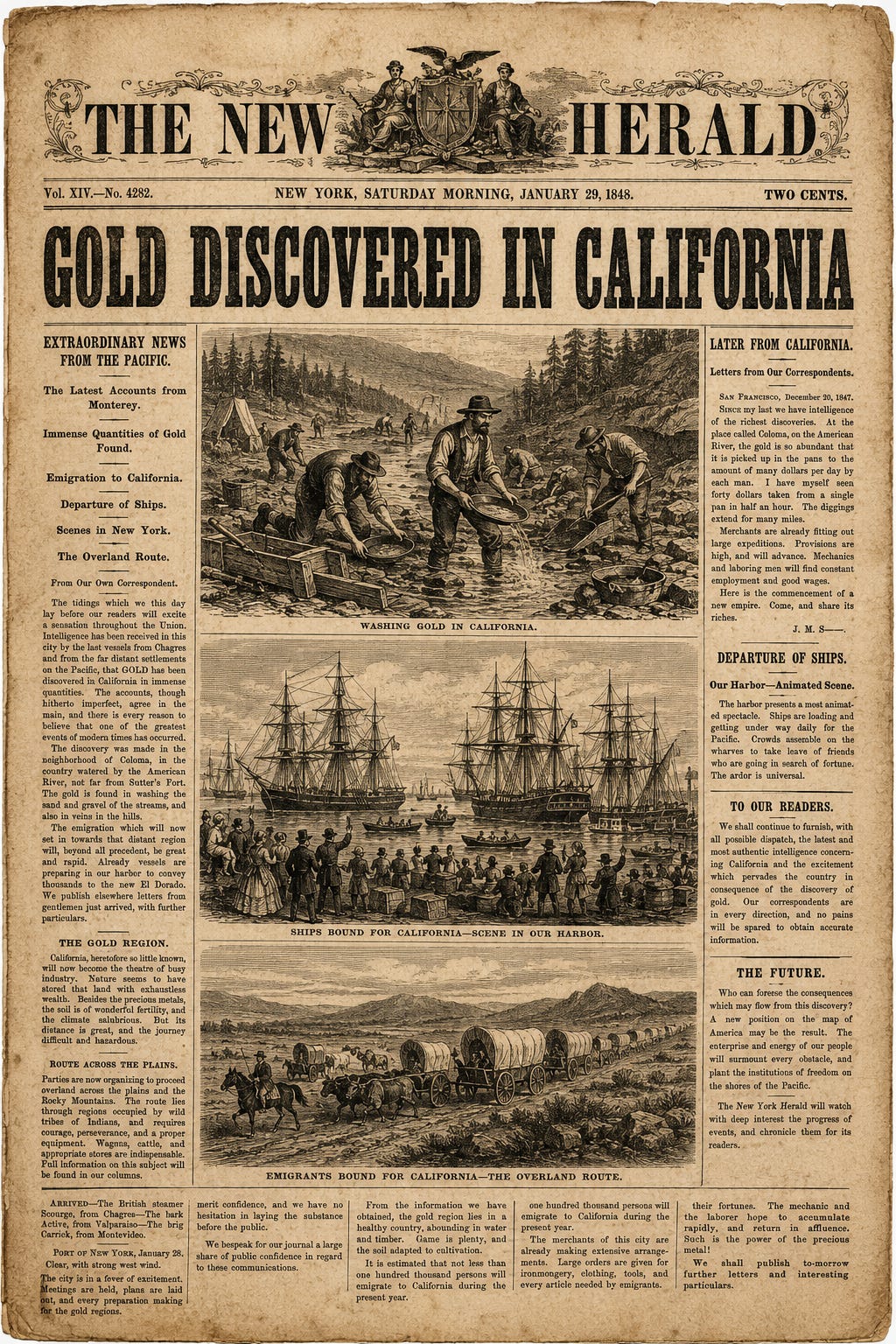
The Media Made the Market. The California Gold Rush was, in significant part, a media event. The Herald’s August 19 report — and the subsequent flood of newspaper coverage — created demand for California migration in the same way that advertising creates demand for a product: by making something distant feel immediate, possible, and urgent. Shipping companies, outfitters, and travel agents ran advertisements in newspapers alongside gold rush coverage. The news and the commerce were inseparable. Within weeks of the Herald report, eastern merchants had begun organizing expeditions, stocking California-specific goods, and establishing supply chains to the Pacific Coast.
What It Built. The Gold Rush’s most durable commercial legacy was not gold — it was California. The rush accelerated California statehood (1850), financed the transcontinental railroad’s political constituency, created San Francisco as a major port and commercial city, and established the Pacific Coast as an integrated part of the American economy decades before it might otherwise have happened. It also introduced mass immigration from China (Chinese workers comprised a significant portion of California’s early industrial labor force), Latin America, and Europe — creating the demographic diversity that has characterized California’s economy and culture ever since. Levi Strauss arrived in San Francisco in 1853 to sell canvas goods to miners and ended up making pants.
Where It Stands Now. California is now the world’s fifth-largest economy by GDP, larger than most nation-states. The technology industry that defines its economy today — the Silicon Valley gold rush — has structural similarities to 1848 that observers have noted since the 1990s: a new resource (digital, rather than mineral), a media ecosystem amplifying opportunity, a migration of talent to a single geography, and the consistent pattern that the people selling the infrastructure make more reliable fortunes than those prospecting directly. California’s gold ran out. Its capacity to attract people chasing the next thing has not.
Did You Know? Sam Brannan, a San Francisco merchant and newspaper publisher, is generally credited with triggering the California Gold Rush’s actual stampede — not through the New York Herald’s report but through his own actions in May 1848. Brannan had quietly stocked his stores with every mining supply he could find, then walked through San Francisco’s streets holding a vial of gold dust and shouting “Gold! Gold from the American River!” He became California’s first millionaire. He had not found the gold — he had simply positioned himself to sell to everyone who went looking for it. The Brannan Model has been replicated in every gold rush since.
No posts
Comments
Nothing yet. Say the first thing.
Sign in to join the conversation.