
On August 21, 1959, President Eisenhower signed the proclamation admitting Hawaii as the 50th state of the Union, ending a 59-year campaign for statehood that had been consistently blocked by southern senators who feared the racial composition of Hawaii’s population. The islands had been a U.S. territory since 1898, integrated into the American economy through sugar, pineapple, and military contracts without enjoying the political representation that integration implied. When the vote for statehood finally came, Hawaiian voters approved it by a margin of 17 to 1. The economics had been there long before the politics caught up.
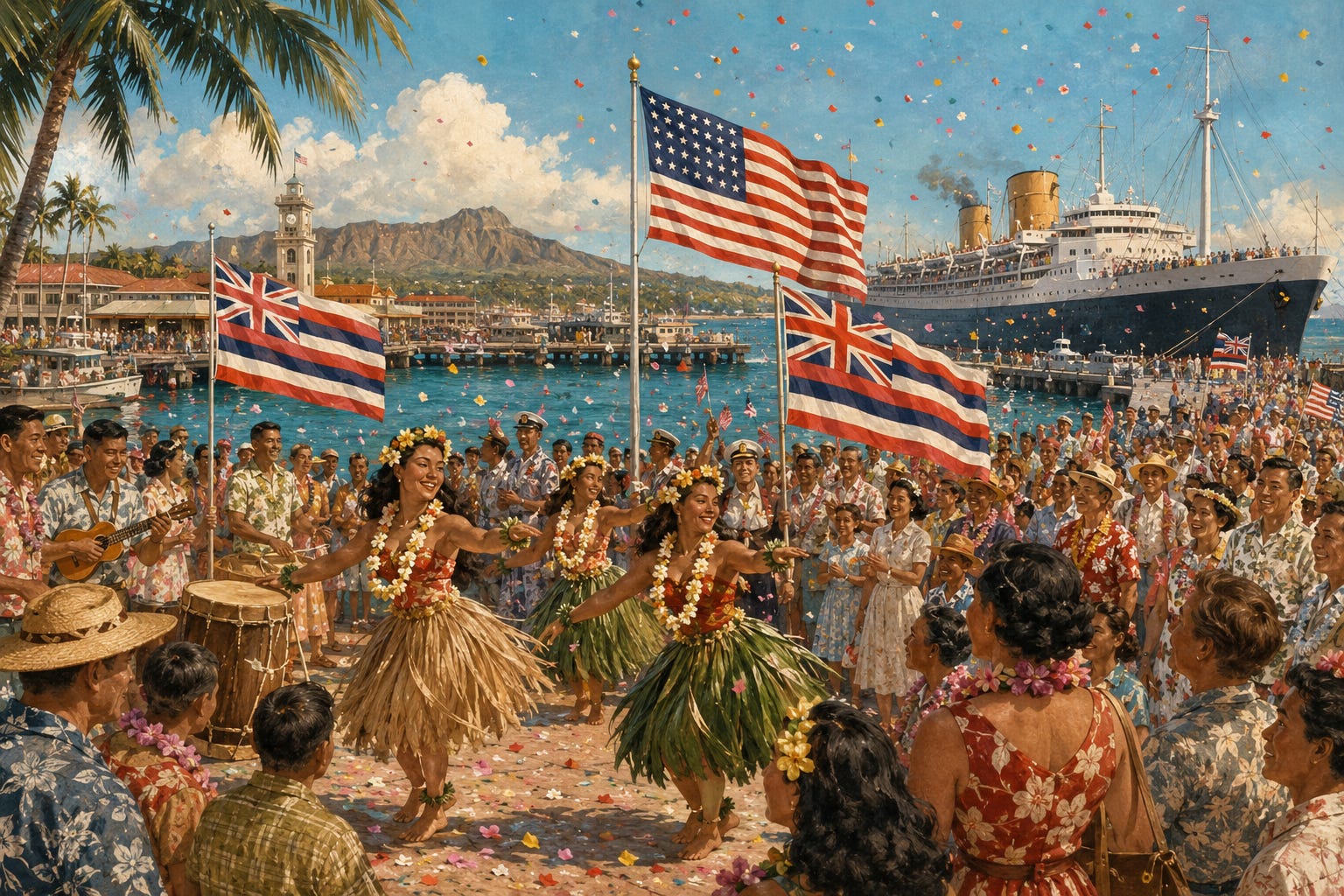
The Agricultural Economy That Made the Case. Hawaii’s push for statehood was driven in significant part by its agricultural industry — specifically, the “Big Five” corporations that controlled sugar and pineapple production: Castle & Cooke, Alexander & Baldwin, C. Brewer & Co., American Factors, and Theo H. Davies. These companies had built the physical and commercial infrastructure of the Hawaiian economy and had every incentive to ensure that their investments were protected by U.S. statehood rather than the more uncertain status of territorial governance. The Dole company’s pineapple empire, in particular, had made Hawaiian pineapple a ubiquitous presence in American kitchens and a significant contributor to the territory’s tax base.
What Statehood Changed. Admission to the Union integrated Hawaii into federal commercial law, federal infrastructure spending, and federal labor protections. It also opened Hawaii’s land market to mainland capital investment in ways that accelerated the tourism economy — already growing in the 1950s — at the expense of the agricultural one. The pineapple industry that had helped argue the case for statehood went into decline within a decade of admission, as cheaper production in Southeast Asia undercut Hawaiian costs. Tourism replaced agriculture as the dominant commercial force. Hawaii is now the most tourism-dependent state in the union, with roughly 10 million visitors annually contributing more than $20 billion to the state economy.
Where It Stands Now. Hawaii’s economy remains heavily dependent on tourism and military spending — two sectors it largely cannot control. The commercial tensions inherent in that dependence — rising housing costs, limited economic diversification, environmental pressure from visitor volume — have made statehood’s commercial promises a subject of ongoing debate. The Hawaiian sovereignty movement has raised questions about whether the commercial integration statehood provided was worth the cultural and political trade-offs it required. The 93% of Hawaiians who voted for statehood in 1959 made a calculation that subsequent generations have continued to reckon with.
Did You Know? James Dole — the “Pineapple King” — arrived in Hawaii in 1899 with a Harvard degree in agriculture and $1,000 and built an industry that, at its peak, produced 75% of the world’s canned pineapple. Dole’s genius was not cultivation but logistics: he built a cannery that could process pineapples faster than any competitor and a marketing operation that convinced American consumers that Hawaiian pineapple was not just a tropical fruit but a symbol of quality. By the time of statehood, the Dole brand was synonymous with Hawaii’s commercial identity. Today, the Dole Plantation on Oahu is itself a major tourist attraction — the industry that shaped the island now partly draws visitors on its own nostalgia.
No posts
Comments
Nothing yet. Say the first thing.
Sign in to join the conversation.