
With Florida Republicans voting tomorrow for their nominee for governor, the broader polling picture is fairly clear at the top even if there is still some uncertainty underneath it.
Based on the polls, our current estimate of the race looks roughly like this:
Byron Donalds 44.8%
Jay Collins 14.9%
James Fishback 10.0%
Paul Renner 6.2%
Other 2.9%
Undecided 21.2%
You can view our own poll for this race.
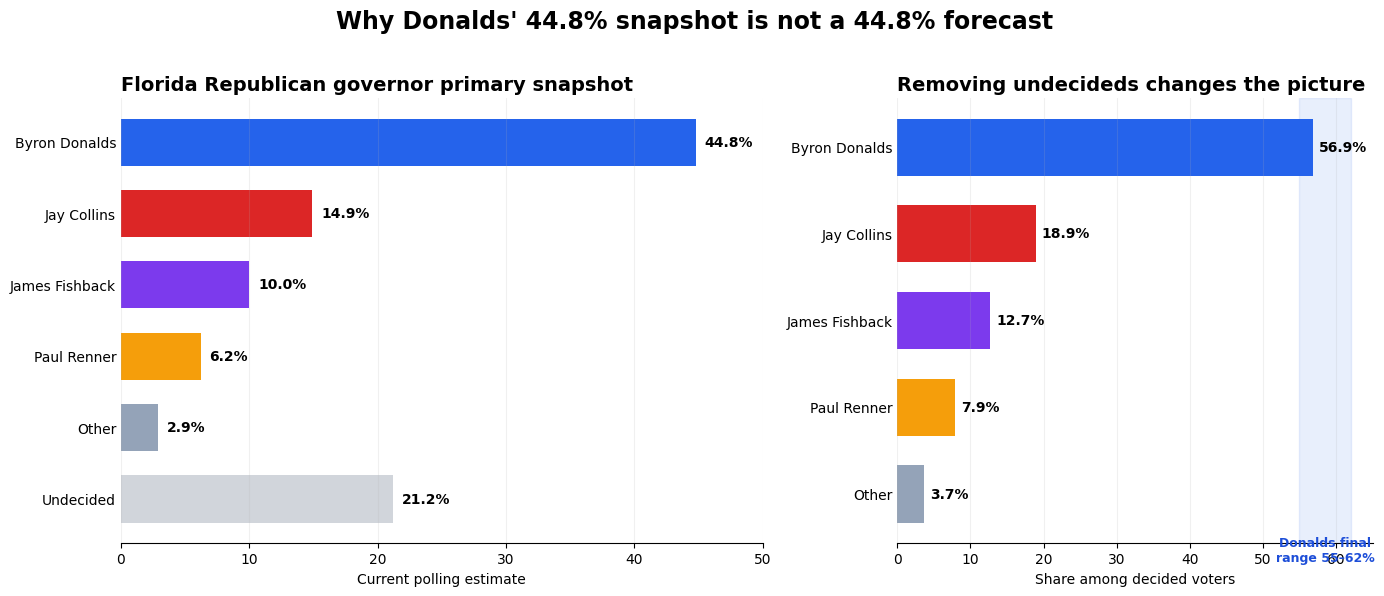
Those numbers are best understood as a snapshot of the polling environment, not a literal prediction of the final vote.
Using several approaches, including robust LOWESS smoothing, we think a reasonable final range for Donalds is approximately 55% to 62%. The more interesting question is not whether Donalds finishes first, but how the rest of the field sorts itself out; particularly Collins and Fishback.
For the LOWESS analysis, we used field date as the time variable, a smoothing fraction of .65 and three robustifying iterations. Each survey received equal base weight. We did not weight by sample size, margin of error, partisan affiliation or whether a poll was conducted internally for a campaign.
We also ran the analysis twice: once with Public Sentiment Institute included and once without it.
That distinction matters because PSI has produced a dramatically different picture of James Fishback than nearly everyone else.
Its three recent comparable surveys have placed Fishback at: 26.7%, 32.3% and 29.4%
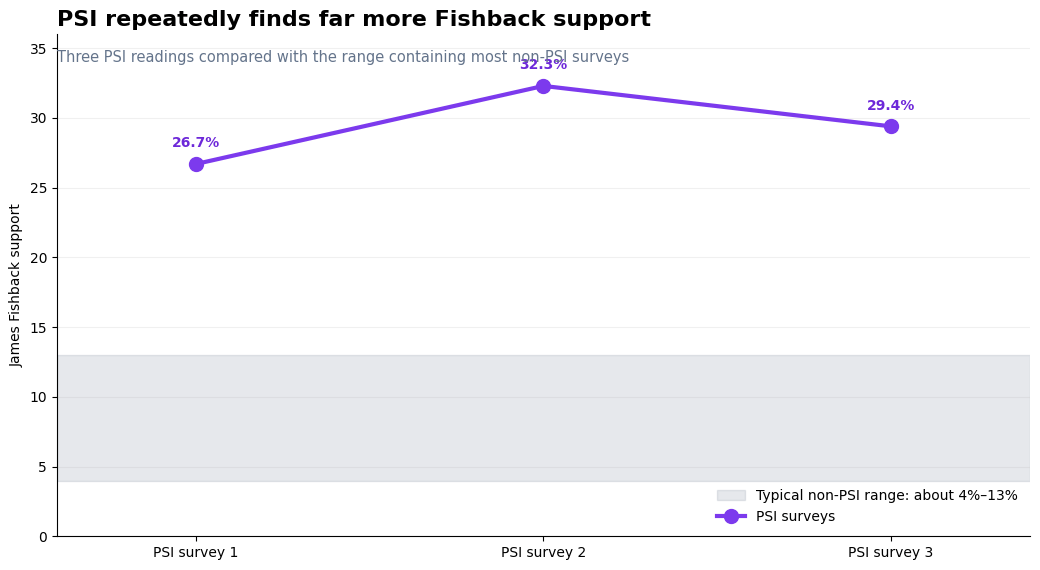
By comparison, the ten non-PSI surveys in this period have overwhelmingly placed him between roughly 4% and 13%.
That does not mean PSI must be wrong. Polling surprises happen, and it is certainly possible that one methodology is detecting voters others are missing.
But the disagreement is large enough, and persistent enough across three separate field periods, that it deserves to be treated as more than ordinary sampling variation.
LOWESS is reasonably good at handling an isolated strange observation. What makes PSI interesting is that the same basic pattern keeps repeating.
This also helps explain why public polling averages can look very different depending on what enters the calculation. DDHQ’s current average, for example, has Donalds around 37%, Fishback at 18%, Collins at 17% and Renner at 8%.
Tomorrow will provide an unusually clean test of whether PSI was identifying a real bloc of Fishback support that nearly every other pollster missed, or whether we were looking at a substantial house or methodological effect.
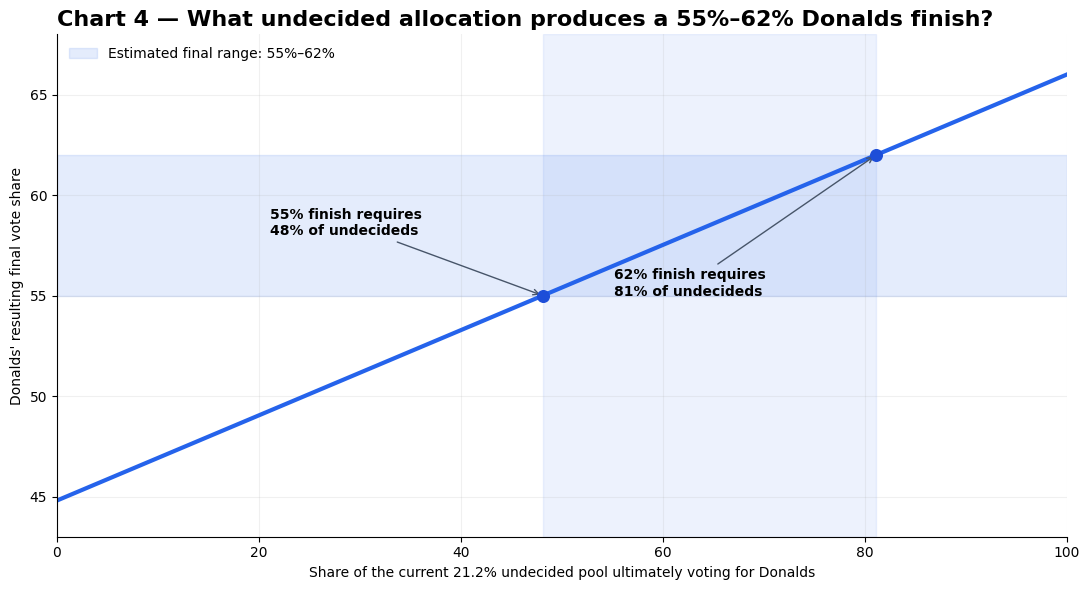
The other important point is Donalds’ 44.8% polling number. Our model does not treat that as an expected final vote share.
Roughly one-fifth of the electorate remains undecided in the aggregate. Once those voters are removed, Donalds is already approaching 57% among decided voters and here is how it matters.
If Donalds is polling in the mid-to-upper 40s while surveys are still carrying 15% to 25% undecided, projecting him to finish at 48% or 50% would effectively require late undecided voters to break heavily against the frontrunner.
There is not much in this race that compels that assumption. Donalds has led throughout the campaign, holds Donald Trump’s endorsement and has enjoyed a substantial resource advantage.
For that reason, we currently center the underlying polling environment around something close to:
Donalds: 45%
Collins: 12–15%
Fishback: 10%
Renner: 6%
Undecided/other: roughly 20% or more
The remaining uncertainty is largely about how those uncommitted voters resolve themselves.
Crowded primaries also have a habit of producing at least one candidate who materially outperforms the polling. That could change the exact toplines and substantially alter the margins or finishing order beneath Donalds.
But based on the polling evidence available today, it would take an extraordinary miss to change our projected winner.
No posts
Comments
Nothing yet. Say the first thing.
Sign in to join the conversation.