

Russell Fry’s endorsement of Darline Graham does not decide South Carolina’s Republican Senate runoff. But it does make Ralph Norman’s path considerably more difficult.
The reason is less about the endorsement itself than the shape of Fry’s vote.
Graham finished the first round with 109,881 votes, or 32.7%. Norman followed with 82,628, or 24.6%, while Fry finished third with 66,011 votes, or 19.7%. That gives Graham a 27,253-vote head start over Norman before a single eliminated candidate’s voter is reassigned.
Runoffs do not work that neatly, of course. Turnout falls. Some voters disappear entirely. Others who supported a losing candidate may have little interest in choosing between the remaining two.
Still, the starting math matters.
If Graham and Norman simply retained their first-round voters at roughly equal rates, Norman would need to win close to 60% of the returning voters who backed someone else just to erase Graham’s initial advantage.
That is where Fry becomes important.
His support was not scattered randomly across South Carolina. It was heavily concentrated in the Pee Dee and Grand Strand, where he has a genuine political base. Fry carried Horry, Florence, Darlington, Georgetown, Dillon, Marion, Marlboro and Chesterfield.
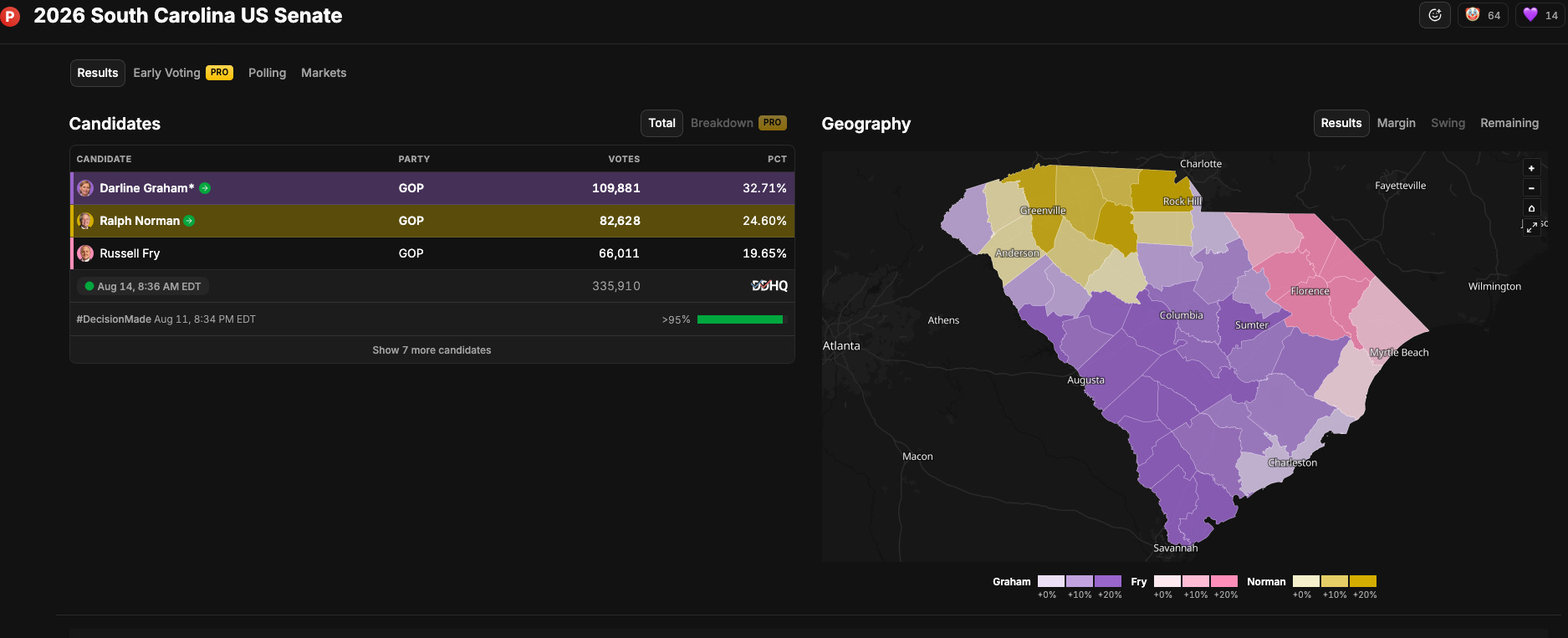
Horry is particularly important. More than 32,000 primary votes were cast there, accounting for roughly 59% of all ballots cast in counties Fry carried.
And Norman was not particularly strong across Fry’s best territory.
That does not mean Fry can simply hand those voters to Graham. Candidates rarely possess that kind of control over their supporters, and Fry and Graham were hardly allies during the primary. They went after one another pretty aggressively. Some Fry voters undoubtedly chose him specifically because they did not want Graham.
But endorsements can still provide a signal, especially where a candidate has a recognizable geographic and personal following.
A reasonable starting assumption might be that only 55% to 65% of Fry voters return for the runoff. That would leave roughly 36,000 to 43,000 Fry voters actually choosing between Graham and Norman.
If those voters broke 50-50, the endorsement would mean very little.
But the geography suggests that is unlikely.
A 60-40 Graham split among returning Fry voters would give Graham a net advantage of roughly 7,000 to 9,000 votes from that bloc alone. At 65-35, the advantage approaches 13,000.
Those numbers are not forecasts. They are simply a way of illustrating how consequential even a modest lean among Fry voters could become.
Norman’s challenge is that he cannot merely collect the Sanford and Lynch vote and assume the rest takes care of itself. He begins the runoff behind by more than 27,000 votes and therefore needs a fairly decisive victory among voters whose first choice has been eliminated.
Some of those voters will certainly move his way. Sanford’s electorate, in particular, could be important, and runoff turnout could disproportionately favor Norman’s more conservative Upstate base.
But Fry’s endorsement prevents Norman from having a clean path to consolidating the anti-Graham vote.
The largest remaining bloc of voters belongs to a candidate who has now explicitly pointed them toward Graham.
That makes Horry County one of the most interesting places to watch on runoff night.
If Graham carries Horry after finishing second there in the first round, it would be a meaningful sign that Fry’s support transferred her way. If she wins it comfortably, and similar movement appears elsewhere in Fry country, the effect becomes much more consequential. At that point, Norman would be losing ground in one of the largest remaining pools of available runoff voters, substantially narrowing his path statewide.
And if that same pattern shows up across Florence, Darlington and the rest of Fry country, Norman may find that his real problem was not simply catching Graham. It was finding enough voters left on the board to do it.
No posts
Comments
Nothing yet. Say the first thing.
Sign in to join the conversation.