
Arizona has spent the better part of a decade becoming one of America’s great political battlegrounds. Our latest survey suggests 2026 will be no different. (see the presentation and cross tabs here).
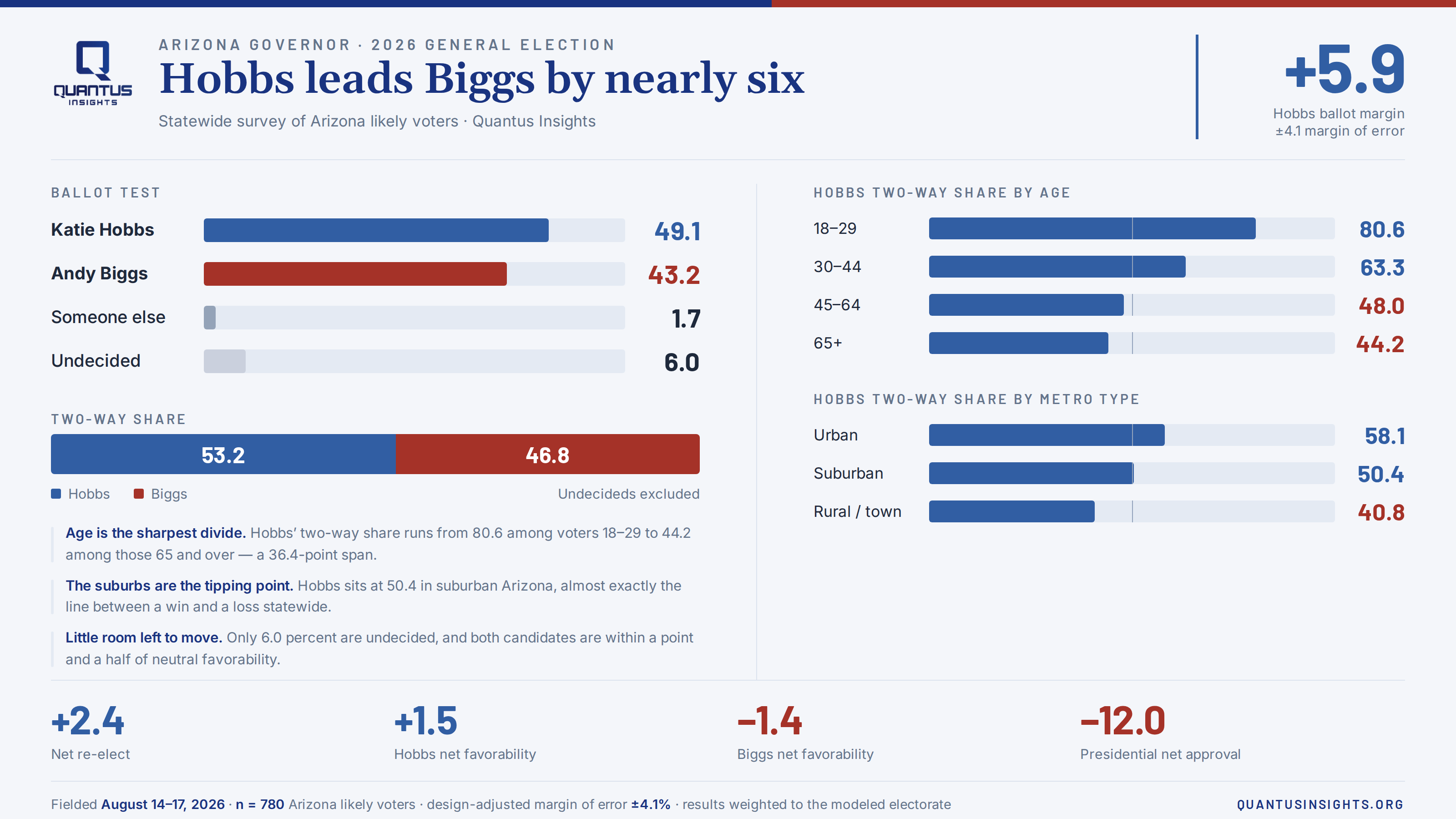
Democratic Gov. Katie Hobbs begins the general-election contest with an advantage over Republican Andy Biggs, leading 49.1% to 43.2%, with 6.0% undecided. Among voters choosing between the two candidates, Hobbs leads 53.2% to 46.8%.
That is a meaningful lead, but not quite a commanding one. The survey’s design-adjusted margin of error is ±4.1 percentage points, and Arizona remains what it has been for several cycles: closely divided, highly polarized and capable of moving quickly.
What stands out most, however, is how little open ground remains.
Hobbs’ ballot number almost perfectly mirrors the public’s judgment of her governorship. Half of Arizona likely voters, 50.0%, say she deserves re-election, while 47.6% say it is time for someone new. Only 2.4% are unsure.
The candidates themselves are similarly well defined. Hobbs is viewed favorably by 48.8% and unfavorably by 47.3%, a net rating of +1.5. Biggs stands at 46.1% favorable and 47.5% unfavorable, or −1.4. Neither candidate is broadly popular, but neither is politically unknown either. In other words, this is not an electorate waiting for an introduction. Most voters already know the players and have chosen their side.
The sharpest fault line is age.
Among voters 18 to 29, Hobbs receives 80.6% of the two-party vote. Among voters 30 to 44, she receives 63.3%. But the race flips among older Arizonans: Hobbs falls to 48.0% among voters 45 to 64 and 44.2% among those 65 and older.
Geography tells much the same story. Hobbs wins urban voters 56.0% to 40.4% on the full ballot, while Biggs leads among rural and town voters, 47.6% to 32.8%. The suburbs sit almost exactly on the dividing line.
That leaves the campaign fighting over familiar Arizona terrain: older versus younger, urban versus rural, college-educated versus working-class, and above all, the voters who fall somewhere between the two parties.
Indeed, the ideological composition of the electorate may explain why Arizona remains so difficult to classify. Conservatives make up 38.3% of likely voters, but moderates are almost identical at 38.1%. Liberals account for just 21.7%. The decisive voter in Arizona, therefore, is not necessarily the ideological partisan. It is the voter in the middle.
And hanging over all of it is the national environment.
President Donald Trump’s job approval in Arizona stands at 43.4% approve to 55.4% disapprove, a net rating of −12.0. More important, the intensity is lopsided: 53.2% strongly disapprove while 38.0% strongly approve.
For Biggs, that is the central problem. A Republican can win Arizona. Republicans do win Arizona. But in a state this closely divided, a national environment where the party’s president is running twelve points underwater can turn a competitive race into an uphill one.
For Hobbs, the danger is different. Her lead is real, but she sits just below 50% on the ballot, and her personal standing is essentially even.
So the race begins with Hobbs ahead but not beyond reach.
Arizona remains Arizona: divided, restless, increasingly defined, and once again likely to make both parties fight for every last vote.
No posts
Comments
Nothing yet. Say the first thing.
Sign in to join the conversation.