
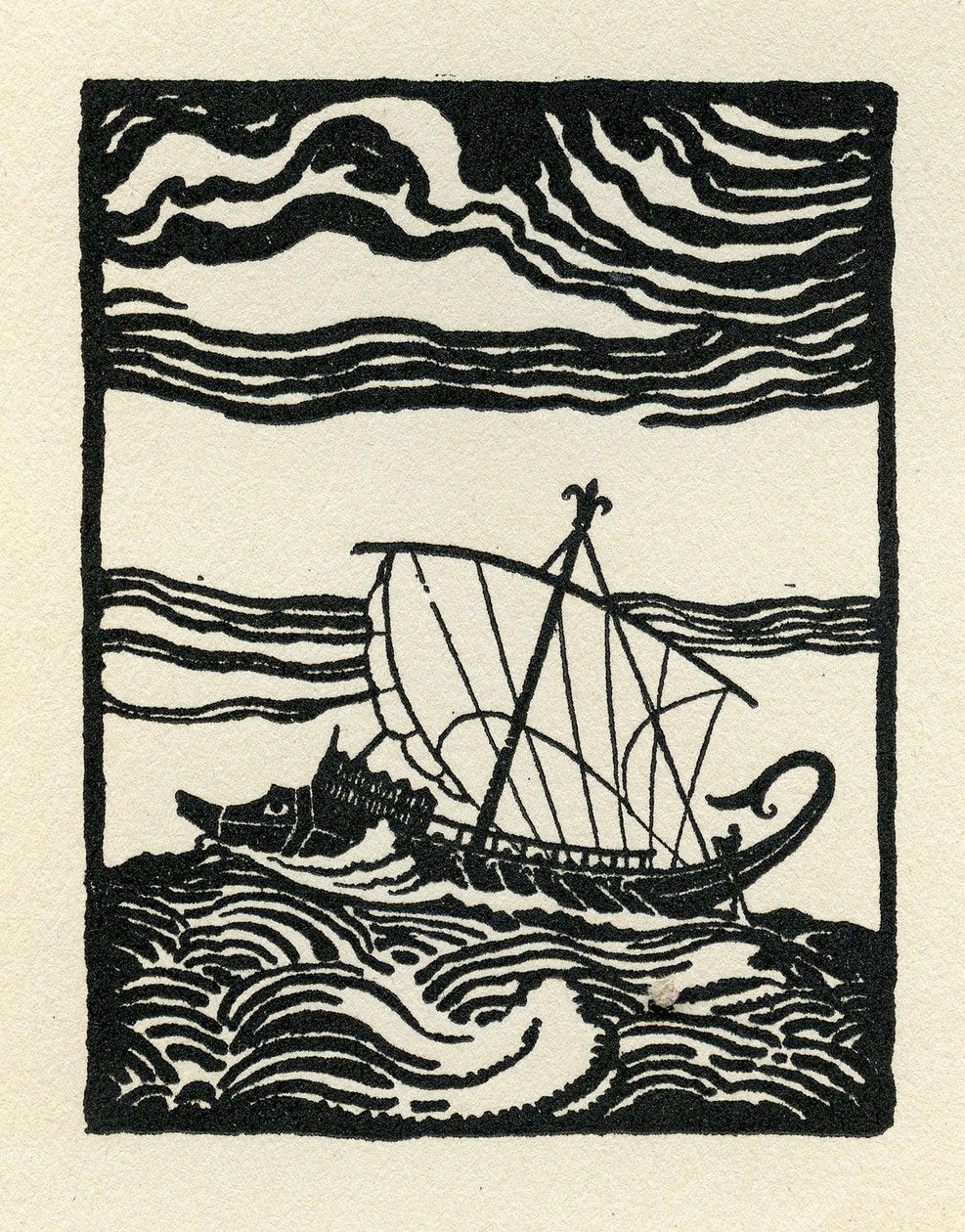
[Newell Convers Wyeth, Odysseus’ Ship (1929)]
.
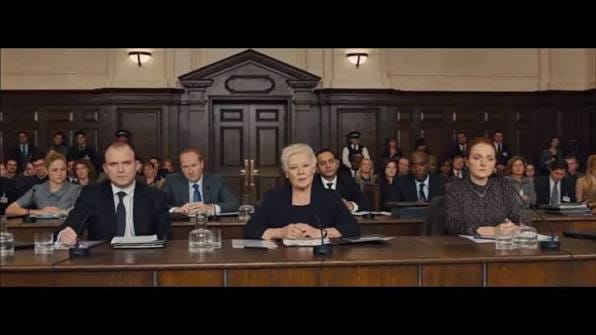
This, one of Tennyson’s most famous poems, is often discussed by critics in terms of whether it articulates a heroic striving against the depredations of old-age and decline—rage, rage against the dying of the light—or shows a selfish old man, abdicating his proper responsibilities and dooming his crew to death. Ulysses (that is, Odysseus) addresses the crew of his ship. He has returned to Ithaca, killed the suitors, reunited with his wife, but he is unhappy, he cannot stay, he must move on. He announces that he will turn over his throne to his son, Telemachus, and set sail again, voyaging this time not east to Troy, but to the undiscovered west. According to Dante, whom Tennyson knew, Ulysses (and presumably his crew, though we don’t meet them in Dante’s Hell) die on this voyages, drown-dead. Should he stay and do his duty by ruling? Is he heroic in sailing away, or cowardly? ‘Some see Ulysses as heroic,’ says John G Peters, ‘some see him as derelict, while others place him somewhere between these two poles.’ The standard Victorian reading of the poem took the former view, where the irony-loving New Critics and Deconstructionists of the 20th-century largely took the poem in the latter sense, full of subtle underminings and aporia, a critique of the ideology of heroism. What is, I suppose, the most famous 21st-century iteration of the poem returns it to being about grizzled heroism and undimmed will: I’m talking about Judy Dench’s improbable recitation of the poem’s final lines in Skyfall.1
Tho’ much is taken, much abides; and tho’
We are not now that strength which in old days
Moved earth and heaven; that which we are, we are;
One equal temper of heroic hearts,
Made weak by time and fate, but strong in will
To strive, to seek, to find, and not to yield.
This sets-up agéd Daniel Craig2 to come running in, to strive with Javier Bardem’s Silva, to shoot, to fight and, of course, not to yield. And Christopher Nolan’s movie-de-jour ends with a Tennysonian gesture: as in Homer, Nolan’s Odysseus returns, kills the suitors and reclaims his wife (though he doesn’t hang all the slave-girls). But then he hands-over the rule or Ithaca to his son, and—which is not in Homer—takes Penelope onto his ship and the two sail away beyond the sunset and the baths/Of all the western stars.
I have never quite been able to parse the opening sentence of ‘Ulysses’, or grasp why Tennyson deforms syntax in the way he does:
It little profits that an idle king,
By this still hearth, among these barren crags,
Match’d with an aged wife, I mete and dole
Unequal laws unto a savage race,
That hoard, and sleep, and feed, and know not me.
The ‘that’ in the opening line sets-up a subsequent clause that doesn’t come (as it might be: ‘it little profits that an idle king should rule among these barren crags’). If we take it that a ‘be’ has dropped out (‘it little profits that an idle king … [be] match’d with an aged wife’) we run up against the transition to the following clause, ‘I mete and dole’, which positions ‘match'd with an aged wife’ as a preliminary clause in a new sentence. Indeed, if we take ‘it little profits’ as meaning ‘there is little profit in …’ then we have to trace the sentence as ‘there is little profit in the fact that (by this still hearth, among these barren crags) …’ and we are left dangling for the rest.3 Parse it how you like, it doesn’t fit together. [Update: in the comments, several people provide one possible reading of the lines—the lack of the comma needful for this still irks me, but it does make sense of the opening.]
I don’t mean to get too tangled up in this: broadly we can see that the poem’s opening sentence is saying ‘I, Ulysses, am stuck here on this barren island with an aged wife ruling a savage people, and there’s no profit it this for me’. But the dislocation of the syntax wrongfoots the very opening of the poem, and destabilises what follows, even though what follows is perfectly comprehensible.
I cannot rest from travel: I will drink
Life to the lees: all times I have enjoy'd
Greatly, have suffer'd greatly, both with those
That loved me, and alone; on shore, and when
Thro’ scudding drifts the rainy Hyades
Vext the dim sea:
The Hyades are a star cluster in the constellation of Taurus, and Tennyson took the ‘rainy Hyades’ from John Lemprière’s Classical Dictionary (1788):
Hyădes, five daughters of Atlas king of Mauritania, who were so disconsolate at the death of their brother Hyas, who had been killed by a wild boar, that they pined away and died. They became stars after death, and were placed near Taurus, one of the 12 signs of the Zodiac. They received the name of Hyades from their brother Hyas. Their names are Phaola, Ambrosia, Eudora, Coronis, and Polyxo. To these some have added Thione and Prodice, and they maintained that they were daughters of Hyas and Æthra, one of the Oceanides. Euripides calls them daughters of Erechtheus. The ancients supposed that the rising and setting of the Hyades were always attended with much rain, whence the name (ὑω pluo). Ovid, Fasti, bk. 5, li. 165.—Hyginus, fable 182.—Euripides, Ion.
These are superbly euphonious, measured, evocative lines of verse, amongst my favourite in all Tennyson: when/Thro’ scudding drifts the rainy Hyades/Vext the dim sea. If I could write poetry so amazing I’d die happy. It has something to do with the balance of monosyllables and polysyllables: ‘Ulysses’ has a high proportion of lines composed of eight monosyllables and one disyllable (from ‘Match’d with an aged wife, I mete and dole’ through to, here, ‘I cannot rest from travel: I will drink/Life to the lees: all times I have enjoy’d/… That loved me, and alone; on shore, and when’) and many lines entirely made of monosyllables, such as the poem’s superb final couplet. Tennyson usually balances these two types of line, as in:
The long day wanes: the slow moon climbs: the deep
Moans round with many voices. Come, my friends.
It means that when he disposes a line containing several polysyllables it draws and slows the flow, focalises the words: in Thro' scudding drifts the rainy Hyades/Vext the dim sea the vivid ‘scudding drifts’ (a disyllable and a monosyllable, but three short vowels) leading into ‘the rainy Hyades’ (a monosyllable, a disyllable and a trisyllable, a sequence emphasised by the passage from short ‘the’ through the dipthong in ‘rainy’ and the long ‘y’ in Hyades) builds to the enjambment and is completed by the wondrous vext—an unusual, evocative word, rendered more striking by the use of -t rather than -ed—and the dim sea. It’s one of those moments of poetic flawlessness that are common in Tennyson’s verse.
Text within this block will maintain its original spacing when published
I am become a name;
For always roaming with a hungry heart
Much have I seen and known; cities of men
And manners, climates, councils, governments,
Myself not least, but honour’d of them all;
And drunk delight of battle with my peers,
Far on the ringing plains of windy Troy.
‘I am become a name’ records that odyssey now means ‘a long and winding journey’, and Ulysses ‘always roaming with a hungry heart’ presumably indicates that Bruce Springsteen is a reader of Tennyson, which is cool.
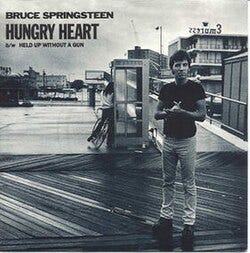
The phrase ‘hungry heart’, as anima esuriens, is Biblical (Proverbs 27:7: Anima saturata calcabit favum, et anima esuriens etiam amarum pro dulci sumet) and, as cor esuriens, crops up often enough in later devotional and hymnal writing (eg); but we have to assume Tennyson is deploying the phrase in a secular, not spiritual, sense.4 That last couplet, much celebrated in the nineteenth-century as hitting the authentic Homeric tone, brings out, with its ‘drunk delight of battle’, the trope of Ulysses drinking— ‘I will drink/Life to the lees’—that leads into the possibility (the inevitability, as per Dante’s Ulysses, with whom, as I say, Tennyson’s poem is in manifest dialogue) of Ulysses himself being drunk-down, by the wine-like sea: ‘It may be that the gulfs will wash us down’, wash us down being a very potable way of talking about drowning. The narrator’s heart-hunger is a physical yearning, like an empty belly to be filled, like a thirst.
I am a part of all that I have met;
Yet all experience is an arch wherethro’
Gleams that untravell'd world, whose margin fades
For ever and for ever when I move.
Matthew Arnold quoted these lines in his On Translating Homer (1861) as (a) superb poetry and (b) quite unlike the music of Homer:
If blank verse is used in translating Homer, it must be a blank verse of which English poetry, naturally swayed much by Milton’s treatment of this metre, offers at present hardly any examples. It must not be Cowper’s blank verse5 … It must not be Mr Tennyson’s blank verse.
Text within this block will maintain its original spacing when published
For all experience is an arch, wherethrough
Gleams that untravelled world, whose distance fades
For ever and for ever, as we gaze.
It is no blame to the thought of those lines, which belongs to another order of ideas than Homer’s, but it is true, that Homer would certainly have said of them, ‘It is to consider too curiously to consider so’. It is no blame to their rhythm, which belongs to another order of movement than Homer’s, but it is true that these three lines by themselves take up nearly as much time as a whole book of the Iliad.
This last point is astute: there is a leisurely dwelling on the moment in Tennyson’s lines here, although that Arnold has misremembered the arch as something upon which we gaze, rather than as something towards which we move, is very telling. It betrays Arnoldian bias, which sees Tennyson as a static, visual, prettifying poet. He can be: but ‘Ulysses’ is assuredly not that—it is a poem about motion, not rapid motion as Arnold believes Homer to be, but inexorable motion. These lines are behind one of Thom Gunn’s greatest poems ‘On The Move’, Man, you gotta Go.
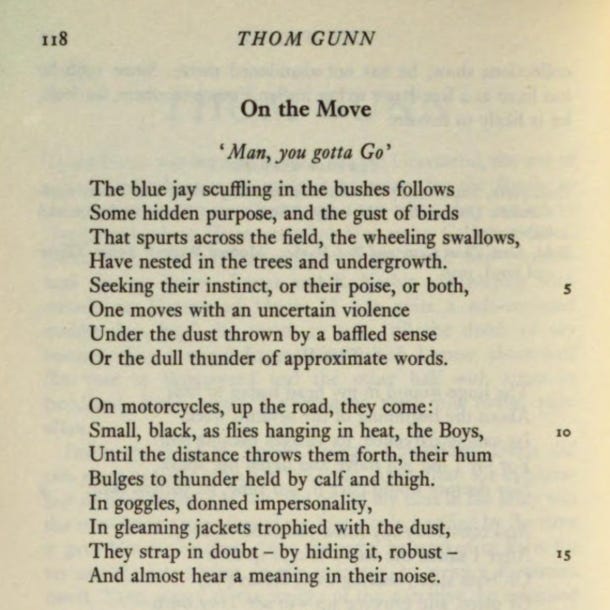
… the poem that ends so beautifully: ‘At worst, one is in motion; and at best,/Reaching no absolute, in which to rest,/One is always nearer by not keeping still.’
One thing I’m not sure about: did Tennyson know that ‘arch’, his trope for experience as such, in Ancient Greek is ᾰ̔ψῑ́ς (hăpsī́s), which means not only ‘arch, vault’, but also ‘loop, mesh, net’ and, fittingly for the man who strung the unstringable bow, ‘any curved form, bow’? Maybe.
There’s been quite a lot of academic discussion of the poem’s second verse-paragraph, in which Ulysses brings in his son: ‘this is my son, mine own Telemachus,/To whom I leave the sceptre and the isle…’ The consensus is that this has something to do with Victorian imperialism, the notion of taking command of ‘savage’ peoples and forcing them into ‘civilisation’: ‘by slow prudence to make mild/A rugged people, and thro’ soft degrees/Subdue them to the useful and the good’. I don’t think so. It’s not that Tennyson was in any sense anti-Imperialist (quite the reverse) but this reference seems to me unlikely to be a colonising one. Ithaca after all is home—is the England, we could say, to which the imperialist returns, only to find the English a savage race, interested only in the accumulation of wealth, and ease, and physical appetite (‘that hoard, and sleep, and feed’) rather than heroic adventure. There are other places in his work where Tennyson deplores the nation-of-shopkeepers petty bourgeois English, and that’s what he’s doing here. England must be governed, but Ulysses if not putting himself forward for the job: ‘he works his work, I mine.’
Then we come to the poem’s third and last verse-paragraph, leading up to the superfamous final lines quoted above.
Text within this block will maintain its original spacing when published
There lies the port: the vessel puffs her sail:
There gloom the dark broad seas. My mariners ...
The lights begin to twinkle from the rocks:
The long day wanes: the slow moon climbs: the deep
Moans round with many voices. Come, my friends,
‘Tis not too late to seek a newer world.
Push off, and sitting well in order smite
The sounding furrows; for my purpose holds
To sail beyond the sunset, and the baths
Of all the western stars, until I die.
It may be that the gulfs will wash us down:
It may be we shall touch the Happy Isles,
And see the great Achilles, whom we knew.
This last detail has troubled critics, because Odysseus/Ulysses has already met Achilles in the afterlife, and he was not in the ‘Happy Isles’ but in the lightless gloom of Hades. The great warrior is hideously reduced, and though Odysseus tries to console him that his name lives on after his death, he refuses to be placated:
O shining Odysseus, never try to console me for dying.
I would rather follow the plow as thrall to another man,
one with no land allotted to him and not much to live on,
than be a king over all the perished dead.6
Arthur D. Ward is puzzled that Tennyson’s Ulysses talks of finding Achilles in Elysion, since ‘his crew had already seen the great Achilles and had spoken with him, not in the Happy Isles, but at the edge of Hades … why remind them of a gruesome meeting in the land where sailors go after the gulfs have washed them down?’7 Ward thinks that Tennyson is painting Ulysses here as confused: ‘the confusion is Ulysses’, not Tennyson’s … indicative of Ulysses’ indifference to the afterlife that he confuses Hades, the Homeric “hell,” with Elysion, the Homeric “heaven”.’ But this is surely not right. Ward forgets that this crew, whom Ulysses is mustering with his speech, is not the same as the crew with which he sailed from Troy—they all died, and though Homer’s Odysseus tells the Phaeaceans about the gloomy encounter with dead-Achilles there’s no reason to believe that he also told the Ithacans.8 Rather we can take this as Ulysses doing an Erik the Red: ‘sail with me to this new land of miraculous fertility and warmth I have named Greenland! You won’t believe how warm and fertile and above all how green it is!’9 Ulysses is floating the beguiling possibility for them that if they join him on this voyage they might reach the Happy Isles. It’s true he also notes that they might drown, ‘it may be that the gulfs will wash us down’, but this is a well-known rhetorical strategy, as with Churchill’s ‘nothing to offer but blood, toil, tears and sweat’: if you are trying to persuade people to do something they know to be dangerous, flatly denying the danger will bounce them out of your persuasiveness. Better to acknowledge the danger whilst balancing it with the greater possibilities of glory. I don’t know anyone who thinks that the crew being addressed in this poem turn Odysseus down: clearly they go with him, after the poem is over.
And so to the glorious final lines. I’d be lying if I pretended 61-year-old me wasn’t stirred by them: to strive (Homeric Greek: μᾰ́χεσθαι), seek (ἀναζητῶ), find (εὑρῐ́σκω) and not to yield (μην ὑποκύπτω). What’s implicit in the line is the ‘it’ against which Ulysses and his crew will fight—death, clearly—such that they seek it and find it and, in a last moment of resistance, to refuse to bow-down to it. ὑποκύπτω—under-bend—and κύπτω (bend, stoop, yield) is what Homeric heroes do when they die (cf Iliad 4.468; 17.621; 21.69 and Odyssey 11.585). We none of us can evade death, but at least we don’t have to abase ourselves before it.
I say improbable because ‘M’ specifically disavows any interest in poetry, saying that her ‘late husband’ liked verse ‘and some of it stuck’. But I don’t think a person can flawlessly recite six lines of blank verse by accident. This is something you have to learn. deliberately memorise.
Craig is three years younger, and three billion pounds richer, than I am, as my wife repeatedly reminds me. He was in his early 40s when he filmed Skyfall: hardly the grizzled, old, past-it OAP for which the script called. Still, that’s the conceit of the film.
If Tennyson means ‘It little profits that a king be idle’ (such that line 2 and the first half of line 3 are preliminary clauses for the sentence that starts I mete and dole) then (a) that’s not what he has written, and (b) ‘It little profits that a king be idle’ fits perfectly well within the blank verse T. is employing.
Interestingly, ‘hungry heart’ is a common phrase in Walter Scott’s, an author Tennyson read avidly. In Castle Dangerous [ch 1] heart-hunger is something that mere material victuals cannot satisfy (‘What use of the mountains of beef, and the oceans of beer if there is a hungry heart among our vassalage [that] shouldst experience such a feeling?’). In The Betrothed ch 7 Scott waxes sententious, after the manner of the Book of Proverbs: ‘better is an empty stomach and a hungry heart with a clear conscience than a fatted ox with iniquity and wordbreaking’. And, perhaps relevant to a poem about a seafarer, is The Pirate ch 11: ‘said Mrs. Baby Yellowley: “ane wad think the haill town was on fire! The very hill-side smells of their wastefulness, and a hungry heart wad scarce seek better kitchen.”’
Arnold thinks Cowper too quaintly sub-Miltonic to capture the ‘eminently plain, direct, rapid and noble’ Homer. As illustration he quotes an incident where, as against the fashion of the day to cut down the trees that lined the avenues of one’s country estate, Cowper urged his friend Throckmorton to spares his trees by writing: ‘Benevolus reprieves/The obsolete prolixity of shade’. I must say, I love this! But I have to admit it’s not very Homeric.
Odyssey 11.488–491, Lattimore’s translation
To be fair to Ward, Ulysses in this section talks about his fellow mariners as if they were the same heroes who fought at Troy and toiled home over ten further years:
You and I are old;
Old age hath yet his honour and his toil;
Death closes all: but something ere the end,
Some work of noble note, may yet be done,
Not unbecoming men that strove with Gods.
But, to repeat myself, this cannot be, and Tennyson knows it very well. This new crew has never striven with Gods, for all that they are old. They are here being given the opportunity to experience what that previous crew experienced, to achieve what they achieved.
Other Vikings had tried and failed to persuade people to emigrate to Greenland, but Erik the Red was a Norse of a different colour.
No posts
Comments
Nothing yet. Say the first thing.
Sign in to join the conversation.