
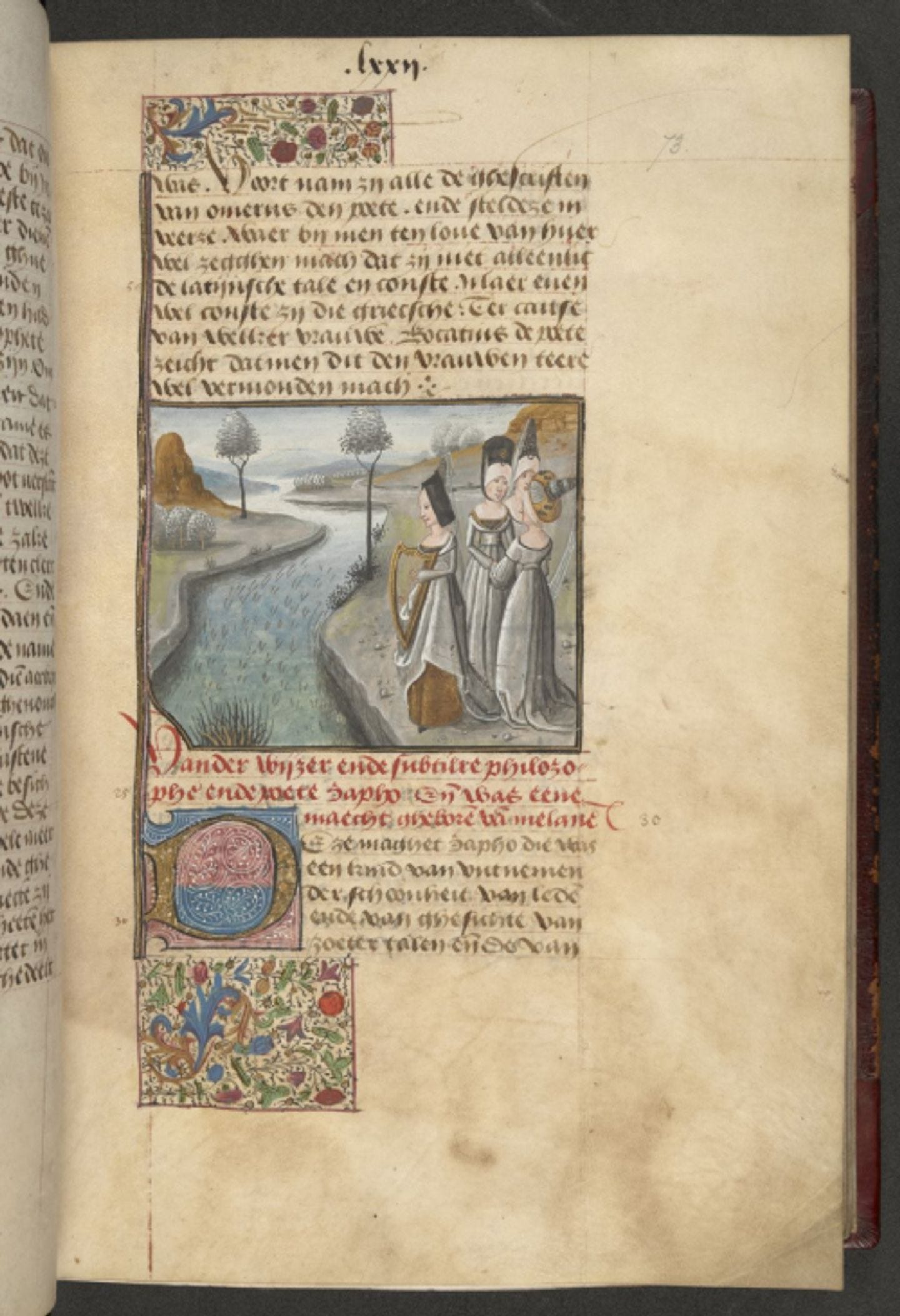
[Miniature of Sappho and her companions, from a Dutch translation of Christine de Pizan’s Livre de la Cité des Dames, Bruges, 1475]
+++
A few years back an abortive project of mine (one of many) was prompted by reading Constantine A. Trypanis’s Penguin Book of Greek Verse: Dual Language Edition (Penguin 1988), in which a wide range of Greek verse from Homer up to the 20th century is anthologised, with Greek text and English prose translations at the foot of the page. These translations are all into contemporary English: fine as far as getting at the meaning goes. But I was struck by the ahistoricality of this as a translation strategy, the way it necessarily flattens and erases our sense of the poetry as a developing tradition—because of course the Greek of Homer is two and a half thousand years older than the Greek of Seferis, as different linguistically as Old English is from Simon Armitage. ‘What would an anthology look like,’ I thought to myself, ‘that translated Homer into Old English, Hesiod into Chaucerian English, the Attic tragedians into Shakespearian English, Hellenistic poets into the idiom of the metaphysicals (or maybe into 18th-century English) and so on?’ It would be a curious and absorbing task to generate so much text; but would the result be worthwhile in any sense?
I decided to give it a go: I turned a few dozen lines from the beginning of the Iliad into Old English, put some Hesiod into Early Middle-English, did Sappho into Chaucerian English, Pindar into Early Tudor English (rather dully, as it turned out) and then Aeschylus, Sophocles and Euripides into Elizabethan English: Marlowe, Shakespeare and Middleton respectively. I quite enjoyed these three, actually, and wondered about rendering an entire Attic tragedy into this cod-Elizbaethanism, seeing how it would play out on stage. It would be a fake-antique, but might achieve certain things, dramatically, that a clear modern-English translation could not.
Then I pushed on a bit further: some of Aristophanes’ Frogs into Jonsonian English, but I was running out of steam. I gormblimeyed up some Theocritus in late 17-century dress, and then threw the whole project over. Part of the problem was that I was running into redundancy issues: it’s possible to find later Greek authors translated into the idiom of the 18th-, 19th and 20th centuries (by English writers working in those centuries), rendering the necessity of my pastiche less pressing. But more I found myself whether what I was doing was worthwhile at all. The quality is certainly very variable, and it will be a rare reader actively eager to read a chunk of confected Old English Homer etc.
But in one case I was pleased with what I managed: by turning Sappho in Middle English I think I brought out something quite striking and effective from the original. Sappho was not unknown in medieval Europe, although in Latin rather than her original Greek,1 and her lesbianism made her a contentious figure.2 There are no contemporary medieval English translations of her poetry, so far as I know, which adds to the appeal of providing one (and all the later papyrus discoveries from the later 19th and 20th centuries are entirely outwith the ken of the medieval world, which makes it more imperative to medievalise them). Here’s Sappho’s most famous poem, the ‘Hymn to Aphrodite’ which survived antiquity pretty much entire, as quoted in Dionysius of Halicarnassus’ treatise On Composition:
Ποικιλόθρον᾽ ἀθάνατ᾽ ᾽Αφρόδιτα,
παῖ Δίος, δολόπλοκε, λίσσομαί σε
μή μ᾽ ἄσαισι μήτ᾽ ὀνίαισι δάμνα,
πότνια, θῦμον.ἀλλὰ τυίδ᾽ ἔλθ᾽, αἴποτα κἀτέρωτα
τᾶς ἔμας αὔδως ἀίοισα πήλοι
ἔκλυες, πάτρος δὲ δόμον λίποισα
χρύσιον ἦλθεςἄρμ᾽ ὐποσδεύξαια• κάλοι δέ σ᾽ ἆγον
ὤκεες στροῦθοι περὶ γᾶς μελαίνας
πύκνα δινεῦντες πτέρ᾽ ἀπ᾽ ὠράν᾽ αἴθε-
ρος διὰ μέσσω,αἶψα δ᾽ ἐξίκοντο• σὺ δ᾽, ὦ μάκαιραv
μειδιάσαισ᾽ ἀθάνατῳ προσώπῳ,
ἤρε᾽ ὄττι δηὖτε πέπονθα κὤττι
δηὖτε κάλημικὤττι μοι μάλιστα θέλω γένεσθαι
μαινόλᾳ θύμῳ• "τίνα δηὖτε †πείθω
ἄψ σ᾽ ἄγην† ἐς σὰν φιλότατα; τίς τ᾽, ὦ
Ψάπφ᾽, ἀδίκηει;καὶ γάρ αἰ φεύγει, ταχέως διώξει,
αἰ δὲ δῶρα μὴ δέκετ᾽, ἀλλὰ δώσει,
αἰ δὲ μὴ φίλει, ταχέως φιλήσει,
κωὐκ ἐθέλοισα".ἔλθε μοι καὶ νῦν, χαλέπαν δὲ λῦσον
ἐκ μερίμναν, ὄσσα δέ μοι τέλεσσαι
θῦμος ἰμέρρει, τέλεσον• σὐ δ᾽ αὔτα
σύμμαχος ἔσσο.3
Here’s the poem as Chaucer or Dunbar might have rendered it:
Glytering-troned and dethlesse Afrodytte,
Gods dowhter, wunder-wicche, on me haf pitee,
Let passe me, queene, thes agonie and thole,
Grinde not my soule.Wheneer byfor thou hast mi hearkenéd—
And ploumbed the distans heering that I said,
And heeding, thou hast com, and left behand
Gods golden land,In char moste flete bi wingéd steedes drawn,
Upon the skye al dark afore the dawn,
Throgh hevenes hy and wide espace in glyde
Doun to erthside;Than soonest com thou blessedest ladie,
With contenance devyne and asketh me
Asmile, what wo anonder me did falle,
That I thee calle?What in my leesting hertes maddenesse
Who now most feele my ane besechenesse?
Who is it most thir own hertsease ago
For wreyed Sapfo?For yif she fleeth, freshly shal she folowe,
Today turn giftes, yet offreth them tomorwe,
She chues nat love, yet loving shal her chues
Thocgh she eschewes.Com then, I preye, gyf me an ende to grief,
Remoeven care o godess yif thou leef,
What I moste coveite an it be provyde,
Thou at my syde!
I do think this rendering works well, as a poem. It is close enough to contemporary English that a modern-day reader can read it and understand it, although different enough to make that reading a little more effortful, and to retain some flavour of the process of translation out of text into comprehension, to estrange the verse a little and so record the difference of the original. I also think the habitus of medieval versifying (word-order inversions, the variable spelling, the vocabulary choices the era permits, the way comparatives and superlatives are construed) add fluency and expressiveness.
[Vénus, from a 15th-century French edition of Boccaccio’s De Claris Mulieribus / De cleres et nobles femmes (1362)]
++
So, that abortive project was aborted, leaving a few stubs here and there online. But lately I have come back to middle-english-Sappho. Not that I think the whole is worth resurrecting: it’s too niche, and too over-elaborate a demonstrate of its central point (as outlined in the first paragraph, at the top there). But I like the effect of Sappho in Chaucerese.
So here are a couple more. First Sappho’s famous, long-ish fragment generally known as ‘31’: also known as phainetai moi (φαίνεταί μοι) after the opening words of its first line—‘he seems to me’, ‘he appears to me’—or as Lobel-Page 31, Voigt 31, Gallavotti 2, Diehl 2, Bergk 2, after the location of the poem in various editions of Sappho’s work. This poem is the other of the two substantially complete poems by Sappho to survive from ancient times.
φαίνεταί μοι κῆνος ἴσος θέοισιν
ἔμμεν' ὤνηρ, ὄττις ἐνάντιός τοι
ἰσδάνει καὶ πλάσιον ἆδυ φωνεί-
σας ὐπακούεικαὶ γελαίσας ἰμέροεν, τό μ' ἦ μὰν
καρδίαν ἐν στήθεσιν ἐπτόαισεν·
ὠς γὰρ ἔς σ' ἴδω βρόχε', ὤς με φώναί-
σ' οὐδ' ἒν ἔτ' εἴκει,ἀλλά κὰμ μὲν γλῶσσα ἔαγε, λέπτον
δ' αὔτικα χρῷ πῦρ ὐπαδεδρόμηκεν,
ὀππάτεσσι δ' οὐδ' ἒν ὄρημμ', ἐπιρρόμ-
βεισι δ' ἄκουαι,κὰδ' δέ ἴδρως κακχέεται, τρόμος δὲ
παῖσαν ἄγρει, χλωροτέρα δὲ ποίας
ἔμμι, τεθνάκην δ' ὀλίγω 'πιδεύης
φαίνομ' ἔμ' αὔτᾳ.ἀλλὰ πὰν τόλματον, ἐπεὶ καὶ πένητα...4
This doesn’t work quite as well in Chaucerese, I think: though there are a couple of nice touches:
Meseemeth him of goddes lykenness
That man beforen thu
Who sitten close and speking sweetenness
Aye listneth to;And thine the laughter that beguyles my breest
Thrusting my hart aflyte
For at the verie moment thee I seest
Myself am quietMy tonge it seiseth fast, and in fyn ore
Hete reds aflame my skin,
Mine eyen blinded and a drowning rore
Mine earres in:Peerspiring wett I shuddre with the forse
In color country greene,
Close ene to dying I have run my corse
So I am seeneSwich al in venture, peyne of being poor …
One final example, to round-out this superfluous post. Two ‘new’ Sappho poems were recently discovered in papyrus form (you can find the text and literal translations here). After its discovery the TLS ran an article about these two lyrics, including Christopher Pelling’s translation of them. Here’s one of the two, the ‘Brothers poem’:
[…] ἀλλ’ ἄϊ θρύλησθα Χάραξον ἔλθην
νᾶϊ σὺν πλήαι. τὰ μέν οἴομαι Ζεῦς
οἶδε σύμπαντές τε θέοι· σὲ δ᾽οὐ χρῆ
ταῦτα νόησθαι,ἀλλὰ καὶ πέμπην ἔμε καὶ κέλεσθαι
πόλλα λίσσεσθαι βασίληαν Ἤραν
ἐξίκεσθαι τυίδε σάαν ἄγοντα
νᾶα Χάραξονκἄμμ’ ἐπεύρην ἀρτέμεας. τὰ δ’ ἄλλα
πάντα δαιμόνεσσιν ἐπιτρόπωμεν·
εὐδίαι γὰρ ἐκ μεγάλαν ἀήταν
αἶψα πέλονται.τῶν κε βόλληται βασίλευς Ὀλύμπω
δαίμον’ ἐκ πόνων ἐπάρωγον ἤδη
περτρόπην, κῆνοι μάκαρες πέλονται
καὶ πολύολβοι·κἄμμες, αἴ κε τὰν κεφάλαν ἀέρρη
Λάριχος καὶ δή ποτ᾽ ἄνηρ γένηται,
καὶ μάλ’ ἐκ πόλλαν βαρυθυμίαν κεν
αἶψα λύθειμεν.5
And here is the poem in cod-med.:
… Sett ay again; say Cracksus cometh soon
His boet al ful of buty; Jovis wat
And al the eother goddes swich are knoown
Think not of that!In sted of it: go gush out many praoyers
To Hera Queene Divine; and fro her crave
To bring this boet back whol to these shoars
To porte and safe.To chanse upon us stationed at the side
The rest let leave to Goddes keping balme
Great stormblastes fill the skie and quicker ride,
Yet cede to calme!Erst King Olympus send a gide to bless
The paysage home, and piloted from far
To safe againe: whens wealth and blessydness
Achevéd are.And us: yif Lareycus but ley his head,
And be the man of ydle eses loy
From souls in dragging deeps encarcerréd
We rise to joy.
That’s enough fake-antiques for now, I think.
For instance, in Henri Estienne’s Latin translations in Carminum poetarum nouem, lyricæ poeseōs principū fragmenta (1566). Catullus also translated some Sappho into Latin. Greek was much less widely known that Latin, which was the European lingua franca.
‘Although Sappho was revered as the greatest woman poet of all time by the Greeks, in later antiquity and the Middle Ages, her love of women was considered shameful and overshadowed her excellent reputation. She was also called a prostitute, and fictional accounts of her affairs with men further “tarnished” her reputation. Dual representations of Sappho existed within two centuries of her death. On the one hand, she was a role model for other poets to follow in their quest for fame, on the other she was the quintessential representation of female vice, which, at least by the Roman period, brought her infamy. Late antique and medieval Christian authors inherited this latter view, and vilified Sappho's sexuality, while church authorities, at least according to legend, had her works publicly burned.’ [Walter Penrose, ‘Sappho’s shifting fortunes from antiquity to the early Renaissance’, Journal of Lesbian Studies 18(4) (2014), 415-36]
[Stanza 1] Glittering-throned and immortal Aphrodite, daughter of Zeus, wondrous sorceress, spare me, o queen, this anguish and distress and do not crush my spirit. [2] Whenever before you discerned my call in the great distance, and heard my words, you came, leaving behind your father’s golden realm. [3] You came with chariot drawn by winged beasts through the darkness of the sky, from the expanses of heaven and down to the earth. [4] Quickly you arrived; most blessed lady, and with a smile upon your divine countenance did ask me what woe had fallen upon me that I had called you: [5] What is it now, in my yearning heart's madness? Who now must be made to feel desire for me? Who now must sacrifice their heart’s-ease for wronged Sappho? [6] For even if she flies she shall soon follow and if she rejects gifts today, yet tomorrow she will offer them, and if she does not choose love yet shall love choose her, howevermuch she tries to avoid it. [7] Come I pray thee, give me release from my sorrows, and if it please you o goddess take away my cares; what my heart most craves may it be provided, and you my ally.
Here’s a ‘literal’ (line by line) translation of this poem by Gregory Nagy:
He appears to me, that one, equal to the gods,
the man who, facing you,
is seated and, up close, that sweet voice of yours
he listens toAnd how you laugh your charming laugh. Why it
makes my heart flutter within my breast,
because the moment I look at you, right then, for me,
to make any sound at all won’t work any more.My tongue has a breakdown and a delicate
— all of a sudden — fire rushes under my skin.
With my eyes I see not a thing, and there is a roar
that my ears make.Sweat pours down me and a trembling
seizes all of me; paler than grass
am I, and a little short of death
do I appear to me.But all may be ventured, since even [the poor]...
[stanza 1] … But though you talk of how Charaxus has returned with his ship full of cargo; in fact only Zeus and all the other gods can truly know. It’s not for you to say.
[stanza 2] Instead you should instruct me to offer up many prayers to Queen Hera, and beg her that his ship be brought safely back, intact.
[stanza 3] and that he be reunited with us, happy and healthy. We should leave all the rest of it to the gods. The ocean knows angry storms and tempests, but calm can return very quickly.
[stanza 4] If it is the will of the King of Olympus, we may find a helper, a guide to bring us back to safety, and a blessed life and happiness.
[stanza 5] And for us too, should Larichus be an idle man, we will be quickly released from a great deal of severe distress …
No posts
Comments
Nothing yet. Say the first thing.
Sign in to join the conversation.