
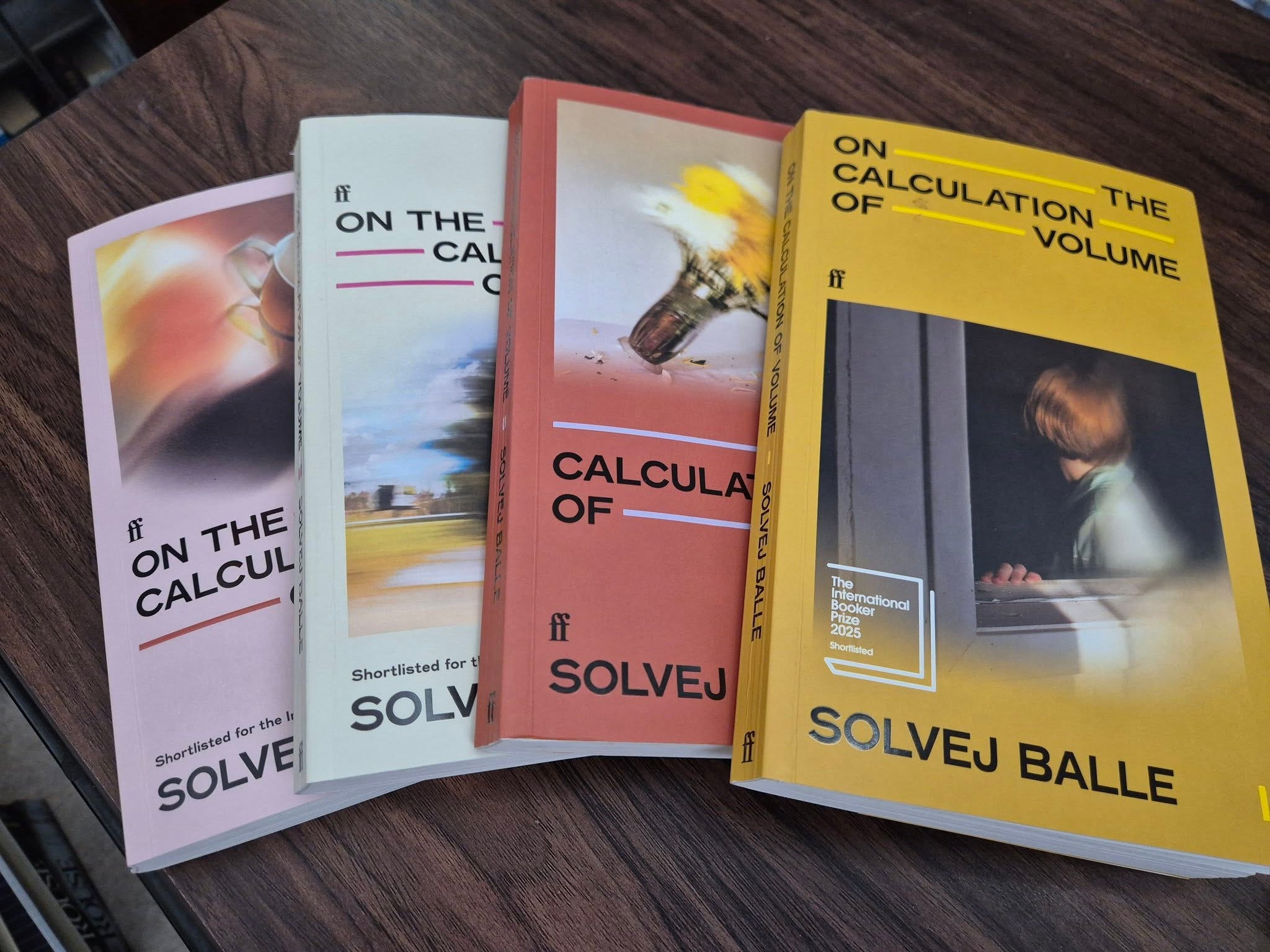
[Spoilers in this post for vols 1-4]
On The Calculation of Volume is an ongoing seven-volume novel sequence—so far Balle has published six of the seven in her native Danish, and four of those have been translated into English (volume 5 is due 5th November 2026—one hopes that, when the final volume finally emerges, the publisher will issue it on 18th November). Reacting to the novel when I’m only a little over halfway through the whole is surely premature, and possibly impetuous, but here we are.
Tara lives in north-east France with her husband Thomas.1 They run an online second-hand book business, have been married a while, are childless. The spark has departed their relationship, though they remain companionable. Tara travels to Paris to acquire some books to resell, and visit some friends. It’s the 18th November. She returns to her hotel room, sleeps, and when she wakes it is again the 18th November. Slowly she comes to understand that she is stuck in a situation in which every day is the 18th November for her.
The novel (treating all the individual volumes as sections of one long 1500-page novel) is narrated by Tara in the form of a journal she keeps, each section headed by a number that indicates how many days since her experience began. We start on #121, with Tara recapping, at prolonged, rather tedious length, her memories of her first four months as a time-trapped individual. Book 1 (180 pages) takes us up to #366; volume 2 (200 pages) to #1144; vol 3 (200 pages) to #1892 and vol 4 (200 pages) to #3637, so you can see that Tara at no point in the story breaks out of her 18th November prison (whether she will in vol 7 remains to be seen).
The trapped-in-time idea is a common conceit in SF of course, and Balle spins some variations upon it. For one thing, Tara is not stuck in the same place every day, as Bill Murray’s Phil Connors character is in Groundhog Day. She can, and does, travel around—initially back to see her husband, although she gets tired of having to explain the situation to him literally every day (he is surprised every morning to wake up next to her in their shared bed on the morning of the 18th because he believes her to be in Paris). After a while she leaves her husband and travels elsewhere. She visits various places in France. Because she yearns for November to end and winter properly to begin, she ‘fakes’ a seasonal change by travelling into the north of Scandinavia, where she can see some snow—she refuses to fly, anxious about what would happen if the flight takes longer than scheduled and her day resets whilst she’s in midair, so this is a long-drawn out journey by train and bus and car. Tara booked her Paris hotel room for the 17th-18th so she knows there won’t be anybody else in it on the morning of the 18th, but when she stays in other hotels she has to spin a yarn to ensure she’s in a room that has been unoccupied for days, or risk disturbing some prior guest when she wakes in the morning. Later she scopes out unoccupied apartments, and afterwards a house, and stays there.
Although the rest of the world simply resets and goes through the 18th over and over, Tara does not. She ages—at the end of the fourth volume, 3637 days into the experience, she is ten years older than she was when she started—and her effect upon her surroundings accumulates. If she stays in a place for a while and shops in the local supermarket for her food, that emporium’s shelves grow increasingly denuded with the things she takes but which the supermarket, forever reliving the 18th, has no time to replace. She calls herself a monster, and likens herself to a locust, for this reason, and as her experience elongates she tries to find less destructive ways of feeding herself.
One other wrinkle: when she wakes every morning of the 18th, herself, her clothes and anything she has close by is carried over. If she acquires something on the 18th and leaves it somewhere else in her apartment, or outside, it is likely to disappear with the reset.2 She often goes to bed hugging food, or other items, under her duvet to ensure they’ll be there the ‘next’ day. At one point she buys a laptop, writes on it, and sleeps with it too; the computer is still there in the morning but, every morning, its memory is wiped clean.
This, then, is the premise. Balle’s treatment is slow, detailed, heavily focused on quotidiana and mundanity, and is of necessity intensely repetitive. It is, not to put too fine a point on it, boring. I don’t say so to be dismissive. On the contrary, the boringness (boringtude, boringosity) is a large part of the point. My English edition of vols 1 and 2 come with a back-cover endorsement by Karl Ove Knausgård (‘a fantastic book’) and you can see why he likes it (this blurb, strangely, disappears from vols 3 and 4)—Balle is doing similar things to the Slow Style school Fosse, Knausgård, Arudpragasam, etc;3 though, thankfully, she lacks Knausgård’s ego and narcissism.
Thomas returns carrying two thin plastic bags … He puts the cheese in the fridge, pops two tins of tomatoes in the cupboard and leaves a bar of chocolate on the worktop. When the bags are empty he crumples them up and stows them in the cupboard under the sink. During the day I hear him in the office upstairs. I hear the swivel chair rolling across the floor and the printer churning out labels and letters … I hear him in the bathroom and I hear a sound from the toilet that can only be made by a man peeing upright.
I am sitting in the back room overlooking the garden and the woodpile. It is the eighteenth of November … I open the window and throw out some bread for the birds. They show up when there is a break in the rain: first the blackbirds, who peck at the last apples on the tree and the bread I have thrown out, and then a lone robin. Moments later a long-tailed tit flies down, closely followed by some great tits who are promptly seen off by the blackbirds. Shortly afterwards rain comes on again.
Thomas has lit a fire in the living room. He has brought in wood from the garden shed and I soon start to feel the house growing warmer. [1:3-4]
And so on. Every little detail, and many of them many times. In the evening Thomas goes out into their garden, digs up a leek, comes into the kitchen, chops it up with some onions, and makes some soup. Balle describes these actions, in detail, multiple times.
Tara’s experiences are reiteratively laid-out because they keep recurring; they are tedious because the day-to-day of our human life’s habitus is often repetitively tedious. This, I take it, is one of the things the book is about and whilst reading can be a chore it captures this aspect of living well. (There are other aspects of life the writing doesn’t capture, though. I’ll come to that.)
Tara is remarkably incurious about why this strange circumstance is happening (‘I don’t know what is going on. Whether time is switched off at night, whether past and future disappear during slumber … maybe it is language that shuts down’ [1:57]). To begin with she she yearns to break through into the 19th November. In Vol 1 she pins her hope to day 365, believing without evidence that one year will complete her sentence. It doesn’t. After that she gives up the hope that she’ll ever escape.
She continues writing (keeping the notebooks near her at night so they don’t disappear) in order ‘to feel as if [she] is no longer alone.’
My days have not been lost to oblivion. They exist. My days exist in my pile of paper, they have not been erased in the night, the paper remembers and on it I can see that it says day number this and day number that and the eighteenth of November but never the nineteenth. [1:95]
Why the 18th November, specifically? I don’t know, but I wonder if it is a reference to ‘18th Brumaire.’ This would be a sly gesture towards Marx’s famous opening line to ‘The 18th Brumaire of Louis Napoleon’: ‘Hegel remarks somewhere that all great world-historic facts and personages appear, so to speak, twice; he forgot to add: the first time as tragedy, the second time as farce’—extrapolating this repeating ‘18th Burmaire’ from a doubling to an ongoing seemingly endless reiteration.4
Tara adjusts to her new mode of living: she travels; she wanders cities as a flaneur; she becomes fascinated with the Roman empire, reads books and even attends university classes on the subject. She reflects upon the ways in which it’s not so different to the life she had before.
I think about Thomas’s grandfather who never moved from the house where he had lived with Thomas’s grandmother. Who lived alone for seventeen years before he himself died. Who always lived the same life, followed the same rhythm. Who grew the same vegetables, in the same amounts, according to a scheme that still hangs in the shed. [1:121]
#754 I don’t know how one can grow used to a situation like this, but that’s what is happening. Perhaps it is the case that you can accept a lot as long as you are spared most of life’s worries. If you are not in danger. If it is life with no drama … I am safe, I have nothing to fear. [2:157]
At one point Tara burns her hand a little and it heals over many days; on another occasion she twists her ankle badly and has to go to hospital, to get a cast on her foot. These injuries heal, over time. Once a bicycling thief steals her handbag.
The whole story could, I suppose, have continued in this manner, Tara solus, recording the minutiae of her days, for years, even decades. Lean into the ennui. But after volume 2 Balle mixes things up a little. The first thing that happens is that Tara discovers she is not the only person trapped in 18th November, chancing upon a man called Henry D. We get his backstory. Henry’s ex-wife and child have moved to America, and he flies over to spend long strings of 18th-Novembers (18ths-November?) with them—obviously not worried, as Tara is, that a delay in his flight might strand him high in the air over the Atlantic one 18th November morning—but he spends quite a long time with Tara too.
Henry is an academic (Tara meets him because she’s been attending university lectures on her sudden passion for Roman history) and speculates not about the cause of the temporal repeated-reset but its effects on those who experience them: ‘existential abruptions, as he called them. He had written an article I could read if I was interested: “Homo Abruptus: the Sociologist of Identity Ruptures”’ [3:33]5
They are very different people, Tara and Henry, and debate, somewhat tepidly, gender differences (Henry thinks Tara’s interest in the Romans is not genuine, since history is for men. ‘Women had always been relegated to the back seat, confined in closed carriages, in palanquins, in the pantry and the kitchen … Why should I be interested in history?’ [3:56]—he rows this back: ‘did he really believe that my relationship to history could be explained by my being a woman? No, he didn’t believe that, he said. But still …’) Henry goes back to the States, and Tara gives her marriage with Thomas another go. Then she leaves him again, he still none the wiser, and Henry returns from the US.
But if these two are trapped in time, then surely there will be others? Tara and Henry put up posters with contact details, moving them to different places to catch the eye of other 18th-November inmates. This results in them meeting a new couple, Ralph Kern and Olga Periti. Ralph has a plan to take advantage of the strange situation in which they are stuck: to scout around, locate circumstances in which people have accidents, die, are robbed, where injustice or injury happens, to tabulate these and then to change them: to warn drivers not to take that corner so fast, to intervene to prevent muggings, to stop people slipping and falling and so on. Improve the world.
Rather than simply doing this, the four debate it endlessly, round and round. Tara, our narrator, who spent two whole volumes doing fuck all for the world (beyond an awareness that she ought not to locust-consume all the comestibles in any one area) is on the non-interventionist side. Still: the four move into a large house and do start making plans.
After two volumes of just Tara, and a third with two then four people, the scrum that piles into volume 4 feels indecently crowded: more and more November 18th people rock up at the house Tara, Henry, Ralph and Olga have set up for themselves; in short order there are nine in the house, and soon after that nearly twenty. Volume 4 is largely made-up of these newcomers’ backstories, their various experiences of waking and realising they were trapped in the 18th November. This (as above) is repetitive, often boring, of a piece with the earlier volumes despite the increased dramatis personae. The group spreads itself around the house, its basement, its outhouse, and spend most of their time in endless discussions as to what is going on, what they should do etc etc. They have various names for it (‘Marlice and Rosi have been together a long time: an anastrophe, that’s what they called the incident’ 4:19), various theories as to what caused it—several feel, guiltily, they are personally to blame—and various observations about it: Martine, one of the new arrivals, points out that ‘all of us in the house … were a fairly homogenous segment of the population. A small subset of society … No one old, no one poor, no one wealthy—at least not before the eighteenth, when we all became rich. Everyone speaks English or German and maybe French … people will loose-fitting identities and unsettled lives’ [4:144]. Towards the end of volume 4 the novel takes a turn towards mortality: a character called Milly Arcmole accidentally hits a cyclist with her car, killing them. This is sobering: the cyclist won’t come back to life. She is guiltstruck.
Not only were we monsters devouring out world, we were also monsters capable of ejecting people from time entirely … [and] we would die. Without a doubt, we would die. Either slowly, after a long journey in the eighteenth of November, or quickly, in an instant, if we weren’t careful … We were in constant danger and were a danger to others. [4:164]
Ralph’s plan to intervene in the world and save lives is superseded by Sonia’s plan to withdraw from the world, to minimise the chance of doing any more active harm. Then we discover that Sonia is pregnant with Peter’s baby—will the baby be trapped in the 18th with its parents, or will it roll through to the 19th and a one-day-old and hopefully be raised by someone else? I guess we’ll find out. There’s a flurry of speculation about the nature of the anastrophe: ‘were we suffering from a neural defect or lapse in consciousness? Was the halting of the eighteenth of November a form of hallucination?’ [4:176] Perhaps everyone else in the world has suffered a collective ‘cognitive malfunction’ that somehow ‘sucked all events of the eighteenth of November into oblivion, a crack in the night’? Had the group tripped into an alternate reality, bifurcated into a sheaf of the multiverse whereby the eighteenth of November was endlessly repeated? It’s not resolved and, as I say above, it’s possible the novel never will provide a resolution.
At the end of volume 4 Tara’s husband Thomas calls her mobile. This is unprecedented: he’s never done it before (it’s not part of his usual 18th November routine). ‘He said he knew something was wrong. With time. That was why he called’ [4:189]. This oughtn’t to be possible. Tara leaves the group and heads home.
I’m glad I read 4/7ths of On The Calculation of Volume, though the actual reading experience was quite often a drag. I have read more boring books, certainly, and many of those were not, as this one is, about boredom, about routine and habit, about the endless ongoing. All this buttoning and unbuttoning, and so on. Although, having said that, its striking that at no point does Tara consider suicide.
Indeed, even though Tara is our narrator and we spend all these years inside her head, she is a curiously flat character, hard to get a handle on. Much of the time she is just affectless, recording her experiences. On occasion she becomes actively dissociated from the world, although mostly she just drifts through her bizarre experience.
One thing that struck me about this novel, or its first 4/7th, is the almost total lack of sex (maybe it will raunch itself up in vols 5-7, I don’t know: but I doubt it). There are two very glancing references of Tara and Thomas making love (one in vol 1 near the beginning, one halfway through vol 3), but for most of the getting on for 4000-days that she narrates Tara not only goes without sex, but makes no mention of being in the least bothered by its absence. I don’t know about you, but ten years of celibacy would not be my idea of fun, and the peculiar circumstance in which Tara finds herself would surely accentuate this. That circumstance would also enable her to manipulate situations, arrange hookups (if she wanted)—and when she starts meeting other time-trapped people, she could shag some of them. But she doesn’t. Maybe she doesn’t want to cheat on her husband, but then you’d expect her to record the temptation, justify the avoidance, or perhaps even just note how little sex troubles her. But it simply isn’t a part of the world of the novel. She’s a bloodless, strange, almost inhuman individual. On The Calculation of Volume is a novel entirely lacking in humour. Reading it is like wading through treacle, although not necessarily in a bad way.
Balle is writing a novel about repetition and recollection, but as that other Great Dane Kierkegaard said, ‘repetition and recollection are the same movement, except in opposite directions, for what is recollected has been, is repeated backwards, whereas genuine repetition is recollected forwards.’ This tension animates what could otherwise be a repellent piece of writing. By writing up her experiences, recollecting them, Tara aims to fix them, to render them inert, but at the same time she knows that she is doomed to repeat these very experiences, to relive them, and in this repetition inheres the chance to escape the melancholy inherent in recollection.6 There’s a late Robbe-Grillet novel called Le Reprise (2001) that takes this Kierkegaad quotation as its epigraph. It opens: ‘Ici, donc, je reprends, et je résume’: reprendre means ‘to take back, recover, regain; to resume (work), to carry on’ and résumer means to condense (eg a text) in fewer words, to sum-up, to boil-down: for a writer, carrying-on the work adds more words and condensing the work takes words away. Robbe-Grillet, of course, is a blessedly brief writer—no 1500 page mammoth ‘volume’ calculations in his oeuvre—and often a very funny one, which Balle is not. But it’s possible she is working over some of the same ground of Le Reprise, here. That novel is also a genre piece—Robbe-Grillet’s genre is spy fiction: an agent is sent to Berlin on a secret mission, meets his doppelganger, ends up repeating his experiences. A lot more ‘happens’ in Le Reprise than Calculation of Volume, in the sense of shootings and pursuits, kidnappings, encounters with double-agents and teenage prostitutes, but these happenings are, as ever with Robbe-Grillet, not in the least the point of the novel. Rather it is a text about the distortions applied to subjectivity by the equal and opposite forces of recollection of the past and carrying-on into the future. There is also (not to harp on about this, but) lots of sex in Le Reprise, because sex is itself a repetitive activity: we do more-or-less the same things over and over, and we engage in the act again and again. This, I think, is why the bleached absence not just of sex-acts but of any erotic charge or sexuality at all in Calculation of Volume seemed so strange to me, so denaturing to Balle’s fictional project. But as I say, it’s not proper to judge a novel when one has only read 4/7ths of it, so I’ll stop there.
They live in Clairon-sous-Bois, a fictional town. It’s not clear exactly where this is exactly, if it’s Balle’s version of Clayes-sous-Bois, then it’s Île-de-France and so quite close to Paris; but the impression the novel gives is that they’re much closer to Lille and the Belgian border.
As the volumes go on, a number of exceptions to this emerge, slowly. These have not, as yet, been explained, though I presume they’ll be significant when—or if, it may well be that kind of story—things get explained in vol 7.
The 18th Brumaire, by the Revolutionary calendar is actually the 9th November by the regular calendar; but Brumaire is basically November and we can add the 18th to the latter.
As a practising academic myself, permit me to say: ooh, sick burn, Solvej.
Kierkegaard’s Repetition (1843) is a quasi-novel about a character, Constantin Constantius, who is unsure whether repetition is even possible. He had previously travelled to Berlin, and decides to go again: ‘I suddenly had the thought: you can, after all, take a trip to Berlin; you have been there once before and now you can prove to yourself whether a repetition is possible and what importance it has.’
No posts
Comments
Nothing yet. Say the first thing.
Sign in to join the conversation.