
What kind of work do you enjoy most when using AI?
And what kind of work with AI feels most meaningful, or helps you grow?
I have been thinking about this more and more as AI becomes part of my everyday work. As AI develops and changes so quickly, the tasks we assign to AI are also changing. The way we use AI is changing too. It is no longer only that we ask AI to complete a simple task. More often, we work with AI interactively.
At least for me, I am impressed almost every day by how much AI can now accomplish. It can help put together a complicated document. It can make suggestions on my first draft. It can help me think about what I may need to consider to make an argument stronger. It can even help me evaluate my work from other people’s perspectives.
At the same time, the more AI helps me, the more mixed feelings I sometimes have.
I feel more productive. I can move faster.
But I also sometimes feel that it may only be a matter of time before AI can do many of the tasks I spent a long time learning to master, and do them better than me.
This kind of mixed feeling seems increasingly common now. AI can be useful and unsettling at the same time.
So I keep coming back to this question:
What kind of work with AI makes our work feel more meaningful and helps us grow, instead of making our expertise feel less meaningful and reducing our opportunities to practice the kinds of challenges that help us develop?
I am still looking for studies that answer this question directly. But I found a recent study that gives a very interesting and related insight.
A recent paper by Lee and colleagues, Relying on AI at work reduces self-efficacy, ownership, and meaning while active collaboration mitigates the effects, examined how different ways of using AI affect people’s relationship to their work.
The authors argue that the key question may not be only whether AI is used, but how it is used. Across a preregistered experiment with 269 participants and a follow-up survey with 270 participants, they examined how different modes of AI use affected self-efficacy, psychological ownership, and the meaning people perceived in their work.
These three concepts are important.
Self-efficacy means people’s confidence that they can complete similar work through their own abilities.
Psychological ownership means the feeling that “this is my work” or “this output belongs to me.”
Meaningful work means feeling that the task is purposeful, significant, and connected to one’s own values or contribution.
The authors explain that these psychological experiences are central because work is not only about producing output. Work is also connected to identity, agency, purpose, and the feeling that our effort matters.
In the main experiment, participants were professionals from several fields, including consultants, data analysts, human resource professionals, managers, and marketers. They completed occupation-specific writing tasks, such as reports, analysis plans, press releases, or delicate emails.
Participants were randomly assigned to one of three conditions:
No AI use
They completed the writing task without AI.
Copy and paste AI
They used AI-generated content directly, without modification.
First human, then AI
They wrote an initial draft manually, then used AI to review and edit the draft.
This comparison is useful because it separates two very different ways of using AI. In one case, AI mostly replaces the person’s effort. In the other case, AI supports and improves work that the person first created.
The main finding was clear.
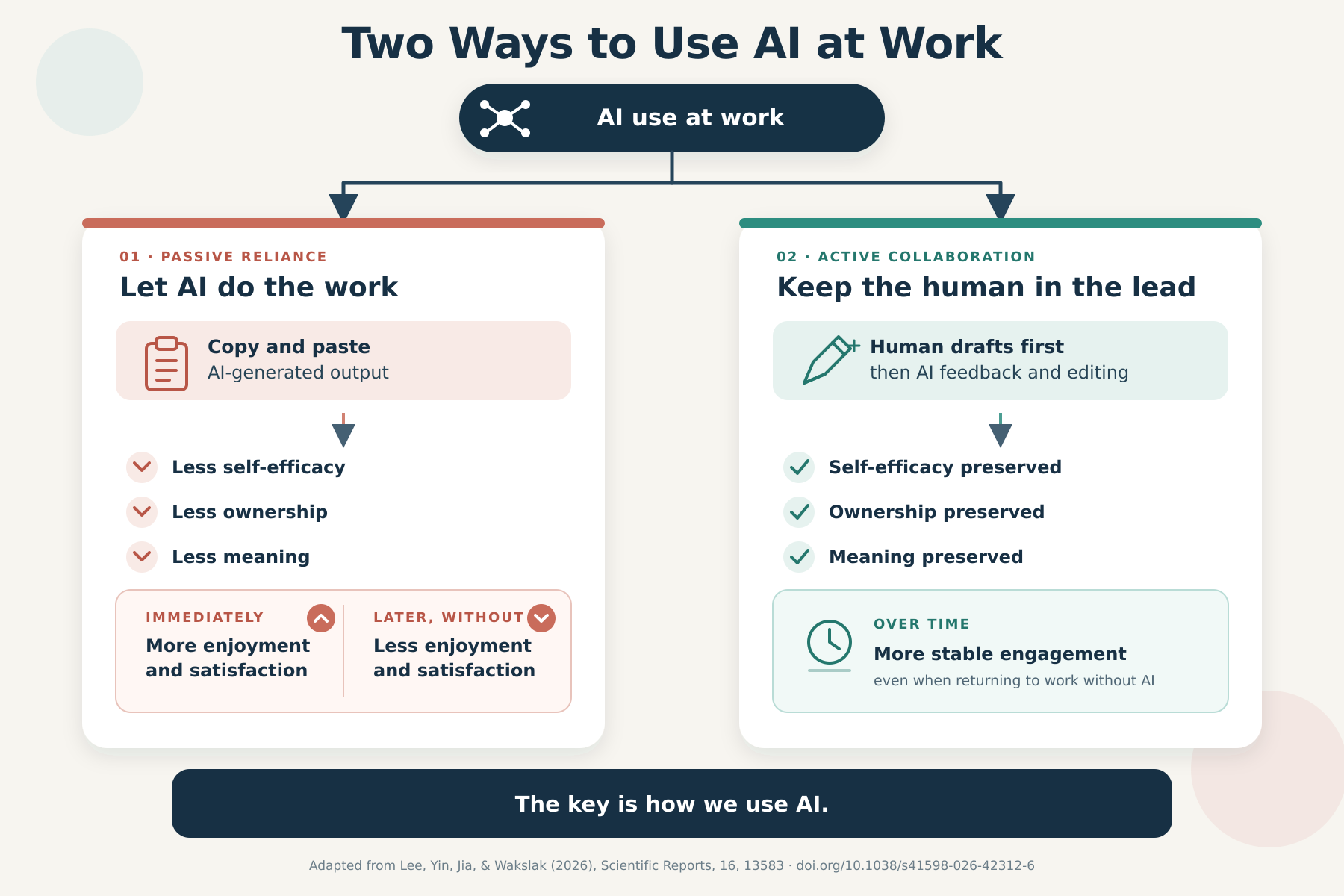
Participants in the copy and paste AI condition reported lower self-efficacy, lower psychological ownership, and lower meaningfulness than those in the no-AI condition. For psychological ownership and meaningfulness, they were also lower than the first-human-then-AI condition. In contrast, the first-human-then-AI condition was statistically similar to the no-AI condition on psychological ownership and meaningfulness.
This is very interesting. Using AI did not automatically reduce people’s connection to their work. Passive reliance on AI seemed to do that. When people first created something themselves and then used AI to refine it, they did not show the same psychological costs.
The study also found that some effects lasted into a second task. After the first task, all participants completed another writing task without AI. Those who had previously used copy-and-paste AI still reported lower self-efficacy and lower meaningfulness than those who had not used AI. Psychological ownership, however, seemed to rebound when they completed the next task on their own.
This part is especially interesting to me. It suggests that when we let AI take over too much, the effect may not end with that one task. It may carry over into how we feel about our own ability and the meaning of our work, even when we later return to doing the work ourselves.
On the other hand, participants in the copy-and-paste AI condition reported higher immediate satisfaction with the outcome. This is also very understandable. It feels good when the task is completed quickly. It feels good when the output looks polished.
But this benefit did not seem stable. When participants later completed a similar task manually, those who had previously relied on copy-and-paste AI reported lower enjoyment and lower satisfaction than the other groups. The authors suggest this may reflect a contrast effect: after experiencing the speed and ease of AI-generated output, manual work may feel more effortful and less rewarding.
This may be one of the most important practical lessons from the study.
Passive AI use can feel very satisfying in the short term. But it may also make our own work feel more difficult, less enjoyable, or less meaningful afterward.
The authors also conducted a follow-up survey with working adults who reported their natural AI use styles. They distinguished between passive reliance on AI, such as using AI to generate content with little modification, and active collaboration with AI, such as using AI to refine self-generated content.
The survey results were broadly consistent with the experiment. Passive AI reliance was negatively correlated with self-efficacy, psychological ownership, and outcome satisfaction. Active AI collaboration was positively correlated with self-efficacy, psychological ownership, and outcome satisfaction.
The insight I take from this study is that the kind of AI use that supports self-growth and meaning may be the kind where we still have command and control over the work.
AI can help with specific parts of the process. It can help us edit, improve, organize, clarify, expand, or check our thinking. But we may need to stay involved enough that the final work still feels connected to our own ideas, judgment, and effort.
This is especially important for work that matters to us.
When I use AI to help me think through a draft, clarify an argument, or consider another perspective, I often feel that AI is supporting my work. It helps me improve something I care about.
But when I let AI do too much, I can sometimes feel less connected to the final product. It may be efficient, but it does not always feel like growth. It does not always feel like the kind of challenge that helps me become better at my own work.
It is often tempting to let AI do most of the work, especially when there is little time. Many of us are under pressure to produce more, move faster, and stay competitive.
But this study suggests that we may need to be more conscious about how we use AI.
Before using AI, it may help to ask:
What part of this work do I want to do myself?
Where do I want AI’s help?
What do I still need to learn or practice?
How will I evaluate AI’s output?
How can I make sure the final work still reflects my own ideas?
For people who already feel that AI is lowering their self-efficacy, meaning, or ownership, one practical step may be to choose smaller areas where they can be more active. For example, they might first write their own outline, first draft, key argument, or personal reflection, and then use AI to edit, challenge, or improve it.
This may sound simple, but I think it matters. It keeps the person in the role of author, thinker, and decision-maker.
AI becomes support, not replacement.
The authors also make an important point about organizations. Many companies are now encouraging employees to use AI as much as possible for productivity and competitiveness. But if organizations only push for maximum AI use, they may unintentionally encourage passive reliance.
That may improve efficiency in the short term. But over time, it may weaken people’s psychological connection to their work.
I agree that AI adoption should not just be measured by speed, output, or cost reduction. It should also be measured by whether people still feel capable, engaged, responsible, and connected to the meaning of their work.
AI can be an incredible tool. It can help us accomplish more. It can help us learn faster. It can help us see new possibilities.
But the way we use AI may either support or weaken our growth.
This is the kind of question I want to explore more deeply in my Deep Thrive work.
What does it mean not only to use AI, but to use AI in ways that support our growth, agency, relationships, resilience, and meaning?
This is what I call deep thriving: not simply keeping up with AI, but learning how to remain connected to our own values, capacities, and meaning while the world is changing quickly.
This question is also the focus of my new live seminar series, Deep Thriving in the Age of AI.
In Part 1: Are You Truly Thriving with AI?, I will help you reflect on where you are in your own deep thriving with AI and share practical tips for using AI in ways that support, rather than weaken, your sense of growth and meaning.
The first session is this Thursday, July 23, 2026, from 11:00 AM to 12:00 PM PDT, live online, and it is free to attend. See my invitation post below and the Luma event page.
Are You Truly Thriving with AI?
·
Jul 15
Dear readers, I would be excited to have you join me this Thursday. You can visit the Luma event page linked in my invitation post and register.
Lee, E. H., Yin, Y., Jia, N., & Wakslak, C. J. (2026). Relying on AI at work reduces self-efficacy, ownership, and meaning while active collaboration mitigates the effects. Scientific Reports, 16, 13583. https://doi.org/10.1038/s41598-026-42312-6.
No posts
Comments
Nothing yet. Say the first thing.
Sign in to join the conversation.