
Many of us feel conflicted in the age of AI.
It is fast. It is exciting. It opens possibilities that did not exist before.
It can also feel overwhelming and concerning. We may be impressed by what AI can do while also wondering how quickly we are expected to adapt, what will happen to our work, and whether we can keep up.
These mixed feelings are normal. They do not mean that we are failing to adapt.
Human beings already have important strengths for navigating change. We can reflect on our experiences, make meaning, clarify what matters to us, learn new strategies, build relationships, imagine different possibilities, and change our actions as circumstances change.
These capacities can be recognized and strengthened.
My goal in the Deep Thriving in the Age of AI seminar series is to provide a “how-to” guide to becoming more informed about how AI impacts our thoughts and actions, recognizing our own strengths, and taking practical steps to continue growing while gaining greater clarity, agency, and a sense of direction.
We want to thrive in both our work and our lives. We also want to thrive in a way that can continue over time.
This is why I developed the Deep Thriving framework.
What is deep thriving?
In the age of AI, deep thriving means continuing to grow, achieve, and move forward while sustaining our well-being, values, relationships, and sense of direction across work and life.
It begins with recognizing the human strengths we already have, such as adaptability, creativity, critical reflection, and human bonds. It also requires identifying which of these strengths matter most for navigating specific problems in our work and lives, then putting them into practice through intentional choices and concrete actions.
What we explored in Part 1: When You are Relying on AI too much, and I don’t find the work very meaningful
In the first session of Deep Thriving in the Age of AI, the first practical question we explored was:
Using AI helps me be productive, but it also causes me to feel that the work no longer belongs to me and that I do not find it very meaningful. How can we use AI more intentionally while preserving the parts of work that support our sense of meaning, identity, and ownership?
Using AI with greater agency and control
AI can help us work faster and improve the quality of what we produce. But we do not have to use AI in the same way for every task or use as much AI as possible simply because it is available.
One of our important human strengths is agency: the ability to decide where AI is helpful, where we want to remain actively involved, and where human judgment, learning, relationships, authorship, or responsibility should remain central.
This is where job and task crafting can help. Instead of accepting a default workflow in which AI gradually takes over more of our work, we can deliberately reshape how AI fits into each task.
For example, we can decide:
Which repetitive or low-stakes parts AI can handle.
Which tasks we want to continue leading with AI support.
Which parts of our work we want to protect because they are important to our growth, identity, relationships, or responsibility.
The key question is whether we are making conscious decisions about what role AI should play, rather than allowing speed, convenience, or outside pressure to make those decisions for us.
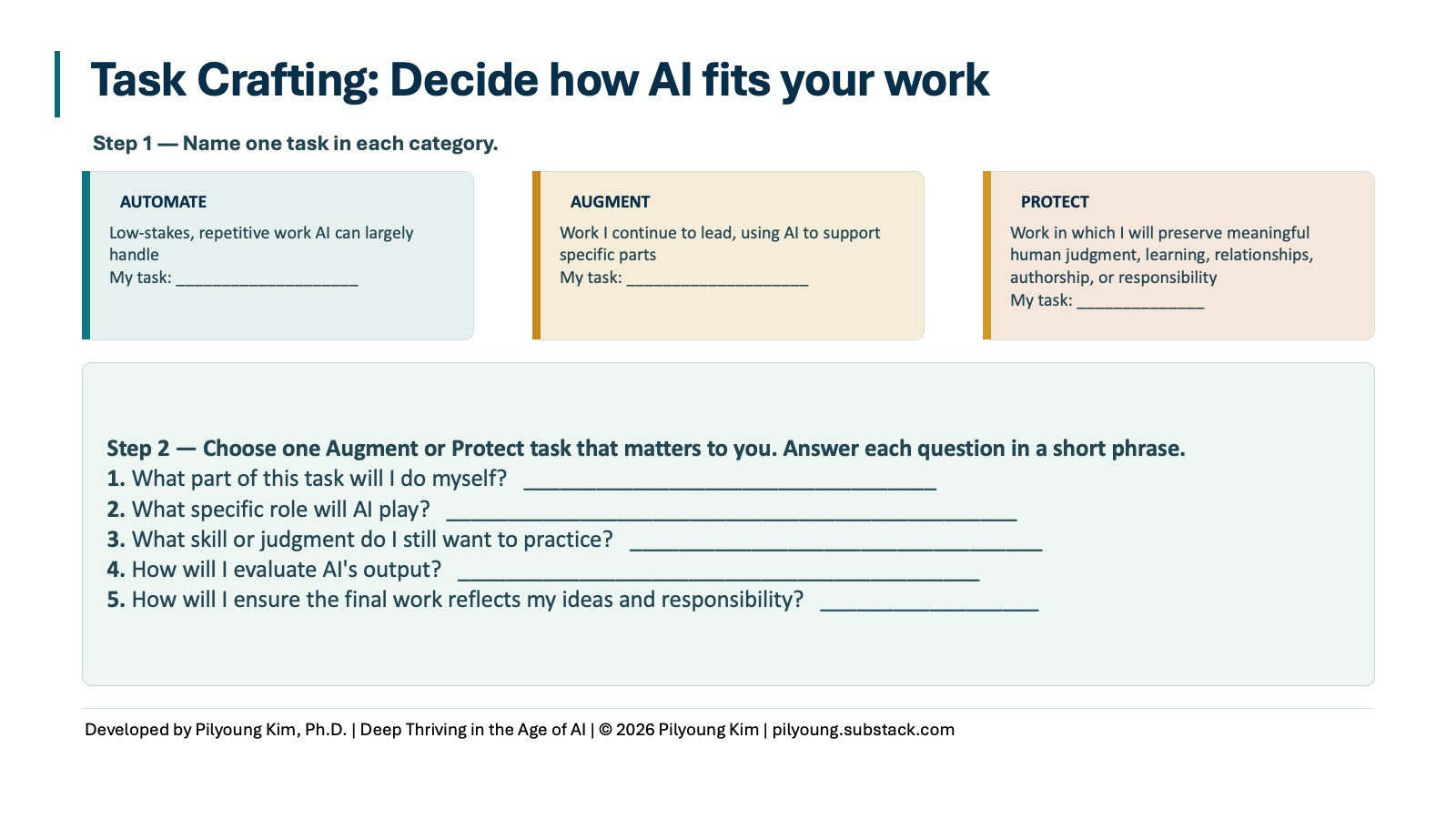
In the seminar, I introduced a simple task-crafting practice:
1. Automate
Low-stakes, repetitive work that AI can largely handle.
2. Augment
Work that I continue to lead, with AI supporting specific parts.
3. Protect
Work where I preserve meaningful human judgment, learning, relationships, authorship, or responsibility, using AI only in a limited supporting role.
Participants then chose one Augment or Protect task and reflected on five questions:
What part do I want to do myself?
Where do I want AI’s help?
What do I still want to learn or practice?
How will I evaluate AI’s output?
How will the final work reflect my own ideas and responsibility?
This practice helps us move from automatically relying on AI to using it more intentionally.
It also helps us recognize where our human contribution matters most: our judgment, values, creativity, learning, and responsibility.
Productivity pressure can make intentional AI use difficult
Outside pressure to increase productivity may encourage us to rely on AI as much as possible.
Many people have limited time, growing responsibilities, and increasing expectations. Allowing AI to take over more of the work can feel like the only realistic choice.
But over time, using AI mainly to maximize output may make us more vulnerable to losing our sense of meaning, confidence, ownership, and connection to the work.
Even a small change can help. We can choose one task, decide what we want to keep human-led, and give AI a more intentional supporting role.
Please use the attached worksheet in whatever way feels manageable within your own situation.
The next seminar of Deep Thriving in the Age of AI
Part 2: When the Future Feels Uncertain
Practical strategies for clarity, adaptability, and agency
The next session, Deep Thriving in the Age of AI: Part 2, will be held on Thursday, August 13, 2026, at 11:00 a.m. Pacific Time.
The focus will be Practical Strategies for Navigating an Unpredictable AI Future.
AI has pervasive effects on our work, our lives, and our future. This uncertainty can affect professionals at every career stage. It can influence how we think about our skills, roles, future plans, and sense of control.
It is normal to feel hopeful, curious, concerned, and overwhelmed at the same time.
We cannot predict every change ahead. But we can strengthen the human capacities that help us respond: adaptability, reflection, and the ability to make decisions and act.
In the session, we will review research-informed approaches to:
Distinguish what we can influence from what we cannot
Recognize our natural emotional and behavioral responses to uncertainty
Identify when a response provides short-term relief but may not support longer-term well-being
Develop flexible strategies for moving forward with greater clarity and agency
Approach change as a possible source of learning, creativity, and growth
The goal is not to eliminate uncertainty about the future. It is to become more informed about our responses, recognize the strengths we already have, and continue developing the capacities that help us deeply thrive.
I would be delighted to have you join us. Please visit the Luma page to learn more and register for the next session.
Who this is for
This live seminar is for professionals who use AI or are increasingly affected by it, and who want to navigate changing roles and expectations with greater clarity, flexibility, and purpose.
No technical background is required. You are welcome to attend even if you did not join the earlier sessions.
Please visit the Luma event page below to learn more:
Register for Deep Thriving in the Age of AI
Event details
Date: Thursday, August 13, 2026
Time: 11:00 a.m. Pacific Time
Format: Live online seminar
Cost: Free
No posts
Comments
Nothing yet. Say the first thing.
Sign in to join the conversation.