
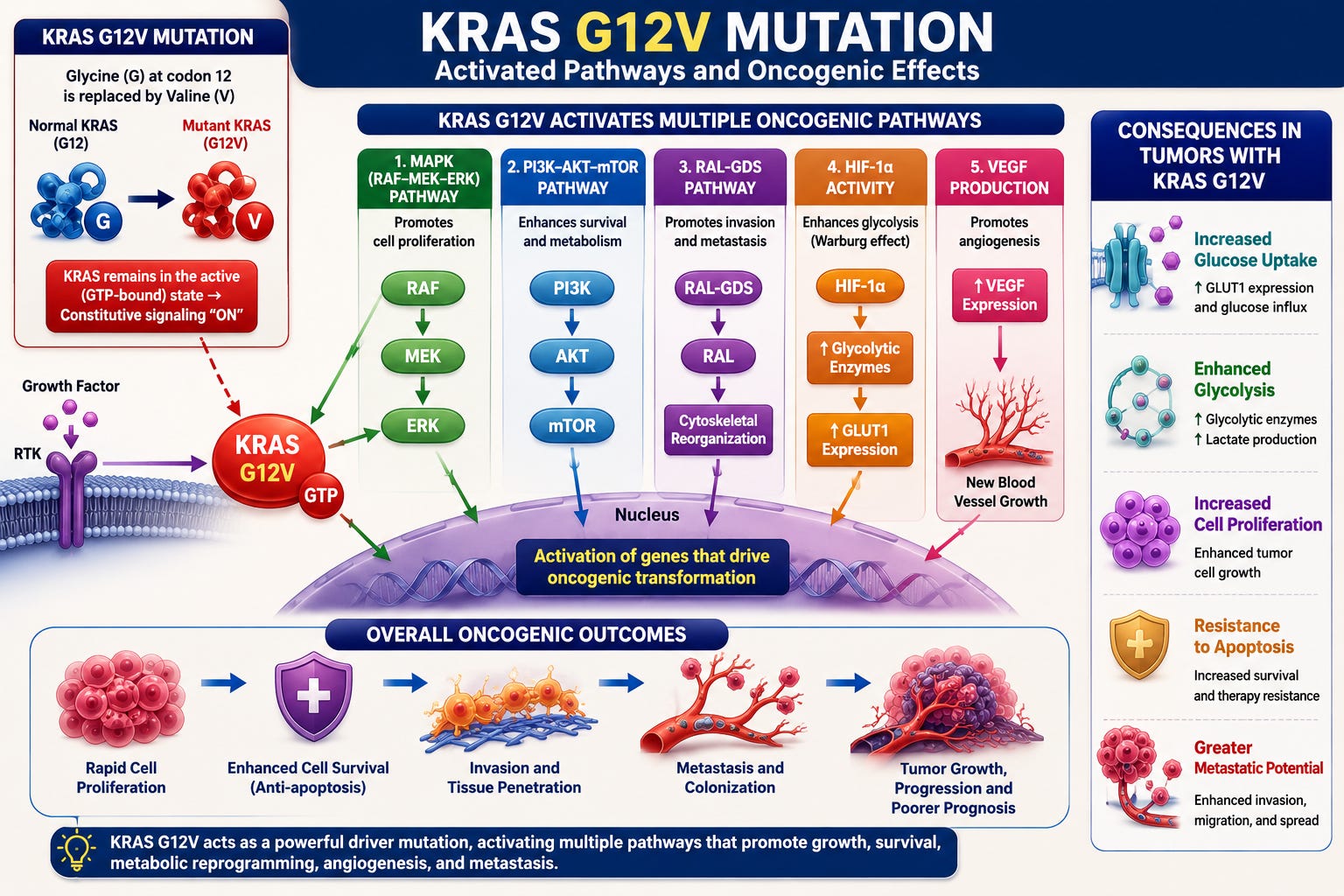
A KRAS G12V mutation is one of the most common activating mutations in the KRAS oncogene. It results from a single amino acid substitution in which glycine (G) at codon 12 is replaced by valine (V). This seemingly small change has profound biological consequences because it locks the KRAS protein into an “on” state, continuously stimulating pathways that drive cancer cell growth, survival, invasion, and resistance to therapy.
What does KRAS normally do?
KRAS is a molecular switch that relays signals from growth factor receptors on the cell surface to the nucleus. Under normal circumstances, KRAS cycles between:
OFF (GDP-bound)
ON (GTP-bound)
After transmitting a growth signal, KRAS normally switches itself off. The G12V mutation prevents this switch from turning off, resulting in continuous activation of downstream signaling pathways.
Which pathways are activated?
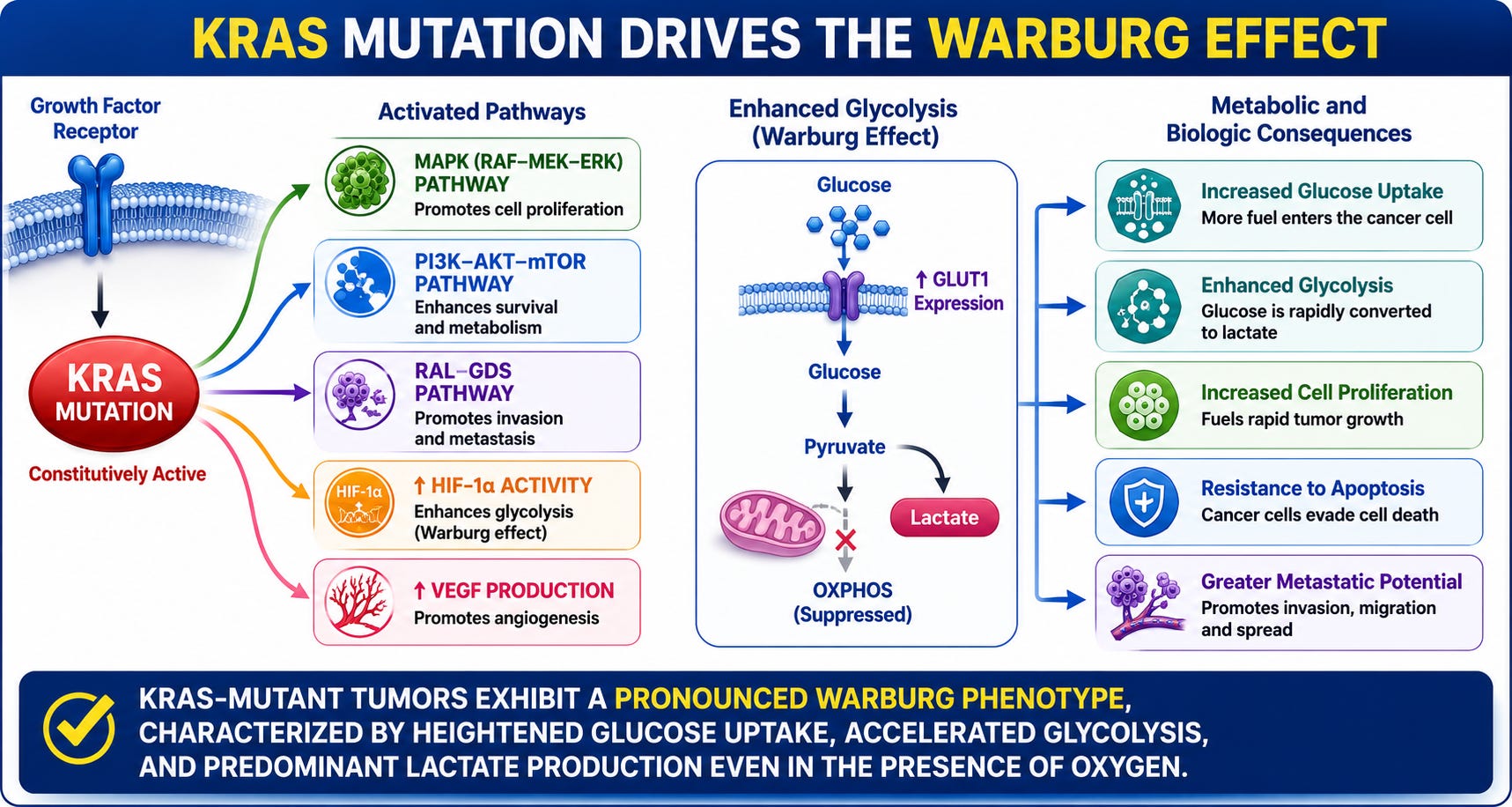
KRAS G12V stimulates several major oncogenic pathways, including:
MAPK (RAF–MEK–ERK) pathway → promotes cell proliferation
PI3K–AKT–mTOR pathway → enhances survival and metabolism
RAL-GDS pathway → promotes invasion and metastasis
Increased HIF-1α activity → enhances glycolysis (Warburg effect)
Increased VEGF production → promotes angiogenesis
Consequently, tumors with KRAS G12V tend to exhibit:
increased glucose uptake,
enhanced glycolysis,
increased cell proliferation,
resistance to apoptosis,
greater metastatic potential.
Tumors with the KRAS mutation demonstrate enhanced glycolysis and exhibit a strong Warburg phenotype.
KRAS mutations in ovarian cancer
KRAS mutations are not equally common across all ovarian cancers.
They are seen most frequently in:
Low-grade serous ovarian carcinoma (LGSOC) (20–40%)
Mucinous ovarian carcinoma (40–60%)
In contrast, KRAS mutations are uncommon in high-grade serous ovarian carcinoma (HGSOC), where alterations in TP53 and defects in homologous recombination (such as BRCA1 or BRCA2) predominate.
Knowing the histologic subtype is therefore important when interpreting the significance of a KRAS mutation.
Does KRAS G12V predict prognosis?
The answer is nuanced.
KRAS mutations are not necessarily associated with a worse prognosis by themselves. Rather, they identify tumors that are driven by specific signaling pathways.
For example:
In low-grade serous ovarian cancer, KRAS mutations help drive tumor growth but these cancers often grow more slowly than high-grade serous cancers.
In mucinous ovarian cancer, KRAS mutations are extremely common and likely represent an early event in tumor development.
Does KRAS G12V have therapeutic implications?
Unlike the KRAS G12C mutation, which now has approved targeted inhibitors in some cancers, there are currently no approved drugs that directly inhibit KRAS G12V.
Instead, therapeutic strategies generally focus on:
inhibiting downstream signaling (particularly the RAF–MEK–ERK pathway),
blocking the PI3K–AKT–mTOR pathway,
combining targeted agents with chemotherapy or other systemic therapies in selected settings.
Clinical trials evaluating drugs that target KRAS G12V specifically, as well as broader “pan-KRAS” inhibitors, are ongoing.
Metabolic implications
From a metabolic perspective, KRAS G12V is particularly interesting because it reprograms cancer metabolism. Tumors harboring this mutation often demonstrate:
increased GLUT1 expression,
enhanced glucose uptake,
increased hexokinase activity,
activation of HIF-1α,
increased lactate production,
greater dependence on glycolysis.
These changes are characteristic of the Warburg effect and provide a rationale for investigating metabolic interventions alongside standard therapy. However, while this biological rationale is compelling, it has not yet been proven that metabolic therapies specifically improve outcomes in patients with KRAS-mutant ovarian cancer.
Bottom line
For a patient with ovarian cancer, a KRAS G12V mutation indicates that the tumor is driven by a constitutively active KRAS signaling protein that promotes cell growth, survival, and metabolic reprogramming. It is most seen in low-grade serous and mucinous ovarian cancers, has important biological implications, and may influence eligibility for clinical trials investigating MEK inhibitors or emerging KRAS-targeted therapies. At present, however, there is no approved therapy that directly targets KRAS G12V, so treatment decisions continue to rely primarily on the tumor subtype, stage, prior treatments, and overall clinical context.
The KRAS mutation provides one of the strongest arguments supporting the metabolic theory of cancer rather than contradicting it. The key is to recognize that, from a metabolic perspective, KRAS is not viewed as the primary cause of cancer but as an adaptive regulator of cellular metabolism. In other words, the mutation drives the metabolic phenotype that allows the tumor to survive and proliferate.
The Somatic Mutation Theory View
According to the traditional somatic mutation theory (SMT):
KRAS G12V is a driver mutation.
Constitutive activation of KRAS continuously stimulates downstream signaling through RAF–MEK–ERK, PI3K–AKT–mTOR, and Ral-GDS pathways.
These pathways directly cause uncontrolled proliferation.
Therefore, inhibiting mutant KRAS should halt tumor growth.
Clinical experience has shown that this model is incomplete. Although KRAS inhibitors have produced meaningful responses in selected tumors harboring KRAS G12C, resistance develops rapidly, and there are currently no effective direct inhibitors for KRAS G12V. Most tumors eventually bypass KRAS inhibition by activating alternative metabolic and signaling pathways.
The Metabolic Theory View
The metabolic theory begins from a different premise.
The initiating event is mitochondrial dysfunction, which impairs efficient oxidative phosphorylation (OXPHOS). To survive, cells undergo metabolic reprogramming characterized by:
increased glycolysis (Warburg effect)
glutamine dependence
enhanced lipid metabolism
activation of stress-response pathways
chronic inflammation
resistance to apoptosis
Within this framework, KRAS mutations are adaptive rather than primary. They enable cells to survive under these altered metabolic conditions by coordinating nutrient uptake, biosynthesis, and stress responses.
Rather than disproving the metabolic theory, KRAS G12V exemplifies it. The mutation orchestrates a metabolic program characterized by enhanced glycolysis, increased glutamine utilization, mitochondrial adaptability, and resistance to oxidative stress. These are precisely the features expected of a cell adapting to mitochondrial dysfunction and environmental stress.
From this perspective:
The mutation is not the engine—it is the accelerator.
The engine is the altered metabolic state.
If the metabolic environment were normalized, constitutive KRAS signaling alone would likely be insufficient to sustain malignant growth. Conversely, even if KRAS signaling is inhibited, tumors frequently survive by rerouting metabolism through alternative pathways. This explains why targeting KRAS alone has produced limited long-term success, whereas a systems biology approach that simultaneously constrains glycolysis, mitochondrial adaptation, inflammation, and immune evasion may offer a more durable strategy for controlling KRAS-driven cancers.
This interpretation is consistent with the concept of the Five-Axis Metabolic Trap, in which KRAS G12V is viewed not as an isolated oncogenic event but as one component of an adaptive metabolic network that can only be effectively challenged through coordinated, multi-target intervention.

Comments
Nothing yet. Say the first thing.
Sign in to join the conversation.