
The Beginning of Precision Oncology
For decades cancer treatment relied on three blunt instruments: surgery, radiation, and cytotoxic chemotherapy. While these therapies undoubtedly saved countless lives, they were fundamentally nonspecific. Chemotherapy attacked all rapidly dividing cells, whether malignant or healthy, resulting in significant toxicity and, too often, only temporary control of disease.
Everything changed in the early 2000s.
The discovery that a subset of lung cancers depended almost entirely on abnormalities in a single gene—the epidermal growth factor receptor (EGFR)—launched the era of precision oncology. For the first time, clinicians could identify a molecular driver of an individual patient’s cancer and prescribe a drug specifically designed to inhibit that abnormal protein.
The responses were astonishing.
Patients with advanced metastatic lung cancer who had been expected to survive only months sometimes experienced dramatic tumor shrinkage within weeks. Cough disappeared. Oxygen requirements improved. Brain metastases regressed. Some patients remained disease-free for years.
It seemed that the long-promised dream of targeted therapy had finally arrived.
Yet two decades later the story has become considerably more nuanced.
Although EGFR inhibitors revolutionized cancer care and remain among the greatest successes in modern oncology, they also revealed the limitations of the mutation-centered view of cancer. Virtually every responding tumor eventually develops resistance. New mutations emerge. Alternative signaling pathways become activated. Tumors adapt metabolically, evolve under treatment pressure, and ultimately escape.
The EGFR story therefore represents both the triumph and the cautionary tale of precision medicine. It demonstrates that targeting a dominant oncogenic driver can produce remarkable clinical benefit, but it also reminds us that cancer is a dynamic, adaptive ecosystem rather than a static genetic disease.
What is EGFR?
EGFR (Epidermal Growth Factor Receptor), also known as HER1 or ERBB1, belongs to the ERBB family of receptor tyrosine kinases.
Its normal biological role is entirely beneficial.
In healthy tissues EGFR regulates:
Cell growth
Tissue repair
Wound healing
Embryonic development
Cell survival
Differentiation
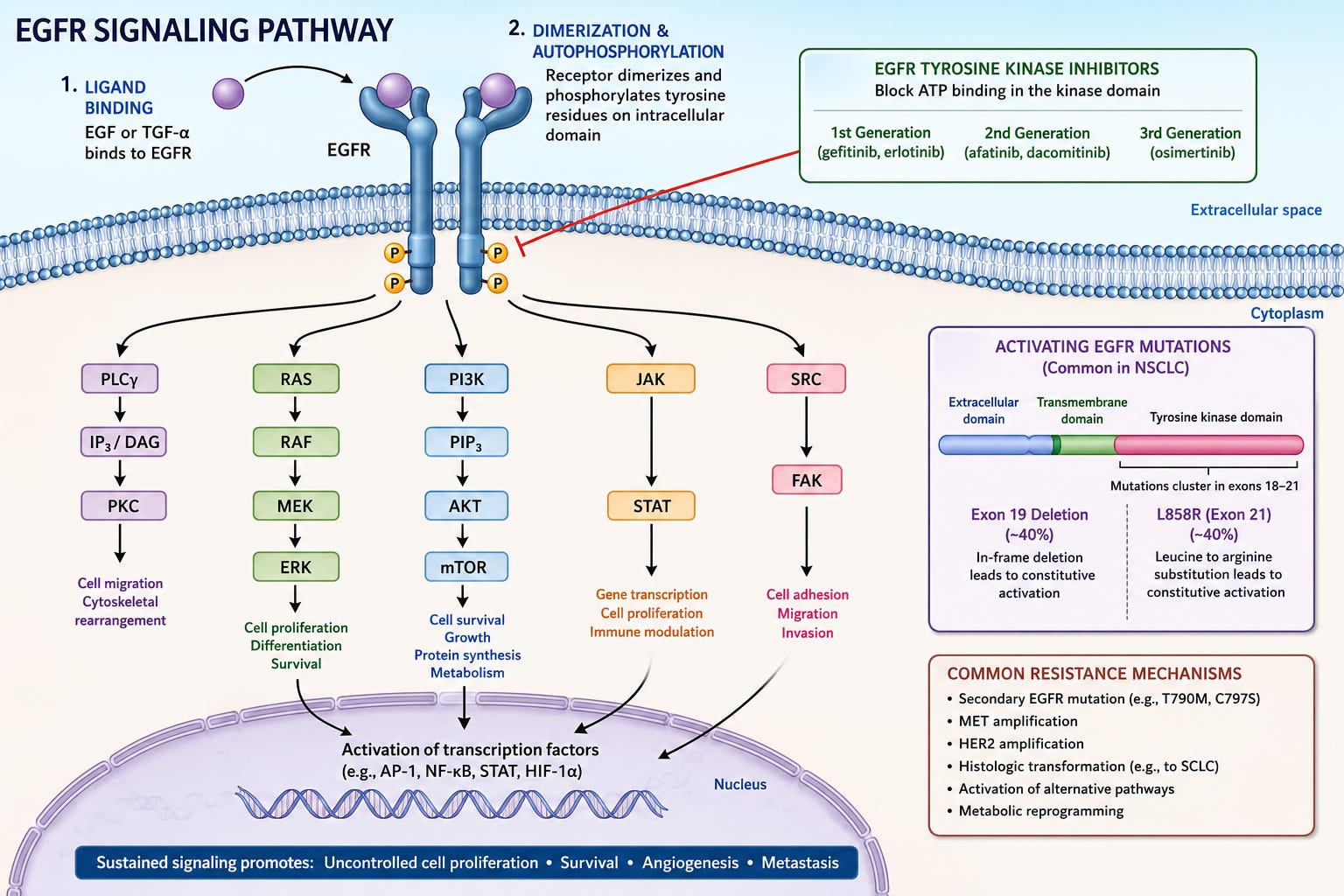
When epidermal growth factor (EGF) binds to the receptor, two EGFR molecules pair together (dimerize), activating intracellular kinase activity.
This initiates a cascade of signaling through multiple pathways, including:
RAS–RAF–MEK–ERK (cell proliferation)
PI3K–AKT–mTOR (cell survival)
JAK–STAT (gene transcription)
PLCγ (cell migration)
These pathways coordinate normal tissue regeneration.
The problem arises when EGFR becomes permanently switched on.
EGFR Mutations: A Stuck Accelerator Pedal
In many cancers, particularly non-small cell lung cancer (NSCLC), mutations occur within the tyrosine kinase domain of EGFR.
Unlike normal receptors, mutant EGFR no longer requires growth factor stimulation.
It becomes constitutally active.
The receptor continuously signals:
Grow.
Divide.
Avoid apoptosis.
Consume glucose.
Build blood vessels.
Invade surrounding tissue.
The result is continuous oncogenic signaling.
Unlike tumor suppressor mutations, EGFR mutations are classic gain-of-function mutations.
The cancer becomes “addicted” to EGFR signaling—a concept known as oncogene addiction.
This addiction explains why EGFR inhibitors can produce such dramatic initial responses.
Which Cancers Harbor EGFR Mutations?
EGFR abnormalities occur across many epithelial cancers.
The highest prevalence is seen in:
Non-small Cell Lung Cancer
Approximately 10–15% of Caucasian patients and 30–50% of East Asian patients with lung adenocarcinoma harbor activating EGFR mutations.
Mutations are particularly common among:
Never smokers
Women
Asian patients
Adenocarcinoma histology
Less common EGFR abnormalities occur in:
Glioblastoma
Head and neck squamous carcinoma
Colorectal cancer (overexpression more common than mutation)
Triple-negative breast cancer
Esophageal cancer
Cholangiocarcinoma
However, the greatest clinical success has unquestionably been in lung cancer.
The Common Activating Mutations
Over 90% of clinically important EGFR mutations consist of two alterations.
Exon 19 deletion
Approximately 45%
These remove amino acids from the kinase domain, locking the receptor into an active conformation.
These patients generally experience the best responses to EGFR inhibitors.
L858R mutation
Approximately 40%
A single amino acid substitution (leucine to arginine) at position 858 similarly activates the receptor.
Together these two mutations account for nearly 90% of EGFR-positive lung cancers.
The Birth of Targeted Therapy
The first EGFR inhibitors represented one of oncology’s greatest breakthroughs.
First-generation agents
Gefitinib
Erlotinib
These small molecules compete with ATP within the kinase domain.
Rather than poisoning dividing cells indiscriminately, they simply switch off the abnormal receptor.
The results transformed lung cancer treatment.
Objective response rates approached:
70%
Median progression-free survival around one year
Marked improvement in quality of life
Significantly less toxicity than chemotherapy
Patients who previously required oxygen sometimes walked out of the hospital within weeks.
Few advances in oncology have produced such dramatic responses.
Why the Responses Were So Dramatic
EGFR-mutant tumors are among the best examples of oncogene addiction.
Blocking EGFR simultaneously suppresses:
Cell proliferation
Glycolysis
Angiogenesis
Anti-apoptotic signaling
DNA repair
Cell migration
The cancer loses its dominant survival program.
Unfortunately, evolution never stops.
Resistance: Cancer Evolves
Almost every patient eventually relapses.
Median resistance develops after approximately 10–18 months.
Cancer evolves through Darwinian selection.
Small resistant clones already exist before therapy begins.
Treatment eliminates sensitive cells while resistant populations expand.
Several mechanisms account for resistance.
1. Secondary EGFR Mutations
The most famous is:
T790M
This single mutation alters ATP binding.
First-generation inhibitors no longer fit.
The receptor resumes signaling.
Approximately half of resistant tumors develop T790M.
2. MET Amplification
Instead of using EGFR, tumors activate MET signaling.
Cancer effectively bypasses the blocked pathway.
3. HER2 Amplification
Some tumors increase HER2 signaling.
Again, proliferation resumes despite EGFR inhibition.
4. Histologic Transformation
Remarkably, some adenocarcinomas transform into small-cell lung cancer.
The mutation remains.
The phenotype changes.
This represents one of the most fascinating examples of tumor plasticity.
5. Metabolic Adaptation
Perhaps the least appreciated mechanism is metabolic escape.
EGFR blockade initially suppresses glycolysis.
However, surviving cells adapt by increasing:
Oxidative phosphorylation
Fatty acid oxidation
Autophagy
Mitochondrial biogenesis
Cancer stem-cell metabolism
These adaptations fit remarkably well within the metabolic theory of cancer.
Osimertinib: The Next Generation
Recognition of T790M resistance led to development of third-generation inhibitors.
The most important is:
Osimertinib (Tagrisso)
Advantages include:
Active against T790M
Better brain penetration
Fewer skin toxicities
Longer progression-free survival
Improved overall survival
Today osimertinib has become first-line therapy for most patients with metastatic EGFR-mutated NSCLC.
Median survival now approaches 3–4 years in many patients, a remarkable improvement compared with the pre-targeted therapy era.
Nevertheless, resistance still develops, with mechanisms including MET amplification, C797S EGFR mutations, activation of bypass pathways, epithelial–mesenchymal transition, and histologic transformation.
EGFR and the Warburg Effect
One of the most interesting aspects of EGFR biology is its intimate relationship with cancer metabolism.
Activated EGFR stimulates:
GLUT1 glucose transporters
Hexokinase II
PI3K-AKT signaling
mTOR activation
HIF-1α stabilization
Lactate production
Collectively these changes reinforce aerobic glycolysis—the Warburg effect.
EGFR-mutated tumors are therefore not simply genetic diseases.
They are metabolically reprogrammed diseases.
Blocking EGFR partially reverses this glycolytic phenotype.
Unfortunately, resistant tumors frequently restore metabolic flexibility by increasing mitochondrial respiration and alternative fuel utilization.
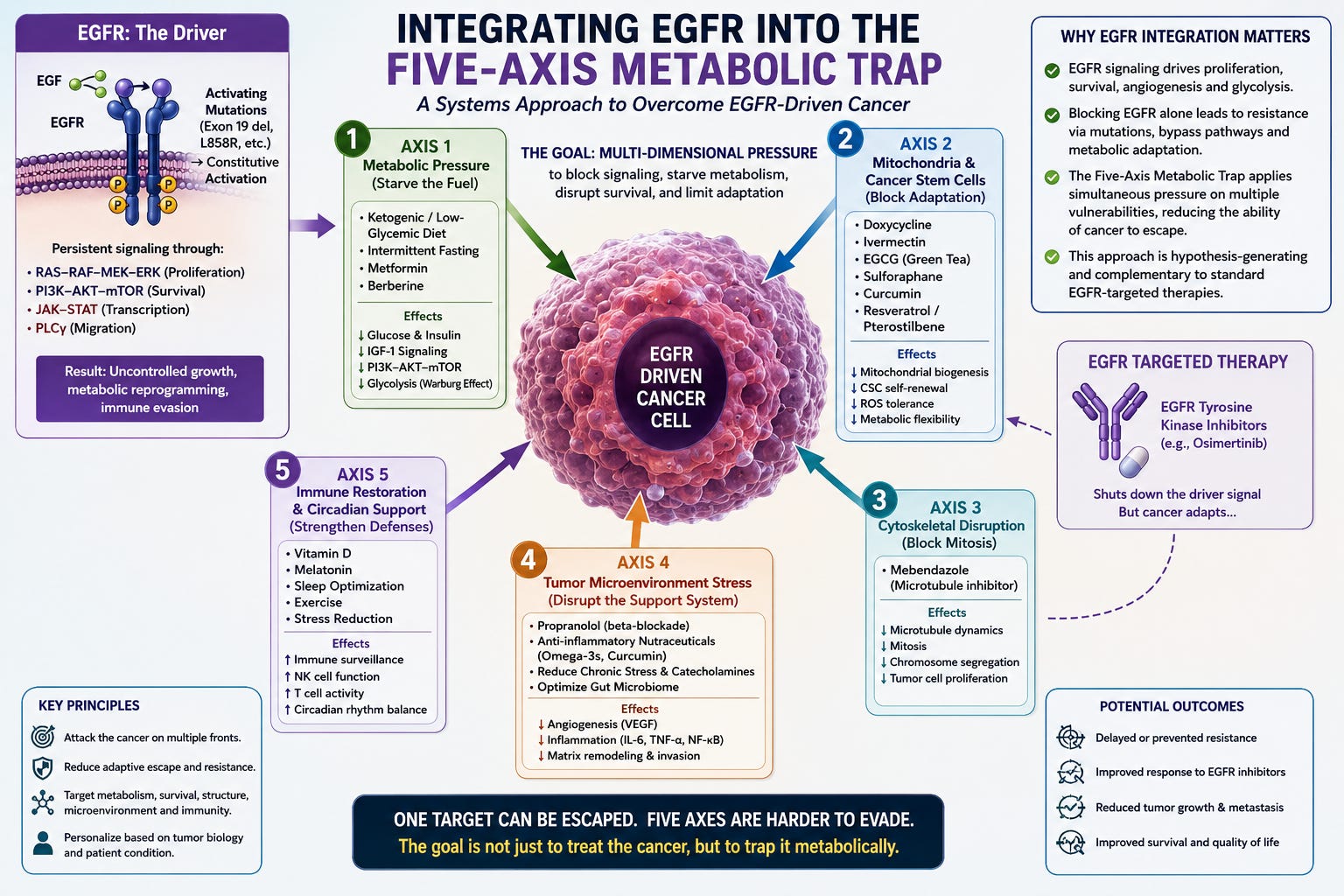
Integrating EGFR into the Five-Axis Metabolic Trap
The EGFR story aligns naturally with a systems-based metabolic approach.
Axis 1 – Metabolic pressure
Ketogenic or low-glycemic dietary strategies
Metformin
Berberine
These interventions reduce insulin and IGF-1 signaling while dampening PI3K–AKT–mTOR activity, complementing EGFR inhibition.
Axis 2 – Mitochondria and cancer stem cells
Doxycycline
Ivermectin
EGCG
Sulforaphane
Curcumin
Resveratrol or pterostilbene
These agents target mitochondrial function, cancer stem-cell biology, and adaptive metabolic escape that may emerge after EGFR blockade.
Axis 3 – Cytoskeletal disruption
Mebendazole
Acts independently of EGFR by disrupting microtubule dynamics and mitosis.
Axis 4 – Tumor microenvironment
Propranolol
Anti-inflammatory strategies
Lifestyle interventions
May reduce stress-mediated signaling, angiogenesis, and inflammatory support for tumor progression.
Axis 5 – Immune restoration
Vitamin D
Melatonin
Sleep optimization
Exercise
Supports immune surveillance and circadian regulation, although evidence specifically in EGFR-mutated disease remains limited.
This framework is hypothesis-generating rather than established clinical practice. Whether combining metabolic interventions with EGFR-targeted therapy improves outcomes will require prospective clinical trials.
Lessons Learned
The EGFR revolution transformed oncology forever.
It demonstrated that:
Some cancers are dependent on a single dominant oncogenic driver.
Precision medicine can produce dramatic clinical responses.
Molecular testing should guide therapy.
Cancer rapidly evolves under therapeutic pressure.
Resistance is the rule rather than the exception.
Perhaps most importantly, the EGFR experience revealed that successful cancer therapy requires more than shutting down a single signaling pathway. Tumors adapt through additional genetic alterations, epigenetic changes, metabolic reprogramming, and interactions with the tumor microenvironment.
Future Directions
The next chapter of EGFR-targeted therapy is already unfolding.
Current research focuses on:
Fourth-generation EGFR inhibitors targeting C797S and other resistance mutations
Bispecific antibodies (e.g., EGFR/MET-directed agents)
Antibody-drug conjugates
Combinations with MET inhibitors
Rational integration with immunotherapy in selected settings
Approaches targeting metabolic plasticity alongside oncogenic signaling
These strategies acknowledge that durable disease control will likely require simultaneous pressure on multiple vulnerabilities rather than reliance on a single target.
Conclusion
EGFR was the first great success story of targeted therapy and ushered in the era of precision oncology. It transformed metastatic lung cancer from a disease treated primarily with nonspecific chemotherapy into one in which molecular profiling directs treatment and targeted inhibitors can produce rapid, meaningful clinical responses.
At the same time, the EGFR experience exposed a central challenge in cancer biology: tumors are adaptive systems. Even when a dominant driver is successfully inhibited, cancer cells frequently survive by acquiring new mutations, activating bypass pathways, or reprogramming their metabolism.
From the perspective of the metabolic theory of cancer, EGFR activation represents one important component of a broader network that promotes uncontrolled growth, glycolysis, survival, and metabolic flexibility. This view suggests that the greatest long-term benefit may come from combining precision-targeted therapies with strategies that simultaneously address tumor metabolism, the microenvironment, and immune function.
The legacy of EGFR is therefore twofold. It proved that understanding cancer biology at the molecular level can dramatically improve patient outcomes, and it taught us that lasting control of cancer will likely require an integrated, multi-target approach capable of limiting the tumor’s remarkable capacity for adaptation.

Medical Disclaimer: The discussion of repurposed medications and nutraceuticals in this article is intended to review the scientific literature and does not constitute a recommendation for self-treatment. Decisions regarding the use of off-label therapies should be made in consultation with a qualified healthcare professional familiar with the patient’s medical history and current treatment plan. Please see the full Medical Disclaimer on the introductory page to Marik’s Cancer & Metabolic Healing Playbook.
Comments
Nothing yet. Say the first thing.
Sign in to join the conversation.