
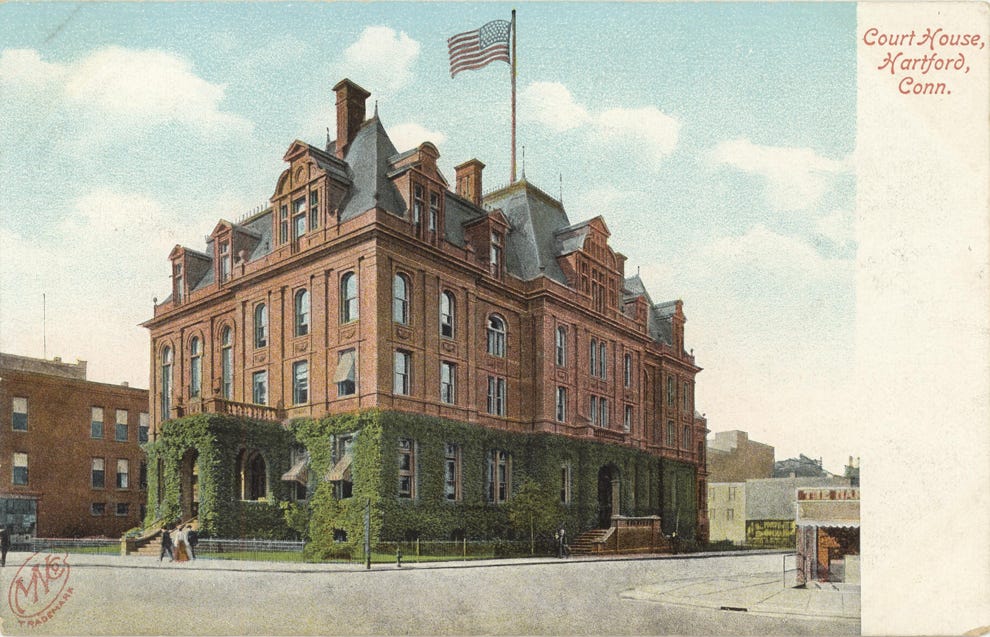
A story about lawyers and their cigar butts that I’ve wanted to share for a few years now. In my most recent video on YouTube, I explain why a historical plaque on a building on Trumbull Street is incorrect. The plaque indicates that the building, which is at the end of Trumbull near Bushnell Park (and includes Salute Restaurant), was once the location of the childhood home of celebrated landscape painter Frederic Edwin Church (1826-1900). In the video, I explain why the plaque is wrong and I identify the actual site of the Church home, which was in the middle of the block on the west side of Trumbull Street that is part of the Hartford Civic Center/Peoples Bank Areana today. The family previously lived on Temple Street, where Frederic was born in a house on a site that is now part of Constitution Plaza. Frederic’s father, the jeweler Joseph Church (1793-1876), later moved to another house on Asylum Street that (you guessed it) is also now lost. As for the old Church family home on Trumbull Street, it became the residence of Dr. George B. Hawley, one of the city’s most respected physicians. Dr. Hawley left the house after about 15 years in December of 1881, and it was soon demolished to make way for the Hartford County Building, home of the county court.
Two notable Hartford architects, George Keller and John C. Mead, submitted competing designs for the building in 1882 and the county commissioners accepted the plans of the latter, which were described in the Hartford Courant as being “modern French Renaissance in style.” Additions were made to the building in the first decade o the twentieth century. A few years ago, I released a video about “Trumbull Street Before the Hartford Civic Center,” which covered the courthouse, as well as other lost buildings. At the time, I wanted to include material from an article, “Lawyers Like Old Library Room,” that appeared in the Courant on May 27, 1912. This piece gives a vivid and entertaining slice of life depiction of the lawyers who frequented the building and enjoyed smoking. I guess I thought it was a bit too long to quote at length in that video. I thought of dedicating an entire video to reading the article and utilizing stock footage of men puffing on cigars for the images (the fact that today, just a few years later, I could easily generate AI images shows how much has changed so quickly!), but the theme of smoking would certainly not have been amenable to the YouTube algorithm! In any case, I’ve decided to quote the entire article below. The section headings are my own. Also, please refer to the footnotes for my annotations about some of the individuals mentioned in the article (lots of obscure tidbits of Hartford history, including links to some historic houses that are still around today!).
There isn't a room in any building in this city where more good stories are told in the cousre [sic] of a week, a month or a year, than the dark room in the county building. The room used to be the bar library, but a few years ago, when an addition was built to the building, a new library was provided for and the addition made the old room dark. For some years the room has been used as a lounging and smoking place for lawyers. It opens into the courtroom and when a lawyer is waiting for a case in which he is interested to be reached, the room is a handy place to lounge or smoke in, and with the lawyers it is the most popular room in the building when there is any lounging to be done by them at the court house.
Generally on Fridays during the court year there are more lawyers in the room than at other times, and while some are discussing current events, others are telling stories and others are endeavoring to adjust cases in which they are interested. There are several chairs in the room and in the center is a long imitation mahogany table, but about the only thing that the table is ever used for is to sit upon. Sometimes lawyers will be sitting on both sides of it and on the ends. In one corner of the room, a corner nearest the door to the courtroom, is a radiator. It has been many years since the heat was turned on in the radiator, but the radiator has its usefulness. When lawyers are in the room smoking and they are told that the case for which they have been waiting has been reached, they will make for the radiator and lay their cigar butts on it, expecting to take the butts again when they finish in court. Sometimes they get the butts and sometimes they don't. At times there will be from a dozen to twenty or more butts resting on the radiator, and as lawyers come out they take the butts. Not always does a man get his own butt, but he gets one that he thinks was the one he laid down and he goes off. Later, as the number of butts gets less, a lawyer will walk up for a butt and discover that some one has taken his, and he will ask, "Who took my butt?" Finding that his own butt is gone he will take out a fresh cigar, and if he hasn't got one he will hold up some other lawyer for a cigar and then will proceed to blaze away upon it.
Alvan Waldo Hyde1 had a case coming before Judge Howard J. Curtis last Friday and as he waited he sat on the table in the dark room and lighted a cigarette. He engaged in conversation with some others in the room as he puffed away. As he made a movement to remove the cigarette from his mouth, a man who was talking to him was emphasizing what he said with a gesture of the hand. His hand struck the hand of the police commissioner [Hyde], knocking the cigarette from it, and the mystery of the lighted cigarette begins.
Mr. Hyde slid off the table to pick up the lighted cigarette, but there was no cigarette to be seen. It wasn't on the floor anywhere and as several of the lawyers had seen it disappear, a half dozen of them, at least, crouched over to inspect the carpeted floor. But there wasn't any cigarette to be seen and one of the lawyers asked, "Where in the devil could that cigarette have gone?"
"Well, that's funny," said another, "What could have become of it?"
After a half dozen had searched the floor carefully without discovery the cigarette, all straightened up and began to comment on the strangeness of the disappearance. William T. Lynch2, who was there, suggested that it might be in some one's pocket. Then a search of coat pockets was begun and sure enough the lighted cigarette was found in the pocket of one of the men in the room. The cigarette was one of the kind that, when once lighted, keeps alight until it burns itself out. But for the suggestion which Mr. Lynch made the chances are that a few minutes later there would have been a man walking around the courtroom with his clothing on fire.
Sidney E. Clarke3 walked down the corridor and into the dark room a few minutes later. He made straight for the radiator and scrutinized closely the dozen or fifteen cigar butts which rested on it. Mr. Hyde had got back on the table. He didn't have to ask Mr. Clarke what he was looking for, as he knew right well, but he did say, "What are you looking for?" "I'm looking for my butt," said Mr. Clarke, “but some one has taken it.” “Well, take another," said Mr. Hyde, as he pointed to the "soldiers" on the radiator. "No, I guess not,” said Mr. Clarke, as he smiled and walked out of the room.
Judge William A. Arnold4 during this time was in the courtroom telling Judge Curtis5 what his view of a certain legal proposition was [,] and about the time that Mr. Clarke left [,] Judge Arnold finished his argument and walked into the dark room. He took a seat on the table and after a short conversation he said, as he placed his hand to his waistcoat pocket and took out a cigar, "I guess I'll smoke Sid Clarke's cigar." Then there was a laugh and as Judge Arnold asked what the joke was, he examined, the cigar as if he suspected that it was one of the explosive kind. He was told what Mr. Clarke had said about some one having taken his cigar from the radiator. Judge Arnold explained that he was in Mr. Clarke's office Thursday, when Mr. Clarke had given him the cigar, recommending it highly, He had forgotten that he had it in his pocket until that minute and he proceeded to smoke up.
William Waldo Hyde (1880-1946), son of Hartford mayor William Waldo Hyde, was long a member of the firm Gross, Hyde & Williams. During his career he served as Police Commissioner of Hartford, Connecticut State Public Utilities Commissioner, and Comandant of the First Company, Governor’s Foot Guard. At the time of his death, he was living at 66 Forest Street, aka the Charles Boardman Smith House, close to the Mark Twain and Harriet Beecher Stowe Houses.
According to his obituary in the Hartford Courant (2/8/56), William T. Lynch (1882-1956) joined the FBI in 1918 and focused on mass roundups of draft dodgers. From 1922 until 1947 he was Probation Officer of the Hartford Police Court and “was noted for his championship of minors and women deserted by their husbands.”
The secret marriage of Sidney E. Clarke (1851-1935) and Mary Robinson of Middletown, which took place at Christ Church in Hartford on May 24, 1902, with a single witness, was notable enough to appear in the New York Times. As that paper reported the following day, “The bride is a member of the Catholic Church and there was serious opposition to the marriage in her family. Mr. Clarke was considered to be a confirmed bachelor, and his course has resulted in a first- class sensation.”
William A. Arnold (born 1874) and his Yale Law School roommate Walter H. Clark were partners in the firm of Clark & Arnold at 50 State Street from the time of their graduation in 1899 until Clark was appointed probate judge in 1921. Arnold’s primary residence continued to be in his hometown of Willimantic, where he became a judge of the police court in 1901. On May 22, 1901, he married Kate Hutchinson at the home of her parents, the old Henry Barnard Homestead at 118 Main Street in Hartford.
Howard J. Curtis (1857-1931) was from Stratford and practiced law in Bridgeport. He had served as Judge of the Civil Court of Common Pleas for Fairfield County before being appointed Judge of the Superior Court in 1907. He was later an associate justice of the Connecticut Supreme Court.
No posts
Comments
Nothing yet. Say the first thing.
Sign in to join the conversation.