
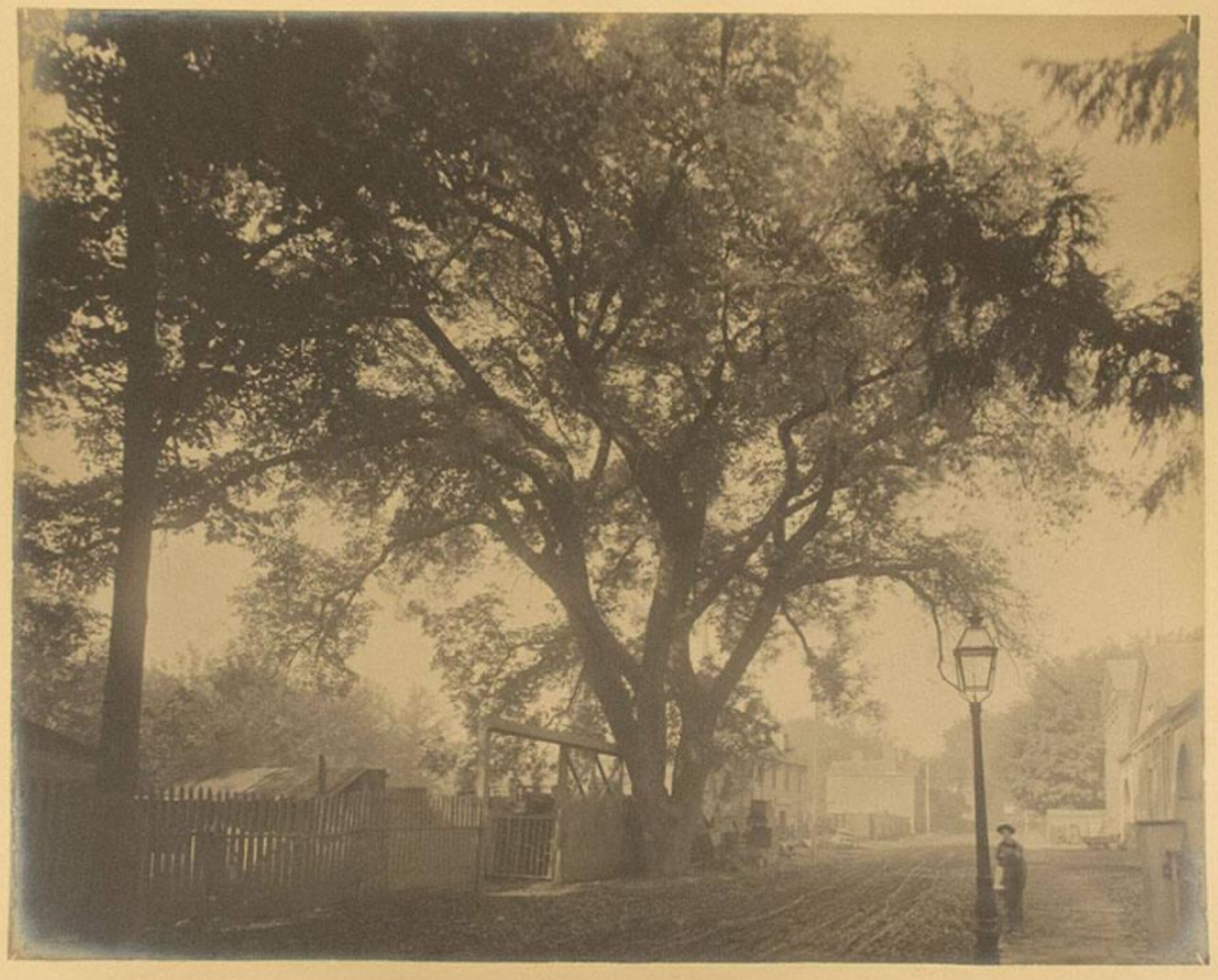
I want to tell you about a notable tree, planted in 1773, that stood on Arch Street in Hartford for nearly a century and a quarter. It’s also the subject of my latest YouTube video, so you can read the text version below, watch the video (remember to hit the “like” button!), or both! The tree grew across from the Phoenix Iron Works (which I wrote about in a recent piece here on Substack). In 1896, the year the tree was taken down, both the iron works and the property where the tree stood were owned by George S. Lincoln and Co.
In April of 1773, young John Ledyard was a freshman at Dartmouth College, which was only four years old at the time. Ledyard was about to start on the first of many adventurous journeys that would take him around the world. Having felled a tree, he proceeded to carve a dugout canoe. He then set off down the Connecticut River, leaving behind his studies and an unpaid tuition bill. The restless Ledyard had earlier alarmed the college authorities when he’d disappeared for two months the previous year to hike through the New Hampshire woods. This time, the determined Ledyard paddled all the way down the river to Hartford, where he diverted up the Little River (later called the Park River) and disembarked at the home of his uncle, Thomas Seymour. Ledyard then planted an elm across from his uncle’s house, on the banks of the Little River.
Born to a Mystic CT merchant captain who had been lost at sea, John Ledyard was a nephew of Col. William Ledyard, who would be slain in 1781 at the defense of Fort Griswold in Groton. While still a teenager in 1765, John Ledyard had been sent to Hartford to be educated. He was under the guardianship of his paternal grandfather, John Ledyard Esq., who lived along Arch Street. When Squire John died in 1771, Ledyard’s uncle Seymour, who lived nearby, became his guardian.
Having achieved his escape from Dartmouth, Ledyard eventually decided to head abroad, where he ended up becoming a royal marine. He was on Captain James Cook’s third and final voyage in the Pacific (1776-1780), in the course of which he is believed to have been the first Euro-American to be tattooed. The expedition, during which Capt. Cook was killed in Hawai’i, lasted over four years. Returning to the Atlantic, Ledyard was sent back to North America, but deserted the marines because he did not want to fight his fellow Americans in the Revolution. Back in New England, he wrote an account of his travels with Capt. Cook, entitled Journal of Captain Cook’s Last Voyage to the Pacific Ocean, and in Quest of a North-West Passage, Between Asia & America, which was published in 1783.
The following year he traveled to Europe to seek backers for a fur-trading venture. This was unsuccessful, but encouraged by Thomas Jefferson, who was US Ambassador in Paris at the time, Ledyard embarked on an audacious new expedition, to travel across Russia and then cross the Baring Strait to North America, where he would make his way from Alaska all the way to Virginia. His daring journey was cut short in Siberia when, under suspicion of being a spy, he was arrested in Irkutsk on the orders of Catherine the Great. Having been deported from Russia, his next ambitious plan was to explore the interior of Africa, but before his new expedition got underway, he died in Cairo in 1789 at the age of 38, possibly from an overdose of sulfuric acid that was used to treat intestinal illness
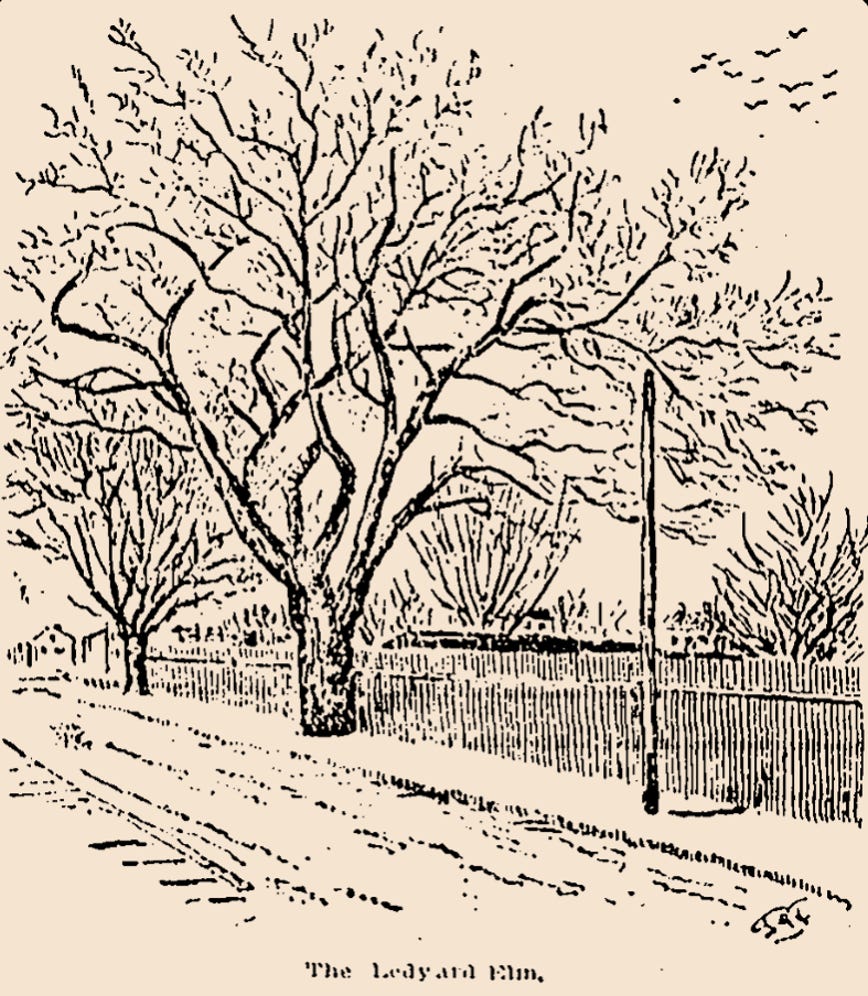
Back in Hartford, the elm tree he had planted on the bank of the Little River grew to become a local landmark. It stood across Arch Street from Thomas Seymour’s House, which itself stood on part of the old home lot of Hartford founder Rev. Thomas Hooker. Thomas Seymour served as the first mayor of the city of Hartford, from its incorporation in 1784 until 1812. In 1824, he hosted the marquis de Lafayette at his home on Arch Street. Every morning, Seymour went for a swim in the Little River, even when he had to break through a coating of ice!
In the 1780s, Seymour set up a grist mill just west of the elm. By 1824, this property was occupied by Ward’s Woolen Mill. Over the next few decades, the industrial development in the vicinity increased until the Seymour House became hemmed in to the north and west by the Phoenix Iron Works. The house was taken down in 1870 and replaced by an expansion of the Phoenix works. Throughout all of these changes, the tree continued to stand across the street. Thought to be the finest elm in the city, it was photographed in the 1800s by Frederick S. Brown, who was documenting Connecticut’s famous old trees. The author of an article on Connecticut’s most notable trees, that appeared in the New York Times on June 8, 1891, wrote:
In the deed conveying the property on which the elm stands to its present owners, is a clause according to the tree the right to “stand” until it “shall die a natural death." It is still a grand and rugged old tree, apparently full of life and vigor, notwithstanding its trunk is gnarled and seamed with the work of time and weather. Many tourists and lovers visit it yearly. In the opinion of arboriculturists earth was banked about its roots once a great many years ago, since the trunk is smallest at the ground and the lower branches are near the earth. The trunk in its smallest part is 132 feet in circumference, and the shadow cast by the tree is 100 feet in diameter.
Sadly, a little over five years later, on November 19, 1896, the Hartford Courant reported:
The old elm tree had died and it was a very large tree. The park commission, who had charge of it, ordered it cut down and it has been sawed off piece by piece and removed so that not even the fence that it overhung has been hurt. The other large elm just east of it is now undergoing the same fate. One can get an idea of the changes that have taken place along the river bank from the fact that Mr. Lincoln himself distinctly recollects when steamboats drawing nine feet of water used to sail up Little River, and at an inlet, just east of where the foundry now stands, unloaded grain for Imlay's mills.

Thus came to an end a living piece of Hartford’s colonial history. The tree is gone, but John Ledyard’s journey down the Connecticut is a well-remembered part of the history of Dartmouth College and inspired the founding of the Ledyard Canoe Club in 1920. The area of Arch Street has gone through even more dramatic changes since 1896, not least of which was the burying of the Little River through a conduit underground in the 1940s. Most recently, the apartments at 81 Arch Street were completed in 2019. They partly occupy the site where the Ledyard Elm had witnessed almost a century and a quarter of change in downtown Hartford, CT.
No posts
Comments
Nothing yet. Say the first thing.
Sign in to join the conversation.