
I drop a stitch and then I pick it up again. I visit Count Zinzendorf in the hills above Görlitz, Germany. Standing at the highest point, on his family’s ancestral lands, today home to the Worldwide Moravian Brotherhood, I look east, beyond the Neisse River, towards Poland and Czech Republic. The Count’s story, the histories of Poland and Czechoslovakia, my story, our stories, all intertwined.
The Count, along with his daughter Benigna, one of the Count’s twelve children, Conrad Weiser, his guide and translator, and Anna Nitschmann, a commoner from Moravia who became the Count’s second wife in 1757, have come together to cross Antons Wüste, their name for the hinterland of the colony of Pennsylvania. They are travelling through what we today call Lykens Valley, heading northwest to the West Branch of the Susquehanna River.
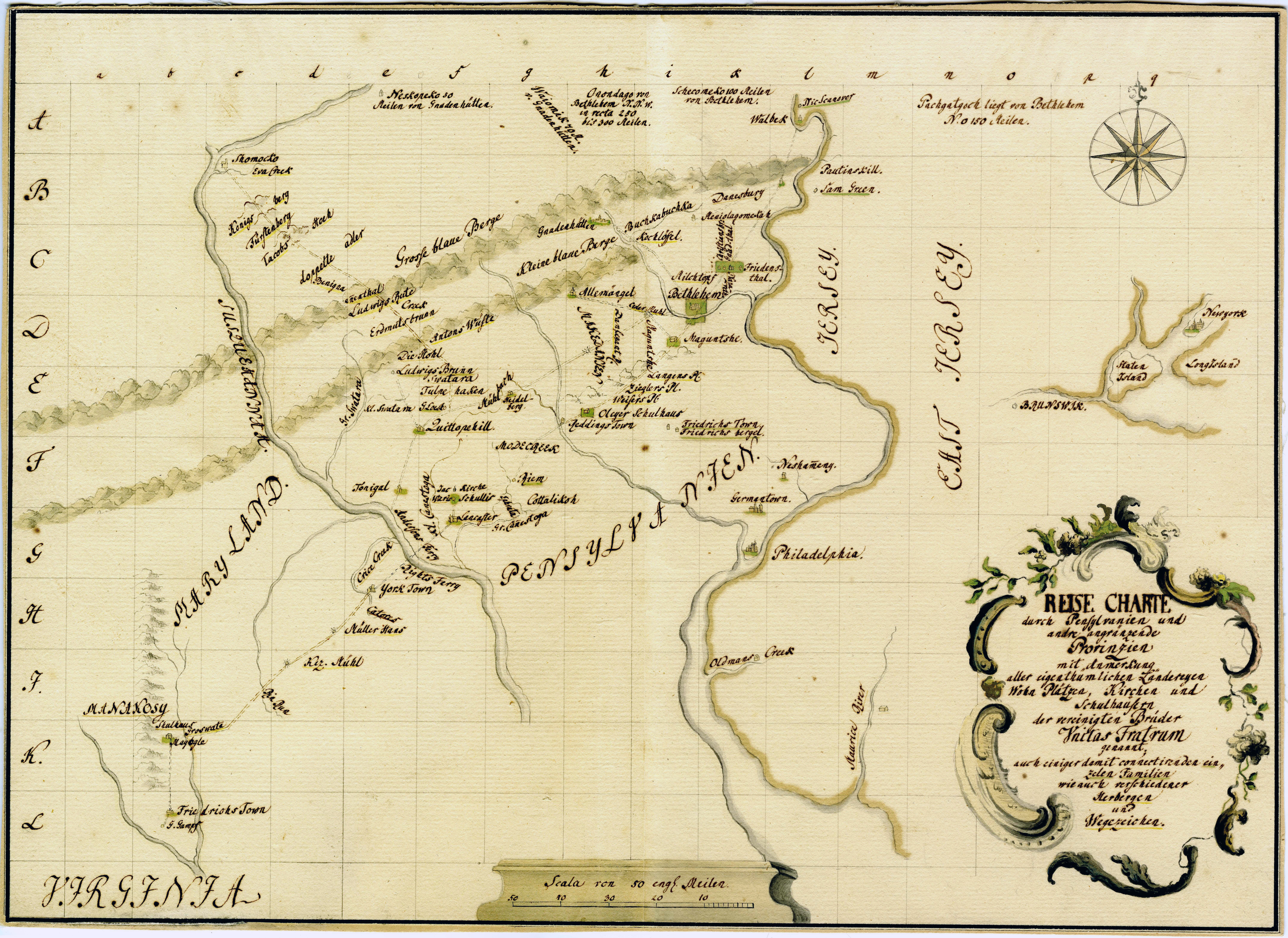
The year is 1741, the forests are teeming with game; the waters of streams and rivers, clear but difficult to ford. Conrad Weiser is the go-between. He assures safe passage for the Moravians over Iroquois lands. Near the Susquehanna’s fork, the Count meets Chief Shikellamy, Oneida chief and overseer of the Iroquois Confederacy, at today’s Sunbury. Travelling further west, Count Zinzendorf and his party cross paths with Madame Montour, fur trader, diplomat, polyglot interpreter. They meet on Great Island, near modern-day Lock Haven.
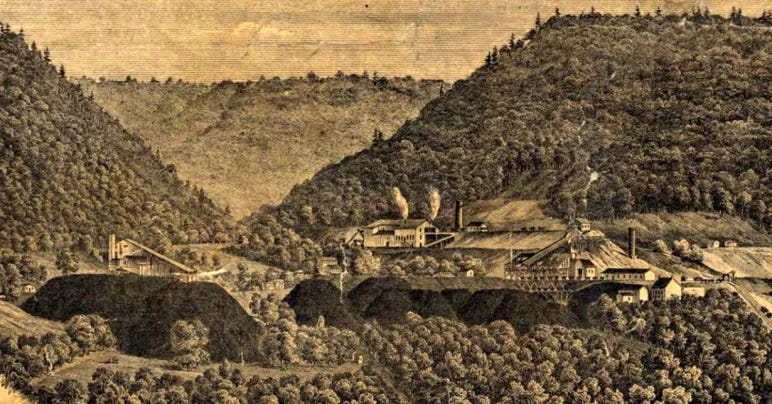
Surely, for part of the journey, the Count and his party followed the path of what is today’s Route 209, which runs through Lykens Valley and ends at the east bank of the Susquehanna in Millersburg, PA. No roads then, only Indian trails and animal paths. Did they pass through Bear Gap near Wiconisco Creek, where, in the 1850’s, the Welshman Henry Thomas would build his Lykens Valley empire thanks to his lease on the Wiconisco mines? Did the railroads being built in Thomas’s day trace the same paths as ancient Indian trails? Perhaps, perhaps.
A century-and-a-half later, a few days after September 11, 2001, I travelled that route with my mother and sisters. I was supposed to be at work in France, but airspace over the United States was closed and no planes were taking off. My Aunt Jean was dying of cancer, living at Luther Ridge outside Pottsville. We were taking a break from our cares and worries, on an excursion to Benigna’s Creek Winery in Klingerstown, PA.
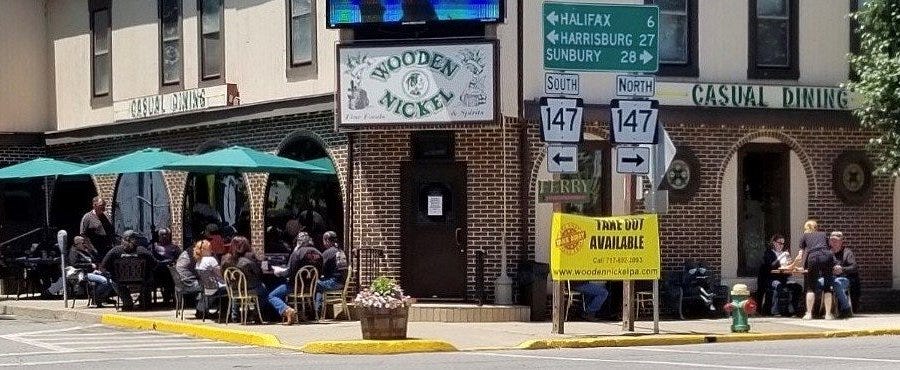
Benigna’s Creek, named after Benigna Von Zinzendorf because she and the Count passed that way. It was a perfect September day, the air crisp, the sky blue, an ideal day for heading west towards the Susquehanna. We drove by Amish farms, through mountain gaps and thick forests, visited the winery, and ended the day at the Wooden Nickel in Millersburg, on the river’s east shore. Seafood platters for everyone.
On the return trip, we took the most direct route home, Route 209, and drove through Wiconisco, PA. It was dusk. The town sits back from the road, beyond Wiconisco Creek, a few streets in the shadow of the mountain, looking forlorn at sunset.
I pick up a stitch I dropped: Edwards Avenue. The Count, Benigna, Anna Nitschmann and Conrad Weiser, Shikellamy and the First Nations, Necho Allen, Henry Thomas, the Mammoth Vein, anthracite, its rise, its fall, our rise, our fall, the dismal lack of preparation for transition, the short-term greed, and all the good things, the good people, the good institutions like the Pottsville Free Public Library, the memorable places like Lakewood Park—without all that, Edwards Avenue would not exist, at least, not as a part of me.
I do not believe in tell-all confessions. A life-story is much more powerful when it intersects with history, with family stories and memories, with everything and everyone touching our lives.
Their name was not really Hornberger. Do you remember them? Three weeks ago, my very young friends and I were in their kitchen eating sugar cookies fresh from the oven. We had shown ourselves in, opening the back door, one of those wooden screen doors with a few decorative curlicues set in the frame. It slapped shut with a bang. That’s how the Hornbergers knew we had stepped inside.
We never gave a thought to bothering them. We just assumed they were waiting for us. That’s why they threw us a party, the best ever, my ideal of everything a party should be, but almost never is. Yes, as far as parties go, the Hornbergers spoiled me for life.
I don’t remember the occasion. I don’t even know if there was an occasion. All I remember, it was summertime. A summer party in the Hornbergers’ backyard. They invited all the kids on the block. I was feverish with excitement and the party was so much fun I thought I would burst with happiness. We played games I had never played, and they were unforgettable. It was so much fun that as I write, I can conjure up the feeling of being there.
So, imagine this. As in so many coal-region backyards, close to the cellar door you have a pole with a clothesline attached, a rope running all the way to another pole at the back gate. Once upon a time, the poles were painted dark green or gray, but the paint has peeled and flaked and now they are rusty and rough to the touch. On Monday mornings, women come outside with wicker baskets and a clothespin bag filled with split wooden pegs. They meticulously hang the wash on the line. The wind and the sun do the rest.
Now imagine that clothesline free of wash and in its place, at regular intervals (just enough space for a child to stand shoulder to shoulder next to another), a string with one end tied to the line, and the other deftly attached to a Saltine cracker. Though the distance between each string is the same, some strings are longer than others, placing crackers at varying distances from the ground.
Mrs. and Mr. Hornberger tell us to line up, each child in front of a cracker at about head level. We scatter and try to find the one best corresponding to our size. We step up, we get ready. Mr. Hornberger blows a whistle. Go!
The goal is to eat that Saltine cracker, keeping our hands clasped behind our backs. Then, once we’ve swallowed, to purse our lips and produce a clear, pure whistling sound.
I did not win, but I had so much fun trying. First of all, just getting that Saltine into my mouth was a challenge. Remember, no hands. It kept getting away from me. I was too small to gulp it down in one bite. And I was only learning to whistle. Once I ate the cracker, my mouth and throat dry, I puckered my lips but did not produce much more than a sputter. I did my best, I tried. A big boy won. His name was Wesley.
Were there prizes? I can’t remember. I was having too much fun.
Then, there was the spoon relay race. We lined up in teams, with half the members of each team standing near the house, the other half, at the bottom of the yard. Mrs. Hornberger handed out tablespoons we had to hold in our mouths, parallel to the ground. Then Mr. Hornberger placed a raw egg on the tablespoon of the first member of each team, waiting at the starting block at the top of the yard. From there, we had to run (!) to the bottom of the yard without letting the egg fall and break. There—I can hardly imagine this as possible, we transferred the egg—no hands allowed—to the spoon of an awaiting team member, who ran the same course in the opposite direction, until every member of our team took a turn. Eggs broke. We jumped and got red in the face with excitement. Did any team succeed? Again, I can’t remember. We were too caught up in the fun.
I did not participate in the burlap-bag races. That was for the bigger kids. But I cheered them on and had just as much fun. They crawled in a burlap bag, held it up with their hands, and then jumped their way down the backyard to the finish line. Some tumbled to the ground and struggled back to their feet; others tumbled and simply rolled the rest of the way. A few ran the full course without a fall.
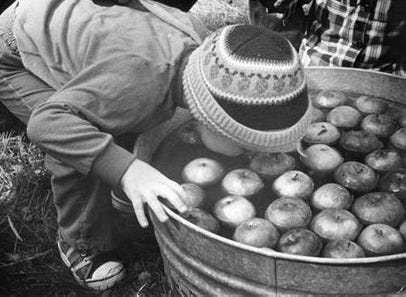
We also dunked for apples, my first time. It was scary, the thought of plunging my face into the icy water of a big ash tin scoured clean for the occasion. I remember being on my knees on the grass, dunking my head, unable to breathe, but hellbent on getting my little teeth into one of the bobbing apples. I did. A childhood moment of triumph.
Were there treats? Did we eat? With all that running around, what did we drink? I was a child extremely preoccupied by food and what surprises me today, I can’t remember. Food is not important when you are experiencing perfect happiness.
Thank you, Mr. and Mrs. Hornberger.
Comments
Nothing yet. Say the first thing.
Sign in to join the conversation.