
Hi everyone!
First, a quick reminder: Naavik will be at Gamescom this year! If you’d like to connect and learn more about how Naavik can support your team, please reach out here.
Moving onto our newsletter — in our inaugural issue, we deeply analyzed mobile F2P’s H1 2026 performance and what it means for the future of the industry. In today’s issue, we do something similar, but instead take a closer look at one of mobile gaming’s most enduring subgenres: 4X Strategy.

Highway Racer Pro hit #1 in the U.S. with zero paid marketing. When launch day traffic surged past forecast, Heroic Labs’ engineers handled troubleshooting, allowing Spektra’s small team to focus on the racing their game deserves, not worrying about whether the backend can hold.
Written by Max Abrahamsen, Consultant at Naavik, and Abhimanyu Kumar, Naavik’s Co-founder

Compared to mobile F2P and its parent genre, Strategy, 4X Strategy’s H1 2026 performance looks impressive. 4X Strategy downloads rose by +5% YoY (+18M), while total mobile F2P fell by -12% YoY (-3B) and Strategy by -3% YoY (-29M). IAP revenue was also up +5% YoY (+$193M), compared with declines of -2% YoY (-$0.6B) for mobile F2P and -5% YoY (-$319M) for Strategy.
However, these six-month totals conceal a sharp quarter-over-quarter decline within H1 2026. The subgenre peaked during Q4 2025 and has since declined, with H1 2026’s YoY growth being concentrated in Q1. During Q2 2026, 4X Strategy’s downloads fell -27M QoQ (-12%) versus -5% across mobile F2P and -9% for the Strategy genre. Revenue declined similarly, dropping -$195M QoQ (-10%) versus -6% across mobile F2P and -11% for the Strategy genre. Notably, 4X Strategy accounted for approximately half of the Strategy genre’s revenue decline.
Examining the potential reasons for the deterioration of mobile F2P’s largest revenue-generating subgenre over H1 2026 is where 4X Strategy’s analysis gets interesting. Let’s jump in.
Data caveat: Throughout this article, data excludes DTC, China Android, and ad revenues. Also, the market size figures come from Sensor Tower’s “Market Size” feature, which covers a subset of the entire mobile gaming market. While the aggregate numbers are smaller than the broader mobile gaming market, we’ve confirmed that this subset is representative of broader market trends. We’ve also flagged where to keep the missing DTC revenue in mind when studying broader subgenre trends.
4X Strategy’s +18M YoY downloads increase during H1 2026 was not really concentrated on a particular platform or region. The relatively minor +5% YoY growth hints towards substantial title-level movement beneath the surface. Roughly 40% of all tracked 4X Strategy titles grew at various intensities, adding +150M YoY downloads. Around 50% saw small to large download drops, collectively driving a -131M YoY decline. The remaining 10% were flat. However, what’s interesting to note is what kinds of titles drove growth and which declined.
When slicing the data by title launch year, it was primarily new 4X Strategy launches over the last two years that added +112M downloads and drove the subgenre’s H1 2026 downloads growth. This included titles like X-Clash (+26M), Kingshot (+18M), Tiles Survive! (+17M), Last Light (+15M), Last Asylum (+14M), and more. Some of these games launched after H1 2025 (adding downloads to H1 2026 versus zero contribution to H1 2025), while others continued to scale UA over H1 2026.
On the other hand, 4X Strategy’s older portfolio (pre-H2 2024) offset -94M downloads of that growth. This included games like Lords Mobile (-13M), Total Battle (-11M), Dark War: Survival (-10M), Last War: Survival (-8M), Evony (-8M), among others. Some of these games are long-standing incumbents that are naturally unable to scale UA to the same degree as newcomers, while others scaled rapidly during 2025 but could not sustain that pace into 2026.
On the revenue side, ~30% of all tracked 4X Strategy titles grew at various intensities over H1 2026, adding +$962M in YoY IAP revenue. Around 45% declined, collectively removing -$769M, while the remaining ~25% were flat. The revenue story was similar to downloads; the subgenre’s older portfolio absorbed ~70% of the newer games’ revenue growth, leaving 4X Strategy up +$193M YoY over H1 2026.
More specifically, newer titles released over the last two years added +$620M YoY in H1 2026, while older titles took away much of that growth (-$425M YoY). Kingshot was the major growth contributor (+$403M), given its early 2025 launch and rapid UA scaling since. Last Z was another bright spot (+$193M YoY) — it technically belongs to our definition of the older portfolio due to its mid-2024 release, although it truly began scaling over 2025, and the game’s H1 2026 results inherited that marketing momentum. However, established incumbents declined significantly. Last War: Survival saw steep declines in downloads, MAU, and ARPDAU over H1 2026, resulting in a significant -$135M YoY (-17%) decline. Whiteout Survival was also down -$126M YoY (-16%) due to declining MAUs, primarily driven by falling downloads.
Based on the graphs and notes above, two observations emerge:
4X Strategy’s performance would’ve been flat to declining if not for newly released titles that successfully scaled UA during their launch years, thereby driving up overall subgenre revenue.
For older 4X Strategy games, sustaining revenue seems to require regular top-of-the-funnel replenishment through stable new- and returning-player-focused UA strategies — especially when new competitors appear. Keeping long-term retention healthy and improving ARPDAU could even result in growth.
The above represents why we found 4X Strategy’s downloads and revenue deterioration over H1 2026 surprising. As a reminder, between Q1 and Q2 2026, 4X Strategy’s downloads fell by -27M (-12% QoQ) and revenue by -$195M (-10% QoQ).
On performing a revenue-weighted analysis of which metrics drove 4X Strategy’s revenue decline over H1 2026, a broader DAU deterioration drove ~73% of it, ~92% of which was attributable to new user acquisition and ~8% came from natural erosion of existing users. The remaining ~27% was attributable to lower ARPDAU over the period.
This demonstrates the critical role of UA in sustaining overall 4X Strategy health — and over H1 2026, UA didn’t play that role very well. Among the subgenre’s top 100 U.S.-grossing games over H1 2026 (representing ~98% of U.S. subgenre revenue), 81 games were running UA in 2025, and 68% of them recorded YoY declines of at least -10% in their U.S. UA channel impression share. Quarter over quarter, 8 of the top 10 grossing saw a similar intensity of impression share declines in the US. Further, 54% of all new releases, and 60% of all old games also recorded impression share declines of at least -10% in the US.
While this does not mean that the top 100 grossing 4X Strategy games stopped acquiring users altogether, it indicates that many of them were no longer investing in UA with the same intensity as before. This could be an early and critical indicator that 4X Strategy’s ability to acquire users with its current UA tactics is beginning to weaken in a new UA environment that’s rearing its head more prominently over 2026.
There is likely no single explanation for this UA pullback over H1 2026, but here are a few factors we believe could be contributing.
#1 – A Contracting Mobile Downloads Market: Mobile downloads fell by -12% YoY during H1 2026, despite gaming ad spend increasing by +8% and impressions by +14%. Publishers likely spent more to compete for a shrinking pool of installs, putting pressure on acquisition costs and weakened returns. For top-grossing 4X Strategy titles, such UA conditions could’ve made previous levels of marketing investment increasingly difficult to justify.
#2 – Midcore Impression Share is Increasingly Consolidating: As mentioned in our H1 2026 mobile F2P analysis, AppLovin and AdMob now control roughly two-thirds of mobile gaming’s ad revenue. This percentage moves up to ~75% when looking only at midcore genres, and consolidation accelerated over H1 2026. 4X Strategy lives within and also acquires new users more broadly from midcore subgenres. Therefore, as midcore’s ad impression share increasingly consolidates around fewer networks, 4X Strategy publishers increasingly compete within a more concentrated auction pool — not only against one another, but also against advertisers across other midcore subgenres. That, of course, could put more pressure on 4X Strategy’s H1 2026 UA economics.
#3 ‒ Non-midcore Subgenres are Competing with 4X Strategy for Impression Share Too: The point above also extends to non-midcore subgenres, whose impression shares are increasingly consolidating towards AppLovin and AdMob too. This can be seen in the graph below, where non-midcore subgenres like Match Merge 2 and Sort have contributed to 4X Strategy’s declining impression share over 2026, likely driven by rapidly scaling games like Gossip Harbor (Match Merge 2) and Pixel Flow (Sort).
Taken together, these market factors could’ve created tougher UA conditions for 4X Strategy — a subgenre that has historically relied on UA for stability and growth. While both new and old games seem to be impacted, new titles at least have a novelty factor to combat the evolving UA environment. On the other hand, older games have already spent years running UA profitably at scale. For them, as the most receptive audiences are gradually acquired and re-targeted, reaching additional high-value players can become increasingly difficult. Therefore, older titles might generate better returns by prioritizing retention and monetization improvements.
That said, acquisition is only the beginning of 4X Strategy’s modern commercial funnel, which we covered here. Broadly appealing advertising and highly accessible onboarding must ultimately convert players into the deeper 4X experience. Pressure at the acquisition stage of the funnel will therefore affect each game differently depending on how well the game has executed on the stages that follow.

This part of the analysis will focus on the four 4X Strategy titles that clearly dominated the subgenre’s revenue ranks over H1 2026 — Last War: Survival, Whiteout Survival, Kingshot, and Last Z. Interestingly enough, each of these titles seems to be tackling 2026’s UA environment slightly differently.
#1 ‒ Last War Might be Retrenching: No title contributed more to 4X Strategy’s Q2 2026 contraction than Last War: Survival. IAP revenue fell from ~$406M in Q1 to ~$278M in Q2 (-32% QoQ), accounting for approximately two-thirds of the subgenre’s quarterly revenue decline. This has primarily been a function of the game taking two very questionable steps in 2026:
UA seems to have been effectively turned off since May 2026. The game reported near-zero impression share on Sensor Tower over the last three months, with slow UA reductions since January 2026. This, combined with natural existing audience erosion, impacted the game’s MAU curve, collectively driving ~72% of the game’s quarterly revenue decline over 2026. MAUs might settle at a core audience baseline over time.
The developer also reduced the game’s monetization pressure in April 2026 by removing a broad selection of purchase opportunities, which impacted the game’s ARPDAU baseline. This move coincided with a Discord message titled “Returning to Our Roots”, where the developer informed players that they agreed with player feedback around how “the constant pace of spending has started to feel overwhelming”, and took action by making “adjustments to some packs, events, and certain purchase entry points, as well as how they are presented in the game”. While this move might’ve been spurred by the game’s ARPDAU gradually declining over 2025 (as the active user base grew), the developer ended the letter in a very telling way: “We know this kind of decision might be confusing. It goes against the usual logic of this industry, and it means accepting some very real costs on our side. Some people may not understand it. Some may feel that these are only words. We understand that some people may see it that way. But if we don’t take even this step, then talking about returning to our roots means nothing at all.”
While we cannot be absolutely certain why Last War: Survival is going down this seemingly self-sabotaging route after dominating the subgenre since 2024, a possible (optimistic) hypothesis is that the game might simply be retrenching – scaling back UA to potentially wait out a harder UA environment, doubling down on improving retention of its most valuable players in the meantime, and evolving the monetization strategy in a way that fits the lifecycle stage of the game. After all, not many 4X Strategy games last forever, and 2026’s UA environment might be making Last War: Survival realize that truth even more. If the hypothesis is true, the key question for Last War: Survival will be whether this approach can minimize established audience churn without sacrificing too much revenue in the process.
#2 ‒ Last Z is Cautiously Returning to Acquisition: Last Z followed a similar UA playbook to Last War during its initial scaling phase. But starting from Q4 2025, ad impression share started to weaken. Interestingly enough, Q4 2025 was also the time Last War: Survival made a major (and possibly last) UA push, which could’ve impacted Last Z’s impression share figures. Fortunately, this Q4 2025 movement did not bubble up to the game’s downloads and MAU curves. However, during 2026, Last Z significantly scaled back UA efforts, which drove half of the game’s quarterly revenue decline. The other half was driven by lower ARPDAU in Q2 2026, which is also when Last Z cautiously started turning UA back on.
The game’s new UA strategy seems to revolve around reducing its focus on AppLovin and AdMob, and instead trying out new channels like TikTok and Moloco. However, the game’s creative strategy hasn’t changed much. Overall, it seems like Last Z has simply chosen to replenish its lost user base by trying a new channel mix. Although given the ARPDAU weakness coinciding with increased UA, it seems like the game might need to go back to the drawing board to find a new growth strategy.
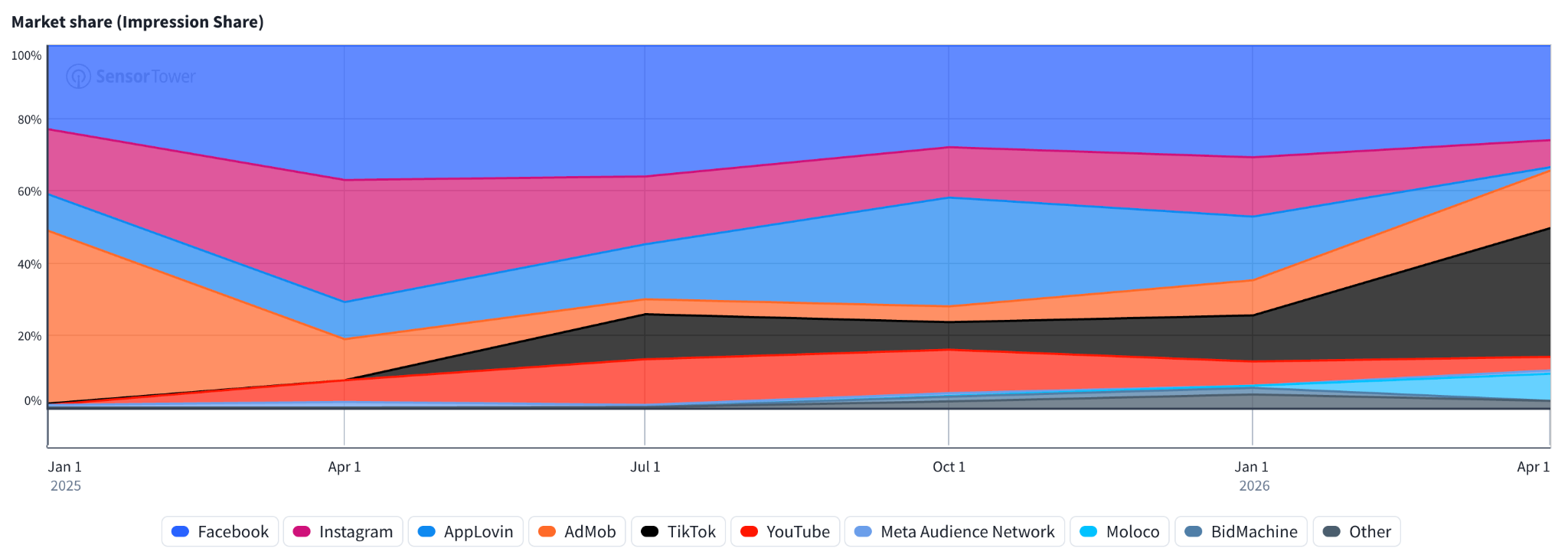
#3 ‒ Century Games Focused on ARPDAU Improvements: Unlike Last War: Survival and Last Z, Century Games took a very different path with Whiteout Survival and Kingshot to combat weakening audience metrics over H1 2026.
Whiteout Survival’s quarterly revenue did not decline in H1 2026. It increased from ~$318M in Q1 to ~$325M in Q2 (+$7M, +2% QoQ). Under the hood, the game did see downloads deteriorate over the same period, and MAU followed. However, this new-user-driven decline was more than made up for with a very healthy ARPDAU over H1 2026. The game did not change much with its UA channel or creative mix either. In other words, if the game did not see healthy ARPDAU, its new user decline would’ve driven a roughly -$23M quarterly loss.
Kingshot showed a similar story over H1 2026. The game’s revenue increased from ~$236M in Q1 to ~$255M in Q2 (+$19M, +8% QoQ). This was primarily because the game’s downloads decline was more than made up for by healthy ARPDAU. If ARPDAU wasn’t healthy, the game would’ve seen a roughly -$20M quarterly revenue decline due to reduced new player supply. That said, the key difference in Kingshot’s story is that it is still in the early innings of its lifecycle, which means it’s likely getting significant backing from Century Games’ UA warchest. This is probably why it was also able to fly above H1 2026’s harder UA environment and maintain a relatively stable impression share throughout the period. It may also be why Whiteout Survival’s impression share dropped to a new baseline in 2025, when Kingshot launched and took the company’s spotlight.
4X Strategy remains mobile gaming’s largest subgenre by IAP revenue (~15% share). But the subgenre’s deterioration over H1 2026 raises questions about the growth model behind it. While top 4X Strategy publishers seem to be reacting to the evolving UA environment in different ways, how long the current UA environment persists through 2026 and 2027 will determine how 4X Strategy will fuel its next stage of commercial growth.
That said, and on a more encouraging note, this is not the first time that changing market conditions have forced the subgenre to adapt. Since 2010, 4X Strategy has cycled through four generations. Each generation thrived under its market conditions while standing on the shoulders of the previous generation to strengthen the subgenre’s fundamentals. This can be seen in the image below, where the table showcases how Generation 4 utilizes all the goods from previous generations while adding something new on top.
While the subgenre is currently in Generation 4, the UA environment pressures visible in H1 2026 could be creating the conditions for an imminent Generation 5. If the consolidation of ad impression volume becomes more permanent, we believe 4X Strategy will need to:
Focus its marketing efforts on either stronger differentiation or net-new user pool unlocks — both difficult endeavors, with the former likely being slightly easier than the latter.
Focus its product efforts on finding new ways to either monetize highly valuable acquired users for longer periods of time or simply improve long-term retention — again, both tough nuts to crack; the latter is especially a long-standing untapped area of the subgenre, and we sometimes like to call it one of 4X’s last battlegrounds.
In other words, 4X Strategy’s era of acquisition at any cost may currently be facing some headwinds, but that may not necessarily be a long-term threat for a subgenre with a long history of successfully adapting to disruption. It may instead be the catalyst for its next evolution. What form this evolution takes remains uncertain, but innovation will likely be required across both marketing and product.
Written by Max Abrahamsen, Consultant at Naavik
The UK Competition and Markets Authority has proposed allowing iOS developers to direct users outside their apps to complete digital purchases. Apple could still charge a fee on those transactions, but, according to regulators, the terms would need to be fair, reasonable, and make steering commercially viable for developers. Apple argues that these restrictions would amount to price regulation and give the CMA an intrusive role in determining how it monetizes the App Store. The consultation has closed, and the regulator is assessing responses before reaching a final decision.
For mobile game publishers, the value of steering will be determined less by the right to link externally than by the fee Apple is allowed to charge. A sufficiently low fee could make webstore discounts worthwhile, improve margins, and give publishers more control over pricing and player relationships. If the fee remains close to Apple’s existing commission, those benefits could be absorbed by payment-processing costs and the added friction of moving players outside the app. The CMA is therefore tackling the most important weakness in similar reforms: payment choice means little when platform fees make the alternative commercially unattractive. Its final framework will determine whether external payments become a meaningful monetization route in the UK or mainly a formal compliance option. Similar disputes have played out internationally, most directly in the EU and U.S., while South Korea and Japan have adopted their own alternative payment regimes. Across these markets, the argument has increasingly shifted from whether alternatives must be permitted to whether Apple’s fees and conditions make them commercially viable.
AppLovin reported Q2 revenue of $1.92B, up 53% YoY but slightly below expectations, while its Q3 outlook also disappointed. Management attributed the shortfall to a quarter with fewer meaningful improvements to its advertising models, saying the company “fell short of that standard.” However, a significant model upgrade launched shortly after the quarter ended, and management said Q3 started strongly. This suggests the weaker quarter may have reflected the timing of model improvements rather than softer advertiser demand.
AppLovin remains one of the most important user acquisition and monetization platforms in mobile gaming, and 53% YoY revenue growth demonstrates the continued strength of its advertising business. The sharp share-price decline reflects the exceptionally high expectations embedded in AppLovin’s valuation more than a meaningful deterioration in its competitive position or product capabilities. Slower growth in gaming advertising and fewer model improvements are worth monitoring, but one weaker quarter provides little evidence that AppLovin’s competitive advantages have diminished. Such reactions are common when high-growth companies deliver strong results that nevertheless fall short of Wall Street’s expectations.
Krafton delivered record second-quarter revenue and operating profit in Q2 2026, driven by the PUBG franchise and Subnautica 2. Revenue rose 95% YoY to ₩1.29T ($899.5M), while operating profit increased 67% to ₩410.9B ($286.5M). PC was the main growth engine, with revenue up 155% to ₩560.4B ($390.8M), helped by Subnautica 2 selling more than five million units within 22 days of its early access launch. Mobile remained Krafton’s second-largest platform, generating ₩451B ($314.5M), up 6% YoY, as PUBG Mobile and Battlegrounds Mobile India continued to grow.
PUBG Mobile remains a durable asset, and the next mobile growth lever is turning PUBG from a hit live-service game into a creator-led content platform. World of Wonder has already produced more than 5.4M user-created maps, and planned Naruto and Spider-Man collaborations should bring more players and creators into that ecosystem. If Krafton can pair stronger creation tools with meaningful monetization opportunities, PUBG Mobile can expand its content supply without relying solely on internal teams and licensed events, improving engagement and extending an already unusually long lifecycle.
Playtika generated $731.1M in Q2 revenue, up 5% YoY, while DTC platform revenue increased 63.1% to $286.9M. Disney Solitaire generated $142.4M during the quarter, up 15.5% sequentially and 288.6% YoY, putting it close to Bingo Blitz’s $145.1M quarterly revenue (down 10% YoY); SuperPlay also became a positive adjusted EBITDA contributor.
Playtika is now generating almost $287M per quarter through DTC, demonstrating how meaningful webstore migration has become for large mobile publishers. Disney Solitaire is also strengthening Playtika’s results, but its growth has required substantial upfront investment. Playtika front-loaded user-acquisition spend into H1, partly because SuperPlay’s earnout incentivized early investment, and now plans to reduce that by roughly 70% in H2. Management expects Disney Solitaire’s revenue to decline sequentially as a result, but says strong retention should allow the game to remain profitable on the players already acquired. Meanwhile, Playtika’s acquisition terms require up to $1.25B in additional cash payments tied to SuperPlay’s revenue and EBITDA through 2027. A reported sale to Tencent could provide cash and reduce these obligations, but would also surrender Playtika’s strongest growth asset.
A U.S. court has ordered Papaya Gaming to pay $719M to Skillz Platform after an April jury found Papaya liable for false advertising and unfair business practices. Skillz alleged that Papaya used bots to simulate human opponents while marketing its cash-based mobile games as fair, skill-based competitions. Trial evidence showed that Papaya’s bots outnumbered human players between 2021 and 2024. The court selected the $719M disgorgement of unjust profits instead of the jury’s earlier $420M damages award, since Skillz can recover only once for the same injury. It also denied Papaya’s post-trial challenges and awarded Skillz approximately $10M in legal fees. Papaya says it is considering an appeal, while Skillz cautions that further proceedings could affect when or how much it ultimately collects.
The judgment is a major warning to cash-prize mobile game operators that opponent matching is not merely a product-design choice. When players are told they are competing against people, undisclosed bots can expose the operator to substantial liability if they affect prize distribution or spending behavior. That makes clear disclosure and auditable matchmaking essential for any studio using simulated players in monetized competitions. The size of the award could also intensify scrutiny of the wider skill-gaming category, where trust is already central to acquisition and retention.
H1 2026 Gaming Digital Market Index (Sensor Tower): “The cross-platform snapshot shows the pattern clearly. Worldwide mobile IAP finished around $40B, down 2% year over year, while mobile playtime held at 221B hours. Downloads told a different story, falling 12% to 24B.”
5 Numbers Hiding in Plain Sight: Sensor Tower’s Ad Monetization Report (Deconstructor of Fun): “I spent half an hour with Sensor Tower’s Lead Analyst, Sam Aune, working through the charts. Five surprising numbers came out of it. Some are buried in the body copy. Some you only get by dividing two of Sensor Tower’s own figures together. Most importantly, none of them are on the summary slide.”
GTA has made over $100m on mobile – and now Tencent, Garena and more are moving onto Rockstar’s turf (Mobilegamer.biz): “With the GTA 6 launch looming large over the entire games business, we’ve had a look at Rockstar’s own games and the wider ‘GTA-alike’ category on mobile to see which other studios are trying to ride the wave of hype coming our way this November.”
The industry makes great games, but nobody can find them (gamesindustry.biz): “The workgroup found that the reason why the discoverability problem hasn’t been fixed is because the solution would be expensive, risky, and go against the short-term interests of almost every party involved. And there’s a deeper issue underneath the discoverability problem: the industry may simply be making too much, and too little of it matters.”
How SayGames uses game analytics to balance difficulty in hybrid puzzle games (pocketgamer.biz): “In one case, we experimented with adjusting the balance of levels without redesigning them. By slightly softening parts of the difficulty curve, the overall pacing of the game improved. Levels felt less frustrating, and the progression through the game became smoother.”
Naavik’s team of experts has helped over 300 companies — publishers, studios, tech companies, and investors — succeed across the video game industry. We’d love to work with you too! Here’s how we can help, spanning all platforms, genres, and regions:
Strategy Consulting: Market research, corporate strategy, game and economy design, gamification, live-ops strategy, AI strategy, product management, brand and performance marketing, and more.
M&A and Investment Advisory: Expert commercial due diligence for buyers, fundraising support for sellers, and fractional CFO/CSO services.
Fractional Talent: The one-stop shop for top-tier fractional talent covering dozens of game industry roles — analytics, design, marketing, art, QA, and more.
Check out the links above to learn more. If you'd like to discuss how Naavik can support your team, click the box below or send us a note at consulting@naavik.co.
No posts
Comments
Nothing yet. Say the first thing.
Sign in to join the conversation.