
Hi everyone!
In this week’s AI x Gaming newsletter, we look into China’s pragmatic approach to applying AI in game development, pushing beyond efficiency to explore AI as a major opportunity to reshape its competitive position.
Also, a final reminder that the Naavik team will attend Gamescom on August 26 and 27. Reach out if you’d like to meet, discuss the AI ecosystem, or explore working with Naavik.

Only 6.5% of playtime goes to new titles, even as the gaming industry grows 7.5% a year. Retention decides who wins.
The next generation of gaming will be powered by intelligence, not just content.
The problem: player data is scattered across telemetry, social, transactions, storefronts, support, and platform identities. Most studios struggle to answer the basics — who is this player, what do they care about, and how do we grow their value? Fragmented systems make it difficult to create a complete view of each player.
AI-driven Player 360 transforms this data into real-time intelligence, helping studios understand player behavior, predict churn, personalize experiences and optimize monetization. By integrating unified data, cross-platform identity resolution, scalable AI models and real-time analytics into the core infrastructure, studios can move from simply understanding what happened to anticipating what happens next. It can even trigger in-game decisions, turning prediction into a personalized, in-session offer.
The result? More adaptive gameplay, smarter engagement, stronger retention, higher lifetime value, and greater operational efficiency.
Discover how AI-driven Player 360 is powering the next generation of gaming!
Written by Mark Ma, Naavik Contributor and Principal Strategist at JM APAC Strategies
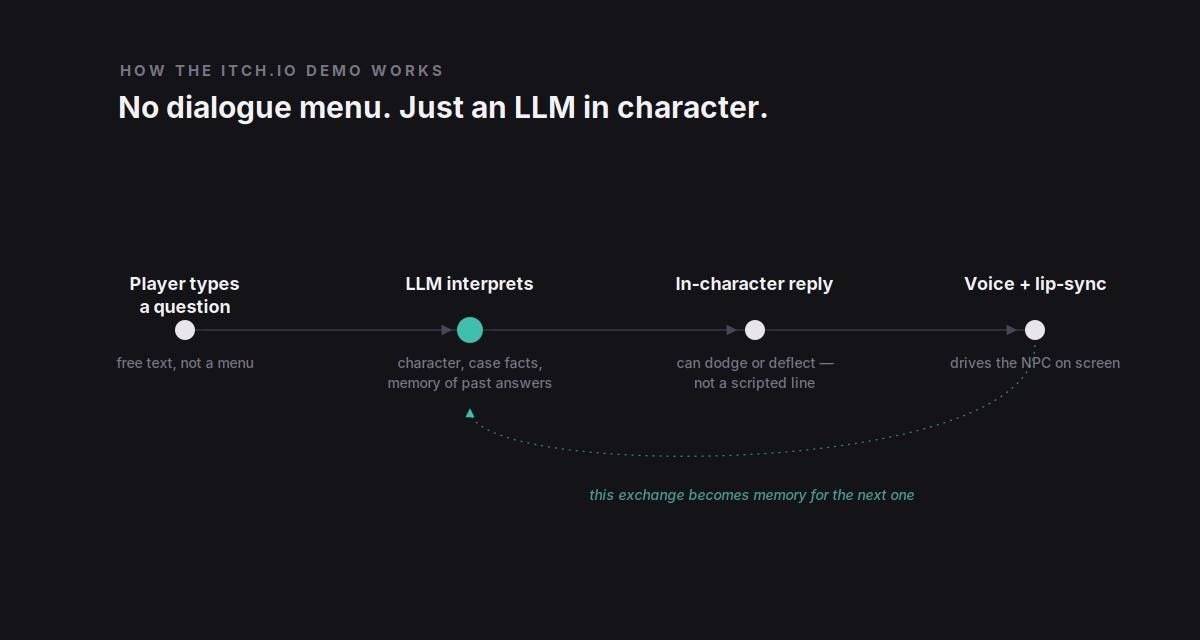
I recently tried an AI-driven detective puzzle game that an independent Chinese developer released on itch.io. The concept is simple enough: playing the role of a detective, you interrogate suspects powered by a large language model that allows them to improvise in character with spoken audio to keep you off balance, requiring you to sift through their answers to solve the crime. The visual presentation still feels a bit rough, and the core mechanic comes across as incremental rather than groundbreaking. Yet, it signals a broader shift: in China, integrating AI directly into core gameplay has evolved beyond isolated experiments; it is now a systemic trend.
Ever since generative AI emerged, Western game developers have primarily focused on copyright concerns, ethical questions, and fears over job displacement. In contrast, studios in China pivoted to a more pragmatic question: how can AI drive practical results? Today, it’s clear that AI is already helping Chinese developers reduce operational costs and streamline production. Yet rather than stopping at efficiency, they continue to push boundaries, investing heavily in unproven, forward-looking applications.
Whenever AI is brought up, a sense of lingering anxiety seems to shadow the Western gaming scene (more so than other industries). The 2026 GDC State of the Game Industry survey found 52% of developers think generative AI is hurting the industry — up from 30% a year earlier and 18% the year before that. As that sentiment has taken hold, AI’s rollout in the West has faced noticeably higher resistance. Most notably, Steam makes developers disclose AI use, and more than 7,300 games had a label as of March. Larian promised to drop generative AI from the concept-art phase of its next game after fan backlash. Call of Duty: Black Ops 7 caught complaints over its AI-made calling cards too. AI still slips into backend work — EA’s Battlefield team runs LLMs to catch duplicate Jira tickets, for instance — but the moment the output lands in front of players, the backlash gets noticeably louder. Many companies are bending the knee as a result.
In China – not unlike mature Western markets – rising development and user acquisition expenses are squeezing margins, and hit rates are falling as companies increasingly compete for existing audiences. However, in response to these pressures, China’s game industry is moving at a completely different pace.
Looking at distribution, Tanwan Games reports an AI adoption rate surpassing 80% across art creation and ad targeting. Similarly, 37 Interactive’s 2024 annual report indicates that AI produces over 80% of its 2D art and assists in more than 70% of its ad video creation.
In core gameplay, AI integration is already directly embedded into major titles. NetEase’s Justice Online markets its dynamic, AI-driven NPCs as creating “a Jianghu that breathes,” while Giant Network’s Supernatural Squad recorded over 25M matches against AI opponents during its launch week.
When it comes to art pipelines, Tencent’s VISVISE platform stands out. Character rigging traditionally took one to three and a half days, while generating a ten-second skeletal animation required three to seven days. VISVISE accelerates character rigging by more than 8x and has been deployed across nearly 100 projects, including flagship titles like Honor of Kings, League of Legends: Wild Rift, PUBG Mobile, and Teamfight Tactics. Beyond a mere feature set, its true strength lies in execution: developed hand-in-hand with the PUBG Mobile production team, the core GoSkinning module (v4.2) was tailored to overcome practical hurdles such as skirt physics and four-legged rigging. Such close integration with an active pipeline provides a competitive advantage that off-the-shelf software would struggle to match.
Gamma Data estimates AI could add ¥53.3–84.6B (roughly $7.9–12.6B) in new market value for China’s game industry. Net profit across the industry is projected to grow from roughly ¥111.37B ($16.5B) in 2026 to ¥162.66B ($24.1B) by 2030, with AI as one of the major drivers.
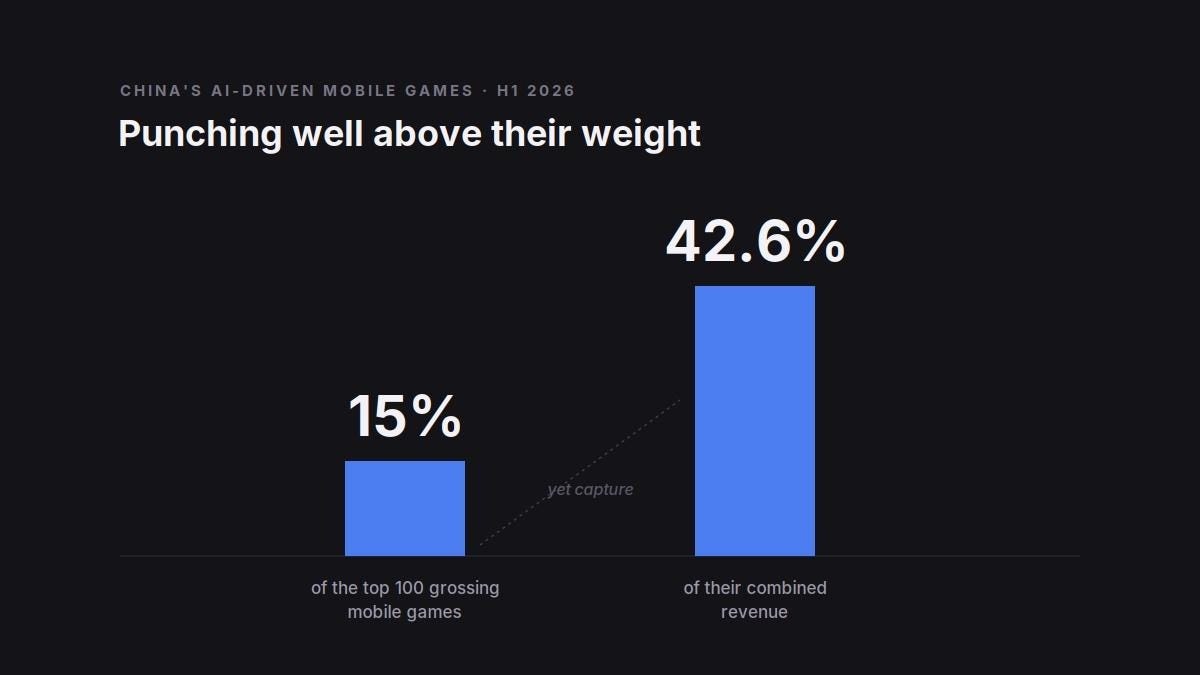
Among China’s top 50 game companies by revenue, 80% have disclosed AI plans publicly, and 56% have built dedicated labs or teams. A 2025 Niko Partners survey puts AI usage at around 60% of Chinese studios. In the first half of 2026, AI-driven titles were just 15% of China’s top 100-grossing mobile games, but they generated 42.6% of the revenue. This also reflects strong products and mature teams that are better positioned to leverage AI, rather than just newer entrants.
However, we’re also starting to see examples of new games that benefit from more efficient AI workflows. For example, 37 Interactive’s AI-native mini-game, Heart of the Moon Palace, would normally have required a development cycle of six months or more. But with AI helping drive the story and art, a team of just two or three people shipped it in about 10 days instead.
Clearly, AI adoption is not just a future promise. It is actively driving revenue, reducing costs, and expanding user engagement. In a landscape where rapid execution is critical, China’s gaming sector has responded by swiftly scaling and industrializing AI workflows.
When AI adoption becomes universal, and its capabilities are widely understood, how do teams gain a true competitive edge? miHoYo’s strategy illustrates one extraordinarily bold approach to this dilemma.
miHoYo co-founder Liu Wei said in May that the company plans to invest up to ¥100B (roughly $14.8B) over the next three years, building its own training systems, GPU clusters, and models from scratch, with NPC intelligence and content generation as the main targets. An early test case is Petit Planet, a life-sim title currently in beta testing designed with persistent-memory NPCs that adapt their behavior based on past interactions. For instance, helping a villager find a misplaced toolbox earns the player pest-resistant seeds the following day, whereas declining to help results in higher tool prices down the line. He didn’t dress it up: “Even if it doesn’t work out in the end, we accept that. Think of it as fireworks.”
That’s a lot of money! For a pure-play gaming company, it’s a huge bet worth at least two years of company profits. As such, it also represents genuine risk. A 2025 survey from the China Audio-Video and Digital Publishing Association’s game committee found 22.7% of companies think AI investment isn’t worth the cost; MIT research from the same year found 95% of enterprise generative-AI projects showed no measurable financial return within six months. Liu Wei’s “fireworks” line suggests that the company understands the risk, but that doesn’t make the risk any less material.
Leading Western publishers tend to treat uncertainty as risk to be minimized. Chinese companies, in contrast, are more likely to view missing a major opportunity as the larger danger. This gambling instinct — moving before there’s any certainty — isn’t unique to gaming either. In February and March, the open-source AI agent framework OpenClaw, nicknamed “the lobster,” set off a nationwide craze; by May it had clearly cooled off. The hype outran its own commercial and safety capabilities.
We can spot this urgency in the hiring data. 51job’s 2026 Online Game Talent Insights ranks “AI algorithm/machine learning engineer” and “AI-generated content (AIGC) application engineer” fourth and fifth among the most in-demand roles, both ahead of the traditional “game development engineer” at eighth. The report also found that companies outside the state-owned sector now account for nearly 80% of all hiring across the industry and notes that these firms tend to respond faster to shifts like AIGC. None of this is unique to China, but while much of the world still treats AI in gaming as optional, China’s games industry is already well past the point of no return.
While there are benefits to larger companies like miHoYo (such as redefining how AI-native gameplay and production work at scale), leveraging AI unlocks material advantages for smaller studios and indie developers, who can do more than ever before. Consider a developer who shared a breakdown this May: in just two months of off-hours work and a budget of ¥1,200, they built a complete WeChat mini-game. By dividing the workload among AI systems — using Claude Code for programming, Claude for text, ElevenLabs and Pixabay for audio, and GPT, Gemini, and Doubao for art — a single person handled roles that previously required an entire multidisciplinary team. The end result featured endless levels, friend leaderboards, and daily quests, even if its commercial viability remains unproven. While this phenomenon extends beyond China, the country stands apart due to its sheer volume of developers and their willingness to jump in despite the uncertainty.
Is this momentum likely to continue? Almost certainly. Facing a deceleration, China’s gaming sector has found in AI a major opportunity to reshape its competitive position.
Whether this translates into accelerating market share gains globally remains undetermined, but it would be a continuation of what’s already been happening for years. Currently, AI provides the greatest leverage in mobile development and indie projects (areas where Chinese studios are already well established), but in the long run, expensive AAA productions face the largest competitive threat from business model disruption. I expect a surge in Chinese game production: faster output and broader participation, though not necessarily higher success rates.
Western observers must realize that there is no turning back. Reluctance toward AI in one region will not stall advancement elsewhere. Disparities in adoption speed and openness to innovation will ultimately carry competitive consequences, even if the transition involves missteps or excessive investment. Because the Chinese gaming market regards AI adoption as inevitable, that expectation becomes self-fulfilling, leaving open the question of when Western counterparts will come to the same realization. Of course, not all of the West is entirely lagging (mobile is seeing faster innovation, not to mention the U.S. leads the world in AI research), but console and PC gaming markets in particular are moving at much slower speeds.
As China’s game industry moves forward aggressively, an influx of developers will continue experimenting with these technologies. It remains to be seen to what extent Chinese studios can leverage AI to create novel gameplay experiences — an area where progress currently lags — but their active AI-enabled development at scale will gradually pull the global industry in the same direction.
Written by Devin Becker, Consultant at Naavik
Unity posted $546M in Q2 2026 revenue, up 24% YoY, and CEO Matthew Bromberg called it the company’s best quarter ever — but not due to its game engine. The Grow division, powered by Vector AI, its AI-driven advertising platform, surged 69%. Net losses narrowed from $108M a year ago to just $23M, and the stock jumped roughly 20%. Bromberg framed the business as a flywheel: as more developers build on Unity and more players engage with those games, more data trains the ad platform, and the ad platform gets better at serving games to players. It’s an ecosystem pitch, and investors seem to be buying it. Unity continues making improvements to Vector AI that helped drive growth, including rapid adoption of its Day 28 ROAS campaign tracking, increasing agentic capabilities, ingestion of legacy ironSource data, and hybrid monetization optimizations.
As Unity pushes deeper into the ad platform business, there’s a question of how big a competitor it can become compared with others like AppLovin. There’s currently a fairly big gap, but Vector is on a strong trajectory with four straight quarters of accelerating sequential growth, and the runtime data integration gives Unity a structural advantage that other big players can’t easily replicate. Unity’s unique position as the engine powering the majority of top mobile games means it can see behavioral data from inside the game session itself, not just around the ad impression. If that runtime signal meaningfully improves prediction accuracy in combination with increasing automation, it could significantly increase Vector’s competitive position. Catching AppLovin is unlikely any time soon, but becoming a strong second option in a market where developers are actively worried about AppLovin’s dominance is a possibility if improvements continue at this rate.
A survey of 100 speakers at this year’s Gamescom Dev Conference found that 83% expect generative AI to affect team structure or productivity in the near term, but the consensus fractures from there. 36% believe AI will change roles without reducing headcount, 33% expect smaller teams, 17% don’t expect team reductions at all, and only 14% anticipate higher individual output. In terms of current use, code and production led at 34%, while 30% of respondents said they want as little AI in game development as possible. Art, animation, narrative, and localization collectively barely registered. These results are broadly consistent with the same survey from a year earlier, suggesting the industry’s ambivalence has stabilized rather than resolved.
Developers are converging on the idea that AI will matter but cannot agree on how it will matter, what it will change, or whether the change is desirable. Meanwhile, as discussed above, Chinese studios and publishers are making aggressive, top-down bets on AI integration across production pipelines. The gap between Western hesitancy and Eastern acceleration is widening. Studios that spend the next few years arguing about acceptable use policies while competitors ship AI-assisted games faster and cheaper are ceding ground. The backlash cycle of “use, get caught, apologize” will fade as AI-assisted production simply becomes production.
Indie developer Freya Holmér posted a 50-second prototype clip of a rotating Tetris concept, and within days multiple vibe-coded clones appeared on app stores. One cloner admitted that the process took about a day using AI tools, but the problem goes beyond solo copycats. A former employee of Midnight Works admitted that the studio’s established playbook of cloning popular games and using confusingly similar titles has now been accelerated by AI at every step, from banner art to 3D models. Game cloning is as old as the industry itself, but AI collapses the time and cost of producing them. Clones now proliferate not just on mobile app stores but across UGC platforms like Roblox, where the barrier to publishing is even lower.
For indie developers, the instinct is to share less publicly or to treat this as an existential crisis, but ultimately both are counterproductive. The harder truth is that a novel game concept was never a durable competitive advantage on its own. Ideas getting copied and built upon is part of the way games evolve. What separates successful indie games from their clones is everything that surrounds the idea, including superior execution, community building, smarter marketing and distribution, with the kind of polish and personality that a vibe-coded knockoff can’t easily replicate. Developers investing in those layers are building moats that resist cloning regardless of how fast AI tools get. The teams that treat a cool prototype as the product rather than the starting point are the ones most exposed here.
A report from Japan’s Online Game Association (JOGA) and Kadokawa ASCII Laboratories found that 100% of surveyed Japanese online game developers are using generative AI in some capacity, with some important caveats. The dominant use cases are user preference analysis and user behavior prediction, not content creation. Google Gemini led with a 94% usage rate, followed by Claude at 84% and GitHub Copilot at 76%. Japanese players, meanwhile, expressed concerns about AI making games look and feel too similar to each other.
The Japan data reveals a split that the Western discourse often misses. Much of the actual AI adoption in game studios, particularly those running live-service titles, is happening in analytics, player modeling, and operations rather than in visible creative work. This makes sense as online games live and die on retention, and AI-powered behavior prediction is a direct lever on that metric. The players’ concern about homogeneity is probably overstated as developers and the market will still highly value creativity. This survey shows that Japan, unlike the West, isn’t hesitant to adopt AI but is doing so where it has the best ROI and the least creative risk.
Fenris Creations (formerly CCP Games) hired Áslaug Arna Sigurbjörnsdóttir, Iceland’s former minister of higher education, science, and innovation, as senior director of AI partnerships. The role is purpose-built: Sigurbjörnsdóttir will lead partnerships with AI labs, universities, and policymakers around a research initiative that positions EVE Frontier, the survival spinoff of EVE Online, as a live proving ground for autonomous AI agents (as much as it was for blockchain tech). The premise is that EVE’s persistent, player-driven economy and its unpredictable social dynamics offer something short-lived simulations cannot, with its realistic, ongoing environment in which AI agents can be studied alongside real people making real decisions. The initiative builds on Google DeepMind’s earlier minority investment in the studio.
Sigurbjörnsdóttir’s specific job is to expand the research partnership model beyond DeepMind, bringing in additional academics, researchers, and policymakers. The DeepMind deal already helped finance Fenris’s return to independence, and more partnerships could bring additional funding and strategic relevance to a studio that recently returned to profitability in 2025. No other game studio is seriously attempting to position a live MMO as formal AI research infrastructure at this scale. If it proves useful for studying long-horizon planning, adversarial memory, and multi-agent decision-making, other developers with complex persistent worlds may try to make deals of their own.
Saber Interactive to add Rideshare ‘Stimulator’ AI disclosure after public controversy
AI startup Reforged Labs shuts down as the “gap we were selling into is closing”
How AI, gaming, and college workloads are changing student laptops
Amazon draws on Assassin’s Creed lore for its first fully AI-generated television series
Twitch will sacrifice you to its AI overlord whether you like it or not
Redditors’ Fake Duskbloods Boss Guides Fool Google’s Dumbass Delusion Machine
Europe’s AI labeling and transparency rules are now in effect
Autodesk launches 3D Editor + Canvas to bring generative AI to filmmaking
The major labels propose rules to keep AI slop off the charts
From TikTok to ‘mini apps’: How Sekai wants to transform vibe coding into a creator medium (Gamesbeat): “For now, Sekai does not have a full-fledged creator economy. Creators can build and share apps on the platform, but can’t directly monetize their creations on the platform. Zhang said his team is not currently focused on monetization, viewing it as something that will naturally follow once creators build momentum on the platform.”
Four takeaways from Mark Zuckerberg’s massive AI manifesto (The Verge): “Doing so ‘will bring an abundance of personal agency, expression of ideas, deepening of relationships, economic and financial prosperity, improved health, and inventions we cannot imagine today,’ according to Zuckerberg. He also says this will have an impact on ‘some aspects of the way we work,’ but waves off concerns that AI will result in fewer jobs overall.”
Creative as the Only Lever You Control, Attribution as a Hunt for the Truth, and the Death of the UA Operator (Sett): “In this episode, Amit sits down with Amos Adler, VP of Growth at SciPlay and a graduate of the Dawap Mafia, the Israeli mobile marketing school that produced a large chunk of the people running UA today… Amos talks about growth the way an analyst talks about a system: creative as the only lever fully in his hands, attribution as a permanent hunt for the truth rather than a one-time decision, and a near future where the UA operator role disappears and commerce, CPA and IAA run 90% autonomous.”
The battle over Tung Tung Tung Sahur is testing the limits of copyright and trademark law (Gamesbeat): “As the legal dispute over AI-generated meme ownership plays out, both sides of the case are concerned over the optics of the case, with both the plaintiff and defendant positioning themselves as warriors in a broader moral crusade. Moss framed the case as a battle to prevent Mementum and other entities from stifling creators’ use of AI-generated memes, which he described as developed and owned by the public; Stein described Mementum’s position as fighting for all creators’ ability to assert and monetize the rights to their content.”
Steam Is Crushing AI Slop (YouTube): “Devs told Game Discover Co. Steam is checking, Steam is catching it. And in one case, Steam was actually able to pick up that a background artist had used some GenAI stuff for their art when the actual dev didn’t even notice themselves. And that means that these Steam disclosure numbers actually do mean something. And the scenario they point to is that by 2028, 50% of all games on Steam could have an AI disclosure. That’s a big number.” Source analysis here.
Naavik’s team of experts has helped over 300 companies — publishers, studios, tech companies, and investors — succeed across the game industry. We’d love to work with you too! Here’s how we can help, spanning all platforms, genres, and regions:
Strategy Consulting: Market research, corporate strategy, game and economy design, gamification, live-ops strategy, AI strategy, product management, brand and performance marketing, and more.
M&A and Investment Advisory: Expert commercial due diligence for buyers, fundraising support for sellers, and fractional CFO/CSO services.
Fractional Talent: The one-stop shop for top-tier fractional talent covering dozens of game industry roles — analytics, design, marketing, art, QA, and more.
Check out the links above to learn more. If you'd like to discuss how Naavik can support your team, click the box below or send us a note at consulting@naavik.co.
No posts
Comments
Nothing yet. Say the first thing.
Sign in to join the conversation.