
Hi everyone!
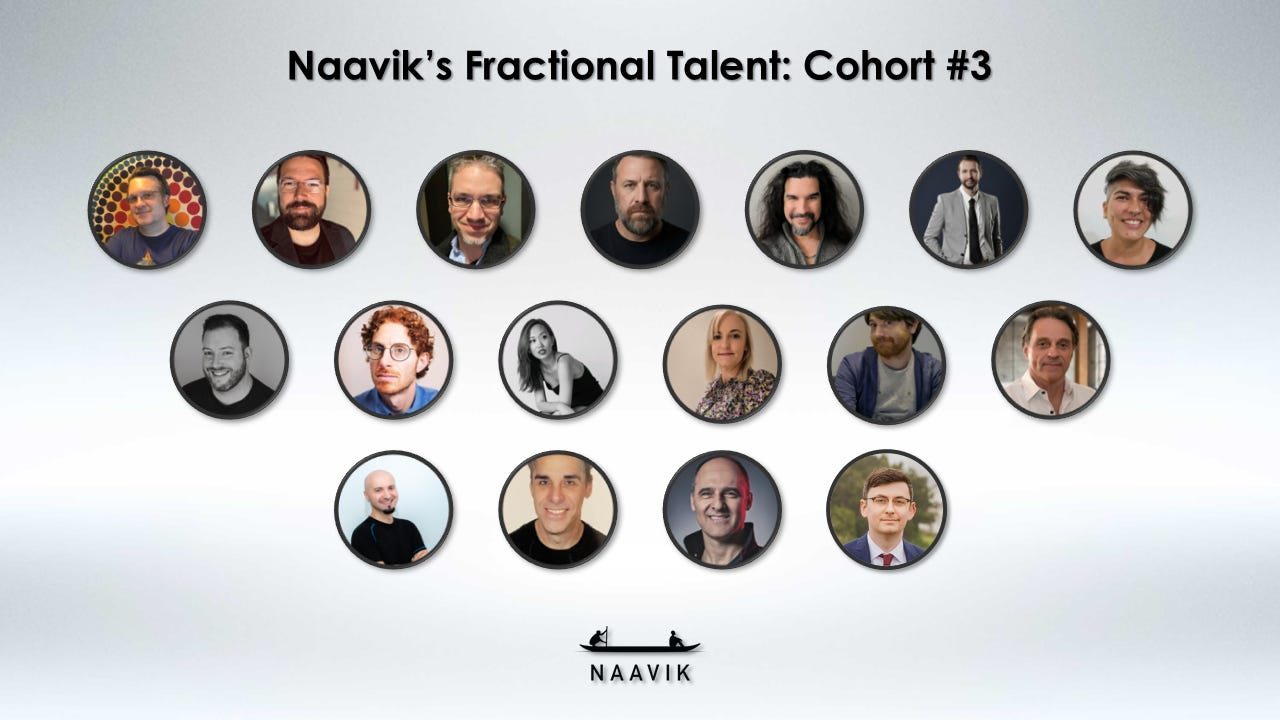
As you may have seen, we are welcoming our third cohort of gaming experts to our Fractional Talent network! We continue to expand our roster of highly accomplished games industry professionals, bringing an even broader range of roles, seniority levels, and geographies.
Naavik’s Fractional Talent service connects clients with pre-vetted experts across a wide range of disciplines, all available for fractional or freelance support. Naavik handles all legal, billing, relationship management, and service quality control responsibilities, allowing clients to quickly access specialized subject matter experts and embed them directly within their team for hands-on support. If your team has such needs, please reach out.
As a reminder, Naavik’s team will be at Gamescom on August 26 and 27. Reach out if you’d like to meet with us or explore how Naavik can support your team.

AWS for Games gives you everything you need to build, run, and grow innovative gaming experiences. Leaders across the gaming industry rely on AWS’s more than 16 years of games expertise to launch and run some of the world’s biggest games, including Fortnite, Roblox, and League of Legends.
AWS and over 300 AWS Games Partners offer the broadest and deepest set of purpose-built services and pre-built solutions for cloud-based game development, content creation, game backend and infrastructure, player acquisition, retention, and monetization. These tools empower game developers to build healthy global player communities, gain player insights, personalize, and monetize player experiences, to create lifelong fans. Around the world, 750 million gamers play games built on AWS each month.
Learn how AWS can help you build, run, and grow innovative gaming experiences.
Written by Francois Courset, Lead Consultant at Naavik
On July 21, 2026, Meshy closed a $400M Series B at a $1.5B valuation, which the company billed as “the largest in 3D Generative AI history.” Beyond the 3D asset generation space, it ranks among the largest funding rounds for an AI startup serving the games industry, with a reported $40M in ARR. Meshy's raise wasn't an isolated event: Tripo, General Intuition, and HiDream have all announced sizable rounds in recent weeks. Together, these deals signal a dramatic acceleration in AI-in-gaming investment.
So what exactly is crystallizing investor conviction around Meshy? What does its trajectory tell us about how close AI-generated 3D assets are to real production-ready workflows? And what does the wider pattern of mega-raises say about where the AI-in-gaming ecosystem is headed next?
Before Meshy became one of the most talked-about names in AI-powered 3D content creation, it was Taichi Graphics — a professional graphics software company founded in 2021 by MIT PhD Yuanming "Ethan" Hu. The pivot came in 2023 when the team bet that generative AI would rewrite the economics of 3D asset creation. Meshy now supports Text-to-3D, Image-to-3D, AI texturing, animation, and API workflows serving game studios, 3D printing, and other creative industries.
Meshy runs its roughly 150-person team across its U.S. headquarters and a significant Beijing operation — a cross-border structure reflected in its cap table. Backers include a who's who of top-tier China-focused venture capital: IDG Capital, Matrix Partners China, Monolith Management, Granite Asia, HongShan (formerly Sequoia China), BAI Capital, and Source Code Capital. The company has maintained an explosive growth trajectory: by July 2026, it had crossed 12M registered users and more than 100M models created, with ARR increasing roughly 12x YoY.
Meshy aims to democratize 3D asset creation, framing itself as a “Canva for 3D.” At its core, Meshy positions itself as an end-to-end 3D asset creation platform. The platform is browser-based, with a built-in 3D viewer that lets users toggle wireframes, inspect polycounts, and preview textures before downloading assets. Meshy currently serves clients primarily across gaming, academia, XR, and 3D printing. Most gaming clients are mobile studios, although the customer base also includes AAA developers such as Square Enix.
Meshy’s functionality can be broken down into five core areas:
Ideation: On July 29, Meshy revealed its 3D Agent Beta, designed as a conversational tool for concept exploration that lets users brainstorm ideas, compare visual concepts, and generate downloadable 3D models.
Asset Generation: Meshy can take text or images as input to generate untextured 3D models (meshes); geometry can be previewed and iterated on before the separate texturing pass. It also offers a multi-view mode, allowing users to upload front, side, and back profiles of a character or prop to lock down the exact geometry and prevent the engine from “hallucinating” the unseen angles. Models can then be downloaded for further editing.
Texture Generation: Meshy lets users create production-quality PBR textures in seconds by describing a surface or uploading a reference image, either on a Meshy-generated asset or on a user-uploaded one. Meshy automatically handles UV projection, seam placement, and texel density for both, addressing the tedious UV-unwrapping process.
Rigging and Animation: Meshy can then auto-rig characters and objects, supporting both humanoid and quadruped models. The feature works best with characters generated in a T-pose. Once rigged, users can apply motions from a large preset library.
Mesh Optimization: A tool that lets users retopologize models to a target polycount while maintaining clean topology.
Additional features include extensive integration and export options, as well as an AI Creative Lab built specifically for 3D printing use cases. Meshy stands out by offering a comprehensive workflow that addresses the most time-consuming parts of the 3D asset pipeline, such as blockout generation, preliminary shapes, asset optimization, and UV-unwrapping. This allows teams to parallelize work within what has traditionally been a waterfall production pipeline.
Meshy's current limitations broadly fall into three areas. First, it remains fundamentally an object generator, with no support for scene or environment assembly, including level layout, world-building, terrain generation, or scene composition. Second, its animation capabilities remain limited, relying primarily on a preset animation library, meaning it lacks features such as keyframe animation, facial rigging and blendshapes, cloth or hair simulation, and non-humanoid or mechanical rigs. Finally, the platform does not yet include downstream production tools such as lighting, rendering, particle/VFX systems, or physics simulation.
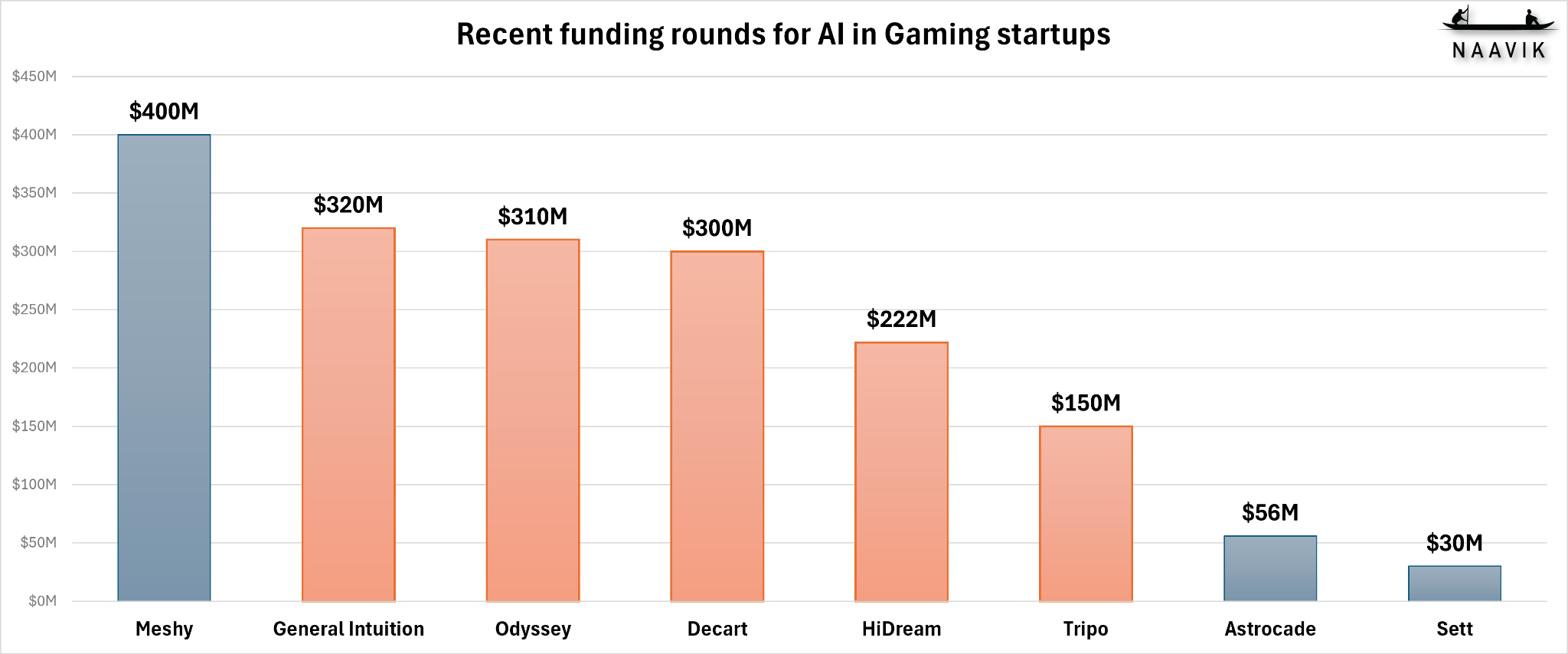
Over the past few months, a wave of major funding has flowed into AI gaming startups, with most of the investment concentrated in foundational model development — world models in particular (highlighted in orange bars above). As we recently analyzed in depth, these technologies have transformative potential that extends well past gaming and justifies the scope of investment.
That said, not all of that investment is flowing toward world models. A closer look reveals that 3D asset production is having its own moment, with Tripo — Meshy’s closest rival — raising $150M and Hyper3D also closing an undisclosed round. A logical next step would be for Meshy to follow Tripo into world models, which could help explain part of its valuation. However, nothing in Meshy's recent communications suggests that is the company's direction.
The key to understanding Meshy's fundraise is scale. The company says the proceeds will be spent on multimodal foundation-model R&D and global expansion — essentially investing to accelerate growth while strengthening its competitive position. Taken together, these investments reflect proven product traction rather than a speculative bet on AI's long-term potential.
Meshy has been on a remarkable growth trajectory over recent months. It reported reaching $15M ARR in November 2025, then $30M by March 2026, and a reported $40M in April 2026, a textbook hockey-stick curve. That growth is supported by 12M registered users, a healthy client acquisition funnel, and an 85% gross margin. While these numbers are company-reported and hence should be taken with a pinch of salt, product traction is undeniable.
Meshy's cross-border positioning is another key strength, providing access to both capital and talent. It has also helped the company attract major China-based clients, such as NetEase Games, FunPlus, and 37 Interactive Entertainment. China-based companies have a more pragmatic approach to pipeline optimization, massive content production requirements for live games, and a more AI-friendly consumer audience — all of which make the market a strong fit for Meshy's offering. Clients featured on Meshy’s website remain predominantly Asia-based, with few Western AAA clients; this suggests that some segments of the industry still have to take the leap, leaving some growth opportunities in the West and across PC and console for Meshy.
As is typical with Series B, client traction is now proven. A report from Room8 earlier this year claimed that its team was already achieving 10–15% faster prop production and an average 30–40% savings on low-poly optimization with 3D AI generation tools. These are strong enough metrics to build a case for adopting such solutions. Human input is still required for hero assets, but tools like Meshy can address much of the lower-hanging fruit, such as ideation, background props, and base meshes.
Meshy’s core offering sits within the creator-application layer. Looking ahead, it will have to maintain competitiveness in foundation-model R&D while strengthening its defensibility. It will also have to expand its platform by covering more of the production workflow, while its 3D agents initiative will push the needle toward orchestration.
As it accelerates its global expansion, one of Meshy's biggest challenges will be maintaining its broad "Canva-like" appeal while meeting the increasingly complex workflow requirements of AAA game development. The fresh capital will also help accelerate expansion toward adjacent categories such as animation, movies, architecture, or industrial applications. Meshy’s cross-border positioning might also raise regulatory challenges, while training data governance risks could pose regulatory and legal challenges, as illustrated by recent high-profile cases.
From a product innovation perspective, world models could be a natural extension of Meshy’s focus, allowing it to support environment generation features and aligning with its mission to let users “step inside what you imagine.” A more active innovation area lies in Meshy’s recent expansion toward gameplay use cases through interactive multimodal content experiences. At GDC, the company unveiled an AI-enabled Survivor-like game called “Black Box: Infinite Arsenal.” The game allows users to prompt actions in-game and dynamically generate weapon mechanisms and game scripts, producing a randomized, evolving experience each run.
From a broader industry perspective, Meshy signals that AI-assisted asset generation has crossed the commercial usefulness threshold. As one of the more technically demanding AI applications, this suggests that other application areas are already crossing similar thresholds (such as Ad creative production). There are strong reasons to believe that Meshy is the tip of the spear, and similar acceleration will likely follow across other gaming use cases such as audio or 2D assets. We might be witnessing the very first steps of gaming AI’s maturity phase, where the focus shifts from experimentation toward increasingly broad and standardized deployment. We'll continue tracking these developments.
Written by Devin Becker, Consultant at Naavik
Voices.com launched Voices for Games, an AI voice platform that takes a fundamentally different approach to the synthetic voice gold rush with every AI voice built on the performance of a real, consenting actor who is licensed and compensated whenever their voice is used. The platform offers two products. The first is Branded AI Voice for Characters, a fully governed system for studios that handles casting, directed recording, exclusive licensing, and production support for everything from cinematic leads to NPCs across 110+ languages. The second is Licensed Character Voice Datasets for model builders, offering 450+ character archetypes and 800+ hours of directed voice data with clean metadata. Supercell already uses Voices for traditional casting and is now working with the AI dataset. Critically, this model aligns with the SAG-AFTRA agreement’s three principles of consent, compensation, and actor control.
According to Amplified’s 2026 voices report, 79% of decision-makers say AI voices should come from real, attributed talent, but most existing AI voice platforms still rely on scraped or fully synthetic approaches. The gap between what studios want (legally defensible, brand-safe AI voice) and what most providers offer is wide, and Voices is hoping to close it. For games specifically, the implications are significant, with AI-driven NPCs and conversational characters becoming standard, through products such as Epic's Conversations and Latitude's Voyage. The demand for high-quality, ethically sourced voice data will likely scale alongside these features. Realistically, this splits the market rather than reshaping it. Studios with recognizable talent or a brand worth protecting have a concrete reason to pay for a clean pipeline to avoid potential legal action from performers, while smaller and international teams filling out ambient NPC barks will keep buying whatever is cheap and good enough. Voices is selling provenance, which only carries a premium for buyers who need to prove it or want the PR benefits.
ForgeGUI, an AI-powered game development tool built by 18-year-old founder Giulio Greco, raised $3.2 million at a $40 million valuation. Greco, a high school senior with eight years of UGC development experience across Minecraft and Roblox, launched ForgeGUI in March to help individual creators quickly build 3D game assets using models from companies like OpenAI. The platform has already crossed 300k users, and Greco believes it will hit 1M by year’s end. He has exactly one employee besides himself, has moved from Texas to San Francisco, and has no plans for college.
Gaining 300k users in four months for a tool targeting UGC game creators suggests real demand for AI-assisted 3D asset generation at the individual-creator level, where traditional tools like Blender or Maya remain too complex and time-intensive. This is the same democratization story playing out across the creator ecosystem, from Roblox’s own agentic AI tools to Meshy and Luma’s 3D generators, but ForgeGUI’s growth rate at this stage is notable. As much as traditional game devs push back against AI, the smaller UGC creators embrace it, further democratizing game development. A $40M valuation on $3.2M raised is aggressive, and the company is extremely early with just one engineer. VCs are clearly betting that the winner in AI-for-UGC asset creation captures an enormous market as platforms like Roblox, Fortnite Creative, and their successors continue to grow their creator bases. Whether ForgeGUI specifically can hold that position against well-funded competitors remains an open question.
Versus emerged from stealth with a pitch that sits squarely at the intersection of games and streaming. Its AI-powered interactive overlays let viewers “play along” with content they’re watching. When users point their phone at a live sport, series, or film, Versus generates games, trivia, polls, and prediction challenges layered on top of the viewing experience. The company has already worked with Disney+, Paramount+, HBO Max, the NFL, Lionsgate, and Reddit, and claims results including 16% longer session lengths, retention lifts of 4.5% to 9.5%, and content start rates exceeding 53% against a 2% industry average. Notably, CTO Jesper Jenson was previously GM of Yahoo Games and a senior executive at Electronic Arts.
This matters for gaming because it represents gamification flowing in the opposite direction. Instead of games borrowing narrative techniques from film and TV, streaming platforms are borrowing engagement mechanics from games to solve one of their most expensive challenges: subscriber churn. The economics are compelling, as subscriber reacquisition costs across the streaming industry run into the hundreds of millions annually. Versus is also launching FourPlay.ai, a direct-to-consumer interactive platform focused on live sports and events, which could create an entirely new category of second-screen gaming. For game companies, this reinforces the gamification concept that the engagement patterns they’ve refined for decades (leaderboards, predictions, real-time competition) are becoming the template for retention across all digital entertainment. Gaming companies could find new licensing and partnership opportunities in developing engagement mechanics for adjacent entertainment verticals.
At Siggraph 2026, Nvidia announced Omniverse Libraries, a collection of disaggregated, agent-friendly software components that give AI agents the tools to build simulation-ready 3D worlds. This is the latest step in a nearly decade-long effort to break Omniverse into increasingly accessible pieces. The new libraries include ovrtx for RTX sensor simulation (camera, lidar, radar), ovphysx for GPU-accelerated physics, and CAD-to-SimReady skills for converting design files into simulation-ready assets via OpenUSD. Partners SideFX and PTC are already integrating these into Houdini and Onshape, and a Blender integration blueprint is available on GitHub. Alongside the platform news, Nvidia presented 21 accepted technical papers, highlighted by MotionBricks, a real-time motion model trained on over 350k clips that can drive both in-game animated characters and a physical Unitree G1 humanoid robot using the same underlying system.
Nvidia is continuing to try and build an infrastructure layer where game development, robotics simulation, and physical AI all converge. The same tools that let a game studio generate physically accurate environments for a racing game also let an automaker train autonomous vehicles. That convergence is strategic for Nvidia because it means simulation workloads serving a growing robotics market will run on the same stack as the games and content creation market, giving both sides more scale and better tooling. For game developers specifically, the agent-friendly architecture matters most. As AI agents are increasingly used in 3D pipelines (a trend Roblox, Unity, and Epic are all pushing), the studios and tools that adopt simulation-grade standards could produce more robust, reusable content. Nvidia's goal is for OpenUSD and Omniverse to become foundational components of that future.
D&D rival Chaosium removes AI errors added to new game “without our knowledge”
EA boss awarded $38.6M after year of franchise success, studio layoffs, and GenAI adoption
SOCAN partners with Musical AI on music creator attribution, pay and transparency
Artists are lawyering up against AI slop, and some are even winning
Nvidia, Microsoft launch open AI security alliance — without OpenAI, Google, or Anthropic
Meta is testing an AI bedtime story app for people with no imagination
The Most Honest AI Adoption Story in Gaming (Deconstructor of Fun): “Sunrise Village is not an AI growth story. Downloads have halved. Revenue is down by a fifth. But it is a tale of profitability. The team size went from 25 to 3. The game went from deep red to green. And that green is what allows InnoGames to invest in new games.”
Network expert Glenn Fiedler warns game programmers to fix game code vulnerabilities that AI can now find (Gamesbeat): “I passed Claude (Code) Fable 5 over my network libraries starting Monday last week. Starting at 11 p.m., I was up all night until 6 a.m., and have been working non-stop since then to fix everything up. There is something massive coming. First, AI coding is real and it’s going to expose massive security flaws. in game libraries (like my own) that were 10 years old and I thought were completely secure.”
How China’s game industry is using AI, from art to ad-buying (Pocket Gamer): “That claim illustrates one of the central tensions surrounding adoption. The technology can allow companies to support larger player communities, but it may also reduce the number of employees required to operate those services. Lyndon says similar capabilities are also becoming available to companies that previously could not afford the kinds of systems used by China’s largest publishers.”
Liquidnitro Games hires ex-Tencent Games global CTO for AI-enabled game production (Gamesbeat): “Sandeep contacted me and showed me some of the technologies and shared a lot of the thoughts that the team have been putting behind their technology and everything they are working on. I was really blown away. I think you have a lot of AI hype right now, and you have a lot of different things. But what I saw in what Sandeep showed me was really real in terms of taking a live service and really transforming the timelines, compressing the timelines, reducing the operating cost, growing the games, replicating and enhancing what the team had been doing at EA, but really taking it to the next level thanks to the power of AI.”
AI for Games: KRAFTON Highlights ‘Three Fronts’ (Invenglobal): “We have built games using physics engines and graphic rendering until now, but world models that generate video could potentially replace game engines in the long term. Who knows? We might end up using game engines and world models together to create games.”
Building an AI game testing agent with Amazon Bedrock (AWS for Games): “We showed how to build an autonomous QA agent on Amazon Bedrock that connects to a running Unity game, reasons about game state, and executes test scenarios without human intervention. We covered connecting to a game’s internal object hierarchy, a perceive-reason-act-reflect loop inspired by industry research, and a framework of game-agnostic tools that separate game knowledge from execution logic.”
Ethical, low-power, and on-device: Studio Atelico’s vision for the future of generative AI (Gamesindustry.biz): “De Nucci expounded the benefits of on-device AI: namely, low power usage and the lack of a need for constant online connection. Plus, he pointed out that vast amounts of training data simply aren’t needed when you only want the model to do one thing, like character creation.”
Naavik’s team of experts has helped over 300 companies — publishers, studios, tech companies, and investors — succeed across the games industry. We’d love to work with you too! Here’s what we offer, spanning all platforms, genres, and regions:
Strategy Consulting: Projects spanning market research, corporate strategy, game and economy design, gamification, live-ops strategy, AI strategy, product management, brand and performance marketing, and more.
M&A and Investment Advisory: Expert commercial due diligence for buyers, fundraising support for sellers, and fractional CFO/CSO services.
Fractional Talent: The one-stop shop for top-tier fractional talent covering dozens of game industry roles — analytics, design, marketing, art, QA, and more.
Check out the links above for more details. If you’d like to chat about how Naavik can support your team, click the box below or send us a note at consulting@naavik.co.
No posts
Comments
Nothing yet. Say the first thing.
Sign in to join the conversation.