
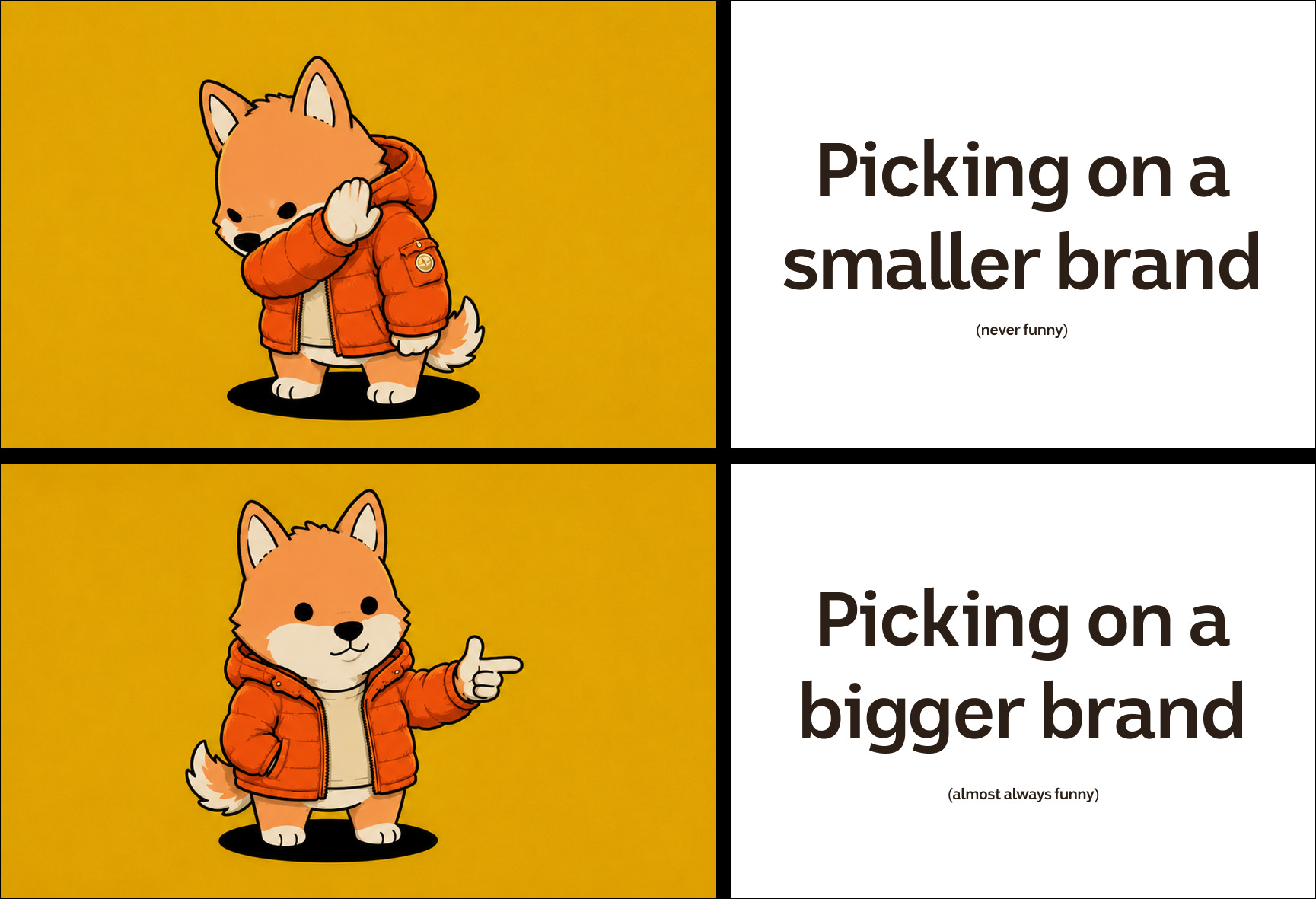
There is a founder on LinkedIn right now, this exact second, extremely excited to post a fresh takedown over some competitor’s small misstep, and they’re about to ruin my morning with it.
These CEO squabbles are just a bit… gross? Screenshotting and retweeting something a competitor did or said and hoovering up likes from nerds on the internet isn’t serving your brand like you think it should.
The annoying thing, though, is that they’re not too far off the mark. They’re just doing it in the worst possible way.
Early-stage brands should absolutely be naming their competitors in their marketing. Whether that’s from your founders on LinkedIn or in comparison ads or on your own website. You should do more than you do now. Loads more.
When nobody knows who you are, piggybacking on your competitors does two brilliant things at once – it gives you a fighting chance to grow inside your category AND it’s one of the fastest positioning shortcuts to land exactly what you do in an instant.
But for it to work, a few things need to be true, and if you don’t follow my rules you’ll just come across as one of those weird CEOs that doesn’t blink quite enough and gives everyone the ick.
Big brands continue to win because they’re big, and there’s really very little small brands can actually do about it. It’s a sad state of affairs backed by heaps of data. Mark Ritson sums it up nicely: you are, in fact, going to get fucked by the Double Jeopardy Rule.
Small brands are structurally disadvantaged with fewer buyers and lower loyalty from the buyers they do have. Conversely, giant brands convert minor proportional spending into outsized share of voice, so small brands have to pour a lot more of their share of revenue into advertising just to stay visible.
Since you can’t afford to buy share of voice, you can try and steal it by picking on the big guy. When you name the giant, you borrow their visibility because their customer already has a fully-formed mental picture of them in their head, which you can easily just define against.
At Yonder we did this for years. In one of our early research interviews someone described Amex as feeling like “my dad’s credit card” and I could’ve kissed them through the screen. Our tagline “Goodbye Amex, Hello Yonder” landed in seconds because Amex had spent sixty years and more money than God building that image for us. Sixty years of someone else’s brand equity, working for us, for free.
So you have two options. Spend years and a small fortune building fresh associations from absolutely nothing, or borrow the ones that already exist. Your competitor’s brand is a fully developed idea in your customer’s head. You can just walk in and plot your brand right down next to them.
And none of this is remotely new. Avis built an entire brand on “When you’re only No. 2, we try harder.” That was sixty years ago. Positioning against the giant isn’t just a proven marketing strategy, I’d argue it’s vital.
There are many ways to do this poorly. Most of which boil down to low-EQ founders who see competitor takedowns as a moment to win, rather than a long-term brand equity and positioning tool.
It tends to go wrong in two ways.
The first is big companies going at each other. When you’re already massive, naming your competitor doesn’t hit as hard. Everyone already knows who you are, so there’s no salience to borrow and no gap to point at. It’s just petty. Watching Musk and OpenAI conduct their feud through press statements is like being trapped in a group chat between billionaires that you can’t leave. This classy response from Satya Nadella, dragged in and choosing poise over pettiness, shows what excellent leadership, and frankly strong PR sense, actually looks like.
The second is punching down. If you’re the market leader or the big guy, going after someone smaller is always a bad move. There’s no story where you come out well. Win and you’ve beaten someone a fraction of your size, which impresses no one and the underdog gets the sympathy and the free attention, and you get to look like the bully who was threatened enough to bother.
Naming competitors is a lever for challenger brands only.
Going after a giant incumbent when you’re obviously the underdog is almost always fine. It’s funny. It’s expected. It’s how stories work. A small fintech pointing at ridiculous bank fees. Some CPG drinks brand pointing out how much sugar there is in your average Coca-Cola. Whatever it is, if you’re small and they’re massive, play on.
Going after a business your size is possible, but harder. It comes down to what you’ve actually got to say. Publicly shaming a same-size competitor that just laid people off, say, is probably not the move. The context changes everything.
If you have to punch around at businesses that are a similar size to yours, then read on.
Attack the product. Attack the pricing. Attack the experience. Just don’t attack the people.
Never any jokes about how someone looks. No commentary on a founder’s personal life. If a CEO has gone to a Coldplay concert with their assistant and the whole internet is already talking about it, you don’t need to add anything. The meme accounts have it covered.
“Look at this startup that used to be successful and now we’re picking up their customers. Maybe they shouldn’t have spent so much on swag hahahaha.”
We all know how fragile startups can be. I’ve worked at companies that were flying and then suddenly weren’t. Probably best not to be on the record slamming a brand that’s had a rough run when yours could be around the corner.
That’s not to say you shouldn’t take advantage of a slip. I always liked how incident.io approached their PagerDuty Rescue Program. It opened by acknowledging PagerDuty was a genuinely great tool that just couldn’t keep pace, then offered to help teams migrate. No dunking. Just a hand and a clear reason to switch.
Watching two enormous brands attack each other is like watching someone’s parents argue at a wedding. You just want them both to stop.
When already huge companies use their scale and PR machines to drag each other through the press it just feels like bad strategy to me.
Having said that, there is a time and place for it, which brings me to my last rule:
The simplest, most effective form of competitor marketing I’ve ever seen is also the most boring. A little table. That’s it.
Wise did this relentlessly. You’d land on their website, punch in how much money you wanted to send to your cousin or your landlord or whoever, and there it was, a table. Wise sitting next to the big banks with the actual costs of each one. Sometimes Wise was the cheapest. Sometimes Wise was not the cheapest.
Comparison works when it’s fair and falls apart the second it isn’t. Readers can smell a rigged table from space. Wise showing the rows where they lost is the exact reason everyone decided they were the good guys. It signals you’re not sitting there terrified that someone might, God forbid, look around a bit.
You don’t have to pretend your competitors are idiots. You just have to be extremely, almost annoyingly clear about why you’re the right choice for one specific kind of person.
Name them. Put them on your pricing page. Take the positioning they spent decades and an unspeakable amount of money building and just, sort of, help yourself to it. It’s the cheapest way you’ll ever grow.
Just make sure you’re doing it in a way that’s fair, punching up, and never personal.
My name is Tom. I’ve launched and grown products at some of the UK’s most loved consumer brands like Monzo and Wise, and was part of the founding team and VP Marketing at Yonder. These days I’m building Brandingo.
If you’re a senior marketer at a startup, this Substack is for you. I write about what actually works in startup marketing (and what definitely doesn’t) for marketers on the verge of breakdown.
Take my short reader survey so I can learn more about who reads this so I can write more useful stuff. I know you ask your customers to take surveys, so one won’t hurt you. Thanks in advance.
Here are some of my most popular reads:
Comments
Nothing yet. Say the first thing.
Sign in to join the conversation.