

Do you know the Four Ps of Marketing? Me either. I’m pretty sure pricing is one of them though.
This is the first in what I’m hoping is a few posts about pricing. How to set it, how to use it to control demand and attract higher-value customers, and how to change it without making everyone angry. But for today, how to set it in the first place.
I’ve priced a lot of things over the years. Cards, subscriptions, add-ons, a rewards programme or two. And every time the method was the same. See what competitors are charging, pick something that feels sensible, add a bit of margin on top, round it to a neat number, move on. I have been doing this for over a decade and at no point did anyone, including me, stop to ask whether it was a good method. It was not a good method.
I’ve been building Brandingo for the last six months and I was about to embark on this tried and tested pricing method of Winging It when I got on a call with Sophia King, Head of Brand & Marketing at Honest Mobile, admitted I had no real idea what to charge, and she asked whether I’d run a van Westendorp pricing survey. I had not. I’d never run a van Westendorp on anything. Googled it while she was still talking.
After hearing how Sophia had used it to price a new SIM plan at Honest Mobile, I went and did the research. It’s a proper, structured method for finding out what people will actually pay.
So today I’m walking through how it works, with an example, and what else to consider when you’re pricing something new.
Please stop saying van Westendorp, Tom. Okay, fine. Its real name is the Price Sensitivity Meter (not sure which is more of a mouthful) and it was introduced in 1976 by a Dutch economist called Peter van… sorry.
It’s a structured survey method for figuring out what people will actually pay for something, and it’s been sitting there for fifty years while most modern marketers (me) price entire business units on a hunch.
Not long ago I wrote that user research is the answer to all your problems, then went and tried to price the single most important number in my business off gut feel. Nice one. So here’s the way I’m doing it now, which is mostly Sophia’s way.
First, describe the product or service, make sure the person understands what they’d be getting, and then ask:
At what price does this start to feel so cheap you’d question whether it’s any good?
At what price does this feel like good value for the money?
At what price does this start to feel expensive, but you’d still consider it?
At what price is it so expensive you wouldn’t consider it at all?
That’s it. Four questions. The reason it works better than just asking “what would you pay?” is that people will lowball you – they’re already negotiating with you before you’ve even set a price. And most buyers don’t have one magic number in their head anyway, they have a range. These questions map the edges of that range for you.
You don’t need a thousand responses. Just a decent number of the right people you’re genuinely trying to sell to. Aim for fifty to a hundred if you can.
For the sake of simplicity, here’s a sample set of fake data from 15 imaginary Brandingo customers giving their fabricated opinion on what my monthly pricing should be:
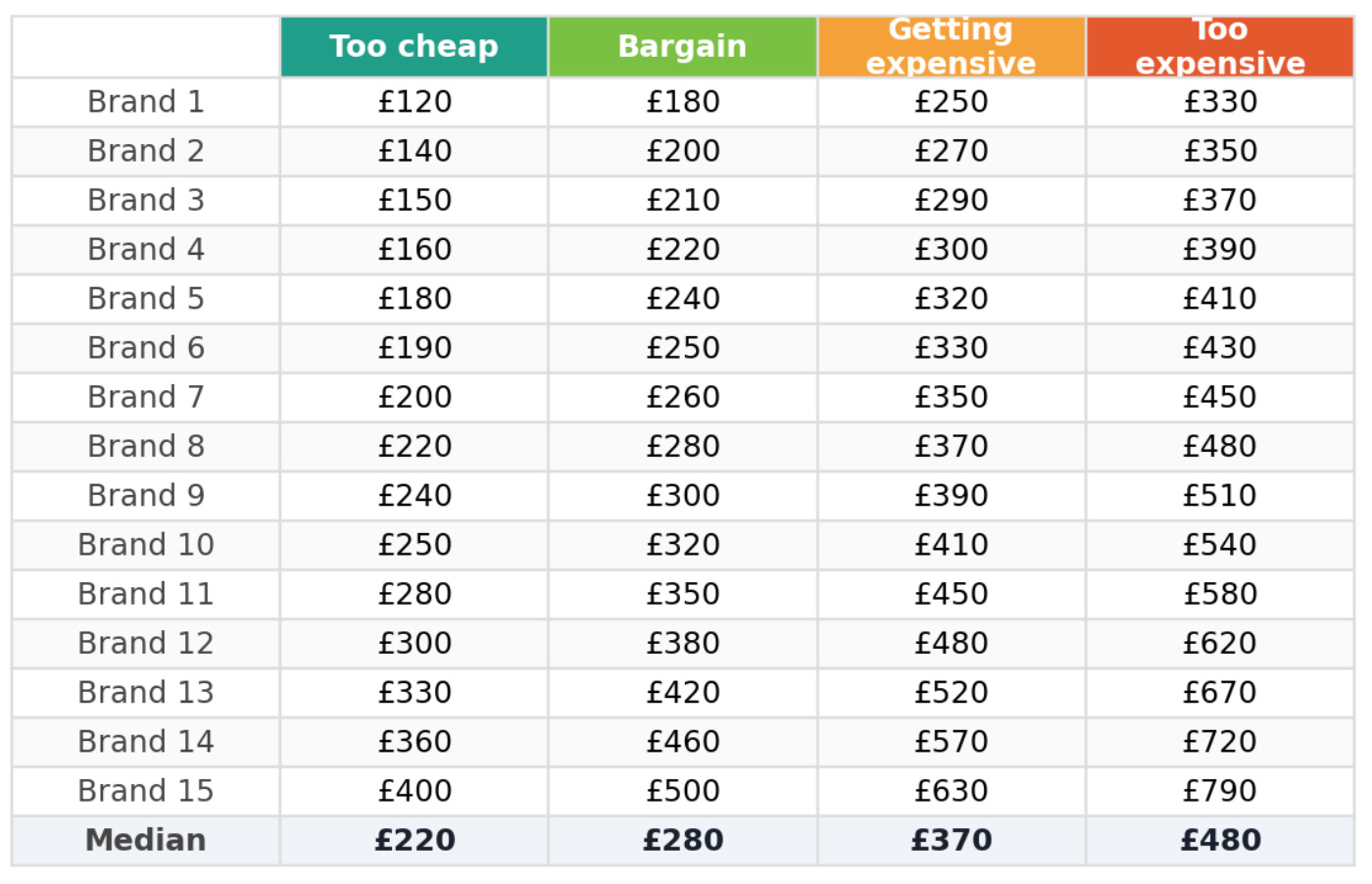
Once you’ve got the responses, plot four cumulative curves on a chart with price on the horizontal axis, percentage of respondents on the vertical. One curve for each question: Too Cheap, Bargain, Expensive, and Too Expensive.
As the price goes up, fewer people say it’s too cheap and fewer say it’s a bargain. Meanwhile, more people start saying it feels expensive and more say it’s too expensive. The four lines slope in opposite directions, which means they cross each other. Those crossing points are where the good stuff is.
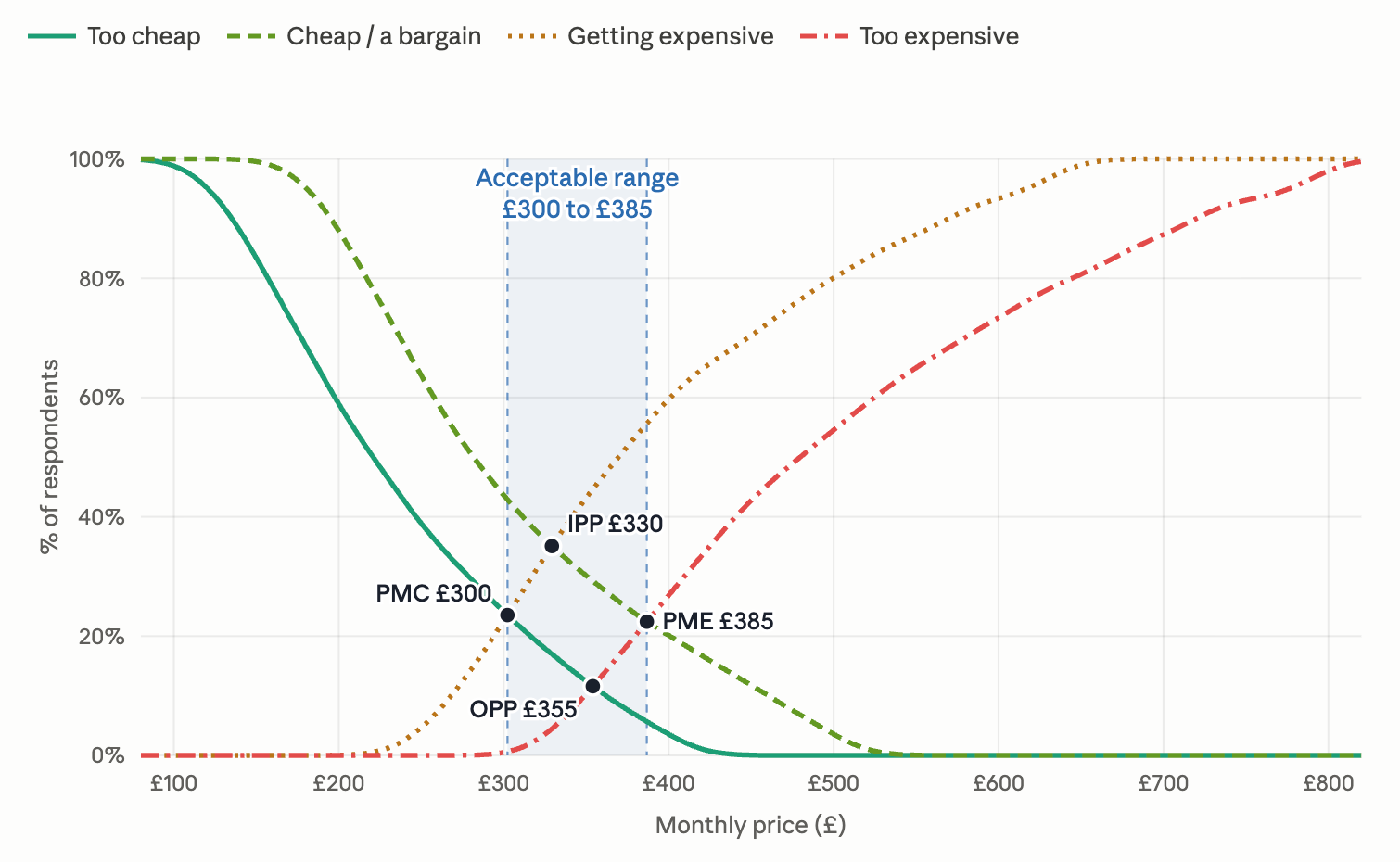
There are four intersections worth knowing about:
Point of Marginal Cheapness (PMC) - where the “too cheap” line crosses the “expensive” line. This is your floor. Go below this price and more people start questioning the quality than find it acceptably expensive. It’s the point where cheapness becomes a liability.
Point of Marginal Expensiveness (PME) - where the “too expensive” line crosses the “bargain” line. This is your ceiling. Go above this and you’re losing more people to sticker shock than you’re gaining from perceived value.
Indifference Price Point (IPP) - where the “bargain” and “expensive” lines cross. At this price, equal numbers of people think it’s cheap as think it’s expensive. Nobody’s thrilled, nobody’s appalled. It’s the price equivalent of a shrug.
Optimal Price Point (OPP) - where the “too cheap” and “too expensive” lines cross. This is the price that minimises the number of people who think something is seriously wrong with your pricing in either direction.
The range between the PMC and the PME is your acceptable price range where your price won’t put people off. The OPP and IPP sit inside that band and give you a sense of where the sweet spot is.
So based on this, I’d be looking to price around £350 a month.
While it’s great for dragging you out of your own head and anchoring you in what real buyers think, it’s important to know that this magical survey doesn’t solve all your problems. The van Westendorp measures price perception - what people say sounds reasonable - not a prediction of what they’ll actually pay when the checkout page is staring at them. Those aren’t the same thing.
On top of that, the OPP doesn’t account for your costs, your positioning, or what competitors charge. If you set your prices too low, your business won’t be sustainable.
That’s what the next steps are for.
Now you’ve got a range with an optimal price point sitting inside it. You’re feeling very smug about the whole thing, possibly for the first time in your career, and it feels good. No need to do your affirmations today. You are brilliant. Bad news, there’s more work to do.
Time to take a look around the market. What do the nearest alternatives charge? Who feels cheap, and who feels expensive in a way that somehow makes them seem more serious rather than less?
If your survey keeps pointing higher than where most competitors sit, it usually means one of three things:
You’ve built something people genuinely value more than the tired old options. Nice.
You’ve surveyed a different segment than the typical category buyer. Not bad, just good to know.
You’ve described your product in a way that is misleading. Not nice. This will cause problems later.
Use what you find in the market to refine your range down. If it was £15-19 before, but your competitors are hovering around the lower end, then you may struggle to get the higher end of your range. £16-17 could be better.
If the number feels completely comfortable to you, it’s almost certainly too low.
This is advice for products that compete on value, not volume. If you’re building a marketplace or something with network effects where adoption matters more than margin in year one, pricing low might be the right call. Slack, Zoom, and Notion all do it. But if you’re selling a differentiated product to people choosing between you and a few alternatives, lean toward the top of your range.
Before you fall in love with your price, does it even work for your business?
Does the price, minus your costs, leave you a margin you can survive on? If your acceptable range sits below your break-even, you don’t have a pricing problem, you have a business problem. No amount of Dutch economist genius is going to help you with that one.
I typically encourage brands to bake in higher margins than they think they need. Higher margins give you room to improve the product without raising the price. Your customers signed up at £20, you keep making it better, they keep paying £20, and nobody has to send an email about anything. Or you improve the product and raise the price, which is a story people can accept.
The alternative is grim. You priced low because it felt safe, your costs went up because that is what costs do, and now you’re raising the price with nothing new to show for it. Good luck with that email.
Starting high gives you discounts, tiers, and annual deals as levers.
This is more of a personal opinion of mine. Take it or leave it.
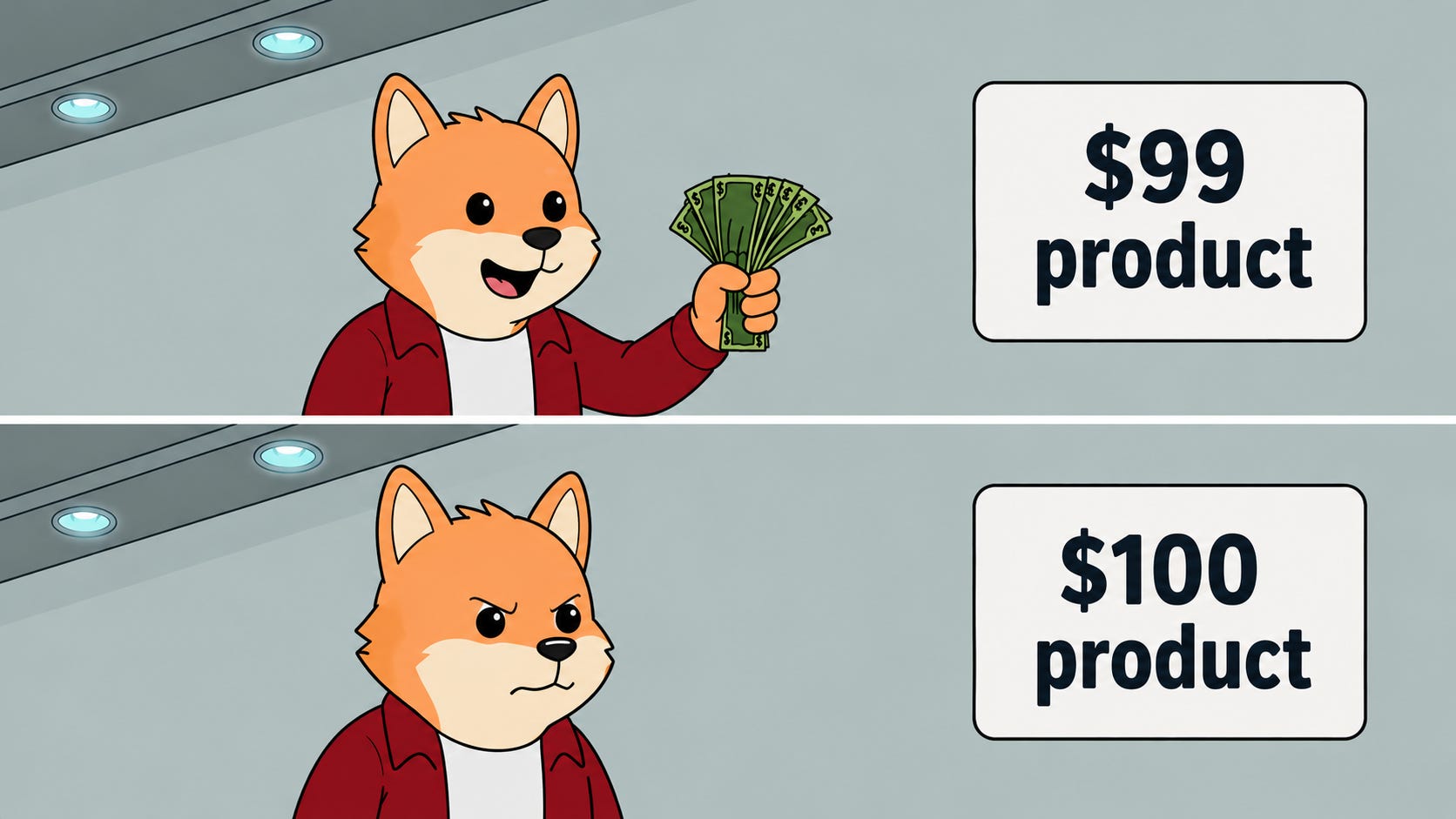
Let’s say you’ve landed on £100 for your new thing. And then someone in the room (a product manager, typically) says, “great, let’s make it ninety-nine instead.”
Nine-endings, fake crossed-out prices, countdown timers that reset when you reload the page… I’m not a fan of any of these. Up to you to decide what works with your brand, but I mostly find them annoying and something that whittles down trust over time.
Sadly, the evidence says this stuff works. Charm pricing ($99, $9.99 etc) lifts conversion in A/B tests. I’m not arguing it doesn’t work. I just think it costs you elsewhere. If you’re selling something considered, to grown-ups, knocking a pound off to look cheaper might get you a marginal uptick on the checkout page, but it makes the whole thing feel a bit more like a supermarket end-of-aisle and a bit less like a tool they’d trust with something that matters.
There are categories where this stuff works better. High-volume, low-attention e-commerce. Knock yourself out. But if the rest of your brand is trying to say “we’re thoughtful and we’re here for the long haul,” the pricing page shouldn’t be the one place you suddenly get clever.
So that’s the method. Survey the right people, check it against the market, make sure the maths actually work, and then try not to undo it all by being too clever at the end. None of it is complicated.
Thanks, Sophia and Peter!
My name is Tom. I’ve launched and grown products at some of the UK’s most loved consumer brands like Monzo and Wise, and was part of the founding team and VP Marketing at Yonder. These days I’m building Brandingo.
If you’re a senior marketer at a startup, this Substack is for you. I write about what actually works in startup marketing (and what definitely doesn’t) for marketers on the verge of breakdown.
Take my short reader survey so I can learn more about who reads this so I can write more useful stuff. I know you ask your customers to take surveys, so one won’t hurt you. Thanks in advance.
Here are some of my most popular reads:
https://mktg.substack.com/p/from-intern-to-cmo-what-you-actually
https://mktg.substack.com/p/im-leaving-my-vp-marketing-role-at
https://mktg.substack.com/p/exactly-how-we-build-and-spend-our
https://mktg.substack.com/p/how-to-actually-write-a-marketing
Comments
Nothing yet. Say the first thing.
Sign in to join the conversation.