

A few years ago I hosted a marketing conference in London. I’d recently bleached my hair, which is somewhat unrelated, but it’s always my first thought during that period of my life and now it’s yours too.
Overall, it was great (the conference, not the hair). On the second day I gave a talk about how product marketing frameworks are dumb and that the best product marketers are the ones who work out what needs to be done and do it. It had a mixed reception. A couple of people told me I shouldn’t say that, in the tone you’d use on someone who’d stood up at a funeral to mention the deceased was really just a bit of a nightmare.
It was this preciousness that was holding them back. Over the two days I kept hearing variations of the same complaint: “I’m building messaging frameworks and my organisation doesn’t seem to care.”
That’s because frameworks are not work. They’re the foundational thinking layer of work. Writing the doc doesn’t count as having done anything, in the same way Boeing laying every part of a new plane out on the runway and telling everyone to jump on in doesn’t count as a flight.
They’re genuinely helpful for formulating your own ideas (writing is thinking, you know this). They’re just not the finished thing. The job is done when the website is live, the email is sent, the post is published, and actual customers are reading them and using them to make decisions.
So here are a few practical ways to ditch the strategy doc and explore your work in the formats your customers will see.
A positioning statement is a fine place to start. It’s a terrible place to stop, because it never captures how anyone will experience your brand.
There are plenty of templates. This one gets attributed to Marc Andreessen a lot but it’s Geoffrey Moore’s from Crossing the Chasm:
"For [target customer] who [has a specific problem], [your company] is a [market category] that [offers a unique benefit]. Unlike [competition], we [key differentiator]"
Fill it out if it helps you think. Then go and build the website, because everything you need to position your business can fit above the fold of your website. If you take one thing away from this post, let it be that.
Here’s the Granola website. I don’t know what their statement would be, but it’s something like this:
“For busy tech workers who don’t have time to organise notes, Granola is a notetaking app that you can chat with. Unlike others, we run without a meeting bot”
Now look at the page. Media, design, copy and hierarchy are each doing a different job supporting their positioning statement. It shows the product recording notes. It shows a couple of strapping busy tech workers. It outlines their category clearly and shows how they’re different. Nice work.
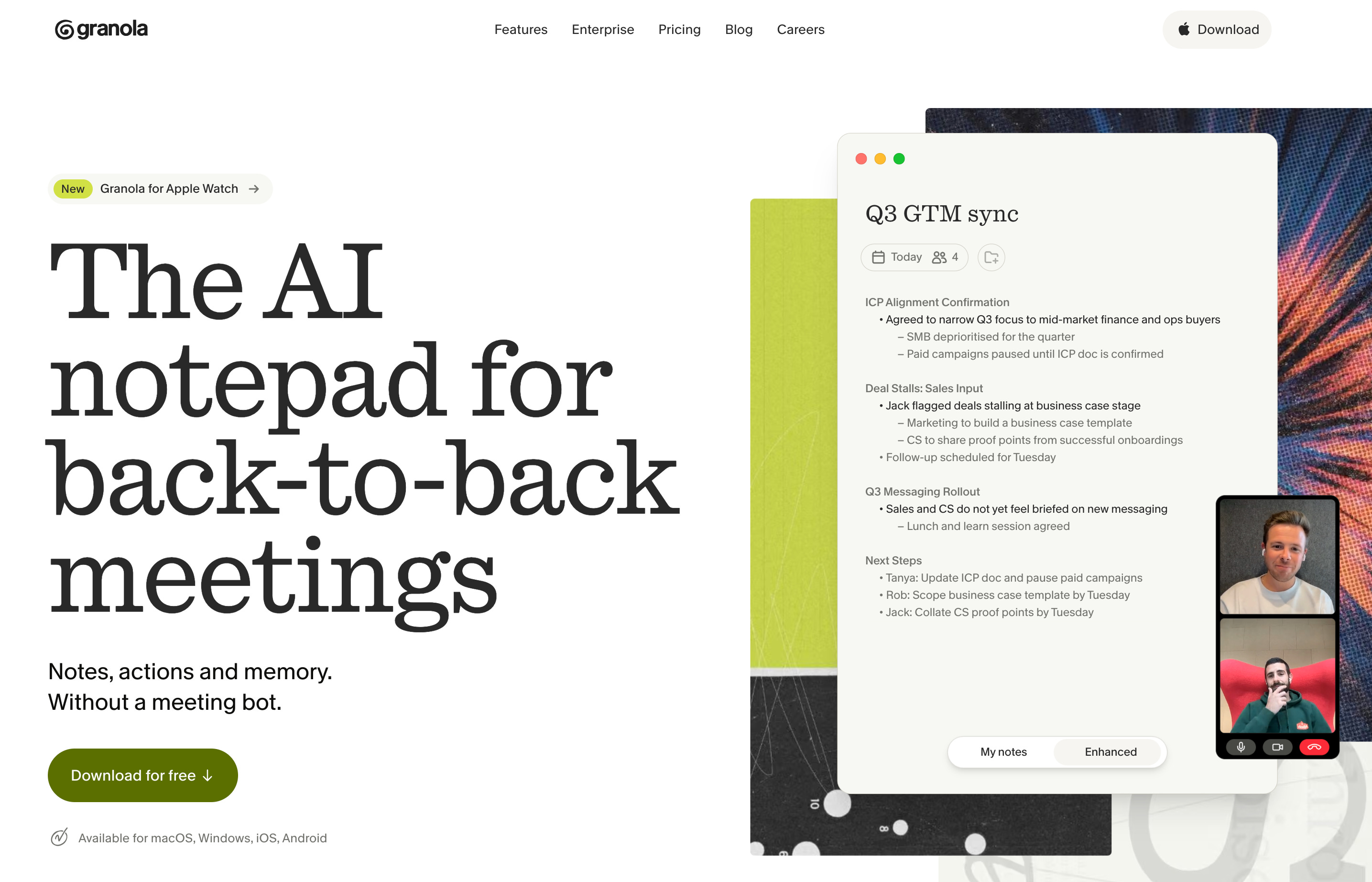
Whether the goal is to build the actual website for users or just communicate how you want to position your new product internally, it doesn’t matter. The value is in bringing your work to life so it can be felt and experienced like as a user would.
Email is such an amazing channel. Literally indestructible. The cockroach of marketing channels. Every few years some startup tries to kill it and here it is in 2026 still doing more for product adoption than whatever AI tool you’ve just pumped your budget into. How good.
The great thing about email is that it forces you to be careful about what you say and how much of it. Unlike Substack, where you can bang on about bleaching your hair for a bit, every word has to fight for its place, which makes it the perfect medium to refine your messaging.
If you can’t come up with a compelling hook (subject line), a teaser to drive interest (preview text), a key asset and two to three points about why your new product or campaign matters, then you just won’t stand a chance.
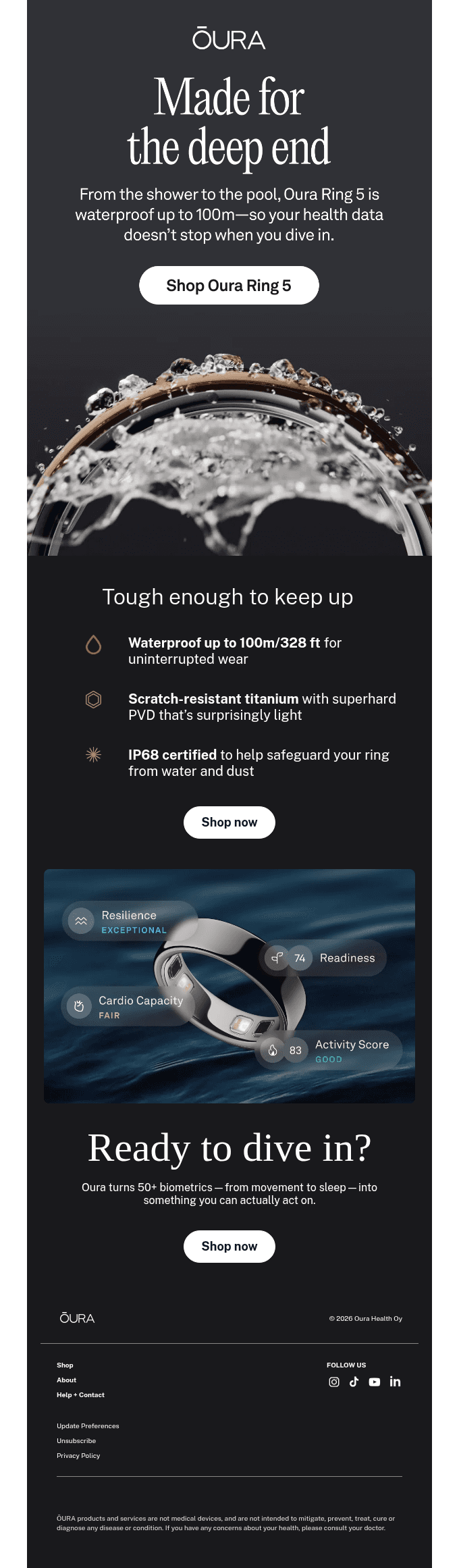
Here’s one I grabbed from Really Good Emails. Space is limited, so Ōura have led with a single selling point, that their new ring is waterproof to 100m. The other benefits sit further down, which tells you some clever marketer there has decided what matters most and what can wait.
You could build a messaging hierarchy, or you could build an email.
I’m not hugely into the actual press release nowadays. PR looks nothing like it did five years ago. But as an exercise for a new product or launch it still holds up. I think Amazon might have come up with this idea. I don’t know. Does it matter?
One of the first articles I ever wrote was around how to get press coverage as a startup. I’d be curious how relevant it still is, but there’s a template in there you can copy and use internally.
Writing a press release forces you to work out what’s newsworthy. You might find one part of your product jumps out and the rest doesn’t, or you might read the whole thing back and find it a bit underwhelming. Either way you’ve now read your own product the way someone who doesn’t care about it would, which is most people.
It’s so easy to build a wireframe, mock up something in Claude Design or literally just write the email. Living in the hypothetical is hurting your ability to be understood clearly.
Process matters, sure. You’ll still need to define your brand, your positioning and your messaging, and a doc is a reasonable place to work that out. I just wouldn’t fire that off to your product team and tell them the work is done.
The work is done when the thing is live.
My name is Tom. I’ve launched and grown products at some of the UK’s most loved consumer brands like Monzo and Wise, and was part of the founding team and VP Marketing at Yonder. These days I’m building Brandingo.
If you’re a senior marketer at a startup, this Substack is for you. I write about what works in startup marketing (and what definitely doesn’t) for marketers on the verge of breakdown.
Take my short reader survey so I can learn more about who reads this so I can write more useful stuff. I know you ask your customers to take surveys, so one won’t hurt you. Thanks in advance.
Here are some of my most popular reads:
Comments
Nothing yet. Say the first thing.
Sign in to join the conversation.