
There’s a moment in some businesses where the numbers still look fine.
Revenue’s up.
The pipeline isn’t empty.
Nothing is obviously broken.
But the system feels… off.
Quotes take longer than they should.
Projects don’t quite resemble each other anymore.
Every job feels like it has a footnote.
And nobody can point to the exact moment it changed.
I sat in a room recently where the conversation kept orbiting around growth.
New customers.
New verticals.
More outreach.
All reasonable. All familiar.
But underneath it, there was something else.
Not said directly.
More like felt.
Every new opportunity required explanation.
“This one’s a little different…”
“We’ll have to handle this one manually…”
“Let’s just get through this one…”
Nothing catastrophic.
Just enough variation to make everything slightly harder than it should be.
The obvious question was how to get more of the right work.
But that wasn’t the question underneath it.
The harder question was why some work was so much harder to absorb than the rest.
The issue wasn’t the cost of acquiring customers.
It was the cost of accepting the wrong kind of work.
Most systems are designed once.
Quietly.
Not in a document—but in behavior.
How quotes get built.
How scope gets interpreted.
How exceptions get handled.
What gets pushed through vs. pushed back.
Over time, that becomes the operating system.
And then, without anyone deciding it explicitly, the system starts to bend.
One customer asks for something slightly outside the norm.
Another requires a different quoting approach.
A third has their own way of handling changes.
Each one makes sense on its own.
None of them feel like a mistake.
Until you step back.
Now the system isn’t really a system anymore.
It’s a collection of accommodations.
And every new piece of work has to find its own path through it.
The instinct at that point is to fix execution.
Better project management.
More oversight.
Tighter controls.
Or to go upstream:
More leads.
More diversification.
More selling.
But that misses it.
Because the problem didn’t start in execution.
And it didn’t start in demand.
It started before the work ever entered the system.
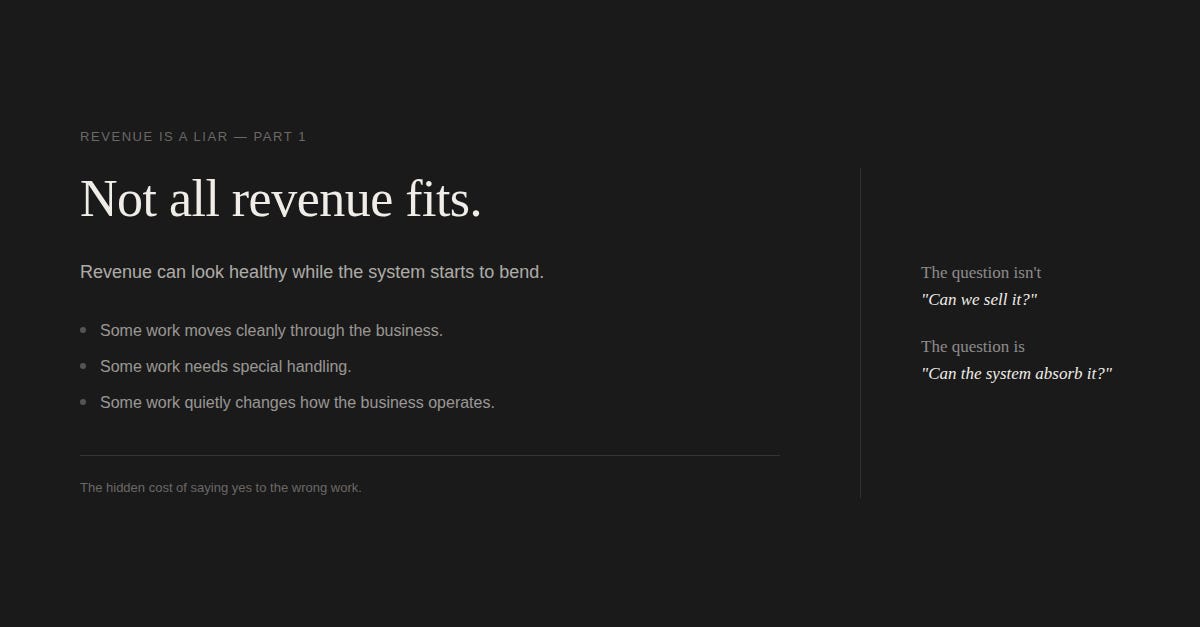
Not all revenue fits the system that produces it.
Some of it slides in cleanly.
It uses the same assumptions.
Moves through the same steps.
Produces roughly the margin you expected.
Some of it… doesn’t.
It requires a different quoting logic.
Creates edge cases in planning.
Introduces just enough ambiguity to slow everything down.
And some of it does something worse.
It reshapes the system around itself.
That kind of revenue looks good at first.
It fills capacity.
It builds relationships.
It signals growth.
But it leaves behind something harder to see:
A system that can no longer repeat itself.
You can feel it when:
Every job kickoff starts with a caveat.
Historical data stops being useful for estimating.
The team relies more on judgment than on process.
And “just this once” becomes normal.
At that point, growth gets strange.
You can add revenue…
…but each new dollar requires more interpretation, more coordination, more energy.
The system isn’t compounding.
It’s absorbing.
So the question isn’t:
“How do we get more revenue?”
Or even:
“How do we reduce the cost of getting it?”
It’s simpler than that.
And harder.
Which work actually fits the way we operate?
And just as important:
Which work quietly breaks it?
Revenue doesn’t show you that distinction.
It just totals everything up and tells you you’re fine.
Until you’re not.
Next: once you recognize that some revenue doesn’t fit, the next step is naming what it does to the system.
In Part 2, I’ll break down the three types of revenue most owner-led businesses are really running: aligned, tolerated, and corrosive.
No posts
Comments
Nothing yet. Say the first thing.
Sign in to join the conversation.