
First you recognize that some revenue doesn’t fit.
Then you name what it does to the system.
Most companies don’t have a demand problem.
They have a selection problem—and they don’t know it.
Revenue is treated as neutral. It isn’t.
Revenue is necessary.
But necessary is not the same as healthy.
It either fits the system and compounds…
or it introduces variation that the system has to absorb.
Over time, that distinction is the difference between scale and stall.
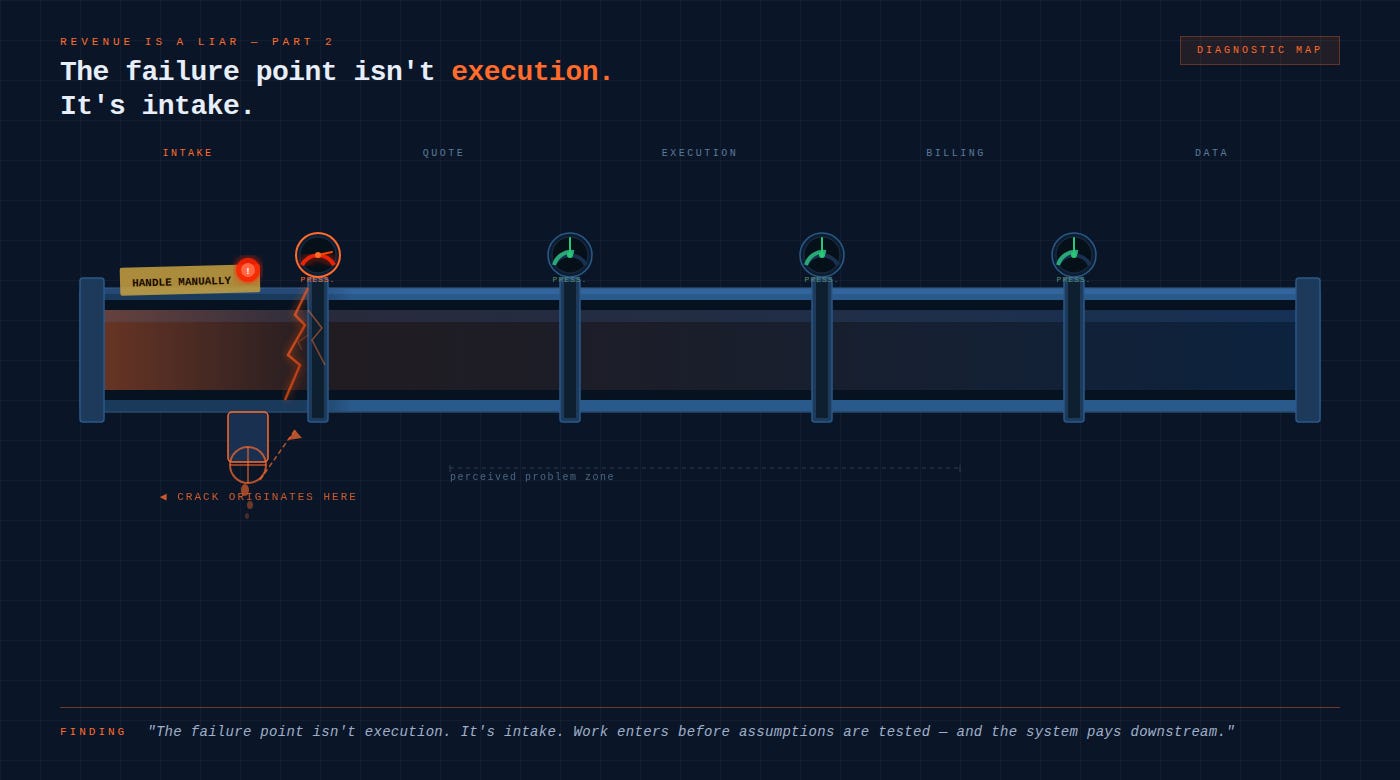
The failure point isn’t execution.
It’s intake.
Work is accepted that:
has no historical anchor for estimating
requires a different quoting logic
introduces new process paths
bypasses standard controls (“just get it done”)
None of that shows up as “bad revenue.”
It shows up as:
longer quoting cycles
inconsistent margins
planning friction
and increased reliance on judgment over process
Operator check: Audit the last 10 jobs accepted. Identify which ones required new logic, not just new effort.
Most cost reduction thinking focuses on efficiency.
This is a selection failure.
You can:
tighten spend
improve conversion
increase pipeline
…and still degrade the system if the work doesn’t fit.
Rule: Stop optimizing acquisition efficiency until you understand acceptance quality.
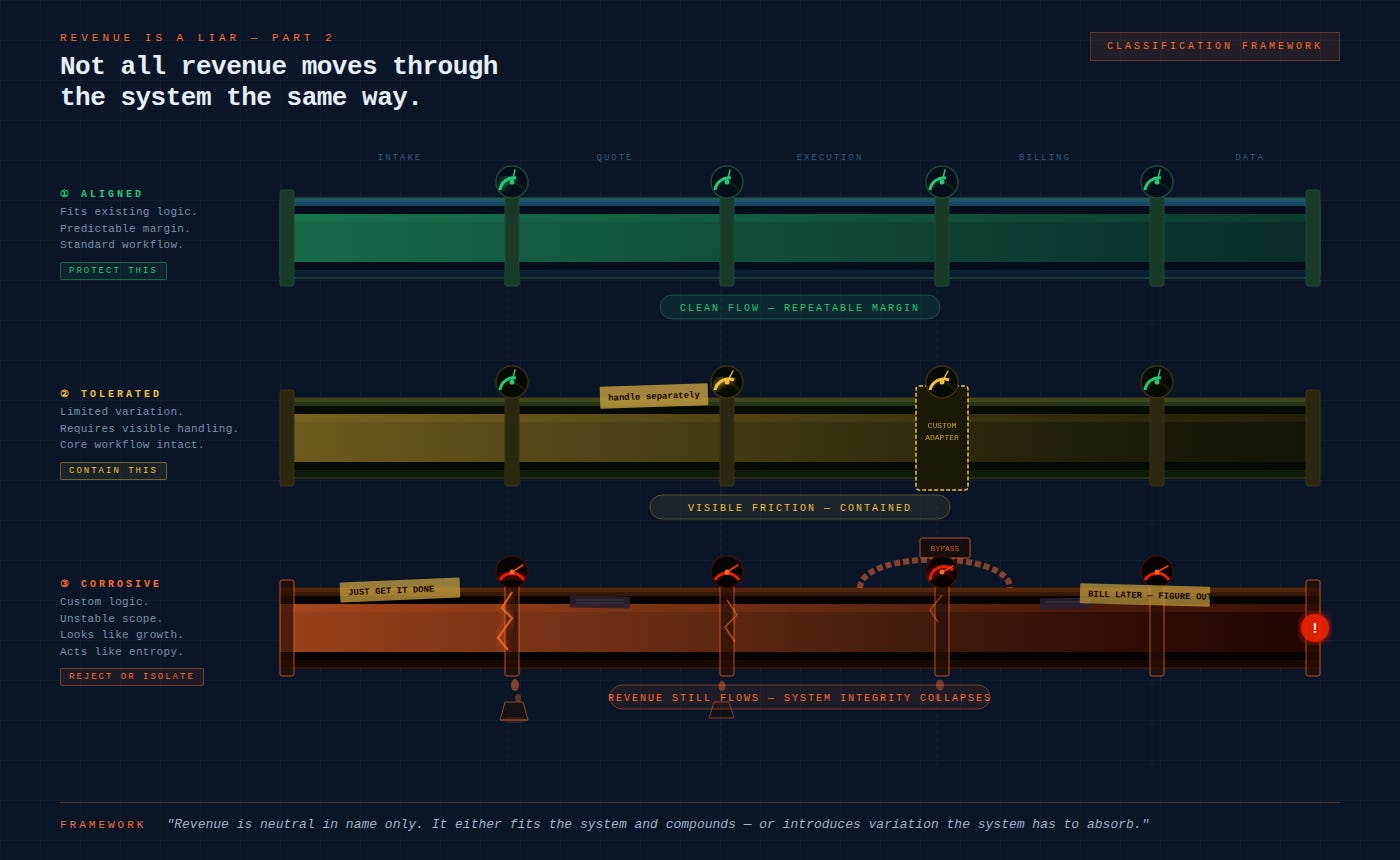
1. Aligned Revenue
Fits existing quoting logic.
Moves through standard workflows.
Produces predictable margin.
Protect this. This is your baseline system.
2. Tolerated Revenue
Creates limited variation.
Requires visible handling.
Does not break the core workflow.
Contain this. Track the variation explicitly.
3. Corrosive Revenue
Requires custom logic.
Creates unstable scope.
Breaks planning, billing, or repeatability.
Looks like growth. Acts like entropy.
Reject or isolate. Do not run this through the core system.
It doesn’t fail loudly.
It accumulates:
Estimating loses predictive power
Each job requires reinterpretation
Standard workflows fracture into exceptions
Operators default to judgment instead of system
You end up with activity, not throughput.
Operator Check: If estimating accuracy is drifting, don’t retrain estimators. Trace the revenue mix.
When the system is misaligned:
More revenue requires more coordination.
More coordination requires more people.
More people create more variation.
At some point, the system stops scaling and starts absorbing.
You’ll feel it as:
“We’re busy but margins aren’t improving”
“Every job is different”
“We just need better execution”
Maybe.
But execution can’t save work the system should have classified earlier.
Operator Check: Before adding capacity, test whether your current revenue mix can run without exceptions.
Not:
“How do we grow?”
Not:
“How do we reduce the cost of growth?”
Which revenue fits the system we actually have?
And which revenue forces us to invent a new system every time?
If a job requires:
new estimating assumptions
new workflow paths
new coordination rules
…it’s not incremental revenue.
It’s a system change.
And you’re approving it one job at a time.
Revenue is a liar.
It tells you you’re growing.
It hides what growth is doing to the system.
Next: corrosive revenue rarely announces itself directly.
It shows up downstream — in quoting, scope, labor, billing, and data — where most teams mistake the symptoms for execution problems.
That’s Part 3.
No posts
Comments
Nothing yet. Say the first thing.
Sign in to join the conversation.