
We were a t-shirt printer.
That’s how I thought about us.
That’s how we priced work.
That’s how we made decisions.
Then we landed the dispensary rollout.
Not a merch order.
A brand moving into physical retail across the West Coast.
Multiple locations.
Real timelines.
Real scrutiny.
We priced it like printers.
We had no idea what it would require to deliver it.
The part I didn’t see at the time—we were already moving in that direction.
I had started pulling us toward more complex work.
More vendors.
More coordination.
More ownership.
Pieces of a supply chain capability were there.
Just… not fast enough to match what showed up.
The scope didn’t show up all at once.
It looked normal at the start.
Then it spread.
T-shirts.
Custom labels.
Embroidery.
Packaging.
Custom rolling paper hang tags.
Multiple vendors.
Multiple timelines.
Dependencies everywhere.
It wasn’t a print job anymore.
It was a supply chain.
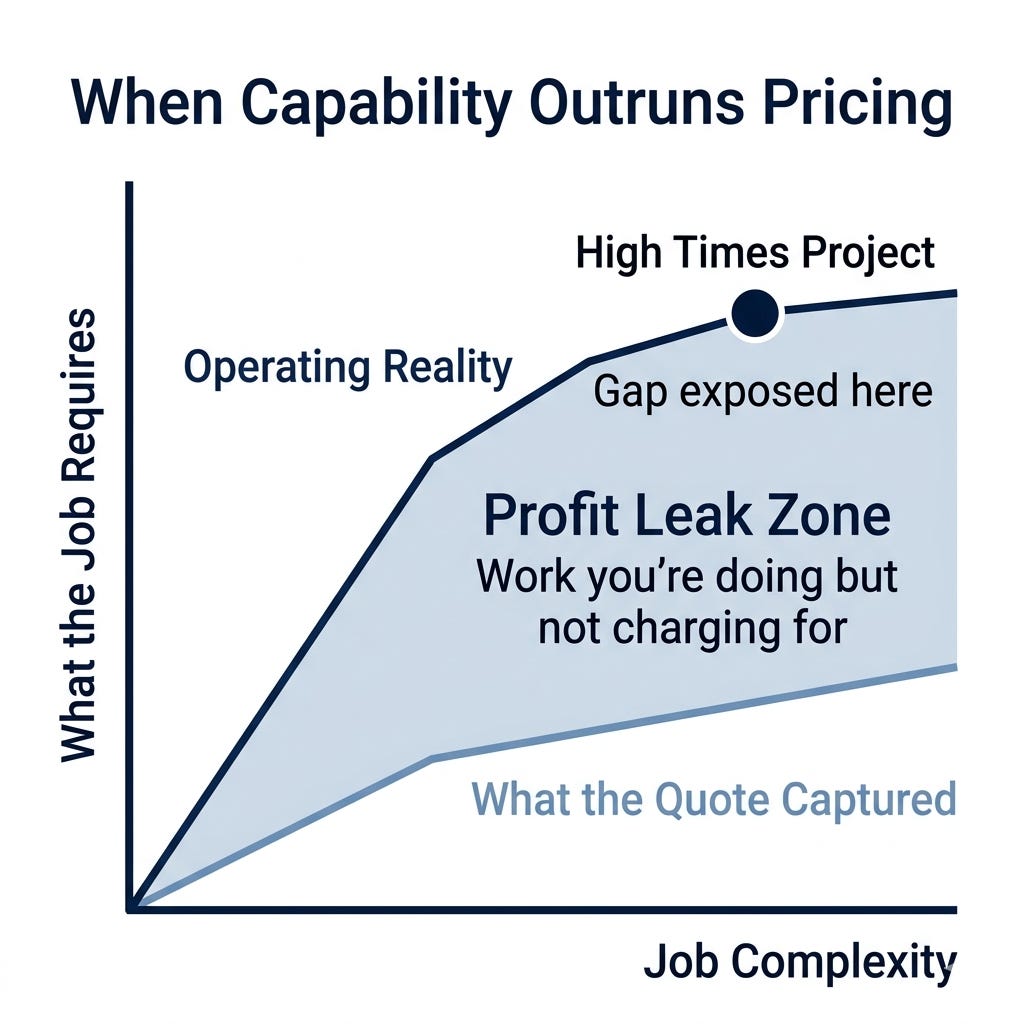
So when that job landed, it felt like a leap.
In reality, it was a collision.
Between what we were… and what we were becoming.
The shift didn’t happen in the org chart.
It happened in my calendar.
I was still the owner.
But my time said something else.
Following up.
Coordinating vendors.
Answering questions no one had asked at quote.
Solving problems that didn’t exist when we priced the job.
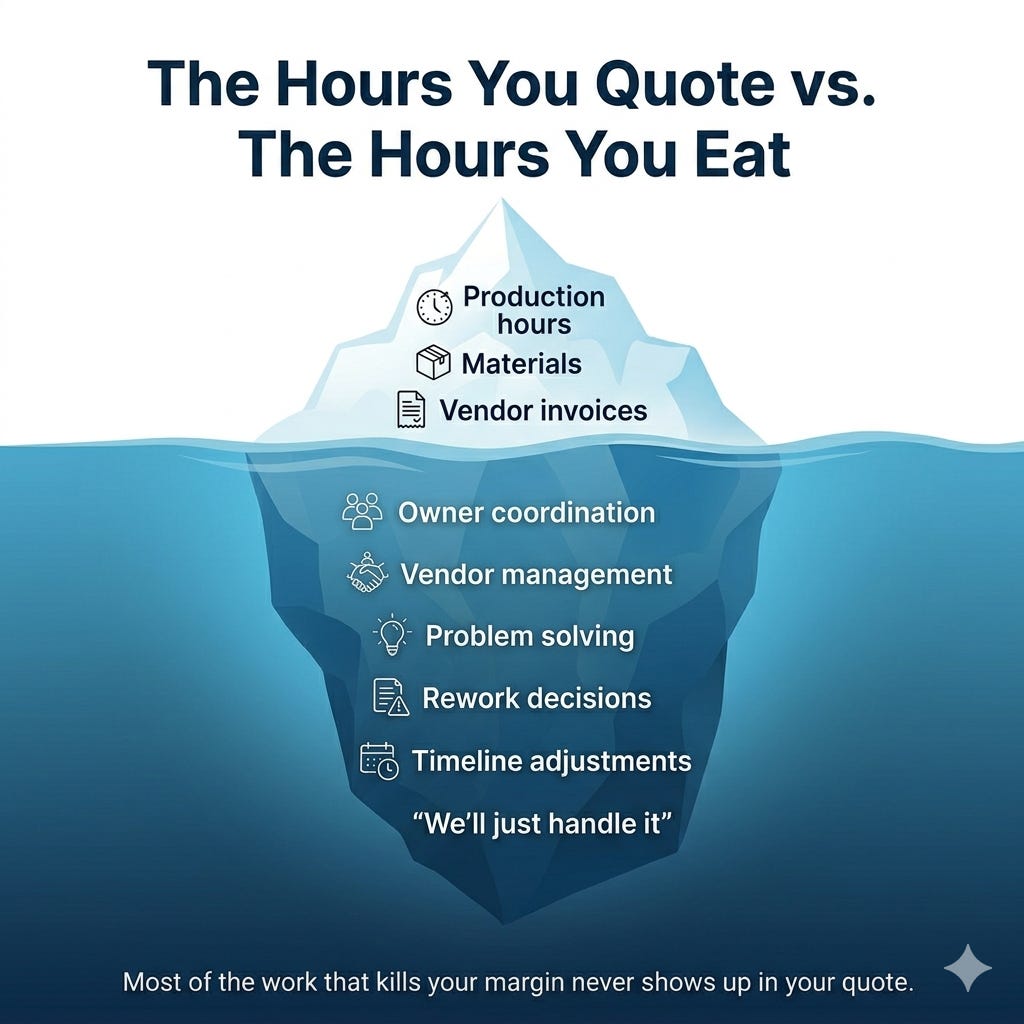
Hours I never planned.
Hours no one approved.
Hours that didn’t exist anywhere in the job cost.
That’s the kind of overhead that doesn’t look like overhead.
It looks like “what it takes to get the job done.”
We didn’t hit the profit we planned.
Not a loss.
Not a disaster.
But not what we planned.
The easy answer would’ve been:
We priced it wrong.
The job was messy.
The client asked for too much.
But that wasn’t it.
We priced it as printers.
We delivered it like operators running a supply chain.
If I had billed my own time to that job,
we would’ve called it unprofitable.
Nothing catastrophic happened.
No single failure.
Just a hundred normal decisions that didn’t belong in the quote.
A vendor delay.
A coordination gap.
A “we’ll just handle it” that quietly became two hours.
Then four.
Then a pattern.
After it was over, we did something we hadn’t done before.
A real post-mortem.
Not “what went wrong.”
What did it actually take?
Every extra hour I worked—captured.
Every coordination point—named.
Every hidden dependency—exposed.
All the invisible work that lived in my head—written down.
We rebuilt the quote from reality.
Not memory.
Not instinct.
Not “feels about right.”
Coordination time—explicit.
Vendor management—priced.
Variation—accounted for.
Ownership of complexity—assigned.
That’s when it clicked.
We hadn’t fixed the job.
We had fixed the lens.
The next time a job like that showed up, it looked familiar.
Same moving parts.
Same coordination.
Same risk.
But this time, it was in the quote.
That’s the difference.
That’s what carried into projects like New York City Pride.
Multi-vendor.
Multi-stakeholder.
Tight timelines.
High visibility.
The kind of work that used to quietly eat margin.
This time, it didn’t.
Because we weren’t guessing anymore.
Most owners think profit leaks come from bad jobs.
They don’t.
They come from good jobs that change what you are—
before your pricing catches up.
If a client like that landed in your inbox tomorrow—
Not a bigger order.
A more complex one.
Would your quote reflect what it actually takes to deliver it…
Or what you’re still telling yourself you are?
No posts
Comments
Nothing yet. Say the first thing.
Sign in to join the conversation.