

NEWS#54 - GLOBAL EDITION


The World Cup tends to produce a rare effect in Brazil: for a few weeks, the country seems to recognize itself in a shared image. The jersey, the anthem, the crowd, and a collective sense of pride reorganize, however temporarily, a feeling of belonging.
But perhaps the more interesting question is not how Brazil presents itself in those moments. It is which Brazil appears when the mirror leaves the symbolic field and enters the realm of data.
It was with this question in mind that I read Brasil no espelho (Brazil in the Mirror), by Felipe Nunes, political scientist, co-founder of Quaest, and professor at FGV. The book brings together the largest values survey ever conducted by the institute: 9,994 interviews in 340 municipalities, carried out between November and December 2023. The material was organized into 37 indexes and 11 analytical dimensions, with breakdowns by generation, income, religion, gender, and region.
It is not a book about design, brands, or architecture. But it should matter to anyone working in these fields in Brazil - and to anyone outside the country trying to understand it beyond its exportable symbols.
Because no brand, home, or city is built outside the value system of its time and territory.
Drawing on the theory of Ronald Inglehart and the World Values Survey, Felipe Nunes looks at Brazil through two axes: survival versus self-expression; traditionalism versus secularization. The thesis is uncomfortable: the country has changed a great deal only to resemble, in many ways, what it has always been. It has become more diverse, more digitalized, and more exposed to the world, yet it remains deeply shaped by religion, family, insecurity, low trust, and traditional values.
The religious data gives scale to this permanence. According to the survey, 96% of Brazilians believe that God is in command of life, and 86% say faith is worth more than science. Even among people with no religion, 91% say they believe in God or in some superior force. Modernization has taken place, but it has not dissolved the country’s deeper symbolic structures.
The generational reading makes this picture even more complex. From the Bossa Nova Generation to the Geração . Com, the book reveals a Brazil less homogeneous than many narratives suggest. Younger generations appear more connected, more open to diversity, and closer to self-expression, but also more anxious and unstable. The country, therefore, does not move in a straight line. It advances and retreats at the same time.
This matters for brands because it exposes the limits of superficial readings of Brazilianness. Brazil cannot be reduced to color, nature, joy, informality, or creativity. These elements exist, but they do not fully explain a country that is both modern and traditional, digital and religious, creative and insecure, proud of its culture and distrustful of itself.
That is why treating Brazilianness as a brand asset requires more than a visual repertoire. It is not enough to translate color, form, rhythm, nature, craft, or joy into language. It is necessary to understand which values sustain those images. Otherwise, the risk is to sell a Brazil that no longer explains the real Brazil.
For those thinking about cities and ways of living, the point may be even more decisive. The book presents insecurity as one of the structuring forces of Brazilian life. Fear reorganizes behavior, consumption, social relations, and institutional trust.
In this context, the home is no longer merely an expression of taste. It also becomes protection, control, refuge, and a marker of belonging. This helps explain why dwelling in Brazil is rarely just an aesthetic question. The choice of neighborhoods, buildings, gated communities, materials, security technologies, or shared spaces responds to something deeper: an attempt to negotiate intimacy, status, protection, and trust in a society that trusts very little.
This is where reading the country becomes relevant to design. If multiple Brazils coexist within the same territory, there is no single language capable of representing Brazil. There are repertoires in tension. The Brazil of self-expression and the Brazil of survival. The Brazil that seeks global recognition and the Brazil that still organizes itself through proximity, faith, family, fear, and distrust.
Before becoming language, Brazilianness must first be read. Before turning into aesthetics, it must be understood as a cultural, social, and emotional system.
For brands, architects, and designers, the challenge is not to decorate Brazil with its own symbols. It is to understand which country those symbols conceal, reveal, or try to organize.
Before transforming Brazilianness into brand value, it is necessary to understand the many Brazils that produce it.



I first came to design through graphic design. It was in that territory, in Rio de Janeiro between the 1980s and 1990s, that I first heard the name Ana Couto. Even though we had never met, her name stayed with me. That says something. In a field where few women held real positions of visibility and respect, Ana built something rarer than presence: she built authority. Part of that authority comes from the way her trajectory helped shift the understanding of branding in Brazil. For a long time, a brand was reduced to a name, a logo, a visual identity, or a campaign. Ana Couto belongs to the group of professionals who expanded that conversation. For her, a brand is not surface. It is a system of value. iF Design describes her trajectory as that of a designer who founded, in 1993, the agency that bears her name with the goal of using design as a tool to build strong brands. Since then, her work has brought design, communication, and business into the same strategic logic. Over the course of this journey, Ana has received more than 50 national and international awards, had her work published in international design books, served as a jury member for platforms such as Cannes Lions, D&AD, the ADC Annual Awards, and iF Design, and published A (R)evolução do Branding, a book in which she organizes her vision of the continuous management of brands’ intangible value. Her work includes brands such as GloboNews, Havaianas, Itaú, CBF, Brastemp, and Natura, among others, and today it is structured as an ecosystem that includes anacouto, the education platform LAJE, and Valometry, dedicated to continuous brand management. There is an important Brazilian tension in this conversation. The country is recognized for its creativity, cultural diversity, and original repertoire, yet it still has no brand among the 100 most valuable in the world in the Brand Finance ranking. Ana Couto’s stated ambition is to confront this mismatch: to transform cultural power into brand value. This interview also matters to me because of a shared path. My own reading of design began in graphic design, in form and visual language, and gradually moved toward an understanding of design as a strategic infrastructure of value. The conversation with Ana Couto begins from that common ground: branding not as appearance, but as the construction of coherence. Not as visual delivery, but as intelligence of value.
1. Do you believe we are witnessing a deeper shift in the way people assign value to spaces, objects, and brands? Which values are becoming more important in this context?
Yes. We are witnessing a structural shift in the way value is built and perceived. For a long time, value was concentrated in major centers of influence, in symbols defined by a limited number of geographies and institutions. Today, we are seeing a symbolic decentralization. Different cultures, territories, and communities have begun to produce their own references and influence the collective imagination on a global scale. As a result, values such as authenticity, belonging, cultural identity, coherence, and experience are gaining strength. People are increasingly less interested in consuming only products or messages, and increasingly more interested in connecting with stories, repertoires, and worldviews they consider legitimate. What cannot be replicated becomes more valuable. In a world where technology makes execution increasingly accessible, personality, trajectory, and the ability to sustain a narrative of one’s own become competitive differentiators.
2. In an environment of constant change, which attributes truly build long-term relevance for a brand?
Long-term relevance is born from the combination of consistency and the ability to evolve. The most valuable organizations are not necessarily those that respond most quickly to every change in context, but those that are able to evolve without losing their essence. In Grandes Apostas 2026, a study launched by anacouto to support brand and business leaders, we identified authenticity as a strategic asset. Execution can be copied, technology can be acquired, but repertoire, vision, memory, and trajectory cannot. That is why brands that know their history, understand their cultural role, and are able to translate that into experiences, products, and narratives build more lasting relevance. Another increasingly important attribute is legitimacy. We are living through a cycle of structural distrust in which institutions, celebrities, and major authorities are constantly questioned. Trust is migrating toward more horizontal relationships, communities, and real people. Relevant brands are those able to generate credibility through experience and through people’s genuine participation in their construction.
3. In many sectors, there is a sense that brands have never done so much. New launches, collaborations, events, content, and initiatives appear all the time. And yet many seem to struggle to sustain a clear focus on who they are and what they stand for. This affects not only the public, but also the press, partners, and the managers themselves. In your view, why has strategic clarity become so difficult — and so decisive - today?
Because we are living through a moment of enormous acceleration. Collective attention shifts rapidly, narratives intensify, new platforms appear all the time, and the pressure to respond is constant. In this environment, organizations tend to confuse presence with relevance. Strategic clarity has become more difficult because the possibilities have multiplied. At the same time, it has become more decisive because it is what allows a brand to choose. Relevant brands do not try to belong everywhere. They choose a cultural territory, a narrative, and a way of participating in culture. One of the points we highlight in our Grandes Apostas 2026 study is that it is not enough to inform. It is necessary to build a storyline. Many organizations produce an enormous volume of actions, but without a narrative line capable of connecting them. When campaigns, products, experiences, and positions are part of the same story, the brand accumulates value over time. When that coherence does not exist, each initiative is born and dies in isolation.
4. For decades, Brazil has been recognized for its creativity, cultural diversity, and ability to produce an original repertoire. And yet few Brazilian brands are able to transform these assets into lasting global relevance. What is still missing from this equation?
I believe there is still a difficulty in recognizing Brazilianness as a competitive advantage. Brazil has extraordinary cultural, human, and environmental richness, but its brands often seek legitimacy in external references instead of deepening what already makes them unique. To some extent, we still carry a kind of national inferiority complex, which leads us to value what comes from outside more than our own cultural assets. This becomes even more relevant in a context of symbolic decentralization, as I mentioned earlier. Different geographies have begun to produce their own references and influence the collective imagination on a global scale. The success of cultural movements from Latin America, Africa, and Asia shows that global relevance does not require neutralizing identity, but deepening it. What Brazilian brands lack is not creativity. What they lack is the ability to transform Brazilianness into strategy. Companies need to explore the unique characteristics of our national identity and use them strategically to create brands that are not only known, but admired worldwide. And this involves a logic I have been calling an on-the-go strategy. Instead of treating Brazilian identity as an institutional discourse that remains locked inside the planning process, organizations need to transform it into continuous decisions across product, experience, communication, and business. Today, strategy and execution happen at the same time. Brazilianness generates value when it stops being only a narrative and begins to guide, dynamically, everything the brand does in its day-to-day life.




For years, brands were trained to optimize everything: journey, data, performance, segmentation, speed, personalization. Technology made communication more precise, operations more efficient, and execution more accessible.
Perhaps that is exactly where the problem begins.
When many brands use the same tools, difference no longer lies only in delivery. It begins to lie in staying power. As Ana Couto points out in this edition’s interview, relevance is not born from being everywhere, but from the ability to sustain coherence.
Two recent signals help explain this shift. An Ipsos study shows that 47% of brand experiences in Brazil are forgettable. It also points out that around 60% of consumers are influenced by friends and family, and that satisfied people recommend a brand, on average, 8.7 times a year. The central point lies in what this reveals: trust remains a social infrastructure, not merely a media outcome.
In the same direction, Cannes Lions, the international creativity festival held this week in France, returned to a simple thesis amid discussions about artificial intelligence, global expansion, and the future: the more technological the world becomes, the more human it needs to be. Technology expands reach, accelerates processes, and refines delivery. But on its own, it does not create belonging. It does not replace repertoire, empathy, imagination, ethics, or collective meaning.
This intersection is where the issue lies for brands, design, and business.
Emotional connection is not the opposite of technology. It is what prevents technology from becoming indifferent. An experience can be fluid, fast, and efficient - and still leave no memory. It can solve a need without creating a bond. It can work without meaning anything.
This discussion appears clearly in Brazil’s interior architecture and home retail sector. Awards, trips, meetings, gifts, actions with retailers, events, and invitations are part of a relationship culture with real value. While in part of the international market the authority of prestige brands has historically organized the relationship with professionals, in Brazil influence tends to be more negotiated, closer, and more relational.
As global competition intensifies, this dynamic stops being a local particularity and begins to offer a lesson: proximity only becomes value when it becomes method.
A trip can enchant. A small gesture can be remembered. An event can bring people closer. An email can inform. But when these actions do not belong to the same narrative, they dissipate. They become effort, not construction. Presence, not relationship.
This is where technology needs to enter in a different way: not as a substitute for the human gesture, nor as cold automation, but as an infrastructure of intelligence. CRM, an organized database, a relationship framework, and a consistent reading of each professional’s history allow something decisive for premium and luxury brands: meaningful personalization.
This is not about calling someone by name or segmenting a list. It is about recognizing context, repertoire, preference, timing, and connection.
In luxury, personalization is not volume with the appearance of proximity. It is a singular story, built with precision.
Relevant brands do not treat the human dimension as a layer applied after the operation. They treat it as a design criterion. Listening, response, recognition, follow-up, and trust must run through product, service, communication, culture, and relationship. Everything must belong to the same story.
The perfect experience may have been overestimated. What builds value is the experience that leaves a legitimate impression: the one the consumer remembers, shares, recommends, and recognizes as part of a real relationship.
This is where the conversation moves beyond marketing and enters the field of strategic design. Design, in this case, is not form. It is a structure of relationship: the ability to organize signals, choices, language, behavior, and delivery so that a brand does not merely appear, but is understood.
Technology will continue to advance. Artificial intelligence will continue to improve execution. The dispute will not be between more technological brands and more human brands. It will be between brands that use technology to automate presence and brands that use technology to deepen relationships.
If almost half of brand experiences are forgettable, being remembered no longer depends on appearing more. It depends on meaning better.

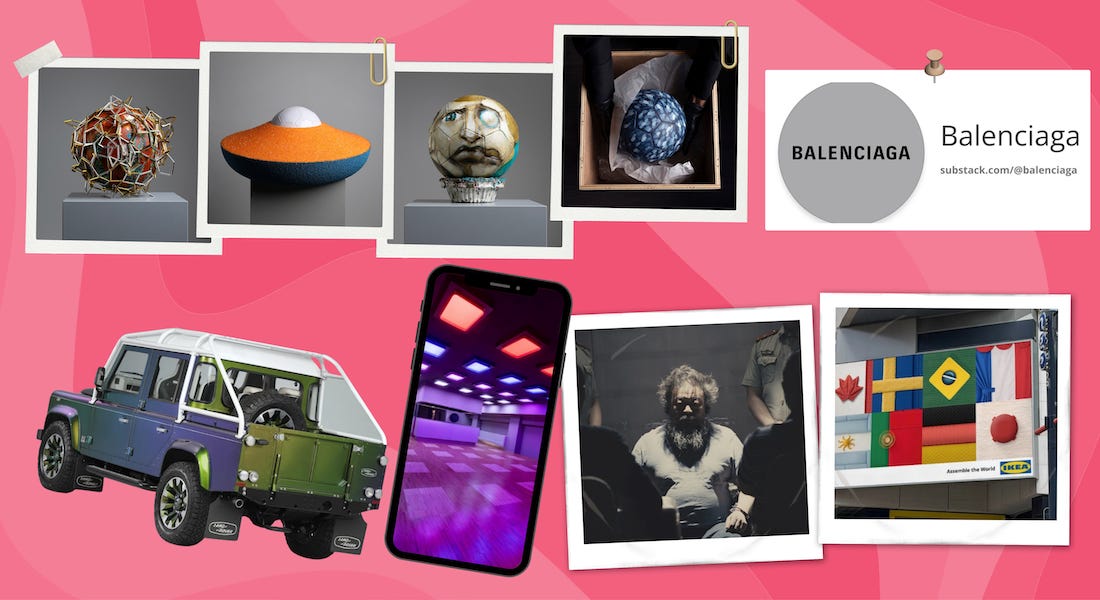
- At the height of the World Cup, the IMAZ Foundation brings Chapter One to New York: eleven artists reinterpret eleven soccer balls in a silent auction. Each sale funds the construction of a home for a single mother and her children in Quito. Here, collecting moves beyond ownership and becomes shelter.
- One year after joining Substack, Balenciaga has become the first fashion house to enter an official partnership with the platform. The move confirms an important shift: luxury brands are seeking cultural presence through newsletters and independent publishing. MBRecebe-Global Edtion is also on Substack, following this migration of media toward more authored territories.
- New on Milan’s nightlife scene: Duro has just arrived in the Certosa district, inside a former industrial building. Designed by Velvet Studio, the club brings brutalism and electronic music together through exposed concrete, stainless steel, mirrors, and light. More than a nightspot, it is a symptom of a city in regeneration.
- Land Rover has pushed personalization to the limit with four one-of-a-kind Defenders. The Spectral Green paint shifts from green to purple and gold depending on the angle of the light, an effect that also appears on the wheels, badges, and interior panel. The car becomes a mutable surface: less fixed color, more optical experience.
- In Argentine Patagonia, Messi has gained monumental scale. Inaugurated in Cutral Co, the 26-meter, roughly 70-ton statue is described as the tallest ever dedicated to a soccer player. Between homage, tourism, and national identity, the idol becomes public landscape.
- In Manchester, Ai Weiwei opens Button Up!, a major exhibition dedicated to the relationship between China and Great Britain. The show will be accompanied by a 24-hour performance inside a replica of the cell where the artist was detained in 2011. Memory, body, and power take the stage.
- During the World Cup, IKEA Canada deconstructed the flag as a symbol and reassembled it as a catalogue. In the Assemble the World campaign, created with Dentsu Creative, 18 national team flags are built from the brand’s furniture and objects. Soccer, retail, and visual language meet at exactly the right point.

No posts
Comments
Nothing yet. Say the first thing.
Sign in to join the conversation.