

NEWS#53 - GLOBAL EDITION


Many readers have asked for my take on CasaCor São Paulo 2026, Latin America’s largest architecture, interiors, and design exhibition. What interests me is not which spaces were photographed the most, but why certain phenomena emerge and what they reveal about broader cultural shifts.
That question is what led me to leave the exhibition thinking about a very specific object: the book.
Not because books were everywhere. But because, for some time now, I have been noticing their reappearance across worlds that do not usually intersect: fashion, design, luxury, architecture, social media, and culture.
When the same object begins to appear simultaneously in such different places, it is rarely an aesthetic coincidence.
In fashion, Miu Miu launched its Literary Club, turning reading into part of the brand experience. Valentino invited writers to contribute to its Narratives campaign. Dior reimagined its iconic Book Tote with covers of literary classics, transforming one of its most recognizable handbags into an object that moves between fashion, reading, and cultural identity. Long before that, Olympia Le-Tan had already turned books into collectible handbags.
During this year’s Milan Design Week, Apartamento magazine presented Reference Library, created in collaboration with Jil Sander and studioutte. Sixty books selected by architects, designers, artists, and writers were displayed as collectible objects-less a library than a statement about cultural capital.
Earlier this month, Domus published an analysis of the book’s renewed role in contemporary culture, echoing a recent observation by The Guardian about the rise of so-called bookshelf wealth-libraries that function less as storage and more as visible expressions of identity and intellectual life.
What interests me most about this phenomenon is that it is happening precisely at a moment when access to information is no longer a problem.
Knowledge has never been easier to find.
The challenge now is building cultural depth.
And the physical book remains one of the few objects capable of making that visible.
A particularly revealing example was the recent collaboration between Coach and Penguin Books: fully readable miniature books, leather-bound and designed to hang from handbags by a metal clasp. The first titles-from Maya Angelou to Jane Austen and Celeste Ng-sold out almost immediately.
The value of the book no longer resides solely in its content.
It also lies in what it communicates about the person who carries it, displays it, and chooses to live alongside it.
That helps explain why books are reappearing on runways, in installations, campaigns, interiors, and architecture exhibitions—and it offers an interesting lens through which to read CasaCor.
In one of the exhibition’s spaces, a library of four thousand volumes occupies the center of the project. What caught my attention was not the quantity of books, but the ability of a library to once again organize an entire architectural narrative.
When clients ask for a library today, they are rarely asking only for a place to store books.
They are asking for a physical expression of who they are-and a visible representation of the intellectual world they have built over time.
Books have reclaimed space because they have reclaimed their role as markers of identity.
And identity, in a world of increasingly similar surfaces, has become one of the most contested resources of all.



I first met Guto Requena more than twenty years ago, during one of his early lectures presenting the research of Nomads.usp, a research center at the University of São Paulo dedicated to the study of interactive forms of living. At the time, hearing someone speak about hybrid living-understood as a condition in which everyday life unfolds simultaneously across physical, digital, and hybrid spaces-felt almost like science fiction. Very few people in Brazil were discussing the home, the city, and technology through that lens. Years later, in 2019, I encountered that same line of inquiry again in Hybrid Living, a book in which Guto proposes a new framework for understanding contemporary life, exploring how technology, emotion, and everyday experience have reshaped the way we inhabit the world. Since then, his work has gained international reach. Founder of Estudio Guto Requena, with offices in São Paulo and Lisbon, he develops projects that move between architecture, design, urbanism, and interactive installations. His portfolio includes collaborations with brands such as Hermès, Google, BMW, and Mercedes-Benz, while also investigating empathy, inclusion, and technology through public and social initiatives. A visiting professor at the Sorbonne in Paris, Creative Director of Architecture, Interior Design, and Landscape Design programs at Senac, researcher, speaker, and award-winning author, Guto has become one of the most consistent voices exploring the relationship between technology, emotion, and space. What interests me most about his work, however, is that even when he talks about artificial intelligence, sensors, biofeedback, and smart cities, his research has never been centered on technology. It has always been centered on people. This conversation is about that.
1. Algorithms are already part of creative processes, and personal data has become an economic asset. Who owns the authorship of an object generated from someone’s intimacy? When emotions become raw material for design, does it still make sense to think about authorship the way we do today?
The idea of authorship is fascinating because it has been evolving for decades. Since the 1980s, concepts such as collage, appropriation, and remix culture have challenged traditional notions of authorship and originality. One of my own projects explored this question directly. For Noise Chair, I scanned Lina Bo Bardi’s iconic Girafa Chair and combined that digital file with audio recordings from Rua Santa Ifigênia, a historic street in downtown São Paulo. The result was a new object: a chair in which the original form remains recognizable, but distorted by the sounds of the city. The final piece was then 3D printed. The central question was simple: who is the author? Lina Bo Bardi? The engineers who worked with me? Myself? Nobody? Everybody? In the digital age, this question becomes even more relevant. Once everything is transformed into data, into bits, it can be endlessly mixed, remixed, and reinterpreted. Today, I am much more interested in open-source models and systems that allow ideas to circulate and evolve within shared frameworks. I strongly believe in collective authorship, collaboration, and multidisciplinary creation. A good example is Love Project. Over fourteen years, I collected love stories using biofeedback sensors capable of measuring heart rate, brain activity, vocal emotions, and physiological responses. Those emotional data sets were then transformed into physical objects. In that case, I see authorship as inherently shared. The people who contributed their stories and emotional data are co-authors. So are the engineers, programmers, and the hardware and software systems involved in the process. Design is becoming increasingly similar to filmmaking, where a work emerges from the contributions of many people. Behind every project exists an extensive network of collaborators who collectively make it possible.
2. Much of today’s urban technology is designed to make cities more efficient. You speak instead about affective cities. What does the first measure that the second finds insufficient?
Efficiency is necessary. It is a function. A requirement. A city must work. The idea of the efficient city emerges from a rational, functional, capitalist, and largely Eurocentric framework. There is no question that cities need efficient infrastructure and systems. What I have been investigating for nearly twenty years-both through my practice and my academic research-is what exists beyond efficiency. I was a researcher at Nomads.usp, the University of São Paulo’s center for interactive living studies, and I am currently pursuing a PhD at the University of Lisbon on a related question: how design and technology can foster empathy in public and collective spaces. When I talk about affective cities, I am referring to design methodologies capable of creating emotional and relational experiences in addition to fulfilling basic urban functions. A bus stop, for example, does not have to serve only as a place to wait for a bus. It can become a place for encounter. It can encourage conversation, curiosity, even a smile. I like to think of urban design as an opportunity to introduce new layers of poetry into the city. In that sense, technology is an essential tool-not simply to make systems more efficient, but to expand the capacity of spaces to generate connection, meaningful encounters, and shared experiences. This perspective is also connected to a central theme in my research: the need to decolonize design. My education as an architect was deeply shaped by Eurocentric references, by perspectives from the Global North, and by a binary, patriarchal, and colonial understanding of the world. Over the past two decades, however, I have come to understand that there are other ways of seeing and shaping reality. Designing and living in Brazil requires us to learn from Afro-diasporic, Afro-Brazilian, and Indigenous knowledge systems. It requires recognizing alternative ways of producing knowledge, inhabiting space, and imagining the city. For me, designing through the lens of empathy is a direct extension of that process. It is one way of contributing to the decolonization of design, architecture, and urban space itself.
3. Your work moves between global luxury brands and projects developed with vulnerable communities. What do these two worlds see in each other that usually goes unnoticed?
That is a very interesting question. Throughout my career, I have had the opportunity to develop projects for brands such as Hermès, Google, BMW, Mercedes-Benz, and Paco Rabanne, as well as for Cidade Matarazzo and other luxury-sector clients. There is something I learned from an interview with Oki Sato, founder of Nendo, that has stayed with me ever since: the luxury industry can function as a laboratory for experimentation. These projects have the resources to explore new technologies, develop algorithms, create software, test materials, experiment with advanced manufacturing processes, and take risks that would often be impossible in other contexts. I like to think of these commissions as opportunities to experiment-and then to share what is learned. The knowledge I gain from developing interactive installations, responsive environments, sensor-based systems, and projects centered on human emotions eventually becomes knowledge that can circulate beyond those contexts and benefit initiatives that would never have access to the same resources. In my case, the opportunity to work alongside neuroscientists, programmers, hardware and software specialists, and multidisciplinary teams has given me a body of knowledge that I now try to redistribute in different ways. Perhaps that is why education has become such an important part of my practice. I serve as Creative Director for Architecture, Interior Design, and Landscape Design programs at Senac. I teach at the Sorbonne in Paris and am also a visiting professor at the University of Lisbon. These are spaces where I can share what I have learned through highly complex projects and transform that knowledge into something accessible to a much broader audience. I see that circulation of knowledge as a responsibility. Luxury finances experimentation. Education expands its reach.
4. You often use the term ancestral future. If innovation is usually associated with looking forward, why can memory be a more powerful tool for imagining the future than artificial intelligence?
I learned the expression ancestral future from Ailton Krenak, one of Brazil’s most important Indigenous thinkers. The first time I heard it, it immediately resonated with the stage of research I was in. For many years, I looked at technology with fascination and admiration. In many ways, I still do. I have been working with 3D printing for nearly two decades, exploring programming, interactive environments, and different ways of integrating technology into architecture. But over the past ten or fifteen years, I began to understand something that profoundly transformed the way I design: the intelligence of nature. When we talk about biophilia, more-than-human intelligence, or a multispecies world, we are talking about technologies that have existed far longer than any digital innovation. That is where the idea of an ancestral future begins to make sense to me. As an architect and designer, I want to use the technologies of our time. But I want to do so in dialogue with ancestral forms of knowledge that Indigenous peoples have preserved for centuries. I can 3D-print houses using earth. I can work with bamboo, sensors, and digital systems at the same time. I see no contradiction between technological innovation and ancestral wisdom. Perhaps the most important lesson is recognizing that civilization will only be able to address the challenges ahead once it understands that we are nature. That means designing for a multispecies world. It means treating nature not as a backdrop, but as a fundamental component of every project. It means working with biodegradable materials and using artificial intelligence as a collaborative tool in the face of the climate emergency. For me, all of this is deeply connected to empathy. We need to recognize ourselves as part of a shared humanity that coexists with countless other forms of life on this planet. And perhaps that is precisely what ancestral memory can still teach us-something no technology, no matter how sophisticated, can generate on its own.




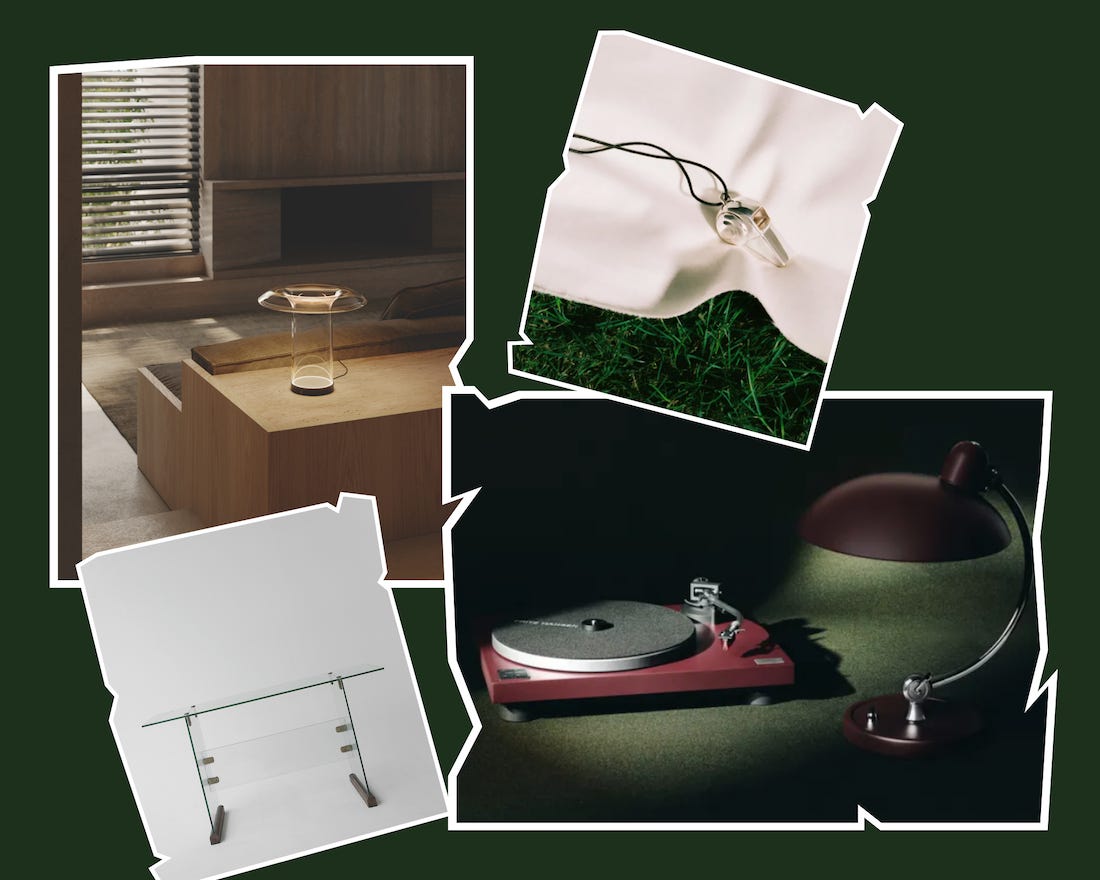
Among the press kits, launches, and discoveries that landed in my inbox over the past few days, a few pieces skipped the “new” category altogether and went straight onto my wish list. Objects that reveal how design, technology, craftsmanship, and imagination continue to find new ways to converse.
Aurea - Carolina Martinelli and Vittorio Venezia - Lodes
In Aurea, light does not rest on the glass. It travels through its interior before emerging along the edges and curves of the piece. The result is a lamp that occupies space without filling it, transforming transparency, technology, and perception into luminous matter.
Whistle - Paula Gerbase - Georg Jensen
Inspired by the form of a snail, this sterling silver whistle is part of Paula Gerbase’s At Play collection for Georg Jensen. A playful object that transforms an everyday instrument into a design piece, exploring interaction, surprise, and craftsmanship.
Side Table, 1939 - Gio Ponti - Dimoregallery
Designed by Gio Ponti for the offices of Vetrocoke in 1939, this rare Vitrex glass side table anticipates themes that would later define postwar modern design. Transparency, structural lightness, and formal precision in their purest form.
FH x Technics Turntable - Technics + Fritz Hansen
Launched during 3daysofdesign in Copenhagen, this limited-edition Technics turntable features a sculptural base created by Fritz Hansen. Available in Burgundy Red, it brings together high

There is a question Arthur Casas has been carrying for years-one that ultimately gave rise to one of the most unusual initiatives in contemporary Brazilian architecture: why have so many intelligent solutions developed in Brazil simply fallen out of use?
Industrialized building systems, passive environmental strategies, prefabricated façades, and rationalized construction components disappeared from Brazilian practice not because they became obsolete, but because they were never systematically documented or transformed into accessible knowledge.
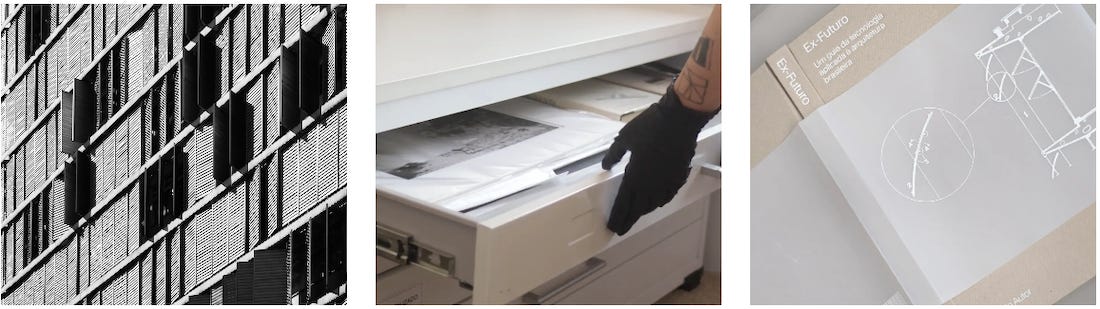
That is what caught my attention when I first came across IACAI. The project is not driven by the search for the next new thing. It is driven by the recovery of knowledge that the industry produced but never managed to pass on.
The Arthur Casas Institute for Architecture and Innovation (IACAI) is a nonprofit organization, approved under Brazil’s Rouanet Cultural Incentive Law in August 2024, created to explore new paths for the country’s construction industry. Its flagship initiative, launched recently, is a free and open-access platform that gathers design solutions, construction systems, technologies, and environmental strategies developed by Brazilian architects across different historical periods.
More than cataloging solutions, the institute asks a simple question: why did these ideas fall out of use-and do they still make sense today?
In an interview I conducted with Arthur Casas about a year ago, I asked what he would eliminate if he could design the home of the future from scratch.
His answer was direct:
“Reinforced concrete, because of its excessive consumption of potable water on construction sites. Bricks, because they rely on poorly paid labor that often borders on exploitation. In truth, I would abandon almost the entire construction system currently practiced in Brazil.”
It is an answer that helps explain why the institute exists.
Readers of this newsletter know that I have been paying increasing attention to discussions around housing, construction, and the future of cities. In the previous edition, I highlighted a figure that should concern the entire building sector: buildings account for roughly one-third of global carbon emissions and energy consumption.
IACAI begins from the same diagnosis.
The platform already includes dozens of cataloged solutions, organized by construction system, material, architect, region, and application. Among them are studies and projects by Rino Levi, Lelé, Paulo Mendes da Rocha, Abrahão Sanovicz, Pedro Paulo de Melo Saraiva, the Roberto Brothers, and other figures who helped shape the technical intelligence of Brazilian architecture.
The institute also preserves archives, publishes research, and makes available sketches and documents that reveal the thinking behind these solutions.
“IACAI is an invitation for new generations to think beyond what is already given,” says Arthur Casas.
For an international audience curious about Brazilian architecture beyond its most celebrated buildings, that may be where the project’s greatest relevance lies.
Brazil developed remarkable responses to challenges involving climate, resource scarcity, industrialization, and housing. What the institute proposes is to transform that knowledge into a publicly accessible infrastructure.
At a moment when conversations are dominated by artificial intelligence, decarbonization, industrialization, and productivity, IACAI is betting on something increasingly rare: making knowledge circulate.
Arthur Casas’s question is not nostalgic.
It is strategic.
And IACAI may be one of the most ambitious efforts ever undertaken in Brazil to ensure that valuable knowledge does not disappear along with the generations that produced it.

Click and share with a friend.

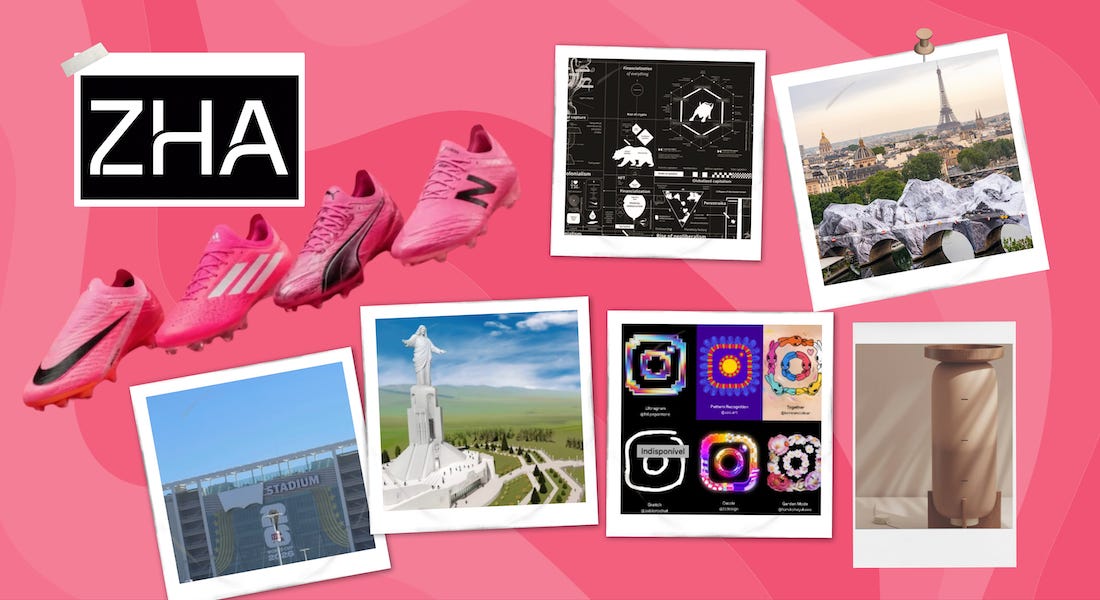
- Ten years after Zaha Hadid’s death, and amid ongoing legal disputes over her legacy, the firm has dropped its founder’s full name and will now be known simply as ZHA. The change marks the transition from an individual signature to a global institution.
- An unintended reminder of the power of visual identity: required by FIFA to conceal its branding at Santa Clara Stadium during the Club World Cup, Levi’s covered only its name-preserving the silhouette of its iconic Batwing logo. The result? Everyone still saw Levi’s. When a brand is strong enough, even its absence communicates.
- Four global giants. Billions invested in research. Hundreds of specialists. The result at the Club World Cup? A field full of pink football boots. When everyone follows the same data, they end up in the same place. And call it innovation.
- This September, MoMA will open Full Disclosure: The Edge of Information Design, its first exhibition dedicated entirely to information design. From the invention of the bar chart in 1786 to today’s data visualizations, the show revolves around a defining question of our time: information only creates value when it generates understanding.
- Armenia is building the world’s largest statue of Christ, surpassing Rio de Janeiro’s Christ the Redeemer. For decades, Brazil exported coffee, football, and that image to the world. Now even one of our most recognizable symbols has competition. No market remains without competitors forever.
- To celebrate its 15th anniversary, Instagram invited six artists to reinterpret its iconic app symbol. Rather than pursuing a traditional rebrand, the platform allows users to replace the icon with versions that better reflect their personality, mood, or aesthetic. The idea: to make more personal a symbol billions of people interact with every day.
- Paris has gained a temporary cave atop its oldest bridge. In La Caverne du Pont Neuf, artist JR covered the structure with giant inflatable arches printed with trompe-l’œil images that mimic rocky formations. The installation also pays tribute to Christo and Jeanne-Claude, who famously wrapped the same bridge in fabric in 1985.
- What if the future of cooling looked more like an amphora than an air conditioner? Developed by Austrian designer Julia Posch, MALU uses clay, water, and natural ventilation to lower temperatures without electricity or refrigerant gases. Rather than reinventing air conditioning, the project revives solutions civilizations understood centuries ago.


No posts
Comments
Nothing yet. Say the first thing.
Sign in to join the conversation.