
Simple classic cocktails, such as Negronis and Manhattans, have long been venerated as the apex of cocktail craft. Their minimalist elegance is undeniable, and the virtues of precision, restraint, and fidelity to ingredient quality are real. Yet beneath this surface of aesthetic simplicity lies a distinction too often overlooked: the scale and nature of complexity that different cocktails demand from the bartender.
Take the Negroni. Three ingredients in equal proportions—Campari, gin, and sweet vermouth—combine to form a drink with a well-codified, fixed recipe. Each ingredient is a reliable constant: the gin, the amaro, and the vermouth (if properly stored) behave predictably day to day. Excellence in execution derives from competent technique and careful measurement, not interpretive skill or adaptive judgment. A properly instructed amateur could produce a Negroni indistinguishable from that of most professional bartenders. It is, in short, the arithmetic of bartending: orderly, predictable, and bounded.
Even more nuanced drinks, such as the Manhattan, follow the same principle. Three ingredients—whiskey, sweet vermouth, and bitters—allow for adjustments, yet the system remains linear and stable. Subtle variations—the choice of rye over bourbon, or the decision to blend sweet and dry vermouth—alter character but don’t fundamentally alter the drink. Like the Negroni, it exists within a closed framework where mastery lies in precision rather than adaptation.
By contrast, tiki cocktails operate on a vastly different plane—both quantitatively and qualitatively. Their complexity begins with sheer scale. Where a Negroni has three ingredients, a Zombie might have a dozen or more, each from a distinct flavor category: multiple rums of varying proofs and esters, citrus juices, syrups, liqueurs, and spices. Quantity of ingredients alone does not define mastery, but the act of selection does. Choosing how to combine these categories—how a dark Jamaican rum interacts with a lighter Virgin Island rum, how cinnamon syrup mediates acidity—introduces a level of creative judgment absent from the stable world of most classics.
If recipe quantity is the first frontier of tiki’s complexity, codification—or rather, its absence—is the second. In the world of the Negroni or the Manhattan, recipe consensus is nearly absolute. But tiki recipes are fluid, often protean. The 1930s Zombie differs sharply from the Zombie of the 1950s, and both diverge from modern interpretations. There is no definitive version—only a lineage of evolving balances—so execution always involves interpretation. The bartender becomes historian, chemist, and artist all at once.
The third dimension of tiki complexity lies in ingredient variability. Fresh fruit juices—lime, lemon, pineapple, orange, grapefruit—change constantly in acidity, sweetness, and aroma. Falernum, pimento dram, and other house-made syrups will likely fluctuate batch to batch. Where a Negroni’s components are shelf-stable and predictable, tiki’s are alive and volatile. The bartender must taste, adjust, and rebalance continuously, working from instinct rather than measurement alone.
Fourth comes compounded interaction complexity—the exponential escalation that occurs when multiple unstable ingredients meet. Split bases of rum, gin, brandy, or bourbon multiply flavor vectors; multiple fruit juices magnify variability; layered syrups and spices amplify sensitivity. A Scorpion Bowl, for instance, may blend four or five different spirits with a trio of juices and syrups, each adjustment in sweetness or acidity rippling across the entire drink. It’s a dynamic system, where equilibrium must be maintained through constant recalibration.
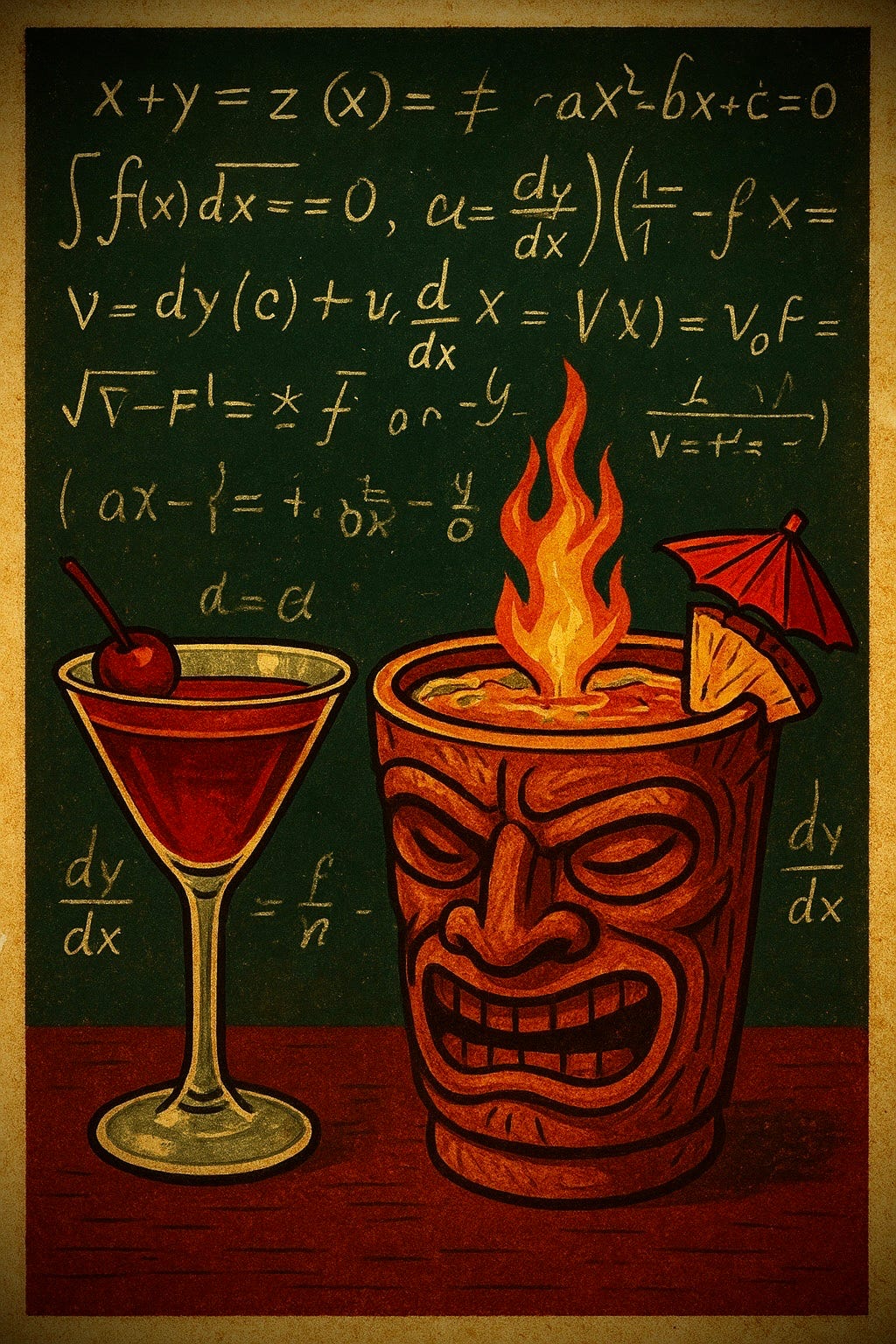
Finally, all these variables converge in the act of execution. This is where tiki mixology becomes its own form of multi-variant calculus. The bartender must synthesize judgment across categories—tasting, adjusting, and anticipating how every alteration affects the whole. It’s an adaptive, real-time performance rather than a rote act of replication. The difference is not just one of difficulty but of dimensionality: tiki bartending transforms linear procedure into multidimensional problem-solving.
Simplicity in a Negroni or Manhattan is not trivial; precision exposes skill, and even minor lapses reveal themselves in the glass, with nowhere to hide. But those simple classics operate within predictable bounds. Tiki, by contrast, lives in the realm of fluid systems—expansive, adaptive, and infinitely variable. Respect is owed to both, but the complexity of judgment rises exponentially as one moves from the codified clarity of the classics to the dynamic artistry of tiki mixology.
No posts
Comments
Nothing yet. Say the first thing.
Sign in to join the conversation.