
Tiki bars were always an act of dreaming. They emerged in the anxious years between two world wars, when a generation of Americans sought a way to recast trauma into reverie. Bamboo, rum, and Polynesian fantasy became their language of escape.
Yet beneath the kitsch and the leis, tiki concealed a subtler artistry: the ability to make artifice feel alive. Every carved figure and exotic lamp, every map of islands only half-known, whispered the same invitation—to step into a world that never quite existed, and to believe in paradise.
In the 1930s, Don the Beachcomber opened his first bar in Hollywood and invented an illusion that would become one of the hallmarks of tiki design: the green “jade” tile breezeway. The tiles were not jade at all, but ceramic stand-ins, arranged in lattices to suggest wealth, mystery, and the promise of another world beyond. Over time those tiles became rare trophies—salvaged fragments of a vanished era, prized by collectors, traded at astonishing prices.
To understand tiki, one must understand its paradox: a fantasy that acknowledges itself as such. Born of an American imagination that borrowed freely from diverse cultures and mythologies, Don’s breezeway didn’t pretend to fool anyone for long; its beauty lay in the knowingness of the deception. It was theatrical in the truest sense—an illusion that asked for participation, that required the guest’s willingness to cross over, to suspend disbelief and, in doing so, to discover something genuine in the artifice.
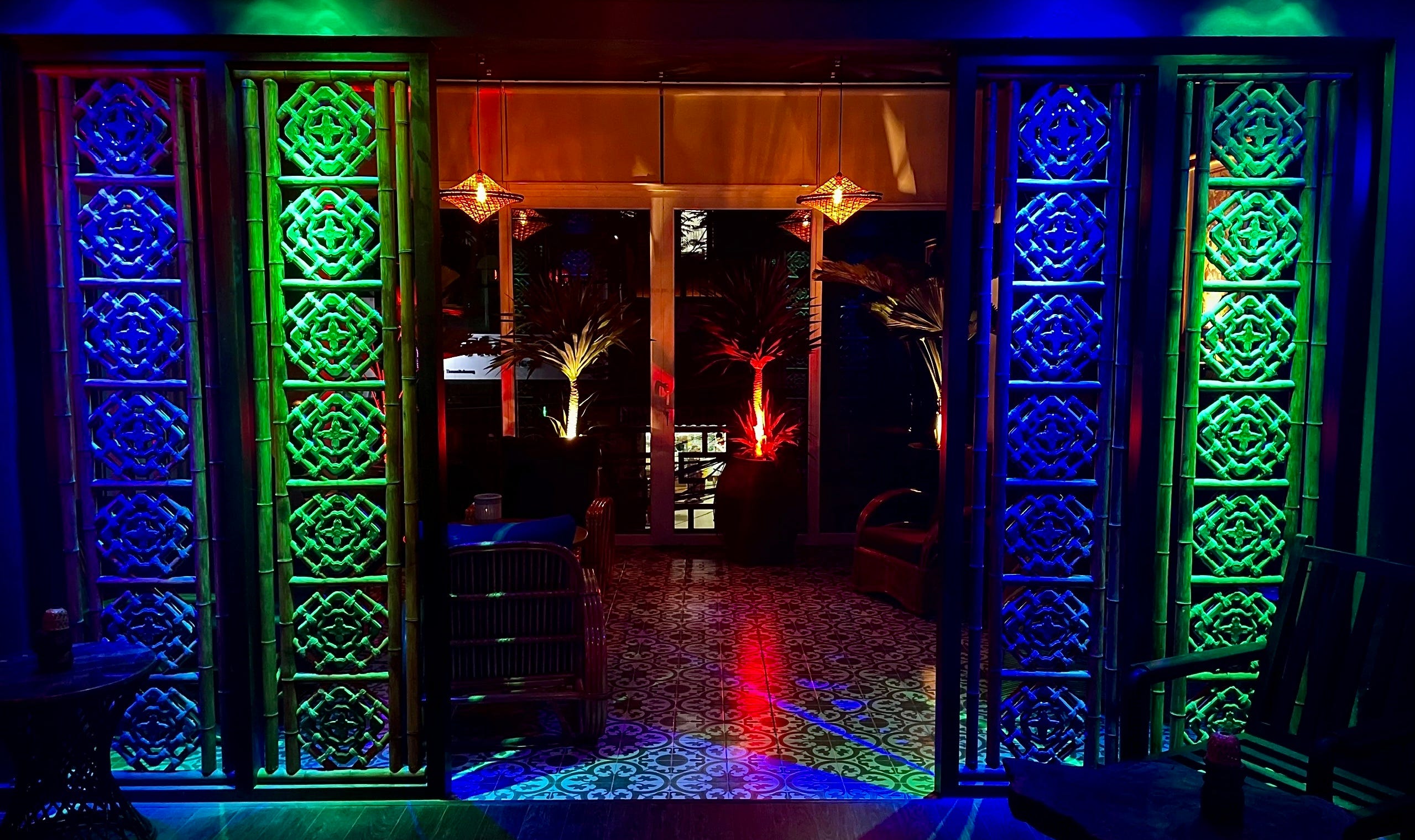
At Makara Bar, a Vietnamese tiki speakeasy, we chose to revisit this lineage in a different way. The traditional green ceramic tiles are still widely produced in Vietnam, so we hand crafted a new breezeway, framed in bamboo and rope, but strung in an intricate diamond pattern rarely attempted in the original tiki designs.
By night, our breezeway comes alive under shifting light—emerald tiles deepening into sapphire, flashing amethyst, a play of color that tricks the eye and unsettles the boundary between real and imagined. Makara’s breezeway is no mere divider; it is a threshold. On one side: the nautical room, with its lantern glow and salt-air memory. On the other: the jungle room, dense with shadow and mystery. To step through is to leave one story and enter another.
For us, that crossing is more than architectural. It is philosophical. The breezeway embodies the passage from nostalgia into reinvention—the movement from tiki’s Californian dreamscape to a modern reimagining in Da Nang, Vietnam. Here, illusion is not denial but dialogue. We work with Vietnamese artisans, with local materials—ceramic, rope, bamboo—honoring their texture and imperfection even as we evoke the ghosts of an imagined paradise.
Tiki, at its core, was never about authenticity but about the artistry of invention. Our breezeway honors that paradox: a design born in California almost a century ago, reimagined here in Da Nang. A relic made new, a screen that conceals nothing yet transports utterly.
And perhaps that is the quiet genius of the original jade tile breezeway: it asked not to be believed, but to be felt. The shimmer was a kind of invitation—a promise that behind the screen, some other world was waiting. At Makara, that promise endures. It is an illusion, yes, but one that reminds us how every act of imagination, if made with care, becomes a way of telling the truth. And in this case, that truth is that we might arrive at the threshold of paradise, but we will never quite arrive.
No posts
Comments
Nothing yet. Say the first thing.
Sign in to join the conversation.