

As marketers, we are often guilty of creating false expectations. This culture of over-promising has widened the gulf between what advertising can realistically achieve and what advertisers demand of it. Agencies feel the strain of delivering results that are unattainable from the outset, while big tech platforms, Google and Meta chief among them, have trained an entire generation to believe that performance miracles are just one algorithm away.
The narrative is seductive: let the algorithms do the work; watch the returns flow in. Yet this story is a mirage. Campaigns do not occur in a vacuum. They are shaped by the gravitational pull of market dynamics. Forces far stronger than the levers of tactical execution.
I have sat across from advertisers who openly admit, “I know our measurement is false, but we have to show something.” This is not measurement. This is theatre. And it distracts from a fundamental truth: the bounds of marketing are more tightly defined by market structure than we care to admit.
Recently, I spoke with Dale W. Harrison, who has an invaluable talent for cutting through marketing illusions with mathematical clarity. His work repeatedly demonstrates a humbling principle: in most categories, the “mountains” marketers aspire to move are statistical molehills. Market dynamics dictate outcomes far more powerfully than individual campaign inputs.
Central to Harrison’s perspective is the NBD-Dirichlet model. The statistical engine underlying some of marketing’s most robust theoretical laws, including the Double Jeopardy Law and the Duplication of Purchase Law. These laws were first observed by William McPhee in 1963, extended by Andrew Ehrenberg in the 1970s, and later popularized by Byron Sharp and the Ehrenberg-Bass Institute.
They still hold true today.
The NBD-Dirichlet model shows that buying patterns are not chaotic. They are mathematically predictable if you accept three simple assumptions:
Not everyone knows every brand.
People, generally, only buy from brands they are aware of.
Consumers typically buy more than one brand in a category (repertoire buying).
From these assumptions emerge two powerful laws:
Double Jeopardy (DJ): Smaller brands suffer twice. They have fewer customers (lower penetration) and those customers are less loyal, giving the brand a smaller share of their spending. Bigger brands enjoy both more buyers and greater repeat purchase rates.
Duplication of Purchase (DoP): Buyers of one brand inevitably buy other brands in rough proportion to those brands’ market share. If Brand X holds 35% market share, then about 35% of Brand Y’s buyers will also buy Brand X.
These patterns are not reflections of marketing brilliance or creative magic. They are mathematical truths, found in the NBD-Dirichlet model. Statistical inevitabilities of market structure that persist regardless of brand, geography and true across many categories..
Of course, even the most elegant theory demands proof. “Science” is true only until it is proven otherwise, which is why these findings must be continuously tested, if for no other reason than to satisfy my own desire to be right.
Last year, a major technology vendor advised an advertiser, a challenger brand under pressure with shrinking share, that growth should come from extracting more value from existing customers. Their analysis suggested competitors were significantly outperforming this brand in terms of revenue from returning customers.
The implication was clear: squeeze more from the base.
But here’s the flaw in that vendors logic. Logic grounded in that fact that they may be a great technology company. But as a marketing partner, they are of limited value beyond providing access to certain products that are occasionally useful.
That flaw? This brand operated in a needs-driven category. Customers buy when they need to, not because a marketer wills them to. Retargeting cannot force a purchase. And while discounting might, it comes at a cost: profit.
My counterpoint was simple: the higher repeat rates among competitors were not the result of superior marketing, but of size. Bigger brands naturally have more repeat customers because they are bigger.
The vendor dismissed this view. So, I turned their own competitive data back on them. Unsurprisingly, it confirmed what Ehrenberg and Sharp have shown for decades: repeat purchase rates are a byproduct of scale, not the magic of retention marketing
The chart below, from this recent US case study, made the point clear. As brand size grows, so does repeat purchasing. Smaller brands don’t have hidden pockets of loyalty waiting to be unlocked; they simply have fewer, less loyal customers.
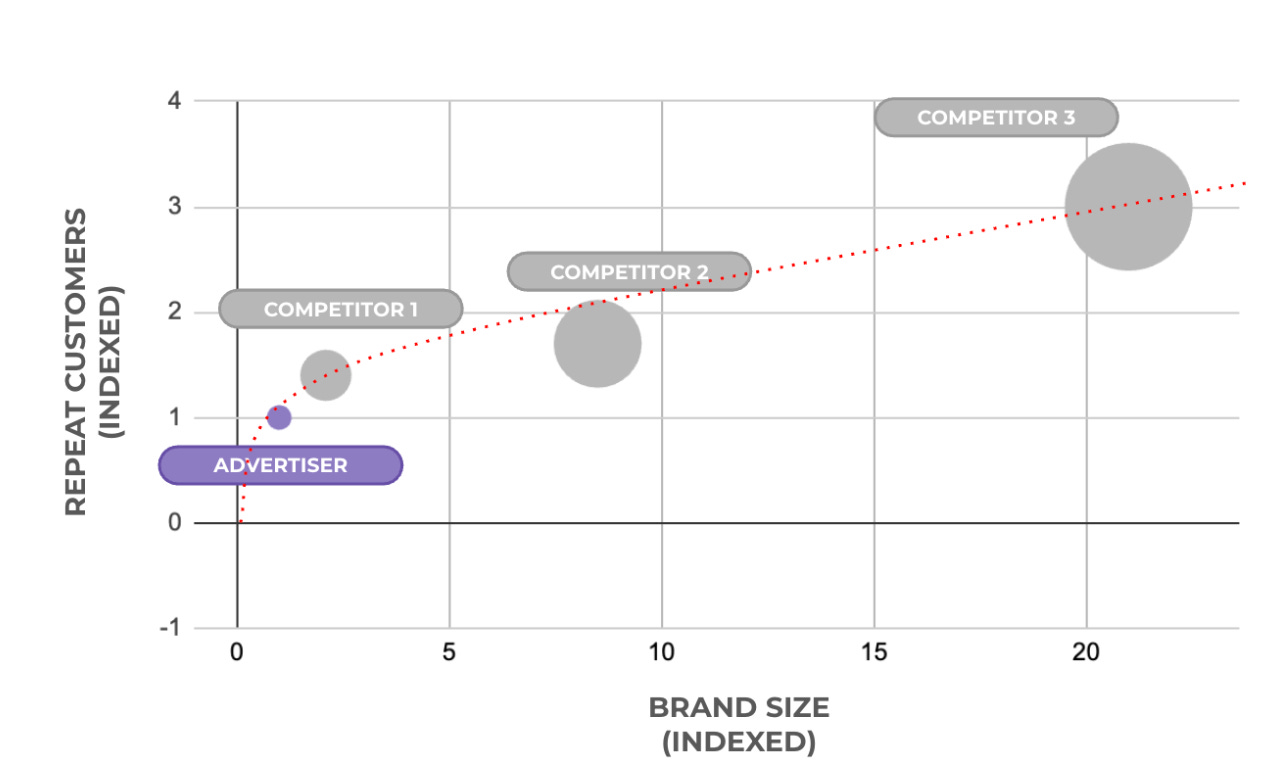
The practical lesson here is stark. Chasing repeat purchase as a growth engine is a dead end. Smaller brands cannot escape Double Jeopardy through loyalty schemes or retention-heavy strategies. Their only path to growth is to increase penetration: reach more category buyers, more often. And reach requires investment.
In other words: growth is about winning new customers, not squeezing existing ones.
The Double Jeopardy Law and the Duplication of Purchase Law are not curiosities. They are statistical guardrails that define a core reality of brand growth.
Marketers who ignore them will continue to throw money into campaigns promising to conjure loyalty out of thin air. Those who accept them, however, will recognize that effective advertising is less about rewriting the laws of consumer behavior, and more about working with them: being Quick to Mind & Easy to Find, reaching light and non-buyers, and competing for category penetration.
While we shouldn’t always feel bound by math, it does become the gravity that holds our discipline to the ground. Ignore it, and marketing risks becoming mere fiction.
Embrace it, and marketing becomes more effective
No posts
Comments
Nothing yet. Say the first thing.
Sign in to join the conversation.