DISCLAIMER: The marketing funnel is a bad idea that refuses to die. A conceptual superbug that’s immune to evidence, logic, and decades of better thinking. I use terms like “upper funnel” here only because they’re still common currency in our industry, not because they’re valid. Advertising doesn’t work by herding people down imaginary stages. It works by making brands Quick to Mind (easily recalled at the moment of need) and Easy to Find (easily bought when purchase decisions are made). Everything else is just a symptom of the funnel infection.
In over two decades working in advertising and media strategy, I have lost count of the number of times I have heard the refrain: “But we have to tie it back to sales.” While superficially reasonable, this statement often reveals a fundamental misunderstanding of how advertising works, why it works, and, most critically, the timeframes in which it works.
This mindset typically emerges in debates about the “value of upper-funnel” activity or the role of “awareness spend.” Frequently, the conversation veers toward using Marketing Mix Modelling (MMM) to prove such value. While MMM can, and is an important analytical tool, it is not always the solution. More often, the problem lies not in the measurement method, but in the expectations being applied to it.
Put simply:
You do not need to tie all upper-funnel advertising back to immediate sales outcomes.
If you attempt to, particularly in categories with long sales cycles and with brands that have little historical investment in brand-building, you will likely fail, not because the advertising is ineffective, but because you will end up measuring the wrong things.
Advertising, whether “upper-funnel” or not, rarely produces large volumes of net new sales in the short term. This is not to say it never yields short-term effects, it can, but those effects are constrained. Campaigns operate within competitive environments that suppress immediate results, and there is a finite number of active buyers at any given time. Unless you significantly outspend competitors, the short-term sales effect will be marginal. If this were not true, most markets would be far more volatile than they are.
The sooner we accept this reality, the sooner we can redirect energy toward the productive elements of building effective communication plans.
Enhanced measurement is important, but it cannot conjure short-term effects that do not exist. Even with advanced methodologies, upper-funnel impact (in fact, all advertising) is constrained by two key factors:
The ~5% who are actively buying: Only a small proportion of category buyers in most cases, are “in market” at any given time. Their timing is largely unpredictable unless the category is highly seasonal. Even then, we cannot fully know when buyers are ready to purchase. Sales within that 5% are typically distributed in line with market share in the short term. Meaning that advertising’s immediate role is as much about protecting share as it is about generating new buyers.
Sales cycle length: In categories with long purchase cycles, upper-funnel campaigns will reach relatively few active buyers over a short period. You cannot force someone who isn’t in the market to buy now, unless through heavy price incentives or rare forms of product innovation, both of which are typically profit-prohibitive. All of this makes attributing large sales effects in the short-term unlikely, no matter how robust your measurement framework.
This does not mean such campaigns are ineffective, it means they require different metrics (not immediate sales) and timeframes to assess their value.
Decades of marketing science demonstrate that advertising performs three core functions:
Protecting market share – Brands that cease brand investment generally experience gradual erosion, unless competitors also reduce spend (rare).
Replacing lost buyers – Due to natural buying patterns and brand promiscuity, customers inevitably lapse. Advertising replenishes these losses.
Generating incremental growth – Achievable only with sufficient spend and effective reach: exposing a large proportion of the category over time via formats that drive cognitive processing (e.g., video, audio, high-attention media). But note, growth potential is bounded by Share of Market, Share of Voice, and the effectiveness of your media choices.
The effects of brand advertising are measurable, but they usually appear first in leading indicators, not immediate sales. Two feedback loops are especially instructive:
1. Organic Search Queries & Share of Search
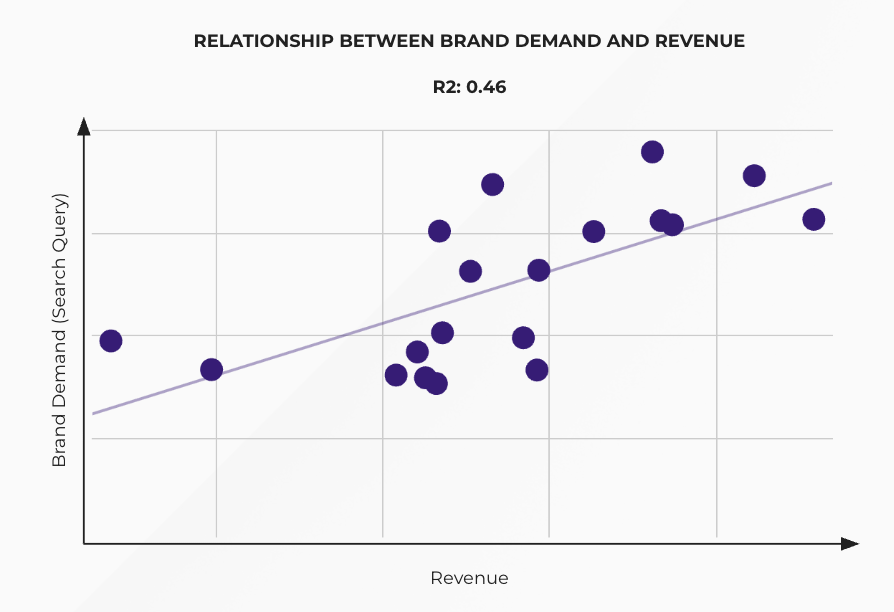
Brand search volume is a strong proxy for salience. What Dale W. Harrison might reframe as Brand Recall At Point of Purchase (BRaP). Perhaps more fitting here: Brand Recall At Need or Desire (BRaND - badum-tss).
Why? No one searches for a brand they have never heard of.
So Share of Search (SoS) can therefore be a leading indicator of future changes in market share, reflecting the reality that people tend to search the way they buy, provided the brand is also easy to find.
IF YOUR NOT THOUGHT, OF YOUR NOT BOUGHT - BRANDED SEARCH QUERY AND THE RELATIONSHIP TO REVENUE - SOURCE: ANONYMOUS GA4 DATA; MYTELESCOPE - VARIOUS BRANDS
2. Lower-Funnel Efficiency
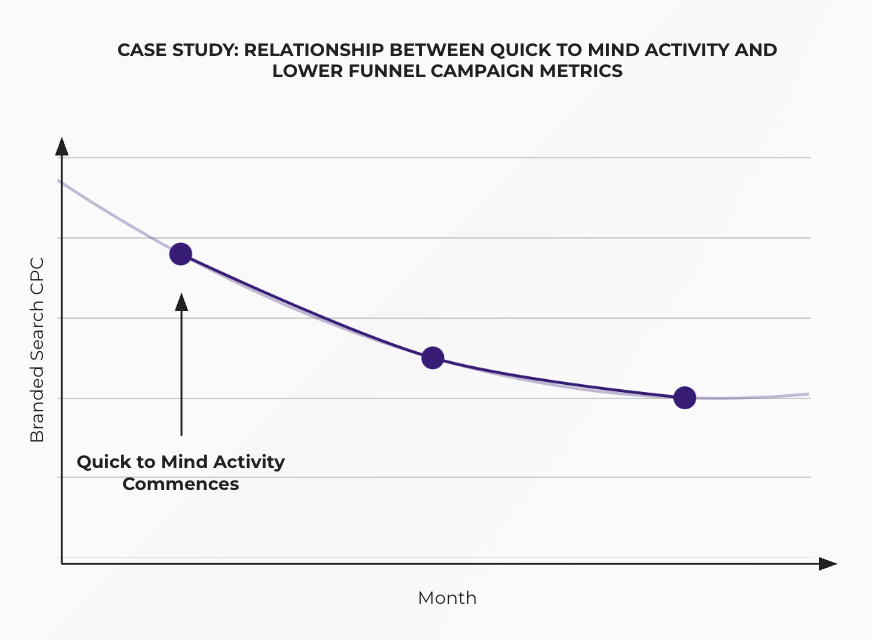
As more people actively seek your brand, acquisition costs in lower-funnel channels decline.
Branded search CPCs drop, platform-reported ROAS improves, and acquisition activity becomes more efficient.
In short: as Quick to Mind effects take place, Easy to Find signposts become cheaper and more effective.
ANONYMOUS CASE STUDY: 2025
Les Binet’s oft-quoted definition remains the clearest articulation of advertising’s role:
Advertising increases or maintains sales and margins
By slightly increasing the probability that people will choose your brand
By making the brand easy to think of and easy to buy
And creating positive feelings and associations via broad-reach ads that people find interesting and enjoyable
And targeted activation they find relevant and useful.
When advertisers demand immediate sales attribution from upper-funnel activity, they are asking the wrong question. The better question is:
Are we Quick to Mind when buyers eventually come to market?
To answer that, we must move away from the flawed assumption that all communications should yield large, immediate effects.
No amount of measurement can spare us from that delusion.

Comments
Nothing yet. Say the first thing.
Sign in to join the conversation.