
Despite decades of validation, the concept of Excess Share of Voice (ESOV) continues to face skepticism—particularly within performance marketing circles, advocates of attention-based planning, and long-time critic, the Dark Lord of Effectiveness himself, Byron Sharp. However, empirical evidence, marketing effectiveness literature, and real-world case studies consistently reinforce that ESOV remains one of the most valuable indicators of long-term brand growth and useful techniques for media budgeting.
This article revisits the theoretical foundations of the SOV/SOM relationship, engages with key critiques, and argues that even small or mid-sized brands can achieve and benefit from ESOV through more intelligent, strategic allocation of media spend.
First, let’s address recent critiques—particularly from proponents of attention-based planning. They’re not wrong. However, the issue is not that the ESOV model is broken; it is that the conventional method of calculating SOV, based purely on media spend, requires refinement. For SOV to be effective, investment must be made in media that is actually seen and heard—media that commands sufficient attention to build memory structures and drive incremental impact. This is not revolutionary thinking, yet it is frequently overlooked.
I remember discussing this very idea with my late father during the early years of my career. His response? “We sent you to university to tell us that?”
Despite his cynicism, I shall now revisit the foundational concepts.
Share of Voice (SOV): A brand’s proportion of advertising spend within in a category. SOV = (Your Ad Spend / Total Category Ad Spend) × 100
Share of Market (SOM): A brand’s revenue or sales volume relative to the category total. SOM = (Your Revenue / Total Category Revenue) × 100
Excess Share of Voice (ESOV): The difference between SOV and SOM. ESOV = SOV – SOM
This framework, first popularized by John Philip Jones and further refined by Les Binet and Peter Field, demonstrates that—on average—every 10 points of ESOV yield approximately 0.5 to 0.6 points of market share growth per annum or purchase cycle, assuming all else is equal. While this relationship is not perfectly linear and the rate of growth varies by category, brand size, creative quality, among other variables, it provides a valuable directional benchmark.
Of course, applying this model rigidly can be misleading. Large brands can lean on historical equity; small brands cannot and must work harder (or spend more) to make their ESOV yield real growth.
Still, the directional principle holds.
Byron Sharp rightly notes that high SOV can be a byproduct of high SOM, as larger brands naturally have the ability to spend more. Sales drive SOV, not the other way around. But that doesn’t invalidate the ESOV concept. If Sharp is correct (he is, by the way) that mental and physical availability are the principal levers of growth, then surely higher SOV, and thus more exposure, more often, increases mental availability.
Indeed, Les Binet, a long-time proponent of ESOV has often illustrated alongside his peers that increases in SOV frequently precede gains in SOM, particularly when paired with effective creative and broad reach.
Karen Nelson-Field, supported by the great Peter Field, has argued more recently that the concept of ESOV required refinement, recognising attention as a filter. It’s not just how much you spend, but where, and how you spend, and whether that spend earns attention— or at least enough attention to build memory. Sharp pushes back, arguing that fleeting exposures often suffice. That may be true for some brands. But for others—especially smaller or newer brands—buying more attention may be well worth it.
What’s clear is that media with low attention yields weak memory effects, reducing the impact of ESOV. And so it becomes important to make a distinction between ‘Nominal ESOV’ and ‘Effective SOV’ (E-ESOV - as if we really needed yet another weak acronym) .
When referring to Nominal SOV, we mean a brand's share of total category ad spend, regardless of media or creative quality. It is SOV in its simplest form. Nominal ESOV, therefore, is Nominal SOV minus the brand’s Share of Market.
Effective SOV, by contrast, considers only that portion of spend invested in channels that genuinely earn attention and build memory—or weights spend based on a medium’s capacity to do so. This means excluding (or adjusting for) tactics that deliver minimal attention or exposure, merely harvest existing demand, or are so narrowly targeted that they are unlikely to generate significant effects. Effective ESOV, then, is Effective SOV minus the brand’s market share.
Effective SOV prioritizes "Quick to Mind" effects—media that tends to be emotionally resonant, attention-rich (where necessary), and broadly distributed. Media that contributes to building familiarity and memory. Why? A dollar spent on a 30-second TVC in a quality environment that reaches one million people, and reaches them more often over time has a very different long-term effect than a dollar spent on last-click conversions from a few hundred in market buyers, many of whom have pre-determined their brand choices.
This is not a new idea, but it is frequently neglected in digital and performance circles. In these cases, we must momentarily set aside our spreadsheets and focus on what actually builds memory and influences behavior.
But can E-ESOV be available to all?
NOTE: The distinction between Effective SOV and Nominal SOV becomes particularly important for challenger brands. In the top half of most categories, share is sticky and changes are rare. But in the fragmented lower tiers, where volatility is higher, Effective ESOV can offer a strategic path to growth. Here, reallocating spend from passive to attention-rich channels could be the difference between being remembered and being invisible.
A common rebuttal is: “Sure, ESOV drives growth—but how can smaller brands afford it?”
It’s a fair concern. One must make money to spend money. This dynamic partially explains why large brands stay large while smaller ones struggle to scale.
But markets are dynamic, and the definition of a “small brand” is often fluid. Brands rise and fall. Many underperforming brands already spend significantly on media—but do so inefficiently: targeting only high-value customers or heavy buyers, aiming to extract more from each purchase, focusing solely on audiences with high potential LTV, or zeroing in on micro-segments far from behavioral norms.
These tactics are often rationalized as low-hanging fruit with lower acquisition costs. But in practice, they frequently rely on weak or non-existent signals, lead to rapidly diminishing returns, and generate limited volume. Many brands also squander budget on low-attention media or duplicative performance channels with minimal incremental effect—exhausting money on sales that would likely happen anyway. The result is a false sense of efficiency, helping fuel a multi-billion-dollar industry that may one day be known simply as “ad-junk.”
That’s why reframing strategic objectives—toward broader, more effective reach—can unlock growth from otherwise wasted spend. In many cases, redirecting even a modest portion of ineffective media spend toward higher-quality, attention-rich environments can contribute to a brand achieving Effective ESOV (E-ESOV).
Let’s look at some real-world examples, using publicly available sources and data from MediaRadar.
NOTE: Media Spend and SOV Calculations:The figures used in the following case studies are directional, based on third-party data sources like Kantar. These tools capture only a portion of total media investment, particularly underreporting digital, retail media, and co-op spend. As such, Nominal SOV figures should be treated as indicative rather than absolute. The strategic takeaway, however, remains valid: ineffective allocation can undermine growth, even with substantial spend.
Market: USA
Brand Size: Annual Revenue $570m
Sub-Category Value: ~$258bn (estimates vary, with Statista suggesting this E-Commerce sub-category to be worth up to $350bn per annum
Share of Market: Estimated 0.2%
Current Media Spend: $55m
Nominal SOV: 11% (Based on Media radar data - the SOV the brands media spend could account for)
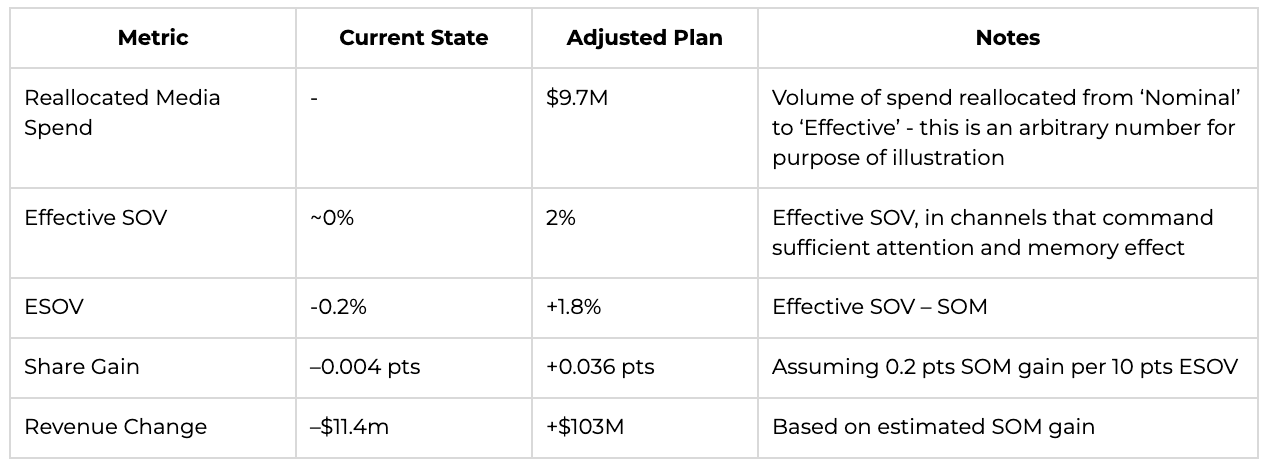
This brand was spending approximately $55M per year on media, achieving a nominal SOV of 11%. However, the majority of that budget was funneled into paid search, and tactics that show little evidence of driving large-scale brand effects. As a result, its Effective SOV was close to 0%. Indeed, while lack of E-ESOV can not be the sole contributor, the brand shrunk by around $90M last year—far exceeding the $11.4M suggested in the model—despite operating in a category that’s growing.
To be clear, I’m not suggesting that restructuring the brand’s media spend is a guaranteed silver bullet. Rather, the point is to demonstrate that even brands with modest market share—just 0.2% in this case—can achieve Effective ESOV by reallocating just a portion of their $55M annual budget into more “Quick to Mind” vehicles. That shift alone could potentially translate into $103M in incremental revenue per year, all else being equal, assuming a modest 0.2-point SOM gain per 10 points of ESOV.
A common fear is that pulling budget from search could jeopardize short-term revenue. In reality, this risk is likely overstated—and even then, the reallocation proposed here represents only a small reduction in search investment, not a wholesale abandonment.
Market: USA
Brand Size: Annual Revenue ~$253m
Category Value: ~$15bn (estimate from Cognitive Market Research)
Share of Market: Estimated 1.69%
Current Media Spend: $10.6m
Nominal SOV: 19% (Based on Media radar data - the SOV the brands media spend could potentially account for)
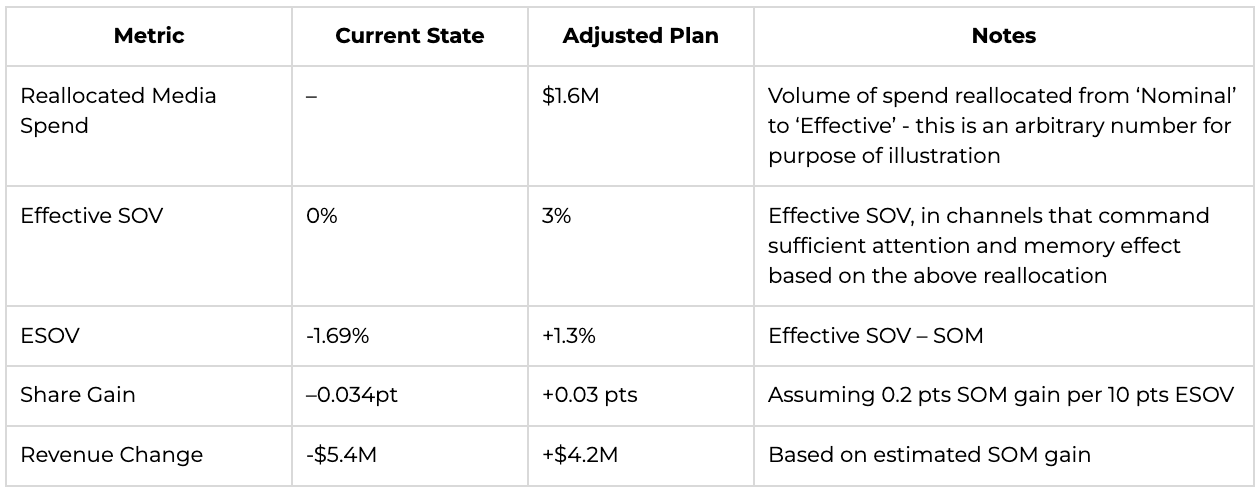
This brand was spending $10.6M—but entirely within Search. The result: 0% Effective SOV and ongoing annual decline. Yet even this modest-sized brand could build Effective ESOV by reallocating just $1.6M of its $10.6M budget into more impactful media—potentially yielding around $4M in incremental revenue, assuming a conservative application of the ESOV model. Again, my point here isn’t to prove the model beyond doubt, but to show that Effective ESOV is achievable—even for brands with relatively small market share.
These examples demonstrate that the barrier to ESOV isn’t always budget—it’s in better planning. This isn’t an efficiency play. It’s not about squeezing more out of the same budget. It’s about effectiveness—making sure that spend reaches people, commands just enough attention, and builds memory. A dollar spent on low-attention media may feel efficient in the moment, but if it doesn’t move the needle long-term, it’s just wasted cost dressed up as performance.
And so many brands can achieve ESOV simply by reallocating spend from low- to high-effect media. There are other examples we could cite—even in more abstract categories like identity resolution, or sectors like education and other conventional markets—where an adjusted SOV/SOM model can apply: ‘Effective’ SOV becomes the input, SOM remains the output, and, assuming all else is equal, growth becomes the outcome.
When grounded in Effective SOV, the SOV/SOM model remains a powerful framework for budgeting and projecting growth—so long as:
Media has sufficient attention and reach
Brands target broad audiences, not just known or active buyers
Cheap CPMs are not mistaken for genuine value
In today’s performance-obsessed world, these are common pitfalls—but avoidable ones.
Even in a fragmented media environment, ESOV is not a privilege reserved for category leaders. With better strategic alignment and an emphasis on attention-rich media, smaller brands can fund ESOV through re-allocation—not escalation.
Because in a world where most brands aren’t P&G or Salesforce, the question isn’t whether you can afford to grow—it’s whether you’re using what you do have to be seen, remembered, and recalled when it matters.
Postscript: This article sparked a healthy public debate. One critique rightly challenged the reliability of syndicated SOV data. That point is acknowledged. But the strategic message stands: many brands don’t lack budget—they lack visibility, attention, and memory.
Ad-Junk: Refers to media spend—or an entire media marketplace—that operates more like flea market economics: turning up to a car boot sale with a wedge of cash and leaving with bric-a-brac and tchotchkes—objects you have no place to store, no real use for, and that add nothing meaningful to your life. It feels like a bargain in the moment, but soon you’re left wondering where your money went.
That’s what ineffective media spend often looks like: cluttered, cheap, and ultimately purposeless. It may tick boxes and fill dashboards, but it rarely builds anything durable. We call it “performance,” but it’s really just ad-junk—digital clutter dressed up as strategy.
Quick to Mind: Describes a brand’s ability to be mentally available—easily recalled when a category need arises. It’s achieved by targeting the whole category with emotionally resonant advertising that builds memory, not just rational benefit.
It’s typically driven by AV-led media that reaches broad audiences, sustains attention, and establishes long-term brand salience.
If your brand isn’t Quick to Mind before the purchase moment, it’s much harder to win at the purchase moment.
E-ESOV: The difference between a brand’s Effective Share of Voice and its Share of Market. Unlike Nominal ESOV—which is based on total ad spend regardless of quality—E-ESOV accounts only for spend in media that earns attention and builds memory. This means excluding (or down-weighting) tactics that merely harvest demand, deliver minimal exposure, or target overly narrow segments.
No posts
Comments
Nothing yet. Say the first thing.
Sign in to join the conversation.