
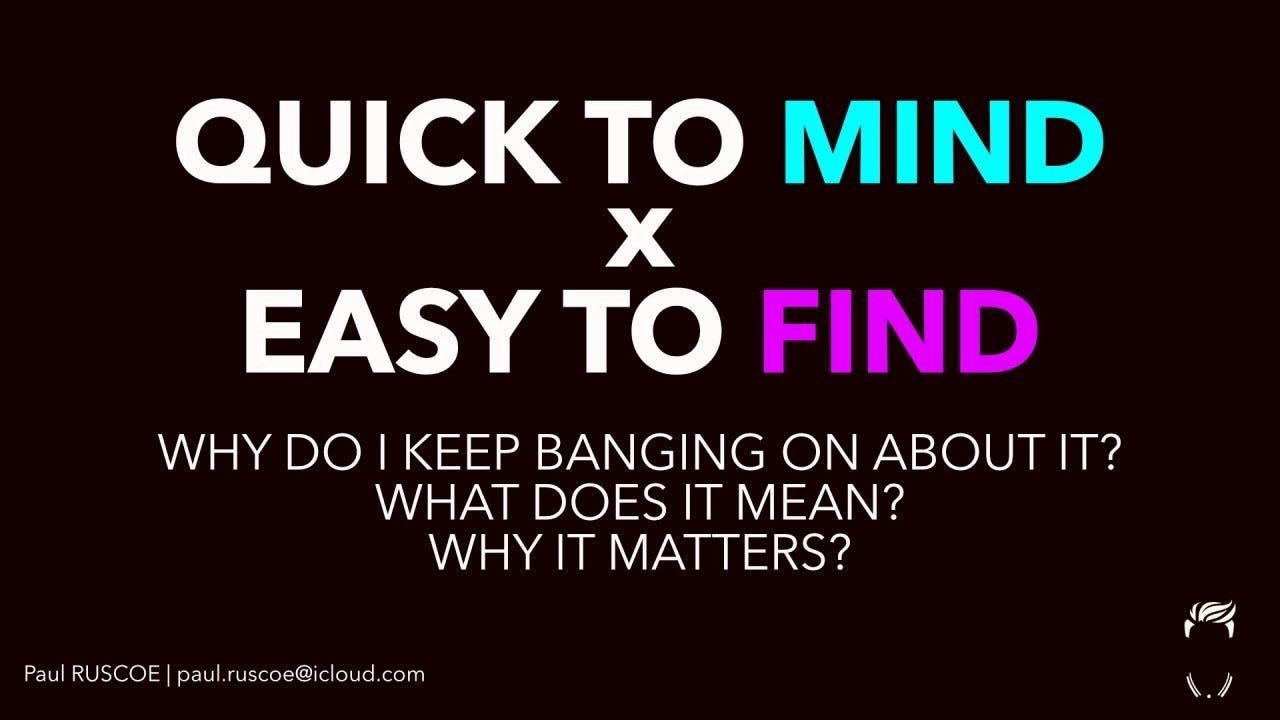
Today, most communications and media plans over-index on “performance” or lower-funnel activity and under-invest in brand building—i.e., nurturing future buyers. This article formalizes a two-part model—Quick to Mind (memory at need) and Easy to Find (frictionless access)—building on the empirical work of Les Binet, Peter Field, and the Ehrenberg-Bass Institute. It presents practical design rules and evidence that: (i) salience, not mere awareness, is the relevant construct at the point of purchase; (ii) misallocated spend produces extreme per-capita cost excess on a small pool of active buyers; and (iii) stronger salience improves the efficiency of performance channels.
Across many categories, small- to mid-market advertisers routinely devote more than 90% of effort or budget to “finding the buyer now,” and less than 10% to building memory so that the buyer finds the brand later. The economic implication is stark: advertisers doing this can end up spending 100×–2,000× more per head on a very small in-market minority than on the entire pool of category buyers who will purchase in the future. That is not operational efficiency; it is waste, especially given that it is near-impossible to force buyers to buy when choice is largely predetermined by familiarity.
If it were feasible to drive very large, incremental sales purely through exposure at the end of the journey, markets would be far more volatile than they are. The notion that an overt focus on “performance” is intrinsically more efficient is, at best, incomplete. The widely discussed case of Casper, among others, shows the limits of over-reliance on performance media: lowering acquisition cost is easier when customers are already looking for you, not when you’re pleading for attention at the last moment.
This is not an argument against performance. Performance media is often a necessary evil, like paying rent or tax. The true driver of growth is the balance: building greater memory so your brand is Quick to Mind—increasing the probability you’re chosen when a buyer enters the market. In most categories, brands are shortlisted—and often effectively chosen—long before a conscious “decision process” begins.
Accordingly, the funnel is a weak planning model for advertising. To sell in line with, and ideally expand, market share, campaigns should optimize a two-sided equation: Quick to Mind × Easy to Find. We consistently undervalue the first part of that sum.
This is not a plea for more “awareness.” Quick to Mind is deeper—salience: brand retrieval at the point of need.
Awareness is knowing a brand exists—usually measured by survey (sometimes aided). It’s a weak barometer of anything that matters at choice. Salience is recalling the brand when it matters—at the moment needs are triggered and choices are made. Conflating the two leads to over-investment in low-yield impressions and, more importantly, ignores how human decisions are actually made.
Salience is situational. We want memory structures tied to buying contexts—e.g., “cheap flights to Europe,” “weeknight meals in 15 minutes”—not generic ad recall.
Andrew Tindall (System1) illustrates this neatly: ask a British audience to “think of an airline” and many say British Airways; ask for “cheap flights to Europe” and Ryanair becomes salient. CEPs mediate recall under real tasks. The risk is treating CEPs as a targeting proxy; that’s a misapplication. Be mindful that overly literal CEP execution that creeps into targeting can throttle reach and limit category penetration.
Quick to Mind: Increase the probability your brand is retrieved at need (pre-purchase). This requires encoding memory structures and is what creates a sustained flow of new customers, brand equity, pricing power, and, ultimately, shareholder value.
Easy to Find: Reduce friction from memory retrieval to transaction (navigation to owned assets and point of sale). This is broader than “lower-funnel ads”—it includes distribution, physical availability, pricing, site UX, and retail execution.
A Quick to Mind plan is not mysticism; it’s a disciplined craft. Core rules:
Target the category (reach light and future buyers).
Avoid over-focusing (precision often taxes reach; even niche brands must expand profiles to remain profitable).
Pursue effective reach (sufficient exposures with sufficient attention; advertising must be seen and heard to work).
Maintain continuity (needs are stochastic; your presence should be predictable).
Maximize SOV within your budget (money spent on placements unlikely to be seen/heard dilutes effective SOV).
Use emotional cues and distinctive assets (this isn’t “save the whales”; it’s aligning to audience needs/desires. The brain is the primary ad-blocker—rational proof points that matter to you but not to them are quickly forgotten. Encode faster; last longer).
Advertisers often resist Quick to Mind investment because it’s “hard to measure” or “doesn’t sell.” Neither claim stands up.
Set realistic expectations. Quick to Mind can work in the short term—often as well as Easy to Find. Why do we think it doesn’t? Two reasons:
Active-market constraint. Like performance media, brand advertising can only affect those currently in the market. Needs drive demand, not ads.
Small short-term effects. Immediate effects are typically modest, and occur over time when sustained. They occur against a backdrop of competitor activity too. That doesn’t mean the effects are absent or unimportant.
A simple illustration.
TAM = 160M. A brand campaign reaches 10% (16M) in a month.
That month, 8% of TAM enters the market (12.8M). Of those, 1.28M saw the campaign.
If the brands market share ≈ 1%, expected sales from that exposed in-market group ≈ 12.8K (not all incremental). Remember, advertising:
If share lifts ~10% relative (to 1.1%), exposed in-market sales ≈ 14.1K—an extra ~1.3K. That signal can be hard to isolate from noise in the near term; yet the campaign may still have worked exactly as expected.
Now that is not to say Quick to Mind campaigns are not measurable in the short term. In fact Quick to Mind effects are highly measurable even without econometrics:
In recent case work, 46% of revenue variance was explained by changes in organic brand search interest (a solid Quick to Mind proxy), with 99% statistical significance. Effects aren’t always instant, but they are material over commercially relevant windows.
Downstream effects. When Quick to Mind campaigns launch, branded search becomes more efficient; people come looking for you. In the same case study. we’ve observed up to ~17% lower CPCs when brand activity runs in tandem.
Attention supply differs markedly by channel (e.g., time-in-view across YouTube, social, display). Ads must be seen and heard, not merely served; otherwise a large share of effective SOV evaporates.
Recent research from Karen Nelson-Field suggests that up to $0.43 in every dollar spent is wasted because advertising is not seen nor heard. Just imagine the impact that may have, if advertisers orientated that investment appropriately. .
When campaigns “fail,” the culprit is often either a natural fluctuation of category demand, or poor long term planning. Let me explain, Over-emphasis on short-term outcomes erodes memory. Indeed, often the culprit is relatively easy to spot. When brands ar shifting spend from memory-building channels to lower-funnel tools (e.g., PMAX), that typically reduces reach, depresses organic search query volume over time, leading to a loss in share as customers simply hear from you less often than they hear from other brands in your category.
Investment-to-memory correlations vary by channel; premium video and broad-reach AV formats generally contribute more to recall than optimized intent-capture tools. Sequence matters. And so as money flows from “Quick to Mind” to “Easy to Find” the consequences are rarely positive.
How do advertisers get the balance right?
The Quick to Mind / Easy to Find split depends on category dynamics. E-commerce, FMCG, and luxury often require more Quick to Mind than heavily researched categories like education or healthcare . But no ratio is universal.
Other factors to model: brand size and life stage, price point, innovation, category maturity, purchase method (online/subscription/physical), strategic objectives, and accessibility. What’s right for one brand can be wrong for another.
This echoes Binet & Field’s findings over two decades. The task is to calibrate, not copy. Even anecdotal understanding of how people buy your brand is a useful starting point. If “finding” and buying are already easy, lean harder into Quick to Mind. Conversely, if you’re established and salient, a “fleeting nudge” may suffice. In heavily researched categories, tilt a bit more toward Easy to Find.
These nuances underpin our own model, informed by Binet, Field, and thousands of global cases, to help advertisers find their own North Star. It’s likely different from your current allocation.
“When a measure becomes a target, it ceases to be a good measure.” — Charles Goodhart
We chase visible metrics—sales, leads, conversions—and design plans around what’s easiest to count, not what actually drives growth. That produces two failures:
Over-funding immediate outputs (even when the numbers are unreliable), and
Forgetting that advertising is probabilistic, not deterministic. Our job is to increase the odds of being Quick to Mind and Easy to Find—not to script a perfect play.
Over the past decade, our pursuit of “precision” has often manufactured systematic error—optimizing beautifully around the wrong things. The antidote isn’t nihilism; it’s measurement with intent, grounded in the realities of the market.
Real choice happens in moving traffic: crowded markets, shifting audiences, constant distractions, and random shocks. “Measurement perfection” is a mirage. Precision without accuracy is beautifully presented nonsense.
Use models to simplify the system so you can see what’s driving outcomes, when, and by how much. No model captures everything; treat them as explanatory, not crystal balls. Good measurement explains what moved what (with lags and magnitudes). In addition to creating the hypothesis that needs to be measured in the first place (good measurement does not make for a good plan), good strategy converts that explanation into what to do next. The two things are co-dependant.
Guardrails to stop you optimizing the wrong thing. Remember:
Not all data is useful. Clicks, last-click ROI, and third-party cookies often mislead more than they inform.
Timeframes matter. Short or arbitrary windows hide or distort the effects you seek.
Context is critical. Always read performance in the wider market and business environment.
Channel effectiveness is often stable. It doesn’t swing wildly week-to-week; don’t let noise steer spend.
Approximately right beats precisely wrong. A sound estimate beats spurious precision.
Build the spine. Use appropriate frameworks to explain cause and effect—but recognize there’s no substitute for strategic expertise. Measurement won’t turn a poor plan into a good one.
Favor accuracy over fetishized precision. Accept messy inputs and slow effects. Widen windows; don’t punish long-cycle levers.
Interrogate “measurable.” If a KPI is convenient but low-fidelity, discount it. Don’t let Goodhart’s Law run your budget.
Report like an adult. Use probabilities and ranges, not false certainty. Show how choices improved the odds under noisy conditions. Even your CFO doesn’t demand clairvoyance.
Growth is not manufactured at the end of the journey; it’s earned upstream and captured downstream. Brands that compound salience and remove friction outperform because they restore the order of operations: make the brand Quick to Mind, then make it Easy to Find. When plans rebalance toward attention-rich reach, and continuity, performance channels work harder—because people were already on their way to you..
Choose accuracy over spurious precision. Widen timeframes. Attribute upstream effects to the work that created them. Calibrate the Quick-to-Mind/Easy-to-Find split to your category, life stage, and constraints—and revisit it as conditions change.
Do this consistently and the curve bends your way: steadier demand, lower capture costs, stronger share. If you’re not thought of, you’re not bought. If your not bought, You’re Casper.
Make yourself Quick to Mind and Easy to Find.
No posts
Comments
Nothing yet. Say the first thing.
Sign in to join the conversation.