
There are many things I like about our little marketing and advertising echo chamber — and many things that drive me to despair. Let me share a little of the latter.
The first is our industry’s appetite for prediction. Every year, normally in the lead-up to Christmas, the trade press fills with forecasts about how next year will “change everything.” As if January 1st marks the dawn of an entirely new age, every single year.
Predictions are a fool’s errand. They either make you look like an idiot, or just highly competent at stating the obvious.
The second thing I dislike is our use of language that nobody understands. In fact, this is something I dislike about myself. I’m guilty of it. I’ve been told — by colleagues and clients alike — that my “five-dollar language” (words like salience and mental availability) has left many utterly miffed.
It’s one of the reasons I tried to reframe it all within the Quick to Mind × Easy to Find model — a way of expressing the same truths in language that’s a little more human.
The third thing that bothers me is the assumption that every new technology kills an old one. It rarely does. Most things find equilibrium. About fifteen years ago, the vultures started circling around TV. Yet today, in the eyes of the viewer, television is as strong as it’s ever been. Yes, one can make a case for the decline of linear TV — which, by the way, remains robust in many markets — but drawing hard lines between linear viewing and great content watched on a TV is one of the least consumer-centric distinctions an agency can make. It’s symptomatic of the world we live in: confusing progress with replacement.
So in this paper, I want to avoid all three traps — (1)making spurious predictions, (2)using marketing obscenities, and (3) declaring the death of anything old.
But I know I’ll fail on all three fronts. So forgive me for that.
Now, on to the subject matter: AI — and its potential impact on the Quick to Mind × Easy to Find ecosystem, an ecosystem that is one of the few core truths in our little world of advertising.
In short, let’s explore how ‘algorithmic availability’ (there it is — rule two broken before the article even begins) codifies rather than disrupts the advertising ecosystem. The model of marketing built on clicks and last-touch analytics is finally going to be exposed, even as its practitioners appear to double down on it.
Ok, so I’ve already fallen into the second trap, and now I’m jumping headfirst into the third — intentionally, I might add.
I recently read an article claiming that the emergence and popularisation of ChatGPT, Claude, Perplexity, and others will “collapse the funnel.” Let me just remind everybody: the funnel does not exist. It was a trope invented by an ad salesman in 1898.
This is not the time to get into that subject — I’ve laboured it many times before — but, in effect, AI will collapse nothing.
Well, not quite. AI won’t collapse the funnel, but it will expose the fact it never existed.
Where I suspect we’ll see the most significant impact over the next five years is in three areas:
The Moment of Machine Mediation: how AI changes where, and how decisions are made, and executed.
The Importance of a little Neurological Real Estate: memory remains the gatekeeper of automation, but it now has a partner, Algorithmic Real Estate.
The Trust Coefficient: trust will re-emerge as a deeply influential factor in the Quick to Mind × Easy to Find equation of the future, certainly between now and 2030.
And there I have it, I’ve broken my final golden rule, the making of predictions - and so I risk becoming either a fool or a parrot.
But let me explain…
The Moment of Machine Mediation (MoMM)
As of today, the noise about algorithmic search eroding traditional search impact feels somewhat premature. Estimates suggest Google handles nearly 14 billion daily searches, while, by comparison, ChatGPT processes roughly 330 million prompts per day — a tiny fraction.
That’s not to say we aren’t at the beginning of a long-term shift in behaviour, but search will likely remain resilient in the short term. By 2030, however, few would argue that the gap between conventional search and LLM-based search won’t have narrowed considerably.
We’re still in the early age of AI search, but clear patterns are emerging. Data from Semrush suggests that AI search currently excels in information sourcing rather than transactional queries, where conventional search remains dominant.
For now, the disruption caused by LLMs appears to be reshaping discovery more than reducing friction at the point of need — but that will change as LLMs integrate payment, delivery, and verified commerce layers. ChatGPT’s new booking and shopping plug-ins are early examples of “closed-loop AI commerce.”
This compression is already visible in search itself. According to data from SparkToro and SimilarWeb, over half of Google searches now end without a click — a phenomenon known as the zero-click economy. LLMs extend that behaviour. The user’s query, the machine’s response, and the answer itself more often exist in the same moment. The machine mediates not just discovery, but delivery.
A future where you can say, “Book me a trip to Lisbon with two days of surf lessons and a boutique hotel near the coast,” and have the system execute it end-to-end isn’t science fiction.
LLMs are transitioning from retrieval to recommendation to execution. The funnel isn’t collapsing; it’s imploding into a single moment of algorithmic arbitration. The buying moment will become truncated into one source of truth — a single ecosystem that removes almost all purchase friction.
What does this mean for the Quick to Mind × Easy to Find equation I’ve long argued as empirical truth?
Seemingly very little. Except this: at the moment of need, fewer brands are seen and fewer options are presented. The algorithm compares for you. It already stores your information, completes the purchase on your behalf, and closes the loop.
This is the Moment of Machine Mediation (MoMM) — the point where a user’s query, an AI’s recommendation, and the purchase itself collapse into one act.
Choice feels personal, but it’s entirely algorithmic — based on what you’ve done before, what you’re familiar with, or, in the absence of either, what the market believes you should do next. Because in the end, AI doesn’t disrupt market dynamics; it codifies them.
And so Ehrenberg’s Double Jeopardy becomes Algorithmic Jeopardy — where small brands remain small because they have fewer buyers and are surfaced less often by the algorithm.
Which leaves one remaining advantage: the neurological real estate your brand already occupies.
The Importance of Neurological Real Estate
The moment of decision is now pre-filtered by algorithms. There’s less room for persuasion — if indeed there ever was much — and more reliance on prior memory, prior exposure, and familiarity.
This is what I call neurological real estate: the by-product of building and refreshing memories so a brand can be retrieved at a moment of need — Quick to Mind.
Most human decisions are instinctive. Brand choice is generally no different. Even in complex decisions, like in B2B, most buyers already have a Day 1 shortlist.
In automotive, we don’t choose from a blank sheet of brands. We already know what we’re willing to drive. The choice narrows naturally — by the colours we want to be seen in, the needs of the family, what is on the lot and the amount we can borrow.
We’re filtering our options long before prompting a model for a recommendation.
Over time, algorithms will learn those preferences — and surface the familiar first. In fact, this isn’t 2030 thinking; it’s 2025 reality. Amazon does it. Netflix does it. ChatGPT will do it.
Sales won’t be won or lost in the machine, but because of human behaviour — our wants, needs, and defaults. This machine will learn, and present options from your preferred palette.
And when those wants are unclear, recommendations rely on scrapable and identifiable signals — reviews, metadata, behavioural patterns, and correlation.
This compounds several effects: the primacy of strong product, strong service, and ultimately, strong market share. Because now Algorithmic Jeopardy takes hold.
Larger brands are surfaced more often precisely because they’re larger. They can afford to fuel the algorithm — maintaining higher recall through greater reach and naturally higher customer volume. And when recommendations are influenced by paid inputs, those same brands can simply afford to pay for prominence.
When buying friction approaches zero, the importance of memory becomes priceless. Advertisers who recognise the value of maintaining Quick to Mind effects will reap the reward in 2030 and beyond, because neurological real estate is mirrored by algorithmic real estate.
What gets remembered, gets retrieved.
Quick to Mind becomes Quick to Model.
Fame generates mentions.
Mentions feed models.
Models retrieve famous brands.
AI won’t democratize fame — it will canonise it. Without Quick to Mind, there is no Quick to Model.
The opportunity to be discovered has been truncated. For brands not on a Day 1 shortlist or easily surfaced by the machine, the odds of winning are even further reduced.
Blackjack offers you better odds. In many cases, it already does.
The ceiling is being raised — and it’s being raised for the big brands.
The Trust Coefficient
In 1968, Robert Zajonc of the University of Michigan identified what psychologists call the mere exposure effect: the more often we’re exposed to something, the more positively we feel about it.
Familiarity bred contentment, not contempt.
We find familiarity appealing. Market dynamics work the same way — they rarely move. Big brands are big, they are more familiar, and they remain more appealing than smaller ones. Safer. More trustworthy.
In the age of Algorithmic Jeopardy, the mere exposure effect is no longer just a psychological bias — it becomes an algorithmic bias.
There are now two layers of trust. The first is human trust — built on familiarity, emotion, consistency, and social proof.
The second is machine trust — built on structured data, verified identity, and reliability, reinforced through scrapable content and reputation signals.
Trust is no longer only a lever in human decision-making; it’s a critical input in algorithmic recommendation.
Mere exposure over time doesn’t just shape what people trust — it shapes what machines trust, and what they present back to us.
But there’s another side to the trust coefficient: the trust humans place in the algorithm itself. The willingness to delegate choice to AI because it’s easier, quicker, and, crucially, feels more reliable than the alternatives.
On the surface, that might seem frightening. The cynic in me insists I’d never give an LLM access to my credit card (although, as a paid ChatGPT subscriber, I already have).
There was cynicism about Apple Pay once, and even contactless payments — yet both are now mundane. Debit cards, cell phones, online shopping, digital wallets — all once viewed with suspicion, now unremarkable habits.
Daniel Kahneman once suggested:
“Thinking is to humans as swimming is to cats. They can do it, but they’d rather not.”
If the machine makes life easier — reduces the need to think, or remember the credit card number, then the barrier of trust will continue to erode.
In fact, this is already happening if you are to believe Edelman’s latest finding that 55% of consumers use generative AI platforms such as ChatGPT — and 91% of those use them for shopping in some way.”
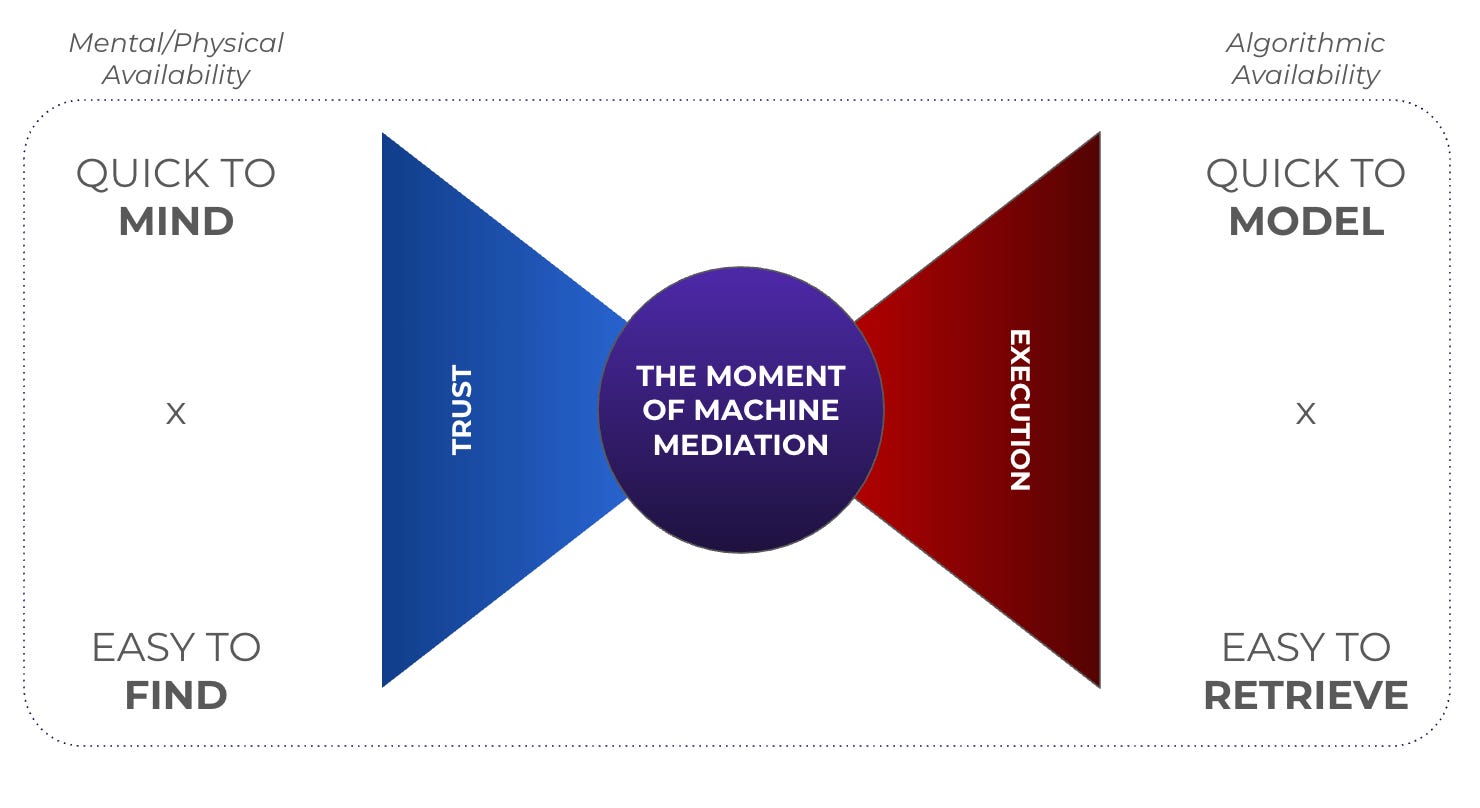
At its core, the model is simple. The principle that has governed how brands survive — Quick to Mind and Easy to Find — remains as true in 2030 as it was in 1980.
What has changed is the context. The human brain no longer acts alone in determining which brands come to mind or which are found most easily. It now has help from the machine — an extension of our collective memory, not a rival to it.
The left half of the model represents the human layer, where recall and accessibility still define success.
Quick to Mind captures the neurological real estate a brand occupies — the mental shortcuts that make it familiar and easy to recall at a moment of need.
Easy to Find captures the frictionless access that makes a brand physically or digitally present when that memory fires.
Together, they remain the most reliable predictors of market stability and brand survival.
The right half represents the machine layer, which mirrors the same logic in algorithmic form.
Quick to Model is the machine equivalent of mental availability — the degree to which a brand is recognized, referenced, and represented within the system’s learning model.
Easy to Retrieve reflects how readily that brand is surfaced when a query is made — its visibility in algorithmic recommendation, ranking, or selection.
Between these two planes sits the bridge — Trust and Execution — the connective layer where the human and the machine continually reinforce and recalibrate one another.
Trust allows human familiarity to become an enabler of machine confidence; execution ensures the machine reflects what people already need, want, do and can act on its behalf. This is the Moment of Machine Mediation, where models truncate the purchase moment, even further.
Together, these layers form the foundation of what might be called Algorithmic Availability by RoboByron or Mark R2Diston in the future. The point where human memory and machine memory converge, defining which brands are surfaced, selected, and bought.
In essence, Algorithmic Availability isn’t new — it’s an evolution. A natural extension of Ehrenberg and Sharp’s empirical truths into the computational age.
It’s 2030. The machines haven’t rewritten the laws of marketing; they’ve simply started obeying them faster, more precisely, and at greater scale.
The irony is that in trying to reinvent marketing, we’ve simply built machines that prove the old guardrails were right all along.
The brands that win will be those remembered by humans, recognised by machines, and trusted by both.
Because I disgracefully broke all three of my rules, making predictions that will inevitably make me a fool, and using language no one bar me will understand, here is a glossary of the fluffery included in this article
Quick to Mind (QTM)
A measure of mental availability: the ease with which a brand is recalled at a moment of need. Built through familiarity, fame, and consistent exposure — the neurological real estate a brand occupies in memory.
Easy to Find (ETF)
A measure of physical or digital availability: how easily a brand can be accessed or purchased when remembered. Availability in-store, online, or via platform interfaces that remove friction from choice.
Neurological Real Estate
The “mental property” owned by a brand within human memory — built through advertising, experience, and exposure. The foundation of Quick to Mind.
Algorithmic Real Estate
The equivalent Neurological Real Estate within machine systems — the structured data, mentions, and digital signals that determine how often and how prominently a brand is surfaced in AI- or platform-driven environments.
Quick to Model (QTMᴹ)
The algorithmic twin of Quick to Mind: the degree to which a brand is learned, recognised, and represented inside an AI’s model weights or data structures. The more a brand is seen, mentioned, and trusted, the faster it becomes “Quick to Model.”
Easy to Retrieve (ETR)
The algorithmic twin of Easy to Find: how readily a brand is returned, recommended, or ranked when a query or prompt is made. The measure of a brand’s accessibility within machine-mediated systems.
Algorithmic Availability (AA)
The convergence of human and machine memory — the combined outcome of Quick to Mind × Easy to Find, and Quick to Model × Easy to Retrieve. It defines which brands are surfaced, selected, and bought in an age where algorithms pre-filter human choice.
Algorithmic Jeopardy
A modern extension of Ehrenberg’s Double Jeopardy law. In algorithmic systems, smaller brands suffer twice: they have fewer buyers and are surfaced less frequently by models that optimise toward scale and familiarity.
The Moment of Machine Mediation (MoMM)
The point at which a user’s query, an AI’s recommendation, and the purchase itself collapse into a single act. A moment of compressed decision-making — the algorithmic equivalent of “the moment of truth.”
The Bridge (Trust + Execution)
The connective layer between human and machine availability.
Trust allows human familiarity to become machine confidence.
Execution ensures the machine reflects what people already need, want, and do and can execute on that. Together with trust, they enable the Moment of Machine Mediation.
No posts
Comments
Nothing yet. Say the first thing.
Sign in to join the conversation.