
Over the past few weeks, I’ve shared a series of charts and provocations inspired by the excellent work of industry leaders, framed against recent evidence from real-world campaigns.
The theme has been simple, but uncomfortable for many: performance media is not a growth engine. Certainly not a sustainable one.
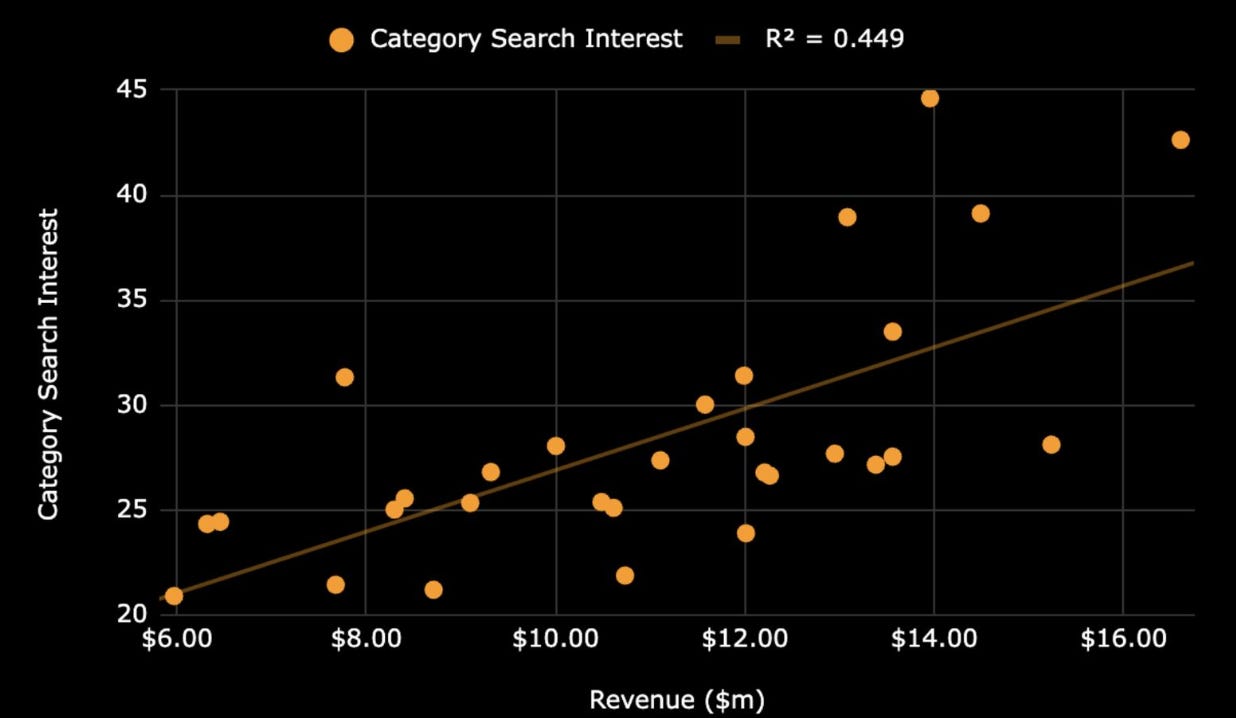
In one post, I showed how closely GA4 revenue often tracks with category demand, echoing findings from Analytic Partners. Put simply, your campaign’s ROAS is likely just a reflection of the natural ebb and flow of category demand. Performance media isn’t driving incremental growth, it’s keeping the lights on.
In another, I argued that Share of Voice (SoV) isn’t really SoV unless it’s actually seen and heard, using branded organic search as a proxy for memory. The eSOV model, the idea that when your share of voice exceeds your share of market you’re likely to grow (slowly, over time), is alive and well. But only if you exclude that vast volume of spend that is neither seen nor heard. Strip the ad tech, strip the performance media that is only seen by a fraction of your market, strip the low-attention, passive, wasted ad spend. Only then does the model stand up.
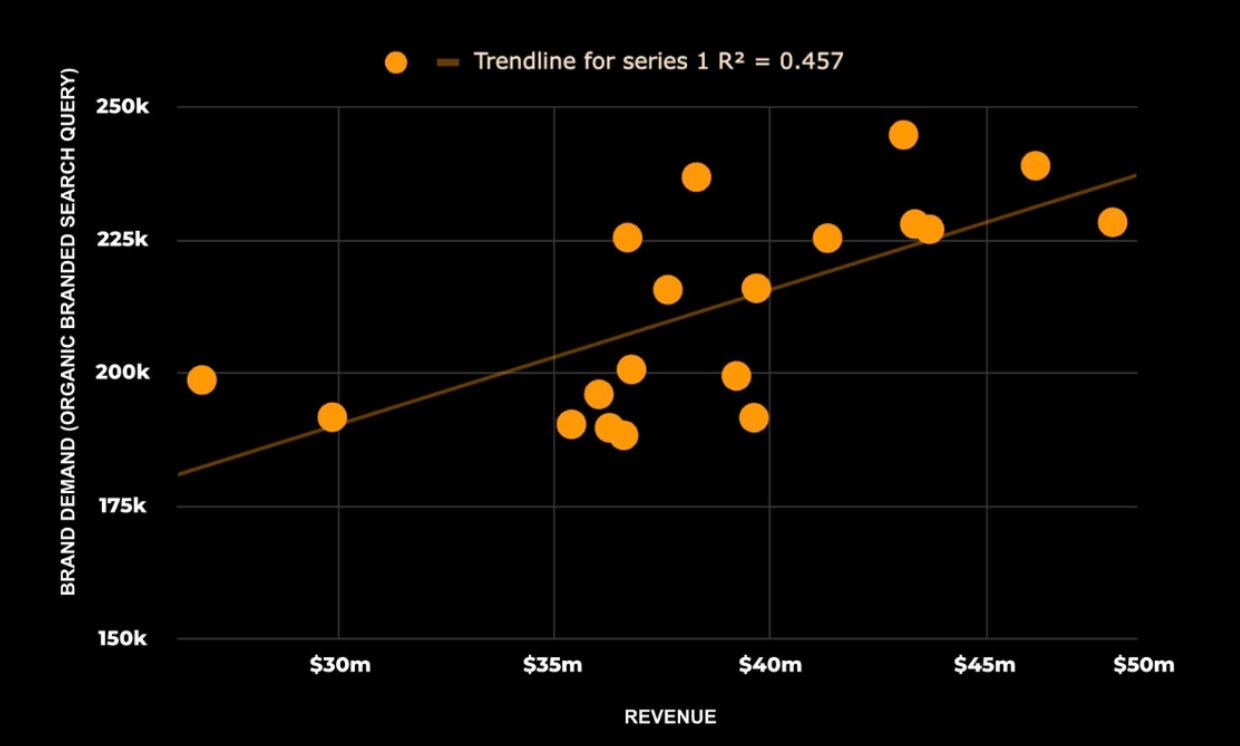
I then introduced evidence for the Quick to Mind / Easy to Find model, showing how brand interest and revenue move together. Nearly half of all revenue variance could be explained by interest in the brand. Quick to Mind.
And finally, I challenged the notion that advertising measurement is “broken,” suggesting the problem isn’t tools, it’s expectations. No amount of measurement wizardry will turn a bad plan into a money-making machine.
This article ties those threads together. For those who missed it the first time:
Performance marketing smooths the path to purchase for people already inclined to buy. It generally doesn’t drive meaningful growth. At best, it maintains equilibrium. At worst, it slows decline. In essence, it’s a defensive measure.
In short, performance media:
Makes brands slightly easier to find.
Prevents inevitable sales leakage to competitors.
Occasionally captures a few new buyers. Emphasis on the word marginal.
A chart I shared recently showed a tight correlation between GA4 revenue and category search demand, a strong proxy for market-level demand. Correlation isn’t causation, but the signal is clear: revenue rose and fell not because of clever optimizations, but because of the market.
When ROAS dips, advertisers typically spin into a frenzy of tweaks and optimizations. But media effectiveness doesn’t change overnight, buyers drift in and out of the market naturally, and that often has more impact than the media itself.
So performance isn’t really performance at all. It’s paying tax. Or keeping the lights on. It’s rent.
Source: US Case Study, various categories, 2025
For decades, we’ve assumed Share of Voice correlates with market share. But that only holds true if the “voice” is actually heard, processed, and remembered.
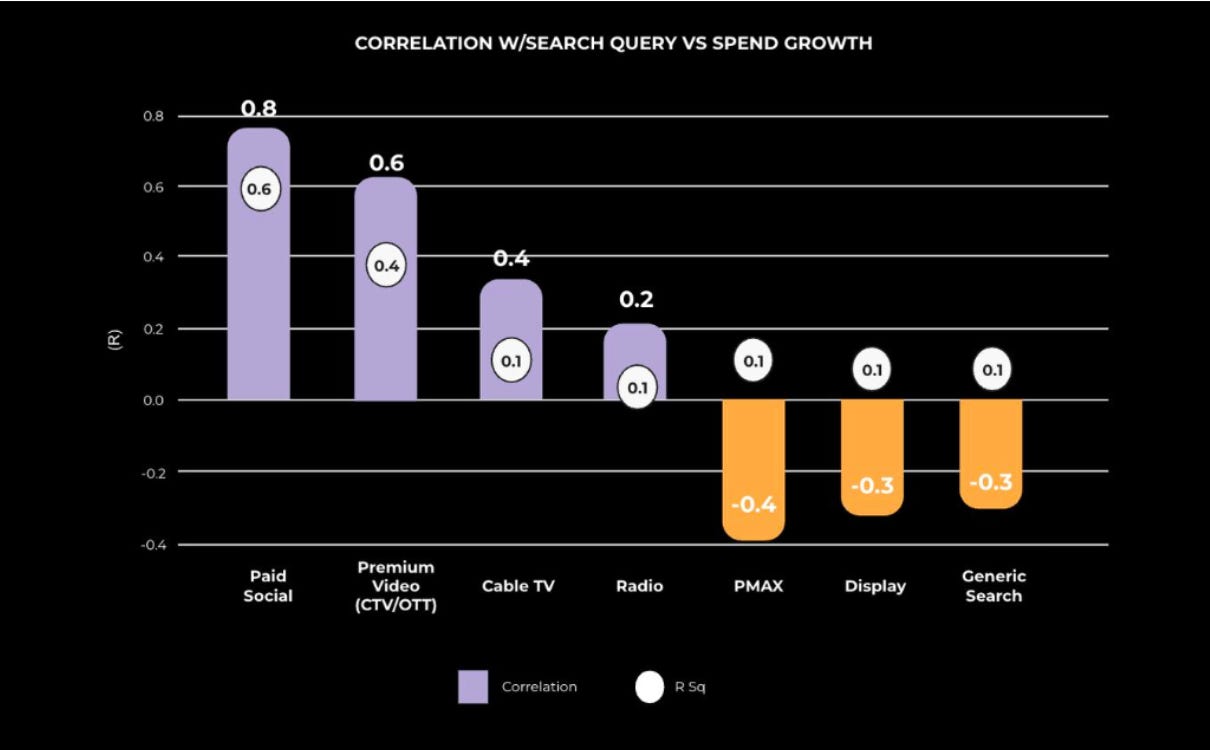
Our analysis correlated channel-level media spend with branded search interest, a proxy for memory creation. After all, no one searches for brands they’ve never heard of. The results were stark:
Some channels strongly contributed to brand memory.
Others contributed almost nothing, despite heavy spend.
If your SOV is being built in low-attention environments that don’t encode memory, then it isn’t really SOV, it’s just relative spend. Those channels may have a role, but rarely one that fuels growth.
To stand still, let alone grow, it’s not enough to be Easy to Find. You must be Quick to Mind.
Like I keep saying: performance media pays the rent. It won’t buy you lunch.
Source: US Case Study, various categories, 2025
So what does “Quick to Mind” mean? It’s rooted in Ehrenberg-Bass principles of mental and physical availability:
Quick to Mind: Media that builds memory, ensuring buyers think of you when they need the category. It requires broad category reach, channels that influence memory encoding, and messaging that isn’t cluttered with rational proof points nobody cares about. It requires genuine market understanding.
Easy to Find: Ensuring the brand is available at the buying moment. This could be paid search, retail distribution, or even pricing. If your price point makes you uncompetitive, you become easy to dismiss, and your competitor becomes easy to buy.
In one analysis, 46% of revenue variance was explained by branded organic search (a proxy for brand interest), a correlation statistically significant at the 99% level.
In other words: when people think of you at the moment of need, they’re far more likely to buy. Being thought of is the essence of Quick to Mind.
Performance channels mostly serve the Easy to Find side. But without Quick to Mind, the efficiency of Easy to Find diminishes over time. There’s a ceiling to what Easy to Find can achieve without Quick to Mind support.
Put simply: if you’re not thought of, you’re not bought. If you’re not bought, you’re dead.
Source: US Case Study, E-commerce
The popular narrative is that advertising measurement is broken. The bigger issue is unrealistic expectations.
As John Dawes has pointed out, only ~5% of buyers are in-market at any given time in B2B. Depending on category, the same is true for most B2C markets.
That means:
Campaigns don’t fail just because they deliver modest immediate sales.
They fail because advertisers expect advertising to deliver what it cannot.
Much of advertising’s role is defensive. Preventing churn, replacing lost buyers, and occasionally adding new ones. Vendors peddling “30x More Conversions” ignore market reality.
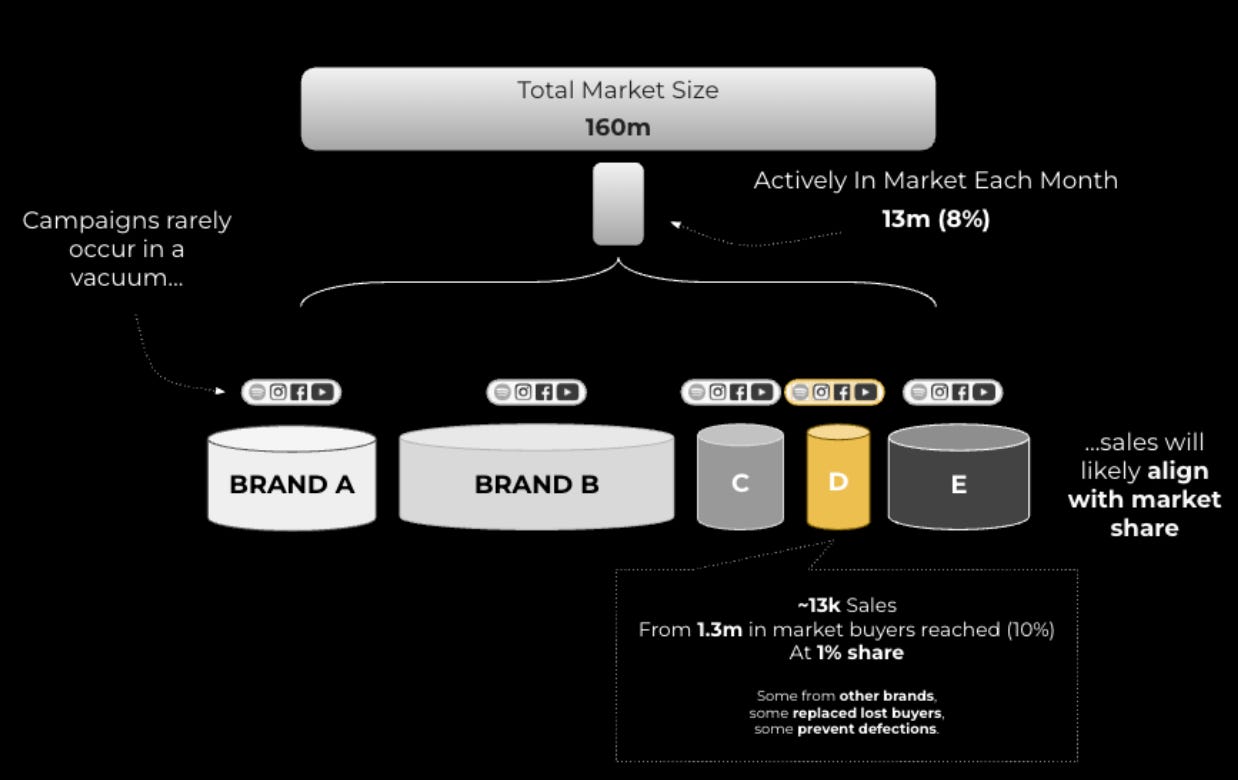
Let’s take a hypothetical example:
In your Target Market, there are 160M buyers per year.
5-day buying window → ~8% in-market each month (~13M).
Campaign reaching 10% of the market (~16M people) → ~1.3M in-market buyers.
With 1% market share, that’s ~13,000 sales influenced.
Few are incremental in the immediate term. Many are replacements for lost buyers. Some are defensive reminders. No campaign exists in a vacuum. Competitor activity cancels out much of your gain. The moment you reduce your campaign reach, you reduce the volume of category buyers you can influence. Whether that be brand advertising or performance media. This is why SOV (or effective SOV) is so critical. And that often requires investment in media that builds effective scale.
So maybe measurement isn’t broken. Maybe we just need fewer delusions. No measurement framework will show you sales that don’t exist.
Advertising works. Gradually. Cumulatively. Often invisibly, masked by the natural peaks and troughs of category demand. What it really does is:
Build memory.
Prevent churn.
Replace lost buyers.
Occasionally deliver some new ones in the short term.
But let’s not confuse defensive efficiency with growth effectiveness.
Equally, the playbook that works for startups doesn’t work for small brands, and it isn’t replicable for mid-market or large brands.
Performance media has its role, but only as part of a broader system that builds memory and availability. Quick to Mind and Easy to Find.
Because without memory, even the sharpest “performance” play is just rent.
It may help you keep the lights on. But it won’t buy you lunch.
No posts
Comments
Nothing yet. Say the first thing.
Sign in to join the conversation.