
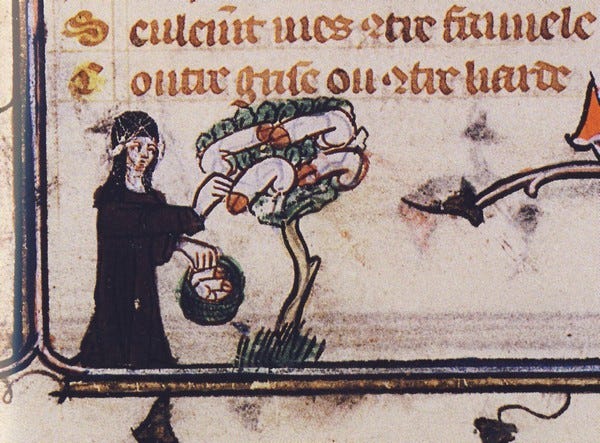
A few days ago, the doyenne of medieval book publishing, Caroline Palmer, posted a delightful snippet as a teaser for a forthcoming book. A certain gentleman, en route to an audience with Elizabeth I, shocked onlookers when he stopped at the palace wall, ‘puld out [his] pintle’ and urinated copiously. This startling breach (of manners, not of the wall) could just about be excused, his companions reflected: after all, the man was Scottish.
As you can tell from the context, in sixteenth-century English a ‘pintle’ did not mean what it means today. In modern English it is the technical term for the bolt or pin that stands upright to secure a corresponding ring or socket. You find pintles on heavy gates, on sailboats, and as part of the gear you use for towing a car. The etymology is all but forgotten, which is no surprise: we all speak of ‘male’ and ‘female’ hose connectors or plug links, without much thought about the anatomical origins of the terms. (Well, unless your mind is in the gutter. Personally, I was delighted: I discovered the existence of male-to-male plug connectors from extremely no-nonsense Yorkshire landscapers, who requested them forthrightly in the middle of Pride week.)
But to a sixteenth-century audience, though a ‘pintel’ could mean a piece of hardware for fastening something, its dominant meaning was genital. I wondered when the shift from innunedo to innocence happened. And that made me think of a scene in my favourite - and truly bizarre - sixteenth-century narrative.
Variously titled The Squire of Low Degree or Undo Your Door, this text is not much studied now. But references suggest that in its own day, it was a popular work. Shakespeare knew it; early printers thought it was worth the investment, and the earliest surviving versions come with fetching woodcut title pages.
We begin with a feisty princess and a decidedly graceless young squire, who camps out in her garden, lamenting his inability to woo her. Suddenly, the narrative slows to a crawl to describe, of all things, the exact technical specifications of the princess’s architectural surroundings, as she stands in her room looking out. Her windows are:
closed well with royall glas.
Fulfylled it was with ymagery;
Every wyndowe by and by
On eche syde had there a gynne,
Sperde with many a dyvers pynne
Anone that lady, fayre and fre,
Undyd a pynne of yveré,
And wyd the windowes she open set,
The sunne shone in at her closet.
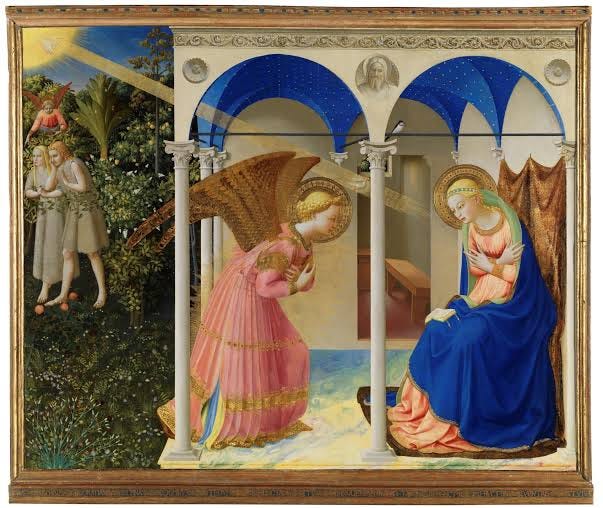
Each window has stained glass in it (that’s the ‘ymagery’) and each has a ‘gynne’ - a ring or slot - on each side. With some apparent arithmetical incoherence, these ‘gynnes’ are matched not with a single, thrusting bolt to fasten them, but with ‘many diverse pins’. One of these, at least, is made not from the expected metal or wood, but from ivory. It is hard to visualise. Why on earth do we need to know so much about these windows, and why do they need such complicated and outlandish opening mechanisms? We will find out, but not until much later.
The story moves on. The princess calls out the the squire, and thus begins a swift exchange of lovers’ promises. Desperate to prove himself to his high-born beloved, the squire announces that he will undertake an adventure-packed quest. But alas! His sworn enemy - the king’s steward - is waiting in the wings. When the squire turns up at the princess’s door to bid her farewell, the steward and his men are lying in wait. A violent scuffle ensues (the first and last literary instance of a corridor taking a starring role as battle ground), and the squire is taken prisoner. The steward, however, is killed. Swiftly and inexplicably, the steward’s men mutilate the face of their leader, dress his body in the squire’s clothes, and dump him inside the princess’s room, before departing with their (apparently, naked?) prisoner.
The princess’s first response is an understandable one of horror. She believes the body in her room is that of her dead beloved: his clothes familiar; his face horribly mutilated. Rather less understandable is her second response. She takes the body, eviscerates and embalms it with impressive and chilling professionalism, and pops it in a large box. Like the window, it is fastened with ‘quaint gynnes’ and with ‘lockes three’. Things proceed to get even weirder.
Comments
Nothing yet. Say the first thing.
Sign in to join the conversation.