
Just recently, I posted an impatient take on the current vogue for ‘prairie-style’ planting. My target wasn’t really the gardens designed (and made justly famous) by Piet Oudolf. Nor was it the desire we all have to find plants that survive well in these incredibly challenging times. What I was fed up about was the lazy copying and bastardising of a trend: the idea that, so long as you chuck five types of miscanthus and some heleniums at a narrow border around some modish bright-white stone paving, you can claim it as a climate-tolerant garden and call it a job well done. Not only are too many of these plantings badly thought-out, they’re also often not what we really want or need to make a liveable environment for us and for wildlife. And, for the love of green growing things, why must they always include so much fashionably rusted iron?!
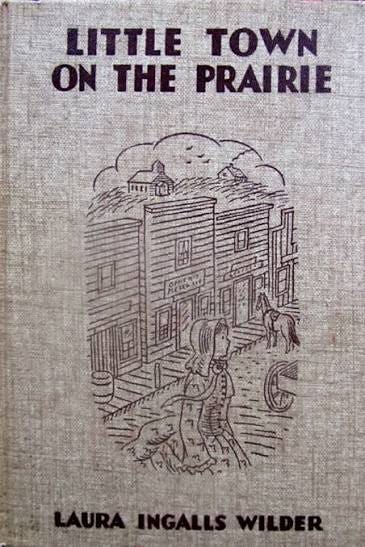
To my absolute delight, the wonderful Marianne Willburn agreed to republish this piece as a Garden Rant. Their audience is primarily in the US, and so it was fascinating for me to read American gardeners’ thoughts on the subject. And it reminded me of my first literary encounter with the idea of a prairie, which came via the classic children’s books of Laura Ingalls Wilder.
Wilder is often dismissed, in the way children’s authors are, as a simple writer. Her books are pigeonholed as charming, homespun reminscences of her pioneer childhood. Yet this is to underestimate her sharp talent for subversive understatement, which provides an occasional piquant undertow to the wholesome surface narrative of her work. Take, for example, this delightfully understated exchange between Wilder and her older sister Mary, as they walk together through the blossoming prairie:
“Sheep sorrel tastes like springtime,” Laura said. “It really tastes a little like lemon flavouring,” Mary gently corrected her.
I could not adore this more. On the surface, that word ‘corrected’ indicates that Mary is right and Laura is fanciful. But Mary’s ‘correction’ betrays so much about how narrowly she interprets the world. For her, the taste of sheep sorrel cannot be evocative, suggestive, or allusive. It must be pinned down precisely, to something that could be found in the domestic pantry. There’s something unintentionally funny, and also remarkably joyless, in the way Mary insists the resemblance is not to actual lemons but ‘lemon flavouring’. (Side note: I went down the rabbit hole with this and discovered Mary won’t be referring to synthetic lemon essence - which didn’t then exist - but it is also most unlikely she means she’s analysed the relative terpene contents of sheep sorrel and lemon rind, to make the comparison).
Wilder leaves us to intuit the gulf of misunderstanding between the sisters. But she also shows a deep vividness and love in descriptions of the prairies. Who could forget the image of head-high prairie grasses where children can get lost, of hidden hollows filled with violets, where the long-departed buffalo once wallowed?
In real life, Wilder’s father - like her husband, in the books - took out a tree claim in South Dakota. At that time, the government believed that the prairie landscape could be transformed, and offered settlers the tempting incentive of land ownership, if they would do it. In a later book, Wilder reflects upon the change to the landscape; the potential of the (few, scattered) cottonwood trees to become a forest. But, of course, the tree claims of the plains states soon failed. Wildfires and drought did for those trees, which could never thrive in a climate perfect for supporting the prairie. By 1900, the whole idea had been set aside.
What strikes me, here, is how Wilder’s love for her surroundings shines through. Although the prairie is clearly cruel and difficult in many ways, the tiny details of violets and sheep sorrel make it come alive, as it does not for her sister, nor for the bureaucrats in Washington, who sought simply to make it much more like the East. It’s an irony that the process is now happening in reverse; the prairie taking over. But to me, Laura’s delight in the taste of sheep sorrel is far the most appealing image of the prairie, and her tongue-in-cheek representation of Mary’s prim propriety, an excellent reminder to challenge what is sold to us as the ‘correct’ way to do things.
No posts
Comments
Nothing yet. Say the first thing.
Sign in to join the conversation.