
An off-the-cuff post today, because my brother is coming up to visit my newborn baby (yay!), and I am writing this while said newborn snores loudly and makes those weird pterodactyl quacking noises. (Why do they do this?)
Glancing over substack, it is clear that we have all been talking about Emily Wilson’s delightfully testy review of Christopher Nolan’s Odyssey, which is a great pleasure in that time-honoured genre of snippy academic reviews. For many people, obviously, the film is a first introduction to Ancient Greek literature, or to Homer. Both this fact, and a line in Wilson’s review, sent me reminiscing about my own childhood reading.
At one point in her review, aggrieved as a latter-day Elizabeth David mourning the absence of lemons in wartime Britain, Wilson laments:
there are no sex scenes, and all the food looks horrible.
As quibbles go, I love this. Wilson is the sister of the food writer Bee Wilson, so I do get it. But I also felt it rang true. I’ve never read the Odyssey in the original (so shoot me), and when we did bits of the Iliad for A Level Greek my main memory is of endless essays where we were required to regurgitate the simile about the hawk chasing the pigeon, as Homer describes Achilles chasing Hector around the walls of Troy. Raw pigeon, yum.
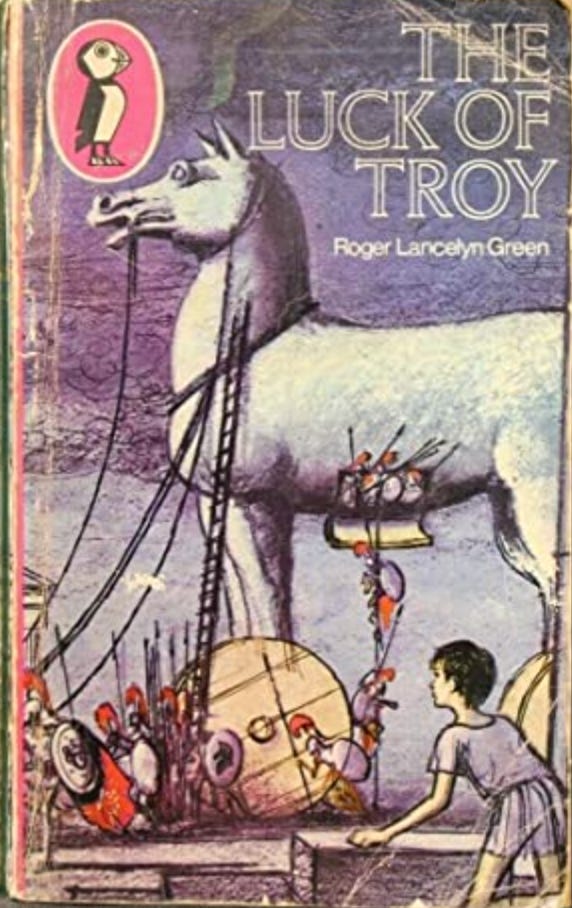
However, long before I read any Classical literature in the original, I came to the early part of the narrative - the bit that corresponds to the Iliad - through the wonderful retelling The Luck of Troy, written by Roger Lancelyn Green in 1961, and which does describe food. In fact, the food in it is so memorable one scene flashed straight into my mind. The scene involves Odysseus - then disguised as a beggar in order to sneak into Troy - sitting down with Helen, captive wife of Paris, as the two plot to bring down the city for the Greek army. During this conversation, Helen provides food:
besides cold meat, a great bowl, and by it an onion on a bronze plate, a measure of barley-meal, honey and goats’-milk cheese. … Helen mixed the honey and the barley in the bowl, with slices of onion to add relish, and grated the cheese over it with a bronze grater, and mixed all this with the dark, fiery wine made on Mount Pramne in the island of Icaria, far away to the south of Troy.
As a child, I found this very satisfying. The way Helen puts the food together is completely unexpected: honey and onion?! Wine, mixed with barley? But Green describes it with a total lack of deadening explanation, conveying quite clearly the message that this just is what Homeric heroes and princesses expect to eat, and that it will be as delicious a meal as can be managed under the circumstances. ‘We have no golden cups left in Troy,’ Helen apologises graciously, as she pours the wine into a bronze cup for Odysseus (even when one’s guest is dressed as a beggar, one must observe the niceties …).
Green borrows quite a lot from Homer, but his story comes to life through the eyes of his young protagonist, a boy called Nicostratus. An author’s note learnedly explains that, though most sources only give Helen and her husband Menelaus a daughter, Hermione":
Nicostratus is, however, as genuine a character as any in the Tale of Troy. “Now Menelaus had by Helen a daughter, Hermione, and, according to some, a son, Nicostratus,” says Apollodorus (Library III. xi. i).
I am not totally convinced that a paranthetical caveat ‘according to some’ makes Nico ‘as genuine a character as any,’ but I love Green for his easy assumption that we will all - child readers included - want to know his sources, and appreciate the reference to the specific line from this quite obscure historian. As with the description of the meal, the attitude here is the absolute opposite of the patronising, ‘now I must make sure everyone understands the context’ kind of writing (or screenplay) that is so tedious.
It is a little bit easy, looking back, to grin at bits of Green’s novel. Delightfully, he neatly disposes of one of the major storyline developments (which is distinctly non-child friendly): the fact that Agamemnon, commander of the Greek fleet, has sacrificed his own daughter in order to convince the gods to give him a fair wind, and his return home is going to end extremely nastily at the hands of his wife Clytemnestra, who has spent ten years smouldering with understandable rage. In Green’s hands, the whole thing is summed up in an aside from Odysseus during a conversation with Helen: ‘Iphigenia is dead, and Mycene not the happy home it was’. You don’t say. Read with hindsight - and, perhaps, Aeschylus’ Oresteia behind you - it is an unintentionally hilarious line, the whole melodrama of bloodshed and raging furies and horrendous internecine conflict condensed into a politely regretful comment on sub-par domestic contentment.
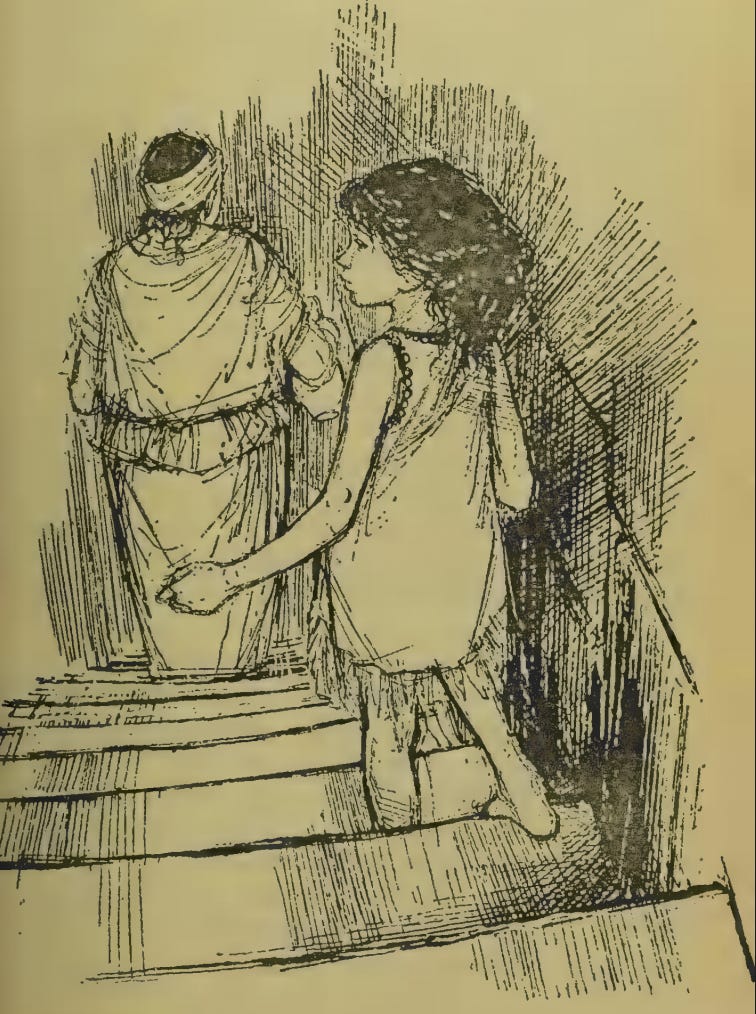
For me, this domesticity is compounded by the fact that the illustrator of The Luck of Troy is Margery Gill, who is better known for her work on Noel Streatfeild’s oeuvre. She specialises in lovely, slightly wisful-looking, long-limbed children; her Nico is all legs and elbows but somehow also slightly dancer-ish; her Helen is distinctly matronly despite her Greek-statue face. They could both fit, quite easily, into Streatfeild’s universe of decorous, thoughtful siblings, playing nicely and only occasionally indulging in a little temper or egotism. It doesn’t half tone down Electra.
We meet both Electra and Hermione - and the ill-fated Iphigenia - in an opening chapter. Green paints a vivid picture of the baking heat of Greece in summer and the stuffy and slightly ghoulish interior of a Mycenean beehive tomb, describing the funeral procession for the children’s grandfather, Atreus. In the picture above, Hermione accompanies her enslaved nursemaid Kilissa (a well-written foreshadowing of women’s fates throughout war-torn civilizations) down the steps to the underground cistern for ice-cold water. Refreshed with this and with honey-cakes, the children begin to gossip about the famous Helen, Hermione’s mother, and the reason she went to Troy.
It will be manifestly obvious that, like Nolan’s Odyssey, Green’s The Luck of Troy is precious short on sex scenes, or indeed on any hint that sex might exist in the world. There is absolutely nothing to suggest that Agamemnon, noble and upstanding father that he is, might bring home a sex-slave Trojan princess. Unsurprisingly, there is no hint that Helen has anything resembling attraction to Paris. Indeed, Green goes out of his way to explain, carefully, that some form of enchantment or hypnosis is responsible for her presence in Troy; that her heart belongs to Menelaus and her home in Sparta. But the icy water and the honey cakes, like the raw onion ‘relish’ and the ‘firey’ red wine, come off the page with such vividness you can almost smell them; you can almost taste Ancient Greece.
***
What was your first introduction to Homer? And do you remember the food in it?!
No posts
Comments
Nothing yet. Say the first thing.
Sign in to join the conversation.