
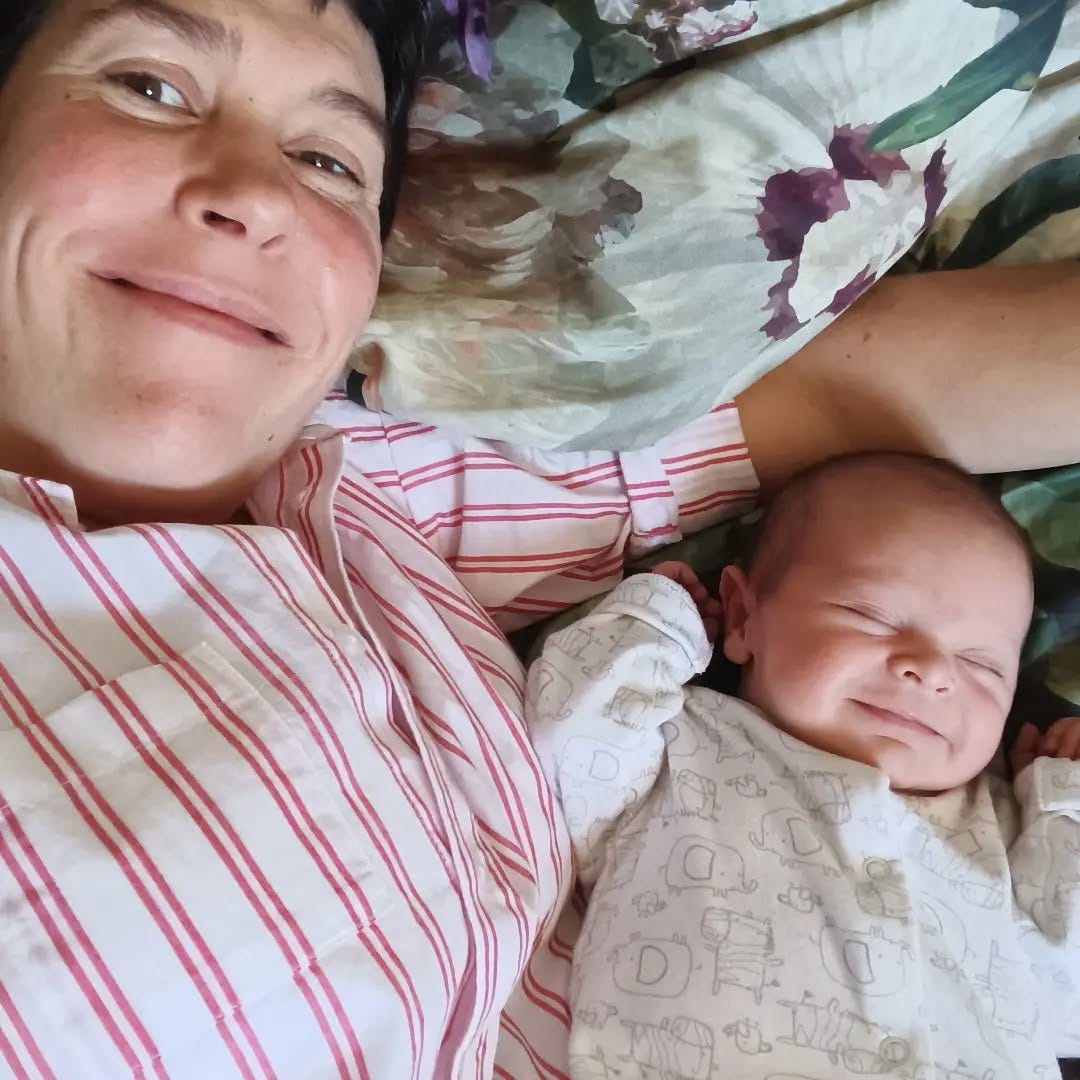
This week, I started reading Erin Maglaque’s fascinating book Presence: A Hidden History of the Female Body, which I encountered through a powerful extract published in the Guardian. Like other historians I know, Maglaque’s understanding of herself as a historian, and her relationship with her body, were both profoundly reshaped by the experience of giving birth - and, indeed, the experience of pregnancies that did not end in birth - and this is the starting-point for her work. I was struck by the vivid way she weaves together snippets of quotation and anecdote, to bridge the gap between past and present and to capture histories of women’s experience that have often slipped into silence. Early in her book, she quotes a Cornish servant woman, writing in 1795:
I have all wise Got the Child night an day so I Canot writ no time for she will not Let me stay up after she is Gone to Bead … I hope you will Excuse this Scroll [scrawl] for I have wrot this with the Child in my arms’.
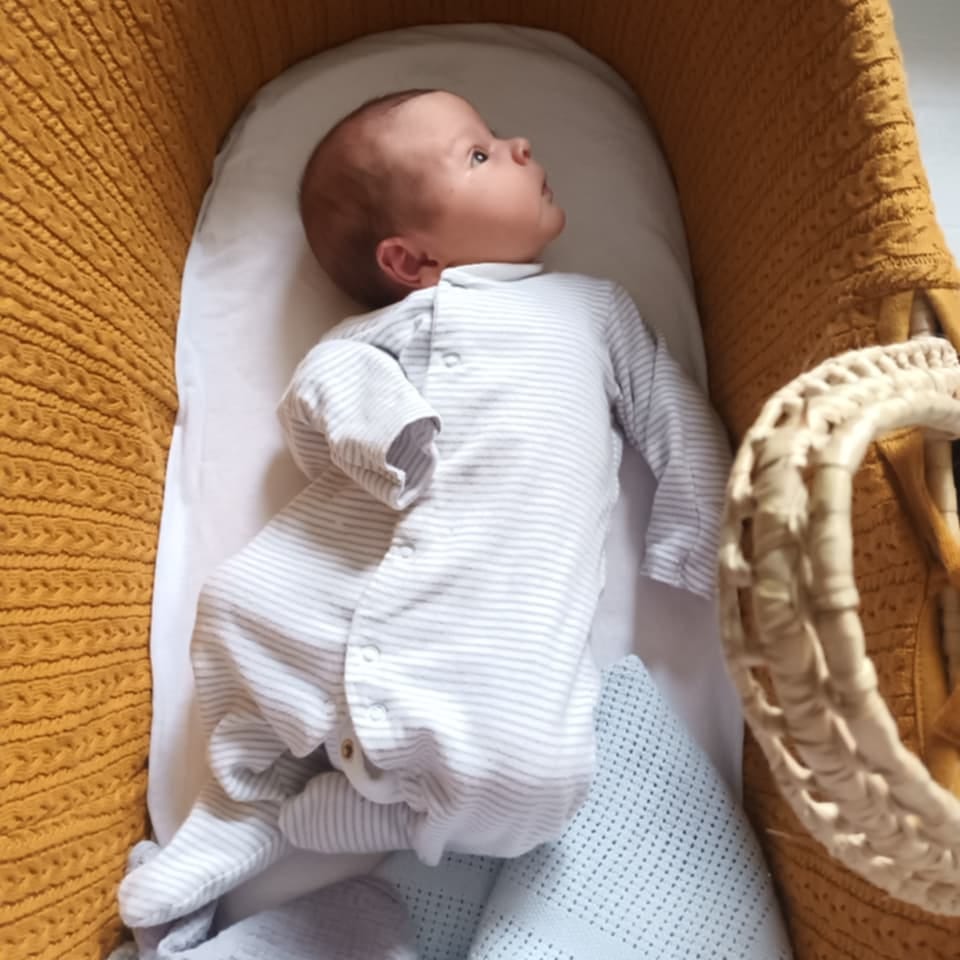
Oh yes, I thought, oh yes, as my two-week-old baby wriggled and kicked in his Moses basket, making urgent noises. When I posted the quotation on social media, I was inundated with responses from other mothers. Despite Cyril Connolly’s snide dictum that the pram in the hall is the enemy of good art, women I knew recalled writing in snatches of time during night feeds. I remembered the wonderful Laura Richmond, describing moments with a newborn during the night - and in the face of a frightening postpartum crisis - as ‘stars in a dark sky’. I laughed at the anecdote left by a reader, about a friend who wrote, not with, but on the baby on her lap.
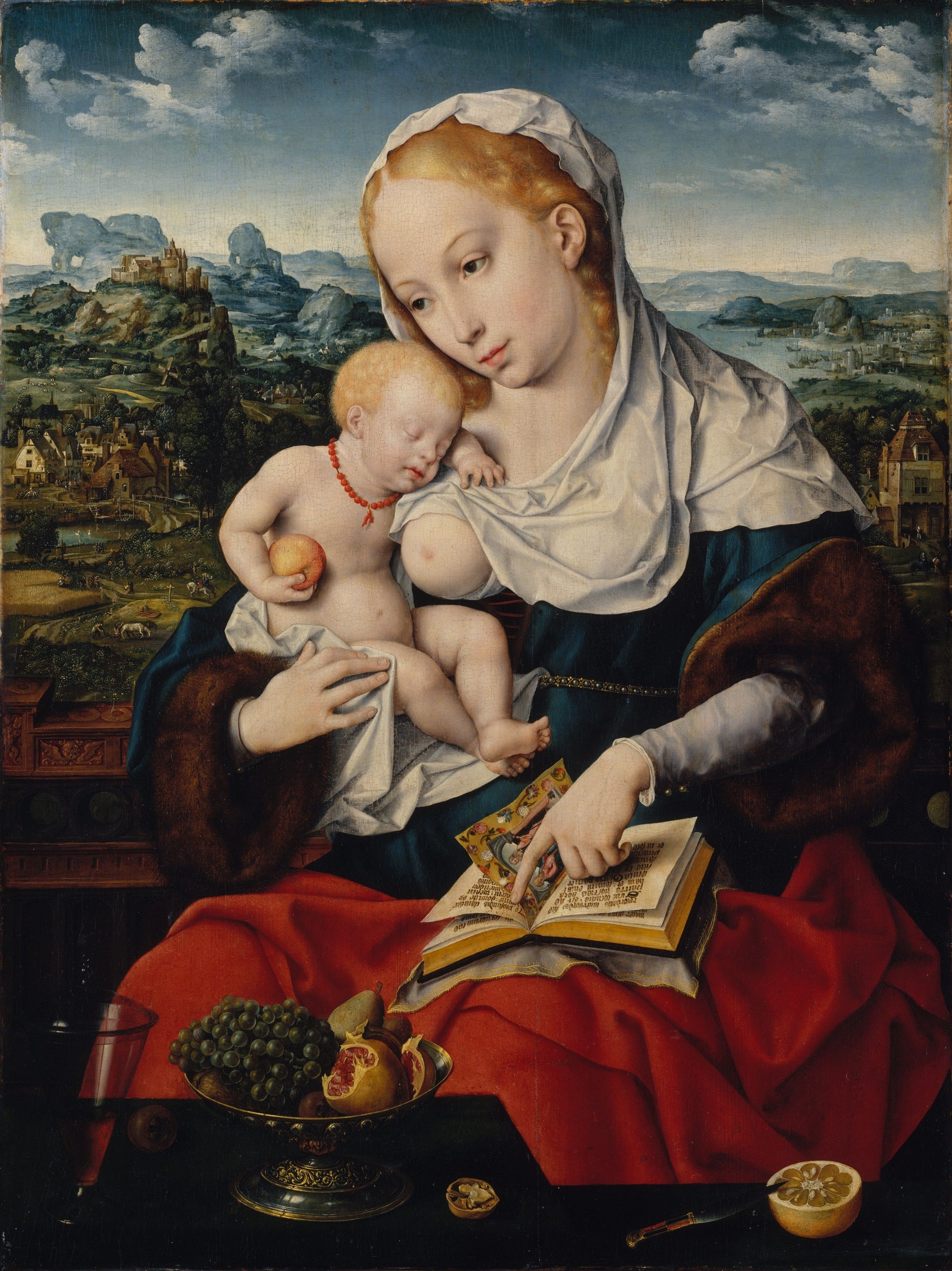
These responses were not sugar-coating the sheer hard work and exhaustion of staying awake with a newborn. Many of them testified to the absolute, annihilating struggle of trying to hold on to a coherent thought in the face of a small creature composed entirely of brute need. But they were not negative responses, by a long way. There is the baby in arms, but there is also the writing - or the reading, the thinking, the gazing out of the window to see the stars move.
It made me want to write a small history, a history of waking with a baby, to stand against those hope-draining naysayings that modern culture so often uses to put mothers of little children in their place.
For medieval people, the experience of trying to put down an infant who is cheerfully wide awake was obviously utterly familiar. A German nun, Margaretha Ebner, writes of her mystical visions of the infant Jesus in His cradle. Visions of Christ’s infancy were quite common in medieval writings, but Margaretha gives us vivid detail:
one night Child granted to me that I saw Him play in the cradle with joy and full of life. Then I spoke to Him: “Why don’t you be quiet and let me get some sleep? I have laid you to sleep very nicely.” Then the Child spoke: “I don’t want to sleep, you must take me to you.” And so I took Him with longing and joy out of the cradle and put Him in my lap. He was a loving child. Then I spoke: “Kiss me, so that I can forget that you have disturbed my sleep.”
Another infant Jesus, this time in an anonymous lyric from the commonplace book of the John Grimestone, written in 1372, participates in another night-time battle of wills with his tired mother. The speaker of the poem falls asleep and dreams of seeing a mother, ‘a may [maid] her child rokkynge’. We are told:
The maiden wold withouten song
Hir child asleep to bring
The child hym thought sche ded him wrong
And bad his moder sing.
It is no good to think, optimistically, you can get away with skimping on the ritual of songs and cuddles, however much you might want only to go to sleep. Yet at the same time, there is creative potential in those sleep-torn night-time wakings; there is the possibility for a vision; a song; a poem, to come. These descriptions of loveable and tyrannical infants, endearing even while the adults around them are battling with sleep deprivation, ring just as true seven hundred years later.
Nor was it only the infant Jesus whose sleep shaped the imagination of medieval poets. In the last revision of his endlessly-reworked, long and searching poem, Piers Plowman, the medieval author Langland imagines the work of poor women, barely subsisting on the meagre recompense they earn from spinning, carding and combing wool, cleaning and mending. He describes how daily routine sees these women ‘waking on nyhtes/ to rise to the reule to rokke the cradel’ (C. IX. 78-9).
The phrase Langland uses here transmutes these women’s tired rocking into something more than just another menial chore. The lines mean that women wake and get up ‘according to the custom’ to rock their babies’ cradles. The word ‘reule,’ which I translate as ‘custom,’ might also carry the suggestion of a natural rule, a natural imperative to nurture. But it also carries a strong hint of another kind of rule, and another kind of night-waking. It is nuns, typically, who ‘rise to the reule’ in the middle of the night. Their ‘reule’ is the Monastic Rule, which requires all professed religious to get up in the middle of the night to recite the lengthy sequence of prayers known as ‘Matins’ or ‘Vigils’. The line dignifies the tired labour of care work with a poignant echo of the sacred, cutting through the poet’s evocation of grinding, abject poverty.
The odd, touching hint of wonder in this line is not the only thing that sets this line aside from the tone of the longer passage. Elsewhere, Langland refers repeatedly to hunger, and women’s constant struggle to eke out meagre ratios of food. It is striking, then, that the labour associated with a wakeful baby at night-time is not nursing, but rocking its cradle. It is true that, in both medieval and early modern parlance, rocking a cradle is the activity that sums up and symbolises the care of an infant. Nurses in wealthy or royal households are referred to as ‘rockers’. Yet, all the same, perhaps here the choice to focus on this activity is a tiny hint of the paternal perspective: a detail most immediate to one who has not nursed a baby but may have taken a turn rocking a wakeful child to sleep.
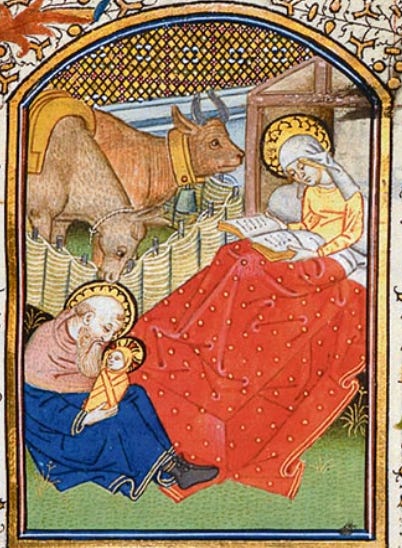
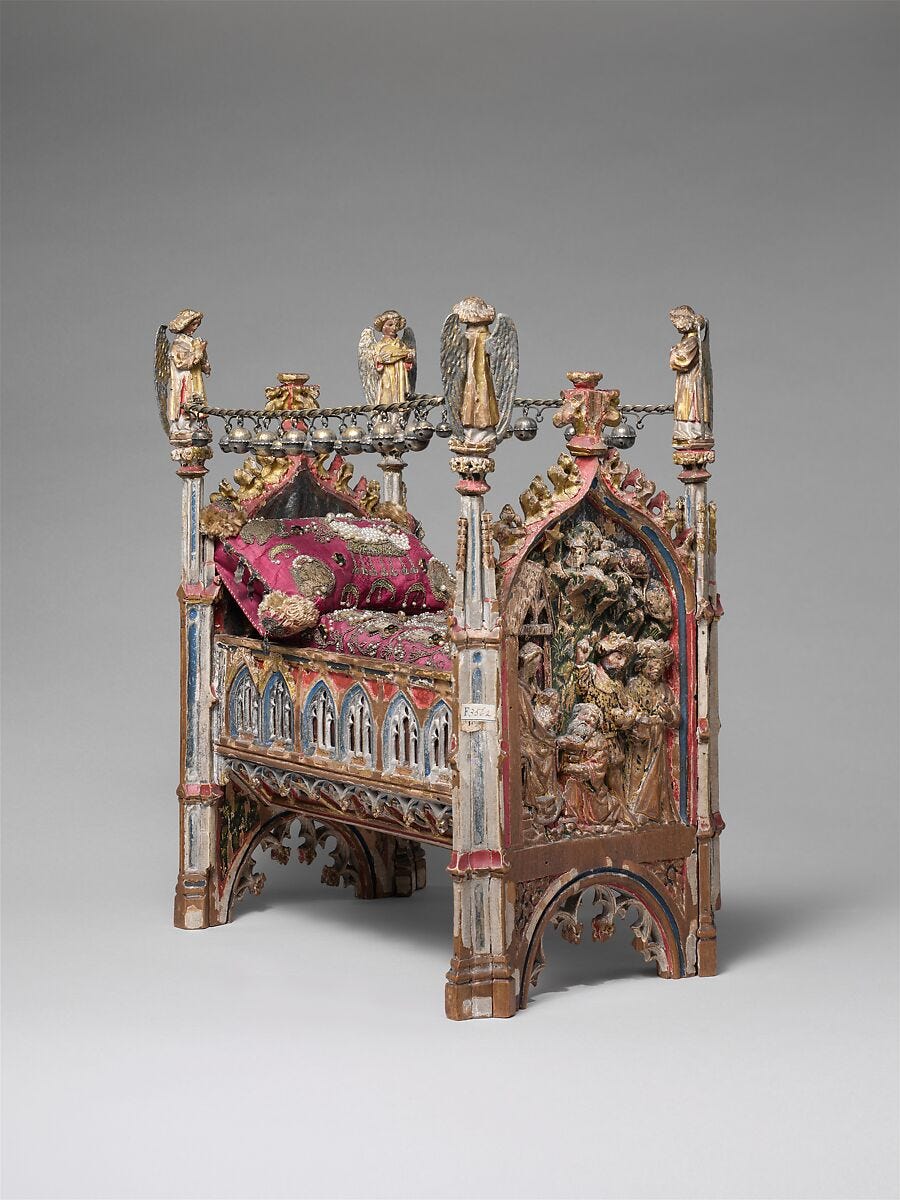
That men did rock cradles is evident. One piece of proof is the strange, rather enigmatic anecdote concerning a Lincolnshire couple, John and Alice Phipps, who were brought before the church court in 1518. ‘They have a cradle near their bed every night and it is used as if there were an infant in it,’ the court record tells us, without more details. It would seem that, to the original audience, the transgression implicit in this activity was entirely obvious. Yet it has baffled scholars since. The anecdote tends to find its way into popular histories of infertility. It is often read, suggestively, as a glimpse into this couple’s imagined longing for a child of their own.
I am very unsure about this, despite my long interest in histories of infertility. The court in which the couple was tried was the church court; the charge was not some form of witchcraft (attempting to conjure up a baby, perhaps?) and no one seemed fearful John and Alice would steal someone else’s child. It was idolatry of which they were accused. I think that John and Alice were practising a form of religious exercise that was more properly the province of women under religious vows (like, perhaps, Margaretha Ebner). Such women were often given model cradles, complete with tiny figures of the infant Jesus, which they were encouraged to rock in order to sharpen the devotional insights of those night-time prayers.
As the late medieval period wore on, explicitly female-orientated practices such as these - and particularly, practices that involved physical representations, sculptures of an actual body or object - began to arouse complex responses of suspicion and mistrust. We might think of the once-popular sculptures known as ‘shrine madonnas’: models of the Virgin made to open like boxes, revealing scenes of the Trinity or the Last Judgement in the hollow where the uterus should be. In England, such sculptures seem to have been a particular target of iconoclastic fury during the Reformation, arousing an anger that is part of a larger shift in attitudes towards the Virgin and her odd, oddly powerful, generative, unsettling female body. Elsewhere, as historian Elina Gertsman records, statues of the Virgin were ‘gutted’ or ‘glued shut’ to hide away that disconcerting postpartum body. My hunch is that the crib John and Alice Phipps rocked, in 1518, fell foul of the same growing hostility, the same desire to shut down this type of religious and imaginative licence.
The brute realities of keeping an infant alive - even now, and certainly in the premodern era - are radically uncompromising. This is a familiar tenet of women’s writing, and it is hugely important. It is not an experience, as Magalque’s book shows, that can be rationalised into convenience; it is not a situation where ‘mind over matter’ makes the slightest bit of difference. But, equally, it is not mindless, tedious, thoughtless work. When it becomes those things, it is because women postpartum have insufficient support, or because our modern society has decided not to concern itself with the details of (still, mostly) women’s care work, of which Langland wrote so movingly six hundred years ago. We have ‘glued shut’ this former knowledge and recognition that, in caring for an infant, there might be moments of vision and creativity, amusement and interest; we have let the Cyril Connollys of this world tell us that if new mothers do not create, it is because motherhood is inherently opposed to creative work. But it has not always been so, and it need not always be so.
No posts
Comments
Nothing yet. Say the first thing.
Sign in to join the conversation.