

I know. We are all far too hot. But I am going to talk about it, all the same.
During this latest heatwave - flipping through magazines; trying to sit indoors instead of going into the garden - I found I couldn’t ignore a little voice that’s been in the back of my head for a while. I’m really really bored of Piet Oudolf. There, I said it. It’s a terrible thing to admit. And I live within a stone’s thrown of Scampston, too, which is widely hailed as one of his triumphs.
It may be I’m being unfair. Perhaps what I really mean is, I’m bored of people who imitate Oudolf without his talent. And I do think the heat has shaped my reaction. When it’s as hot as this, grass bleaches out. Its movement mimics the optical effects of the heat shimmer you get over concrete or tarmac in the baking sun. Where grasses are over-used, or used with too many similarly vertical, floaty growers - verbena bonariensis comes to mind, or persicaria - the whole impression is of scribbled uprights, like a child’s drawing.
The individual plants aren’t doing it for me either; not in this context. Those foamy lime-green sprays of alchemilla mollis, which I love when they send up velveted green leaves in spring, crisp to unattractive orangey-brown at the edges. Too many of those much-touted drought-tolerant perennials come in shades reminiscent of fire-engines, sunburned skin and scorched meat: those orangey yarrows and reddish-plumed pennisetum and flame-coloured heleniums. The silvery leaves and flowers of echinops and eryngium are one more set of dry prickly things, sharp as the grass on a parched lawn. The fashion for rusted-steel planters and water features is the final straw: yes, true, they are very fashionable, but why on earth have something the colour of molten lava (and which heats up to a similar temperature) to detract from any impression of coolness and refreshment?
A brilliant, polemical and persuasive post by Ben Probert discusses the implications of gardening in the heat; his dissection of the ‘macho’ culture of professional horticulture rang absolutely true for me (I am undendingly glad that I didn’t have to navigate the last few weeks of pregnancy working in 40 degree heat in a polytunnel, which I’m fairly sure I would have been doing in my previous job). He points out that many ‘so-called climate change gardens’ are devoid of trees, which I think is a particular weakness of the school of Oudolf rip-off designs (not Oudolf himself!). Dan Pearson, a year or so ago, discussed how he deals with the very un-Mediterranean challenges of UK gardens that are both wet in winter and hot in summer. But a lot of gardens I’ve seen in magazines recently have been heavy on perennials, billows of grasses, and very minimal amounts of anything else. Heat flattens everything, visually, ironing out the dappling of shade and the lushness of water caught in leaves and buds. When much of your planting is all happening at the same height, it can add to this deadening effect, giving you nowhere to relax and rest your eyes, nowhere to escape the feeling of relentless heat.
In my garden, I’ve realised that the space that is making me happiest in this heatwave is influenced by gardens much, much older than any modern ideas about climate-adapted ways of planting. The place where I sit in the garden is underneath a fig tree, which I pruned so that its branches make a shade canopy over my chair and little table. A grape vine tangles into the branches on one side, and romps across the wall behind, until it makes common cause with a honeysuckle. I didn’t plant them together with any thought for it, but in the Old Testament, the epitome of peace and security is a garden where ‘every man shall sit under his vine and his fig tree’.
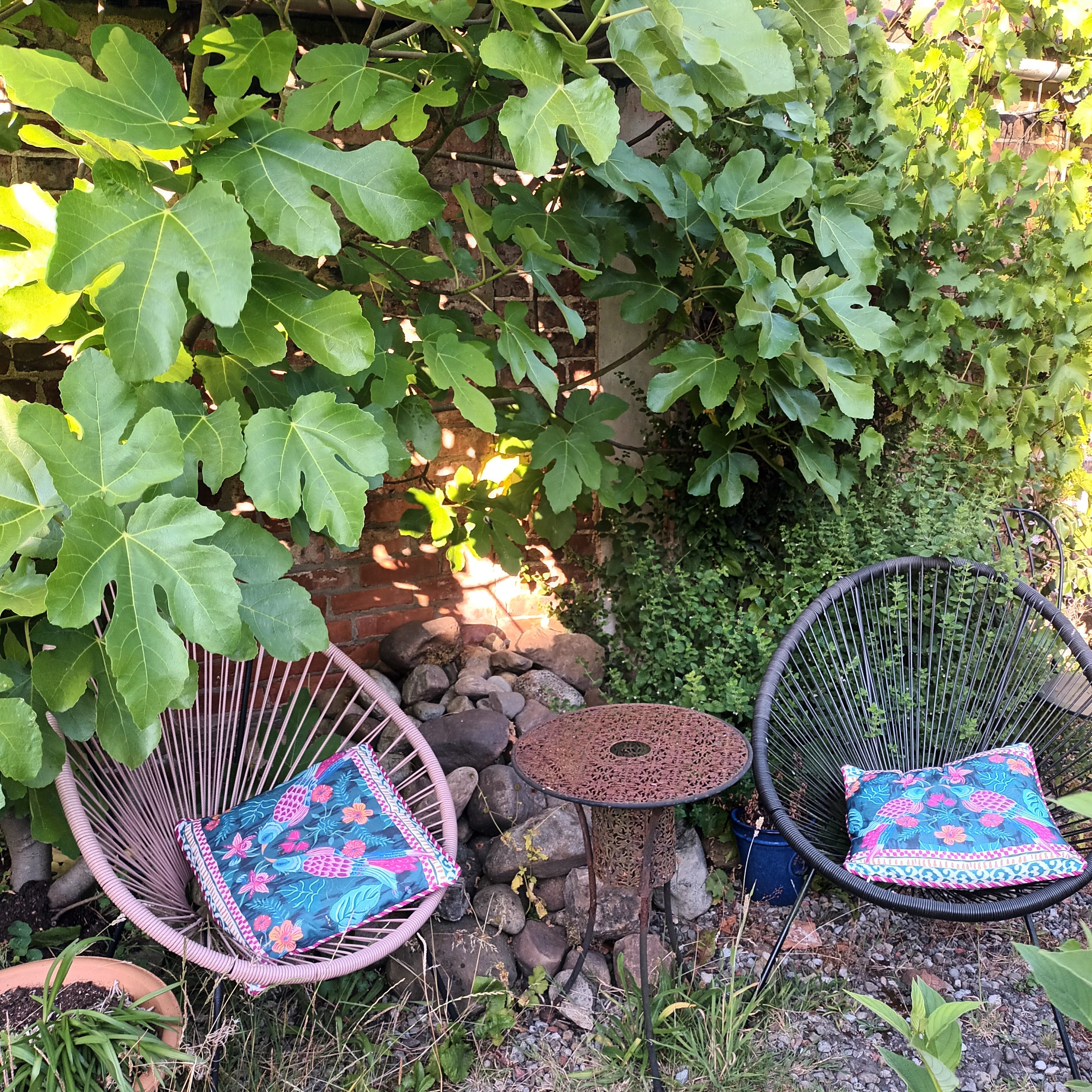
The other planting is less Biblical, more medieval. There’s a wall-trained pear tree, and underneath it a green mass of lemon balm, which I just hack back with shears a few times a year to keep it in order. There is flowering lavender spilling over the stones that separate the border from this seating space, but there’s no formal hardstanding: just stony soil, punctuated with bits of creeping trefoil, purple thyme and self-seeding mint. It’s not at all a ‘smart’ seating area - which, according to the magazines, requires an expanse of beautifully even, blindingly bright stone paving in a crisp geometric shape - but it does have the advantage of not looking weirdly sterile. In this haphazard carpet of herbs, the runaway success has been chamomile ‘trenague’. This very simple little plant has surprising tenacity in drought. When almost everything else goes crispy or thin, it stays green and soft, and when you tread on it, you get a waft of delicious apple scent. It mixes with the herbal smell of the golden oregano that runs through the borders nearby, which produces a great sweep of fresh colour and keeps the roots of plants around it cool and damp. I especially like it swirling underneath my rose ‘Darcey Bussell,’ which is a dark cerise pink, and setting off the irridescent blues of Pentstemmon ‘sour grapes’.

The idea of planting scented herbs underfoot is very medieval; likewise the idea of a garden that is not open, flat grasses and perennials, but an enclosure with green walls and overhanging trees. The dominant colour is green - green fig-leaves; green vines. I think we’ve been persuaded, by the current fashion, to assume green gardens cannot thrive in the heat. But all those green leaves covering the wall help to cool it, preventing it from reflecting back the baking sun. All those soft green herbs on the ground hold the moisture in the soil. And those varied leaf shapes and heights - the flat fig leaves curling out almost horizontally; the vines racing upwards; the chamomile spreading cool on the ground - are not just visually soothing in their variation. As each leaf transpires, sending out water vapour, it adds complexity to the interplay of air currents that move and cool the spaces between the plants, in a way a uniform planting of grasses and prairie plants cannot.
There’s something deeply appealing about a green garden that resembles the cool, shady spaces of a medieval illumination. I’m beginning to wonder whether, in fact, it might carry more potential for the future than the fashion that’s come to dominate modern garden spaces. What do you think?
No posts
Comments
Nothing yet. Say the first thing.
Sign in to join the conversation.