
There is a paywell on the very last section of this post, because I get into spoilers for what I am working on at the moment. Don’t worry, though: the free portion is a completely self-sufficient piece, which you can read on its own. Happy Sunday, and happy reading!
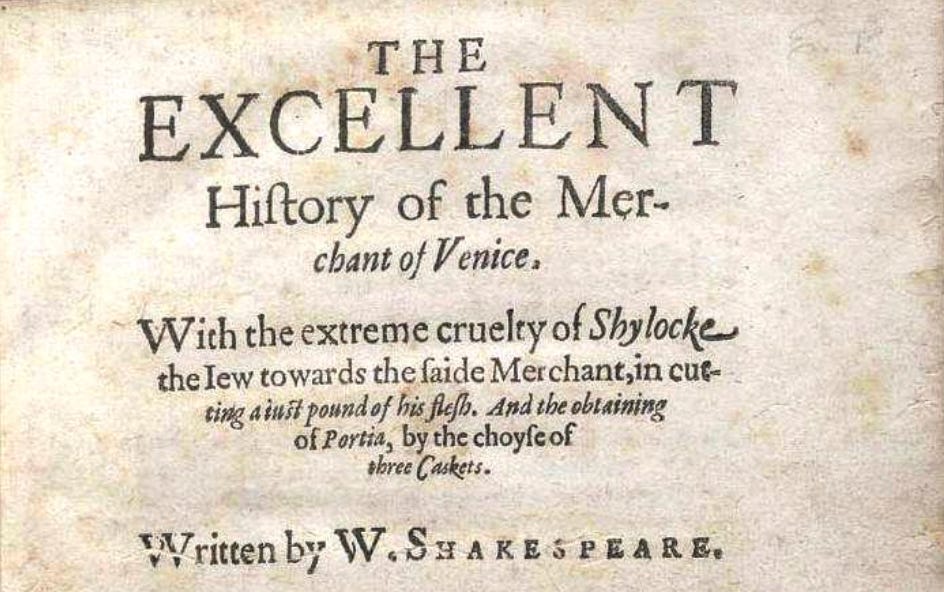
Earlier this week, as I was doing some research, I came across a wonderful article by Eleanor Barnett, who posts on instagram as History Eats. The article is part of her academic work, but it’s written with such a zest and lightness of touch that reading it was much more like fun than work. It focuses on the period from the mid-sixteenth to the mid-seventeenth century, in Venice. And therefore, for me, it instantly made me want to relate its contents to Shakespeare’s Merchant of Venice, written in the last years of the sixteenth century.
First things first: I love food history. I think I was about 11 when my mum bought me Elizabeth David’s French Provincial Cooking. I remember it was Christmas; the book was tucked into the top of my stocking, and when I woke up full of excitement in the dark, it was those receipes I sat reading while I ate the pink sugar mouse, the gold coins and the clementine that we always had tucked into the stocking-toe.
That was my introduction to the food writers - almost always women - for whom the cultural context of any recipe was as important as the recipe itself. I read Jane Grigson’s wonderful, scholarly digressions on Culpepper and Kenelm Digby, which contextualised her descriptions of English traditions of cooking with herbs or spices. I read Claudia Roden, who taught me - without ever making me consciously think about - how profoundly the cultures of the Mediterranean and North African shores betrayed overlapping Jewish, Muslim, and Christian influences, sometimes in the same dishes. Food writing helped me to think about the interconnectedness of early Modern Europe, long before I began to study it in earnest.
In her article, Barnett explores the importance of food in the work of the Venetian Inquisition, during trials attempting to sniff out religious deviance: secret conversions (or relapses) into Judaism; activities amounting to witchcraft. She explains that food is often a signifier of identity and a marker of those tell-tale habits and preferences the individuals in question simply could not bring themselves to hide. Edible ingredients could take on huge significance: what, after all, could be more powerful, or more susceptible to improper use, that the bread of the Eucharist?
The Merchant of Venice is, notoriously, interested in these same questions. Food is a huge motif in the play. Eating with Christians fills the Jewish Shylock with revulsion as he imagines the smell of pork. Portia’s suitors revolt her with their greedy eating and drinking. The wager plot, between Antonio and Shylock, centres upon a piece of meat that has no edible value: a pound of human flesh, weighed out like beef in butcher’s shop.
An early indication of the importance of food, and of its function in organising ideas about human flesh and human worth, comes in the very first scene, as young Venetian nobleman Bassanio and his beloved friend and mentor Antonio prepare to get down to the business of furnishing Bassanio with the financial means to find a wife. A tedious crowd of their various hangers-on have already made verbose, pun-filled speeches to delay the conversation, loudly defending their right to keep talking:
silence is only commendable
In a neat’s tongue dried and a maid not vendible.
These lines are spoken by Gratiano, Bassanio’s main sidekick, a charmless character, whose primary function is to distract our attention from the fact that Bassiano, the nominal hero of the romance plot, is a weak and unprincipled grifter with very little to recommend him. At this point, we are inclined to agree with Bassanio’s weary, dismissive assessment: ‘Gratiano speaks an infinite deal of nothing’.
But, in terms of the themes of the play, he doesn’t. The couplet looks like a proverb. It equates two items: a dried cow’s tongue, and a woman who isn’t for sale. The cow’s tongue doesn’t make a noise because it is being prepared to be consumed; the woman who isn’t for sale should know to keep her mouth shut. It is a predictably nasty, misogynistic little idea, which will prepare us well for the men’s general attitude towards women in this notoriously hetero-cynical play. Gratiano’s Yoda-ified syntax in the second line (‘maid not vendible’) concludes a weak rhyme (what used to be called a feminine rhyme; one that ends with an unstressed syllable), giving the couplet a clumsy, ersatz quality that suggests it should be easily brushed aside.
But it is telling us important things. It is most unlikely that Gratiano has etymology at the forefront of his mind, but this excellent blog from the OUP explains the origins of that archaic word ‘neat,’ which Shakespeare uses to refer to cattle. ‘Neat’ is a very old word for a farm animal, and ultimately related to the verb that means ‘to use’ or ‘to enjoy’. It is part of a larger network of similar etymologies that relate words for cattle to words for money or treasure, and thence to enjoyment. Riches, these connections assure us, come from the enjoyment of ownership, from the monetary value of what one has. It is a transactional worldview that permeates The Merchant of Venice, and most certainly does not begin and end with the figure who concentrates anti-Semitic tropes of greed and monetary obsession, Shylock. In this context, the yoking together of the cattle with the made who is not for sale makes complete and unpleasant sense. Though she is not for sale, she is part of a world where all flesh (or perhaps, all flesh that is not the flesh of white Christian men) is always for sale until presumed otherwise. The very mention of maids not for sale functions as a reminder that Gratiano imagines most women are for sale, an unsurprising belief given the well-known scale of the Venetian sex trade.
While pondering all of this, I looked up recipes for Venetian-style dried tongue, curious to understand what it was. I found something that sounds rather good: cured or salted tongue that’s then simmered slowly in water with herbs and spices, and served with a pounded herb sauce cut with vinegar, to contrast with the fatty richness of the meat. Then, reading Barnett’s article about food preferences, I had a sudden realisation.
Barnett notes that Venetian Jewish tastes were strongly associated with fatty meat: the consumption of fattened goose liver, for example, was almost a byword for Judaism. Likewise, sharp sauces, often with a sweet-and-sour profile, were common in Jewish cooking. A wonderful anecdote in her article concerns an aged Venetian man called Gaspar Ribiera, who was brought to trial on account of his recently-deceased son Giovanni’s marriage to a Jewish woman. It was suggested that Gaspar had known that his son was courting a Jewish woman, and had even condoned the shocking escapade.
There is a strong note of comedy in the account of the proceedings. Asked whether he ever invited the Jewish woman to eat at his house, Gaspar recoiled with a horrified ‘Never, never!’ But when asked whether or not he might have gone to her house in the ghetto and shared meals, he admits he might have eaten ‘a pear, a cherry, a little bit of marzipan, a little bit of malvasia’ (this last is a sweet, dark wine).
It is delightful to imagine a rather venal old man lost in enjoyable reminiscences of these tempting treats. It all comes out: as well as wine and marzipan, Gaspar enjoyed pignocata, a sweet fried dough with sugar and pine-nuts, fritole, small donuts soaked in wine, and ‘many sugared gifts’. Like another venerable stalwart of eating-related mishaps, Gaspar progresses from the modest to the sybaritic; unlike the Very Hungry Caterpillar, the solution to his gluttony is sadly more complicated than a nice green leaf. These worrying details were sufficient to motivate wholesale interrogation of his domestic practice and the full attention of the Inquisition.
With this in mind, I thought back to Gratiano, and The Merchant of Venice. Readers will remember that, in addition to a ‘main’ marriage plot where Bassanio (using money reluctantly borrowed from Shylock by Antonio and secured by the promise of a pound of flesh) courts the wealthy heiress Portia, there is a second marriage plot. Lorenzo, one of the other young Christian men who crowd around Bassanio, marries Jessica, Shylock’s daughter. She abandons her father’s house - first stocking up on money and jewels from his considerable coffers - and also leaves behind her Jewish identity, vowing to become ‘a Christian, and your loving wife’. There’s a scene - variously played as highly romantic and as dubiously saccherine - in which the newly-united couple ambitiously liken their romantic journey to the love stories of famous Classical lovers, before Shylock discovers his loss and rends the air with horrified grief that his daughter has taken and sold the ring he had from ‘Leah, when I was a bachelor’.
In all of this, Gratiano is and remains flagrantly anti-Semitic; a disgust at Jews and Jewishness is as intrinsic to his character as the casual misogyny we saw in that early couplet. But the first time we meet him, his frame of reference is rooted in food that belongs in Jewish kitchens. Is that vaunting anti-Semitism a cover for a deeper-running appetite he would not choose to name?
Comments
Nothing yet. Say the first thing.
Sign in to join the conversation.